The Short Answer: Match the Scale, Then the Instrument
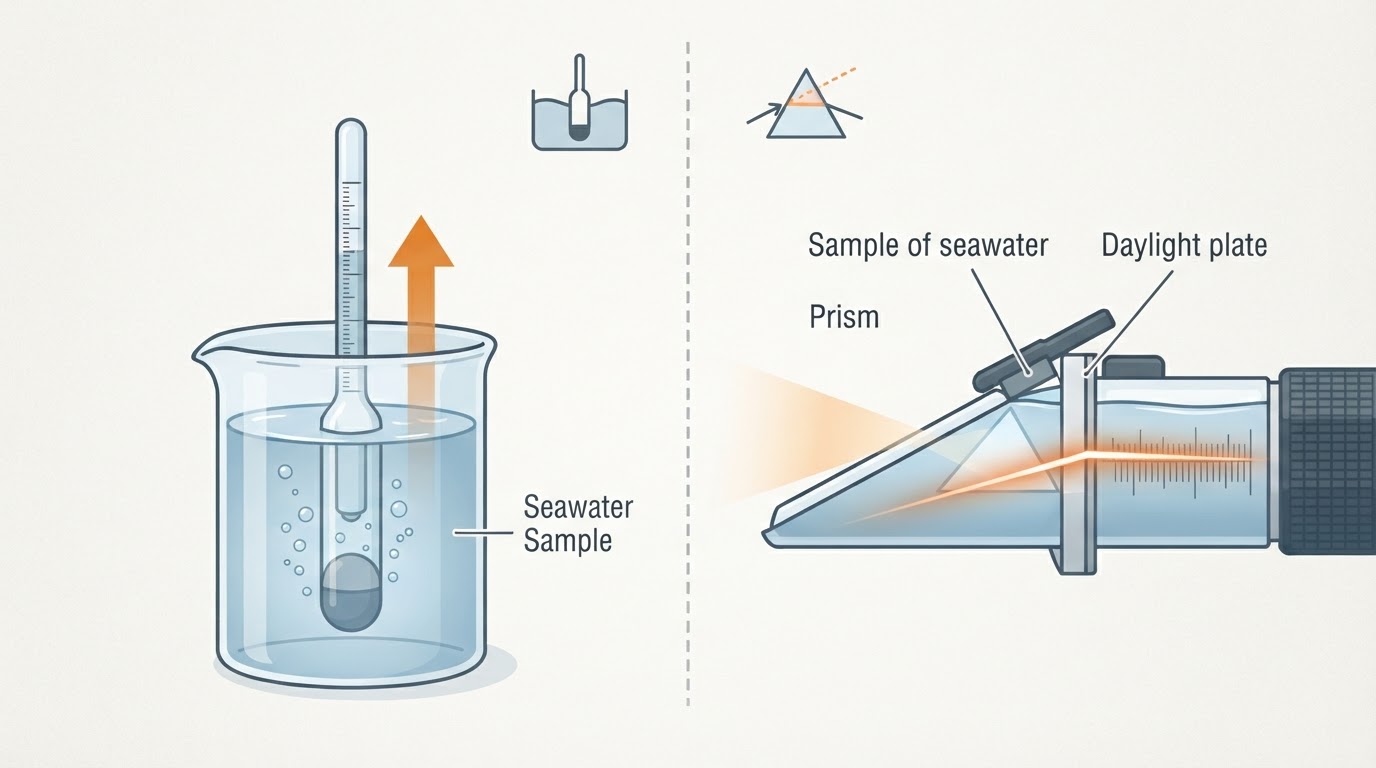
Both instruments can give you a useful salinity reading in a reef tank. The difference is what they measure and what their number assumes. A hydrometer responds to the density of the sample, so a float or arm rises or falls with buoyancy. An optical refractometer responds to the sample's refractive index and converts that optical reading into salinity or specific gravity. Neither method is automatically more accurate; each depends on the scale, the reference temperature, and the condition of the instrument.
A specific-gravity number only means something when you know which scale and reference temperature it was written for. Numbers from different conventions are not directly interchangeable. Numbers from the same convention, measured under the same conditions, can be compared directly. That distinction matters more than the label on the box.
What a Hydrometer Measures
Swing-arm hydrometers
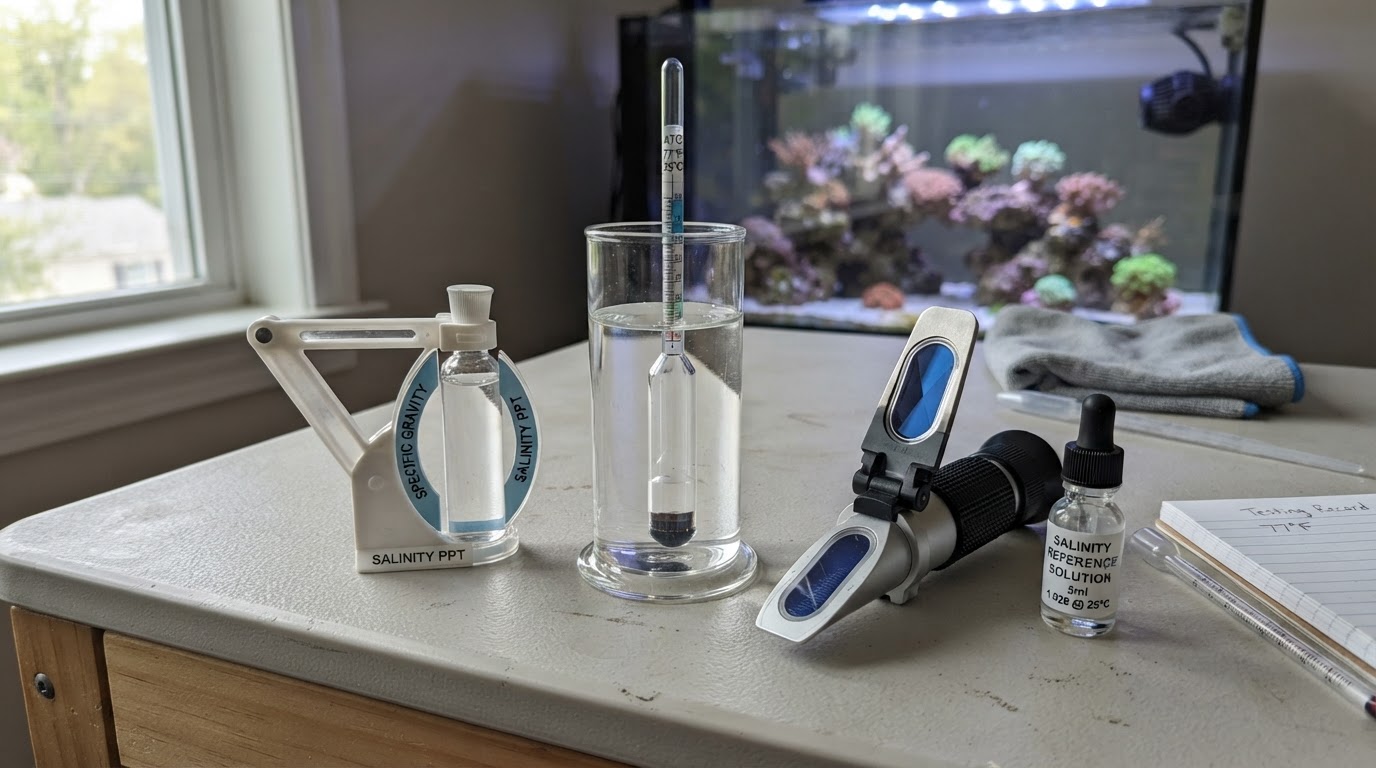
A swing-arm hydrometer contains a pivoted plastic arm that rotates according to the density difference between the sample and the arm's materials. The design converts buoyancy into a specific-gravity reading, but the details vary between products: the fill line, whether the maker asks you to tap out bubbles, the surface the instrument should sit on, the mark you read, and whether the maker calls for any conditioning. Follow the instructions for the exact unit rather than transferring a routine from another design.
That also means there is no single temperature rule you can apply to every swing-arm hydrometer. Some makers state that their scale is intended for use across a range of sample temperatures; others give a reference temperature or a correction. The only safe source for your unit is the maker's markings and manual.
Floating hydrometers
A floating hydrometer is a sealed glass or plastic float. It sinks until it displaces its own weight, so it rides higher in denser water. These are the classic laboratory-style hydrometers, and their scales are often printed with a reference temperature. Some are designed to be read at the waterline; others specify a different mark or a correction table. The structural difference from a swing-arm is straightforward — a free float versus a pivoted arm — but the reading protocol belongs to the individual instrument.
Do not assume that a meniscus rule, a rinse routine or a temperature correction from one hydrometer applies to another. Read the scale as its maker marks it, and keep the instrument within the conditions that maker specifies. A hydrometer handled outside those conditions is giving you an unqualified number, not a laboratory result.
What a Refractometer Measures
An optical refractometer places a thin sample on a prism, closes the cover, and reads the boundary between the clear and blue regions against a scale. The instrument is measuring refractive index, not density. D-D's published instructions explain that salinity itself does not change with temperature, but refractive index does, which is why a refractometer reading is temperature-dependent even though the salt mass in the water is not.
Seawater, brine, and Brix are different scales
Not every "salinity" refractometer is built for natural seawater. A brine or sodium-chloride refractometer uses a scale for salt solutions, and a Brix refractometer uses a sugar scale. Neither is a drop-in seawater instrument. D-D states that its seawater refractometers are calibrated for true seawater, and its instructions distinguish that scale from brine or TDS-style references. If the instrument does not claim a seawater calibration, do not assume its salinity scale is interchangeable with a seawater device.
This is where many hydrometer vs refractometer arguments go wrong: people compare a number from a seawater-calibrated refractometer with a number from a brine refractometer, or with a hydrometer whose specific-gravity convention is different, and conclude that one instrument is broken. The scale is the first thing to identify.
What ATC does and does not fix
Automatic temperature compensation moves the reading scale as the instrument's temperature changes. It does not make temperature irrelevant. D-D's instructions state that its refractometer is calibrated at 20 °C and that ATC operates within the ambient range stated for that model, with the instrument temperature — not the water temperature — being what matters, because a small sample equilibrates to the instrument quickly. That is D-D's protocol for its own model. Another manufacturer may specify a different calibration temperature, a different zero point, a different ATC range or a different equilibration time.
So "ATC" on the box is not a promise that any reading at any room temperature is correct. Let the instrument stand at a stable room temperature, follow its stated equilibration step, and keep it out of direct sun while reading.
Why Two Devices Disagree
When a hydrometer and a refractometer disagree, the gap usually comes from one of five places:
- Different scales. True seawater, NaCl/brine, Brix, and TDS are not the same measurement.
- Different specific-gravity conventions. A scale referenced to one temperature and a scale referenced to another can print different numbers for the same seawater. D-D's instructions, for example, give the specific gravity its 20 °C scale displays at 35 ppt and compare it with the figure a hydrometer calibrated at 25 °C (77 °F) would show for the same water. When both devices use the same convention and are measured under the same conditions, their numbers can be compared; when the conventions differ, the numbers are not directly interchangeable.
- Different temperature assumptions. A floating hydrometer may have a reference temperature; a refractometer's ATC may only be specified within a certain range; a swing-arm's maker may say something different again. Check each instrument's own conditions.
- Different sample handling. Salt residue on a prism or pointer, air bubbles, a tilted hydrometer, too little sample, or a cover that is not fully closed can all shift the result.
- Different calibration points. Some refractometers are zeroed with pure or RO water; some are checked at 35 ppt; some digital models use a one-point calibration. The correct point is the one in that model's manual.
Notice that none of these is a reason to average the two numbers or to treat one as the winner. A disagreement is a signal to check the assumptions, not to split the difference.
A Clean, Repeatable Check That Leaves the Tank Alone
Use the same sequence for either instrument. The goal is a reading you can defend, not one that agrees with the number you expected.
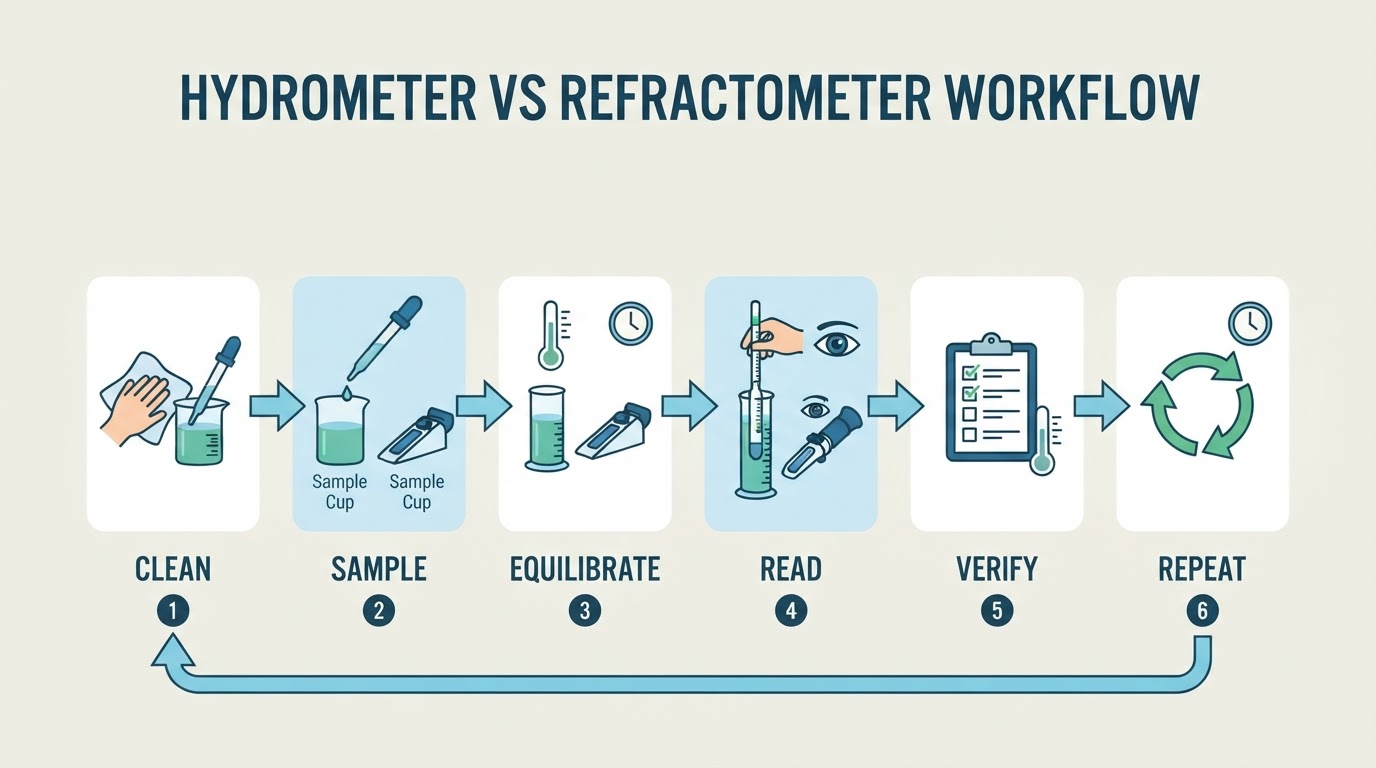
1. Clean each instrument as its maker instructs
Follow the cleaning and rinsing instructions for that device. A refractometer prism and a hydrometer float or arm are different surfaces with different care requirements; a routine that is right for one may not be right for the other. Salt and calcium deposits can shift a reading, so make sure the surfaces the manual names are clean and dry before use.
2. Take one representative sample
Pull one sample from the same place in the tank, at the same time, for both instruments. Avoid surface film, floating debris, and water that has been sitting in a dosing line. If you are checking a newly mixed batch, make sure the salt has fully dissolved and the water has cleared before you measure, and take the sample from a well-mixed part of the system rather than a still corner.
3. Let each instrument reach its own conditions
A refractometer needs its sample to equilibrate to the prism and its body to sit at a stable room temperature. A floating hydrometer may need the sample at the temperature its markings assume. A swing-arm may have its own requirements. These are different waits; do not shorten one because the other is ready.
4. Read each device by its own manual
Record the raw number and the unit. Note whether the scale is specific gravity, ppt, or something else; note the reference temperature if the instrument states one; note the calibration point. A reading without those labels is not comparable to anything.
5. Verify against a valid reference
Use a fresh, labeled reference intended for the instrument. A 35 ppt standard sold for a conductivity meter is not automatically an approved optical reference. A refractometer's 35 ppt check is a verification step, not necessarily its zero point; the site's guide to refractometer calibration at 35 ppt walks through the model-specific difference without treating 35 ppt as a universal adjustment for every device.
For a hydrometer, a fresh reference can show that the instrument disagrees with the standard. Record the disagreement and check the approved reference and the model's instructions. One checkpoint does not establish a constant correction across the rest of the scale, so do not invent an offset, turn an adjustment screw, or apply a tank-salinity correction from that single comparison. If the disagreement remains unresolved, seek a trustworthy comparison — another instrument with a known, valid calibration, or advice from someone who can verify the reference and the method — before acting.
6. Repeat before you believe a difference
Take two or three readings with each instrument, cleaning between them as the maker allows. These are initial consistency checks, not a validated accuracy certificate. If a reading jumps, the cause could be the sample, ongoing mixing in the system, or the technique and the device; do not assume it was the tank, and do not assume it was the instrument either. Use a well-mixed representative sample and investigate each possibility without deciding the cause in advance.
A Practical Decision Table
Your situation | Start with | What makes the reading trustworthy | Main caution |
|---|---|---|---|
You want a quick routine check with a simple device | Swing-arm hydrometer | The maker's procedure followed for base, bubbles and pointer, plus a check against a valid reference | Individual units and designs vary; the maker's stated conditions are not a calibration certificate |
You want a reading near a target salinity and will follow a model-specific protocol | Seawater optical refractometer | A scale that claims true seawater, the maker's calibration point, ATC used within its stated range, stable instrument temperature | ATC does not replace calibration, equilibration, or a valid reference |
You are using a floating hydrometer away from its marked temperature | Floating hydrometer plus the maker's correction data | Known calibration temperature and known sample temperature | A generic correction with an unknown standard can make the result worse |
Your two devices disagree, or you are about to change something that affects livestock | Neither as the automatic winner | Each checked against a valid reference, clean samples, repeated readings, labels recorded | Do not change tank salinity to match one uncertain number |
After the Reading Is Trustworthy
Once you have a verified, repeatable reading, you can decide what to do with it. If the number is high, lowering salinity is a separate livestock-management task with its own pace and risks; the site's guide to lowering salinity in a saltwater aquarium covers that process. Do not average two unresolved readings, and do not use a single reading from a single device as permission for a large or fast change.
The durable habit is simpler than the instrument debate: identify the scale, confirm the reference temperature and conditions, clean and sample as the maker directs, verify against a valid reference, and repeat. A hydrometer and a refractometer can both serve a reef tank when those steps are followed. When they disagree, the useful question is not "which one is better?" but "which assumption is different?"