Freshwater fish care is mostly water management
Most problems new keepers run into — cloudy water, fish hanging at the surface, fin rot, sudden losses — start with water quality rather than with the fish themselves. A freshwater aquarium is a small closed biological system, and the fish in it produce waste faster than a brand-new filter can process it. Understanding that single fact explains most of what freshwater fish care actually involves.
Three waste compounds matter most:
- Ammonia comes from fish waste, uneaten food and decaying plant matter. It is toxic at low concentrations and is the first compound that builds up in a new tank.
- Nitrite is what ammonia turns into. It is also toxic, and it is the second compound that builds up.
- Nitrate is what nitrite turns into. It is far less toxic, and in a home tank it is normally removed by partial water changes and by live plants.
The process that converts ammonia to nitrite and nitrite to nitrate is called the nitrogen cycle. It is carried out by bacteria that colonise the filter media, the substrate and every wet surface in the tank. "Cycling" a tank means giving those bacteria time to establish before you ask them to support fish.
A practical completion standard for a new tank: ammonia reads zero and nitrite reads zero while nitrate is present and rising. That combination tells you the filter is processing the waste your tank produces. Until you see it, add no fish. The usual way to get there is to run the tank with a small controlled ammonia source — fish food or a bottled ammonia product — and test every few days, or to seed the new filter with established media from a healthy tank.
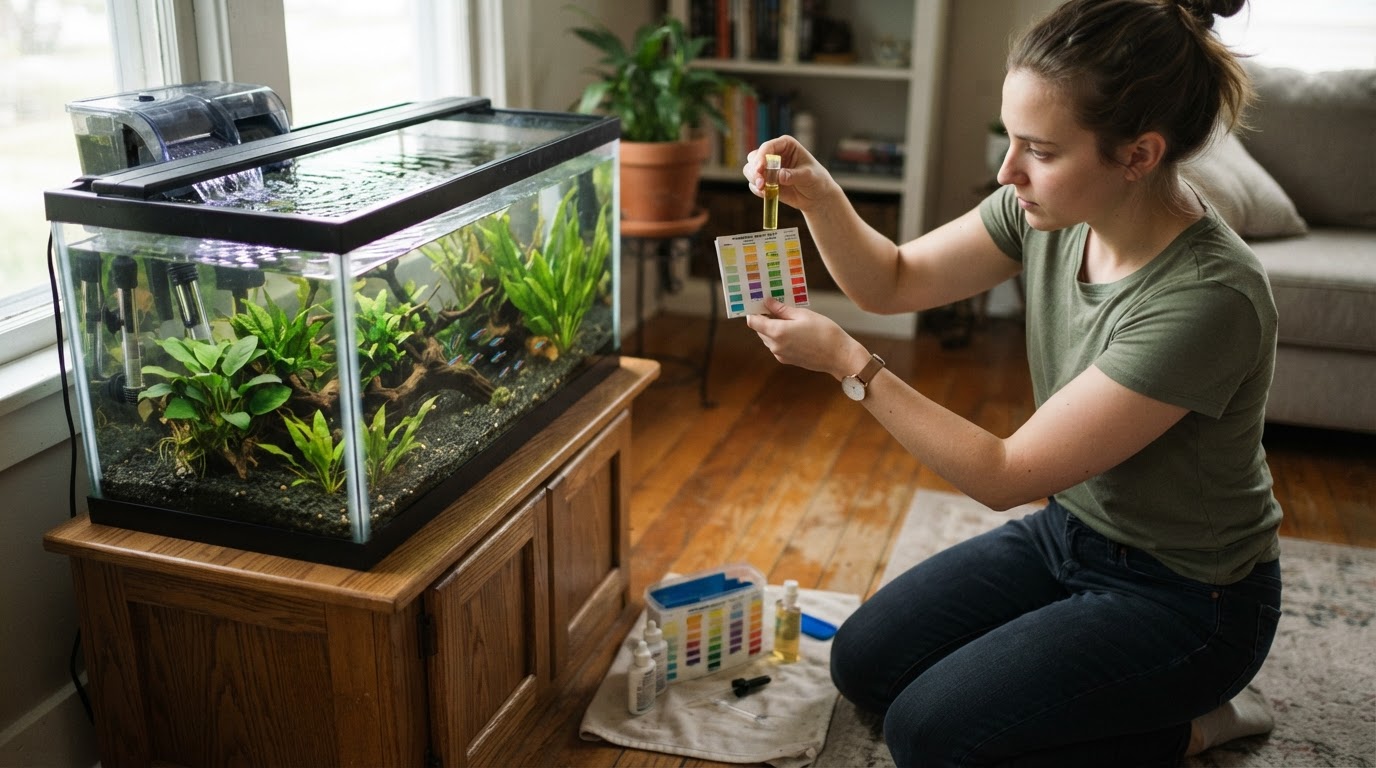
This is the trade-off most beginners miss. A tank that looks ready — clear water, running filter, planted decor — is not cycled until a test kit says it is. Clear water is an observation about particles, not about biology.
Set the tank up in the right order
The order of operations matters more than the brands you buy. Getting the sequence right saves you from fighting the tank for months.
- Choose the position and stand first. A filled aquarium is heavy, and it needs a level surface, an outlet within reach, and no direct sunlight. Decide the final location before you add water.
- Add substrate, hardscape and equipment. Rinse the substrate before it goes in, then place the filter and heater and let the tank run without fish.
- Treat and stabilise the water. Tap water needs a dechlorinator before it touches filter media, because chlorine and chloramine kill the bacteria you are trying to grow. Fill the tank, bring it to temperature, and let it settle for a day.
- Cycle the filter. Run the tank through the nitrogen cycle to completion, test ammonia, nitrite and nitrate along the way, and finish with a large partial water change to clear the accumulated nitrate.
- Stock slowly. Add one small group of fish, then wait a few weeks before adding more. Every new fish is an additional load on the same bacterial colony.
- Quarantine new arrivals. A separate tank — even a simple plastic tub with its own filter and heater — keeps a disease picked up in a store from reaching the fish you already keep.
Match each species to your water and your tank
The most persistent source of ongoing freshwater fish care problems is a mismatch between what a species actually needs and what a store tank makes it look like it needs. Fish are sold small, in bare glass, in mixed groups, and often without the adult size, temperature range or temperament written anywhere near the price tag.
Before you buy a species, find its care profile and check these fields:
Field | Why it matters |
|---|---|
Adult size | Popular fish such as goldfish and common plecos grow far larger than the tank they are usually sold in. |
Minimum tank size | This number describes swimming space and waste load for one adult, not for the juvenile in front of you. |
Temperature range | "Tropical" is not a single setting. A fish kept too warm or too cool is stressed long before it looks sick. |
Water hardness and pH | Fish evolved for soft, acidic water and fish evolved for hard, alkaline water do not thrive in the same tank. |
Temperament | "Community fish" means it can live with some tank mates, not with all of them. |
Group size | Schooling species kept alone or in pairs behave very differently from the same fish kept in a proper group. |
Diet | Herbivores, omnivores and predators need different food, and some grazers need vegetable matter regularly. |
Lifespan | A fish that lives for a decade is a long commitment rather than a decoration you replace. |
Two habits prevent most of the damage. First, choose the fish before you choose the equipment, so the tank, filter and heater are sized for the species instead of retrofitted around it. Second, build a stocking list rather than a shopping list: check every candidate against the temperature, hardness and temperament of the others before anything goes into the water. A fish that "looks fine" with your current residents may still lose out at feeding time, get bullied, or outgrow the tank it lives in.
The weekly care routine
Freshwater fish care is not a daily chore. It is a short, consistent routine that keeps the nitrogen cycle healthy and catches problems while they are still small:
- Test the water. Ammonia and nitrite should stay at zero, and nitrate tells you when a water change is due. Test more often in a new or heavily stocked tank.
- Change part of the water. A routine partial change removes nitrate and replenishes minerals. Match the new water to the tank temperature, dechlorinate it, and never replace all the water at once.
- Clean the glass, the substrate surface and the filter intake. Remove visible debris before it breaks down into ammonia.
- Rinse filter media in old tank water. Tap water kills the bacteria the tank depends on, and this is one of the most common ways a keeper accidentally crashes a healthy cycle.
- Check the equipment. Confirm the heater is holding temperature, the filter is moving water, and nothing has started making a new noise.
- Watch the fish. Behaviour is your early warning system: appetite, colour, activity and where fish hold in the water column all change before obvious symptoms appear.
- Feed only what gets eaten. Uneaten food is one of the most common sources of excess ammonia in a home tank.
What your test results are telling you
Reading | What it usually means | What to do next |
|---|---|---|
Ammonia above zero | The filter is not processing waste as fast as the tank produces it. | Change part of the water, cut back feeding, and check whether the tank is overstocked or the media was recently cleaned. |
Nitrite above zero | The second stage of the nitrogen cycle is still establishing, or the colony was disturbed. | Change part of the water, keep feeding light, and test daily until it returns to zero. |
Nitrate present and climbing | The cycle is working, because nitrate is the end product it produces. | Change part of the water on your normal schedule, and add plants if you want the tank to consume more of it. |
Zero across the board | The tank is cycled and lightly stocked. | Keep testing on your routine so a change shows up early. |
Mistakes that undo good care
- Replacing filter cartridges on a schedule. If the cartridge holds your bacteria, throwing it away throws away the cycle. Rinse it in tank water and replace media only when it is falling apart.
- Cleaning everything at once. A full teardown, a deep substrate clean and a filter scrub in the same afternoon remove too much biology in one go.
- Treating disease without testing the water first. Many symptoms people medicate — clamped fins, pale colour, listlessness — are a fish's response to ammonia or nitrite rather than an infection.
- Overstocking because the fish are small right now. Waste load follows adult body mass, not purchase size.
- Using soap or household cleaner on anything that goes in the tank. Residue is toxic to fish and to the bacteria you rely on.
Where to go next
Sea Life Planet groups its freshwater material into hubs, including a Freshwater Fish hub and a Fish Types index of species guides, with a "Where to Start" entry point on the homepage for beginners choosing a direction. Use a species guide the way you would use the table above: read the requirements before you buy, not after.
First-level category landing for freshwater fish: H1 and intro for freshwater care guides and tank setup.
The foundation does not change as you gain experience. Water first, species second, routine third — and the tank does most of the rest.