The short answer: choose the shape you can live with
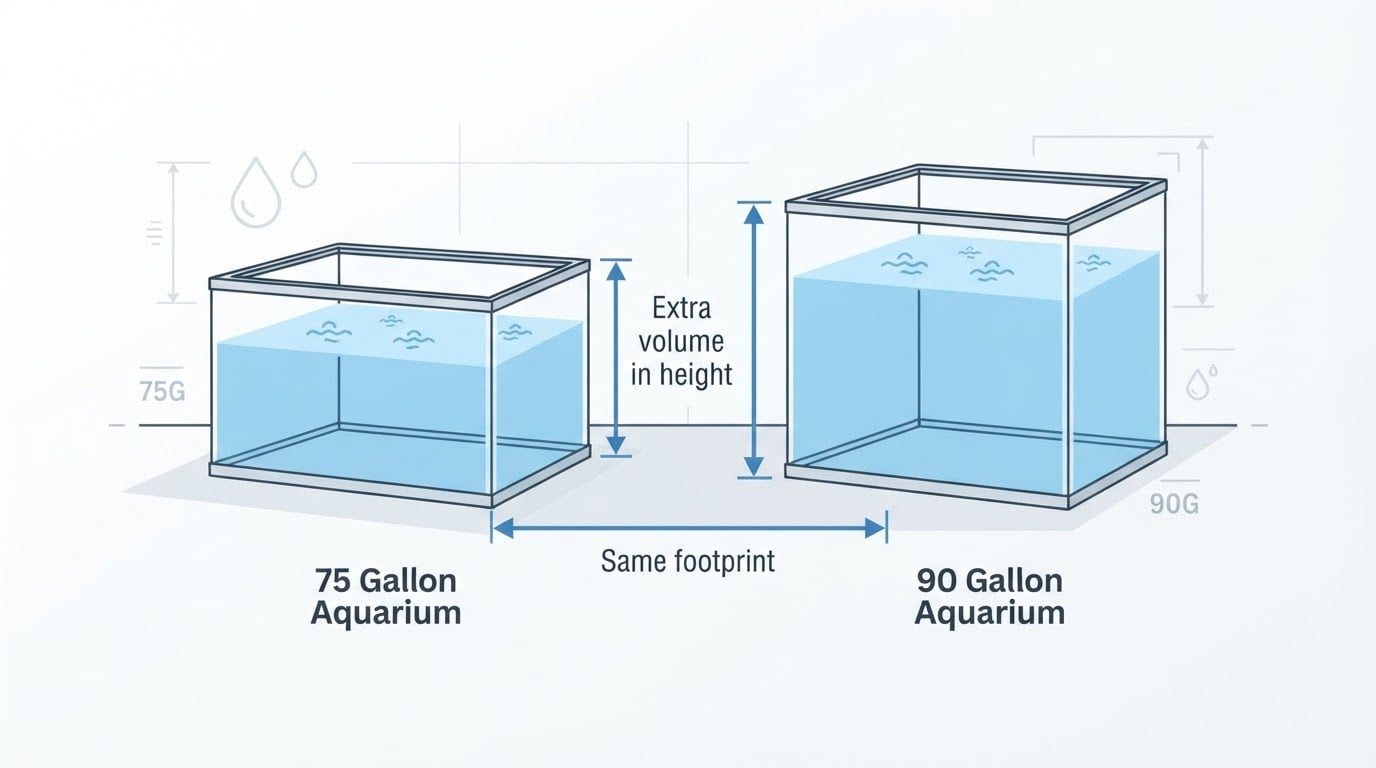
Both tanks are standard rectangular aquariums sold on the same length-and-depth footprint, so the extra gallons in the 90 come from height rather than from more floor space. That single fact drives nearly every downstream difference, and it makes the decision fairly clean once you know your priorities.
Pick the 75-gallon tank when you plan a planted freshwater setup, you want to reach the substrate without long tools or a step stool, you would rather not buy high-output lighting, or your floor and stand are close to their load limits.
Pick the 90-gallon tank when you want more water volume on the same footprint for better parameter stability, you keep tall-bodied fish that actually use the open water column, you plan a reef build that needs vertical rockwork, or you simply want the biggest tank your existing stand and wall can hold.
There is no universal winner here. The right answer depends on how the tank will be maintained, lit and stocked, not on which number is larger.
What actually differs between the two sizes
In the hobby, 75 vs 90 gallon aquarium usually refers to the common standard glass rectangular tanks, and those standard sizes share the same base dimensions. The 90-gallon adds height to the same box, so the two tanks occupy roughly the same floor and wall space while presenting a noticeably different water column.
Decision factor | 75-gallon tank | 90-gallon tank |
|---|---|---|
Base footprint | Same | Same |
Where the extra volume lives | — | Height |
Water volume for dilution and stability | Good | Better |
Light intensity at the substrate | Easier to achieve | Harder to achieve |
Reach and maintenance | Easier | Harder |
Filled weight and floor load | Lighter | Heavier |
Upfront and running cost | Lower | Higher |
Typical best fit | Planted tanks, first large setups, easy upkeep | Reef volume, tall-bodied fish, deeper open water |
Manufacturers and custom builders do vary, so check the actual length, depth and height on the spec sheet before you commit. The table describes the common standard sizes, not every tank sold under those numbers.
Lighting and flow in a taller water column
Light loses intensity as it travels through water, so a fixture that grows plants on a shallow substrate can leave the bottom of a taller tank underlit. Closing that gap usually means more output, tighter optics, or moving the light closer to the surface, and stronger lighting brings more heat, more electricity, and less working room for your arm and tools.
Flow has a similar catch. You still need enough turnover to move the water in the tank, and a 90-gallon holds more of it, so you generally need more pump capacity to hit the same number of turnovers per hour. The footprint stays the same, so return plumbing and wavemaker placement options are largely unchanged; the water volume is what changes the math.
Evaporation is a related trade-off. It scales with the water surface, which is nearly the same on both tanks, but in the larger volume the same top-off loss is a smaller share of the whole. Reef keepers notice that in salinity swings, and it is one of the quieter arguments for the 90.
If your plan is a low-tech planted tank, this section is the strongest argument for the 75. If your plan is a light-hungry reef, budget for the 90's extra depth before you buy.
Reach and maintenance: the difference you feel every week
Depth is easy to forget in the store and impossible to ignore at home. The extra height of the 90 changes how far your arm and tools have to travel for every job: planting and replanting, vacuuming the substrate, moving hardscape, gluing frags, scraping glass, or retrieving a dropped lid.

Reaching a deep substrate often means long tweezers, tongs or a step stool, and some keepers never get comfortable with it. The 75 keeps the substrate within easy reach for many adults, which makes routine work faster and more likely to actually get done. Maintenance you skip costs more than maintenance you plan for.
Water changes scale with volume as well. If you replace a fixed percentage, a larger tank means larger buckets, longer fill times, and more conditioner or salt per change. That is not a reason to avoid the 90, but it belongs in the decision.
Room fit: the taller tank changes more than the tank
A taller aquarium raises its top edge, which shifts the whole setup around it. The viewing angle changes, the light has to mount higher or be aimed more tightly, and any canopy or cabinet needs to accommodate the extra height and the clearance you need for feeding and trimming.
Check the space the tank will actually live in. A tank that towers at eye level in a small room reads very differently from one whose top edge sits below shoulder height, and the taller box can crowd wall art, windows or shelving in ways the footprint alone does not predict.
Weight, the stand, and the floor
A filled aquarium weighs far more than the empty glass box, because water, substrate and rock all add mass. That is why the 90, despite sharing the 75's footprint, puts more load on the stand and the floor beneath it.
Before you buy either tank, check the stand's rated capacity against the filled weight and make sure the floor can carry the load where the tank will sit. This guide is published by Sea Life Planet, the same team behind the tank weight and setup guides referenced below. Sea Life Planet's quantitative setup guides cover exactly this step, including a guide to how much a 75-gallon tank weighs, so you can check the stand and floor before anything is filled.

Above-the-fold hero of the Sea Life Planet homepage: value proposition headline, primary CTAs (Browse Species Guides / Equipment Reviews), trust stats, and primary nav.
If you cannot confirm the load path, the 75 is the lower-risk choice on the same footprint.
Stocking: match the fish to the tank's shape
Most community fish such as tetras, rasboras, danios and corydoras use horizontal swimming space more than height. On an identical footprint they behave much the same in both tanks: the 90 gives them more water around them, but not more room to race.
Tall-bodied and open-water fish such as angelfish, discus and many cichlids do use the vertical column, so height is not wasted on them. That is the clearest stocking argument for the 90.
Territory is tied to footprint too. Bottom dwellers and territorial species claim floor area, and the 90 offers no extra floor to divide. What it does offer is more water per territory, which softens waste spikes and gives you more margin when a stocking plan runs slightly heavy.
For reef keepers, the taller box also means more vertical rockwork, which changes coral placement, light shading and flow design more than the extra volume changes your fish list.
What the 90 costs beyond the price tag
A 90-gallon build usually costs more than a 75 on almost every line of the budget: the tank itself, lighting strong enough to reach the deeper substrate, a filter rated for the larger volume, a heater sized for the water mass, and the salt or conditioner that scales with each water change.
The 75 is the cheaper tank to build and the cheaper tank to run, and its lower height keeps replacement lighting and maintenance tools simpler. The 90's premium buys volume, stability and vertical space, which are real benefits but not free ones.
If your budget is fixed, spending less on water volume and more on a proper filter, a light that suits your chosen depth, and the right test kits will usually produce a healthier tank than stretching for the larger glass box.
A neutral way to decide
Score the two options against the criteria that actually differ:
- Footprint: identical, so this is a tie.
- Water volume: the 90 wins for stability and bioload margin.
- Light and flow: the 75 is easier and cheaper to light and turn over.
- Reach and maintenance: the 75 is easier every week.
- Load: the 75 puts less weight on the stand and floor.
- Cost: the 75 is cheaper upfront and ongoing.
- Fish needs: choose the shape your intended livestock actually uses.
Whichever tank matches more of your constraints wins for your situation. There is no objective champion in the 75 vs 90 gallon aquarium question, only a better fit for a particular plan.
Before you check out
- Confirm the real dimensions from the manufacturer's spec sheet instead of assuming.
- Check the stand's capacity and the floor's load path for the filled weight.
- Decide how you will light the substrate depth before you pick a fixture.
- Think about how far you are willing to reach for weekly maintenance.
- Count the running costs, not just the tank: lighting, filtration, heating and water changes.
Then buy the tank whose trade-offs you are willing to live with for the next ten years.