What makes a saltwater fish beginner-friendly?
A good first saltwater fish is hardy, accepts prepared food, tolerates a small tank, and stays peaceful with its tank mates.
Hardiness comes first because a new marine tank changes quickly. Temperature, salinity, and nitrogen waste all drift while the keeper learns, so the species you choose should tolerate those swings instead of responding with disease or a hunger strike. Feeding is the second filter: a fish that already eats frozen or dry prepared food is far easier than one that only grazes live copepods in a mature tank. Tank size comes third, because a small volume of water changes faster than a large one. Temperament decides whether your first fish leaves room for the next additions, and captive-bred fish usually arrive already adapted to aquarium food and aquarium conditions.
Quick answers for first-time marine keepers
These short answers cover the decisions most beginners face first; each line can be read on its own.
- Easiest first fish: captive-bred ocellaris clownfish, firefish, royal gramma, yellow watchman goby, or neon goby.
- Smallest sensible beginner tank: 20 gallons for a pair of small fish, with 30-40 gallons easier to keep stable.
- Water targets: salinity 1.023-1.026 specific gravity, temperature 76-80°F (24-27°C), ammonia and nitrite at 0.
- Cycle before stocking: allow roughly two to six weeks before the tank can support a fish.
- Stock slowly: add one fish, wait two to three weeks, then consider the next.
- Fit a lid: firefish, wrasses, and many gobies jump.
- Quarantine new arrivals: two to four weeks in a separate observation tank.
- Replace evaporation with fresh water: top-off water is unsalted; only mixed salt water goes into water changes.
The best saltwater fish for beginners
Start with small, peaceful, captive-bred species that stay under about four inches as adults and eat ordinary prepared foods.
The table below lists species that keepers most often recommend for a first marine tank, together with the conditions each one needs. Treat the tank sizes as commonly cited minimums rather than absolute rules: a cleaner, more mature tank can support more than a brand-new one, and a heavily stocked tank needs more filtration and more frequent water changes.
Species | Typical minimum tank | Temperament | Why it suits a first tank |
|---|---|---|---|
Ocellaris clownfish (Amphiprion ocellaris) | 20 gal | Semi-aggressive, territorial | Very hardy, widely captive-bred, and eats almost anything; it guards a small territory instead of roaming |
Percula clownfish (Amphiprion percula) | 20 gal | Semi-aggressive, territorial | Similar disposition and care to the ocellaris, with the same captive-bred availability |
Firefish (Nemateleotris magnifica) | 20 gal | Peaceful, shy | Calm mid-water fish that accepts prepared food; needs a lid because it jumps when startled |
Royal gramma (Gramma loreto) | 30 gal | Peaceful, territorial toward similar fish | Hardy cave dweller with strong color; give it rockwork and one hiding place it can claim |
Green chromis (Chromis viridis) | 30 gal | Peaceful, schooling | Active open-water fish that brings movement; keep one or a small group in a larger tank |
Banggai cardinalfish (Pterapogon kauderni) | 30 gal | Peaceful, slow-moving | Eats prepared food readily and does not race around the tank; captive-bred stock is preferable |
Yellow watchman goby (Cryptocentrus cinctus) | 20 gal | Peaceful | Bottom dweller that sits on the sand and can share a burrow with a pistol shrimp |
Neon goby (Elacatinus oceanops) | 10-20 gal | Peaceful | Tiny cleaner goby that suits a nano tank and rarely bothers other fish |
Two species that are often sold as beginner fish deserve a caveat. The sixline wrasse is hardy, but it can become aggressive toward shy tank mates and does best in a tank with an established population of small crustaceans. Damselfish tolerate rough conditions, but several species bully fish added after them, which makes them a poor first pick if you want a calm community.
Tank requirements that decide which fish you can keep
Set the tank up and cycle it before you compare species, then check every candidate against tank volume, water parameters, adult size, and temperament.
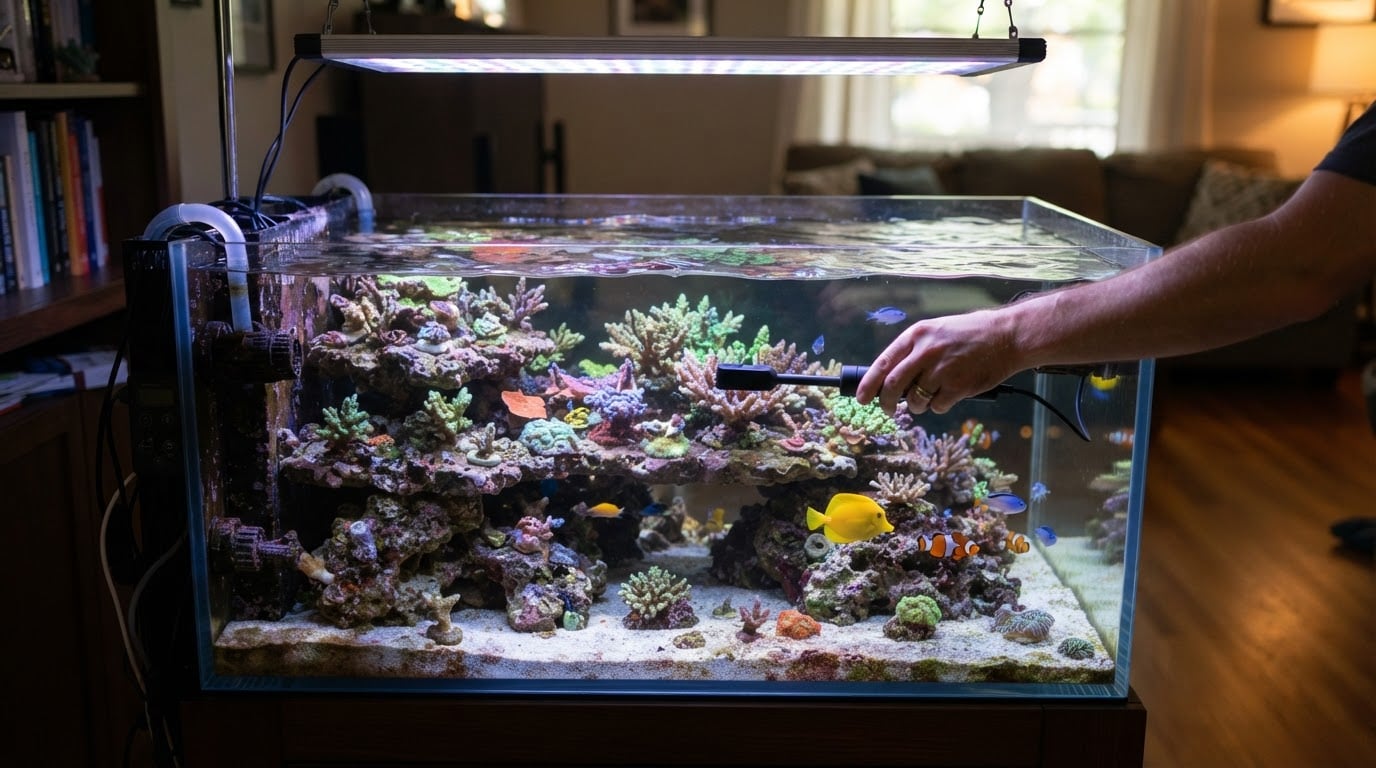
A basic beginner setup includes live rock or a comparable biological filter medium, aragonite sand, a heater, a powerhead or return pump for flow, and a test kit that covers ammonia, nitrite, nitrate, pH, and salinity. A protein skimmer is optional in a small tank with regular water changes, but it removes waste more efficiently than water changes alone in larger or more heavily stocked systems. Mix salt water with purified water, and use plain purified water for top-offs, because evaporation leaves the salt behind.
Hold the water in a stable range rather than chasing a perfect number. Most beginner-friendly fish do well at a specific gravity of 1.023-1.026, a temperature of 76-80°F (24-27°C), zero ammonia and nitrite, and nitrate kept low through routine water changes. Stability matters more than any single reading: a fish that experiences a slow drift adapts, while a fish that experiences a sudden jump often does not.
Cycling is the step that makes the tank safe for fish. The filter bacteria that convert ammonia to nitrite and nitrite to nitrate need time to establish, usually two to six weeks. Add a fish only when ammonia and nitrite both read zero, and add a small cleanup crew before you add the first fish. Every new arrival should spend two to four weeks in a separate quarantine or observation tank, which lets you treat problems before they reach the display.
How to compare species before you buy
Match every candidate against your own setup, not against a photograph of someone else's reef.
Work through the same four checks for every fish you consider: will it fit the tank as an adult, does it need water parameters or a diet you cannot provide, will it accept the food you can reliably stock, and what will it do to the shyest fish already in the tank? A species that fails any one of those checks is a poor first choice, no matter how hardy it is.
Catalog-style references make that comparison quicker. Sea Life Planet's saltwater species guides, for example, pair each species profile with a Quick Facts panel covering care level, minimum tank size, temperament, diet, and water parameters, so you can rule a candidate in or out against your own setup without reading a full care article for every fish.
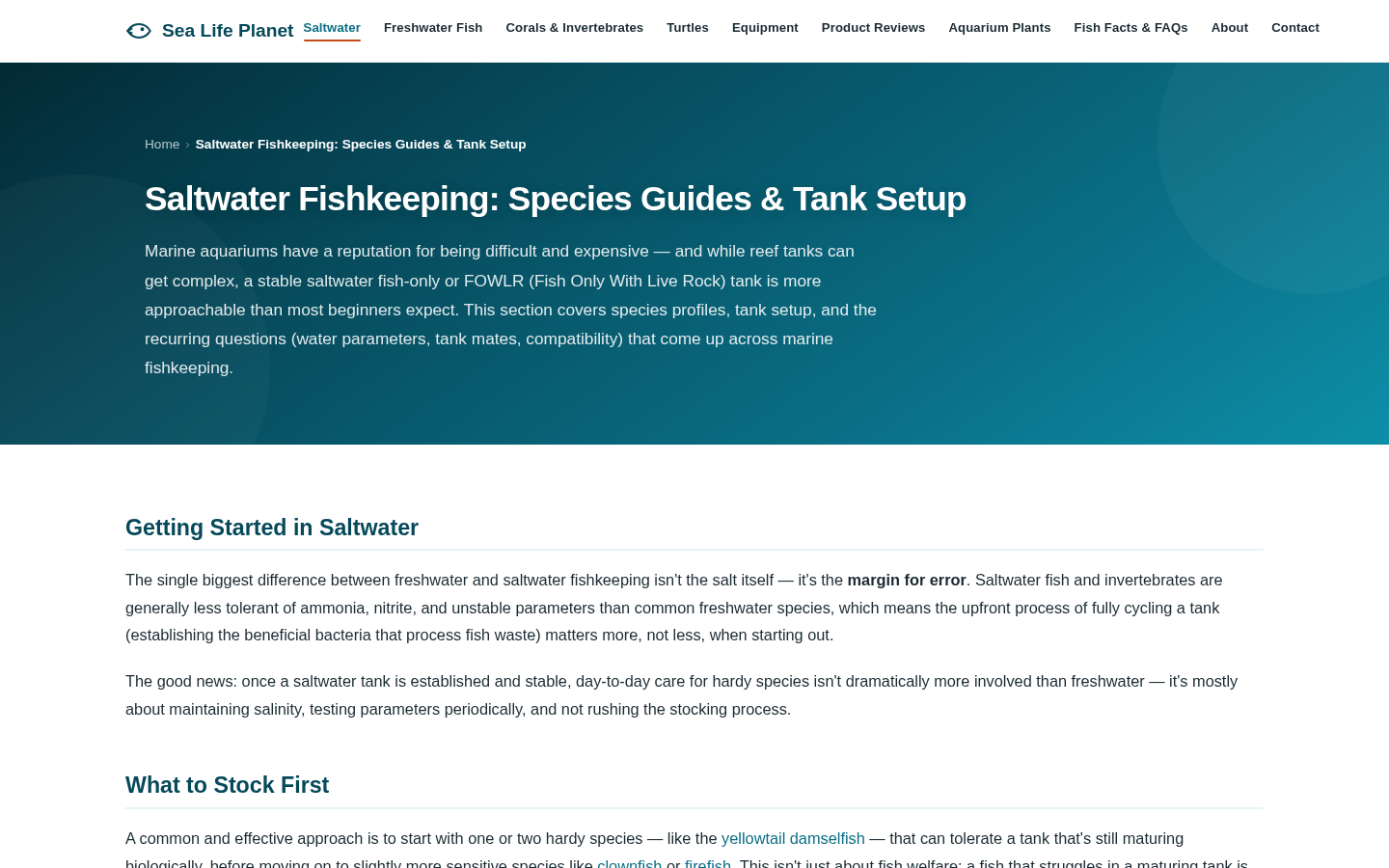
First-level category landing for saltwater fishkeeping: H1, section intro, getting-started and stocking guidance, species-guide filtering below.
Ask three practical questions before you pay: how big will it get, what does it eat, and how does it behave toward tank mates? If the shop cannot answer all three, the fish is not a beginner purchase yet.
Fish to avoid as a first purchase
Skip species that need live food, a very large tank, or a system built around them — mandarin dragonets, blue tangs, moorish idols, lionfish, and seahorses are the classic examples.
The mandarin dragonet is the most common beginner mistake. It looks peaceful and is often inexpensive, but it grazes live copepods and starves in a young tank that has not grown a pod population. Larger tangs need swimming room that a starter tank cannot provide, lionfish and moray eels will eat small tank mates, and seahorses need a dedicated, low-flow system with near-constant feeding. If a fish is described as "difficult", "expert only", or "not for beginners", accept the label.
The first month: what beginners get wrong
Most early losses come from stocking too fast, skipping quarantine, and topping off with salt water instead of fresh water.
Quarantine is the step most beginners skip, and it is also the one that most reliably prevents a disease outbreak from wiping out a new tank. Keep the observation tank bare-bottomed with a simple filter and a hiding place, watch the fish for two to four weeks, and treat only what you can actually identify. Feed lightly, test ammonia and nitrite weekly at minimum, and resist the urge to add a second fish before the first one has settled. When something goes wrong, change water and correct the parameter before you reach for a medication.
The first month is also when beginners over-clean. Rinse filter media in old tank water rather than tap water, keep the rock and sand undisturbed, and let the bacterial population grow.
Beginner questions, answered
Short answers to the practical questions that decide a first purchase.
What is the easiest saltwater fish for a beginner?
A captive-bred ocellaris clownfish is the usual first recommendation because it is hardy, eats prepared food, and adapts to a range of conditions. Firefish, royal grammas, and yellow watchman gobies are close behind.
How many fish can I keep in a 20-gallon saltwater tank?
Plan for one to three small fish, and let filtration, rockwork, and tank maturity decide the final number. Add them one at a time and watch ammonia and nitrite after each addition.
Do I need a protein skimmer?
Not in every small tank. Regular water changes can carry the waste load in a lightly stocked nano tank, while larger tanks and heavier stocking benefit from a skimmer. It is a useful upgrade rather than a requirement for a first fish.
Can I put a fish in a brand-new tank?
No. A new tank has not grown the bacteria that convert ammonia, so a fish placed in it is exposed to toxic waste. Cycle the tank until ammonia and nitrite read zero, then quarantine the first fish before it goes into the display.
How long does it take to cycle a saltwater tank?
Usually two to six weeks. The exact time depends on the amount of live rock, the starting bacteria product, and temperature. Test ammonia and nitrite every few days and wait for both to reach zero before stocking.
Is a 10-gallon tank too small for saltwater?
It can work for tiny peaceful species such as a neon goby, but small volumes change quickly, so a 20-gallon tank or larger is easier to keep stable for a first attempt.
Bottom line
Choose one hardy, captive-bred fish, give it a cycled tank with stable water, and add livestock slowly. The beginners who succeed are rarely the ones with the most equipment; they are the ones who quarantine, test, and wait.