The short answer
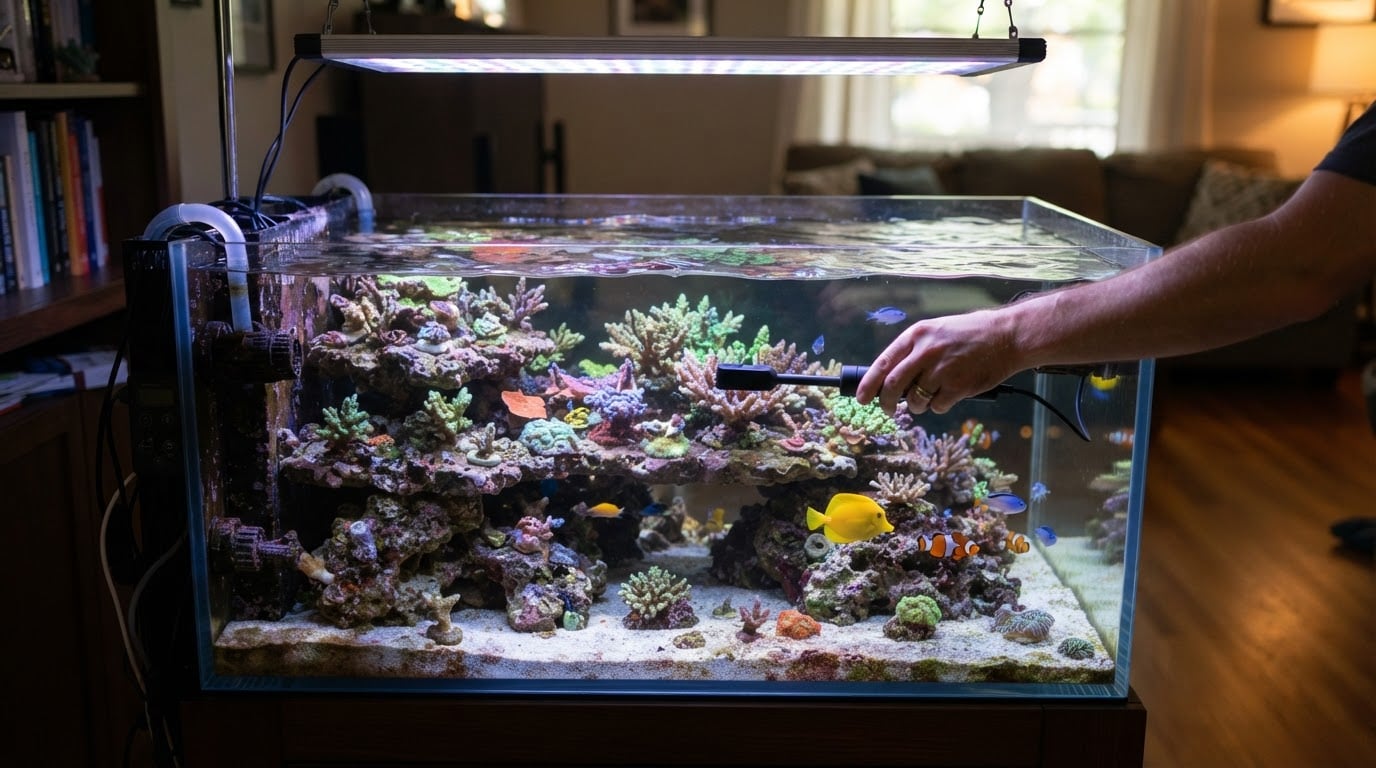
Clownfish are saltwater fish, so a marine tank is the first requirement — a freshwater setup will kill them. Past that, three more things decide whether the tank works: enough water volume to stay stable, steady salt and temperature, and a lid that stays closed. A skimmer, a sump, an anemone, and corals are upgrades or optional extras, not requirements.
Clownfish tank requirements at a glance
Every row below stands alone, so you can check a single requirement without reading the whole guide.
Requirement | Target | Why it matters |
|---|---|---|
Water type | Full-strength saltwater, 1.023-1.025 specific gravity | Clownfish are marine fish; low salinity is a short-term treatment, not a permanent home |
Tank size | 10 gallons (38 L) minimum for one fish; 20 gallons (75 L) for a beginner; 30 gallons (115 L) or more for a pair | More water swings more slowly, and a pair needs room to hold two territories |
Temperature | 74-80°F (23-27°C) | A one or two degree daily shift is normal; four or more is a stress event |
pH | 8.0-8.4 | Marine fish evolved in stable, alkaline water |
Alkalinity | 7-11 dKH | Buffers pH between water changes, especially with corals present |
Ammonia and nitrite | 0 ppm, always | Both burn gills; any readable level means the biofilter has failed |
Nitrate | Under 10-20 ppm in a fish-only tank; lower with corals | Creeps up with feeding and is the most common slow-burn problem |
Filtration | A cycled biofilter: live rock plus a mechanical filter or a sump | The bacteria process waste; the filter box just holds them |
Flow | Moderate current with no dead spots | Clownfish swim against light flow, and stagnant zones collect waste |
Lid | Tight-fitting glass or mesh | Clownfish jump, and a dried clownfish on the floor is a routine beginner loss |
Anemone | Optional | Captive-bred clownfish will host a coral, a powerhead, or nothing at all |
Tank mates | Peaceful reef fish, one clownfish species per tank | Clownfish are damselfish: territorial, and capable of bullying |
Cycle time | Four to eight weeks before the first fish | A new tank has no bacteria to convert fish waste |
Tank size: why the "minimum" keeps changing
For a beginner, 20 gallons (75 L) is the honest starting point, and a pair needs 30 gallons (115 L) or more. A 10-gallon nano tank can work for a single fish — it just leaves you less margin for mistakes.
Published minimums for one clownfish range from about 5 gallons to 30 gallons, and the spread is real. The number depends on what else goes into the tank and how much babysitting you will actually do.
The fish is not the hard part. A captive-bred ocellaris or percula clownfish (Amphiprion ocellaris, Amphiprion percula) settles around 3 inches (7.5 cm), holds a small territory, and does not patrol the whole tank. That is why a nano tank can work at all.
The water is the hard part. A small tank has little volume to absorb a mistake: one overfeeding, one dead snail behind the rock, one missed top-off. Evaporation raises salinity in a nano tank within days, and a small heater can swing the temperature on a cold night. A 20-gallon (75 L) tank gives you a week of margin where a 10-gallon gives you a day.
If you want a pair, plan for 30 gallons (115 L) or more. Two clownfish work when they are a bonded pair — one female, one male — bought together or matched young. Adding a second clownfish to an established one usually ends with the new fish pinned in a corner.
If you want a host anemone, size the tank for the anemone, not just the fish. Anemones wander, sting corals, need strong light and a mature tank, and can double the difficulty of a first setup. Most first-year keepers are better off with a clownfish and no anemone.
Water parameters: hit the range, then stop chasing numbers
Clownfish tolerate a range of conditions. What they do not tolerate is change.
Salinity is the parameter beginners get wrong most often. Mix saltwater to 1.023-1.025 specific gravity, measure it with a calibrated refractometer rather than a swing-arm hydrometer, and replace evaporation with fresh RO/DI water — never saltwater. Topping off with saltwater is how salinity climbs week after week.
Temperature belongs between 74-80°F (23-27°C). A heater on a separate controller is cheap insurance against a stuck heater, and a second thermometer lets you confirm the first one.
Ammonia and nitrite must read zero at all times. If either shows up, change water and find the cause: a dead fish, overfeeding, or a filter that was cleaned too thoroughly.
pH should stay between 8.0 and 8.4, with alkalinity around 7-11 dKH. Alkalinity is the reserve that keeps pH from swinging, and it drops as corals and coralline algae grow. Test it before dosing anything, and do not chase a "perfect" pH with chemicals. Stable and slightly off beats adjusted and bouncing.
Nitrate is the slow one. In a fish-only tank, anything under 10-20 ppm is workable. If it keeps climbing, you are feeding more than the tank can process, the biofilter is undersized, or the water changes are too small.
Equipment: what is required and what can wait
A cycled biological filter, a heater, a refractometer, marine test kits, and a lid are non-negotiable. A protein skimmer, a sump, and reef lighting are upgrades that depend on what you plan to keep.
- Filtration. Live rock is the primary biofilter. Add a hang-on, canister, or all-in-one chamber for mechanical and chemical media and for water movement. A protein skimmer removes dissolved organics before they break down; on a lightly stocked tank it helps, but it is not mandatory.
- Heater. Sized for the tank volume, set to 77-78°F (25-26°C), ideally on a controller with a high-temperature cutoff.
- Flow. A small powerhead or return pump provides the moderate current clownfish stay healthy in. Aim for no dead spots behind the rock.
- Test kits. Ammonia, nitrite, nitrate, pH, alkalinity, and salinity. Check expiration dates; expired reagents cause wrong readings, and wrong readings cause wrong fixes.
- Lid. Glass or 1/4-inch mesh, fitted. This is the cheapest piece of equipment that prevents a real loss.
- Light. A fish-only tank needs enough light to see the fish. Corals and anemones need reef-grade lighting, which is a different budget and a different level of care.
- Quarantine tank. A 10-gallon (38 L) tank with a sponge filter, heater, and hide is enough to observe a new fish before it enters the display.
Setting up: the order that avoids killing fish
Set up and cycle the tank first, then quarantine the fish, then introduce it. The fish is the last step, not the first.
- Build the tank. Live rock, substrate, saltwater mixed to 1.023-1.025, heater, and flow pump. Let the rock settle and the water clear.
- Cycle it. Add an ammonia source and let the bacteria colonize the rock and filter. Expect four to eight weeks.
- Confirm the cycle finished. The completion standard: ammonia reads zero, nitrite reads zero, and the tank converts a full ammonia dose to nitrate within 24 hours. A tank that passes once and then spikes again is not cycled.
- Hold parameters for a week. Check salinity, temperature, and pH daily for seven days. Fix drift before adding livestock, not after.
- Quarantine the clownfish. Two to four weeks in a bare quarantine tank gives you time to observe for disease and treat without medicating the display.
- Introduce, feed lightly, keep testing. Small meals, siphon uneaten food, and test ammonia and nitrite for the first two weeks.
Tank mates and compatibility
Clownfish do best with peaceful fish that ignore them, and with one clownfish pair per tank.
Good tank mates are small, non-aggressive fish that occupy different water layers: gobies, blennies, cardinalfish, firefish, and small reef-safe wrasses. Avoid other damselfish, large angelfish, groupers, triggers, and most predatory fish — they will either bully the clownfish or treat it as food.
The compatibility question that trips people up is a second clownfish. Outside a bonded pair, the result is usually aggression, and the same rule applies across species: an ocellaris and a maroon clownfish are not a pair. Sea Life Planet's compatibility library covers questions such as which corals clownfish host, and just as usefully, the combinations that don't work.
First-level category landing for saltwater fishkeeping: H1, section intro, getting-started and stocking guidance, species-guide filtering below.
The mistakes that make clownfish tanks fail
Most clownfish losses trace back to one of a handful of avoidable setup errors.
- Adding a fish to an uncycled tank. Ammonia burns gills before you can see a symptom. Cycle first.
- Topping off with saltwater. Replace evaporation with fresh water, or salinity climbs and the fish dehydrates.
- Leaving the lid off. Clownfish jump. Mesh or glass is not optional.
- Buying two unrelated clownfish. Get a bonded pair, or keep one fish.
- Buying an anemone for a new tank. Anemones need mature, stable water — often six months or more of it.
- Overstocking a nano tank. Two fish, an anemone, and a coral collection in 10 gallons is three setups' worth of demand in one.
- Making big changes at once. A large water change, a filter deep-clean, and a temperature shift in the same week is how a stable tank crashes.
Questions worth answering before you buy
Work through these in order: setup decisions first, ongoing care second, problems last.
Setup decisions
Do clownfish need an anemone? No. Captive-bred clownfish do fine without one, and many will host a coral, a rock ledge, a powerhead, or nothing at all. Skipping the anemone removes the hardest requirement on the list.
Can a clownfish live in a 10-gallon tank? One fish can, if you keep up with top-offs and water changes and skip the anemone and corals. A 20-gallon (75 L) tank gives the same fish a much larger margin for error.
Do I need a sump? No. A hang-on filter or an all-in-one rear chamber handles mechanical and chemical filtration on a clownfish tank. A sump adds water volume and hides equipment, which is nice to have, not required.
Can clownfish live in freshwater? No. Clownfish are marine fish and need full-strength saltwater. A freshwater tank will kill them.
Ongoing care
How often do I do water changes? Small, regular changes beat large, occasional ones. A 10-20% change every one to two weeks keeps nitrate and trace elements in range on a typical clownfish tank.
What should I feed a clownfish? A varied diet: frozen mysis or brine shrimp, a quality marine pellet or flake as the base, and occasional nori or algae-based food. Feed small portions once or twice a day, and remove what is not eaten.
How long do clownfish live? Clownfish are long-lived for a small aquarium fish — ten years or more is common in a settled tank, and some individuals live twice that long.
Troubleshooting
Why is my clownfish hiding? New fish hide for a few days while they settle. Hiding that continues usually points to a parameter problem, an aggressive tank mate, or too much light in a bare tank.
Why won't my clownfish eat? A new clownfish may take several days to start feeding. If it refuses food for more than a few days, test ammonia, nitrite, and salinity first, then look for disease.
Why is my clownfish swimming at the surface? Surface swimming can mean low oxygen, rising ammonia, or a bully below. Test the water, add surface agitation, and check the tank mates before assuming it is normal behavior.
The five-minute pre-purchase checklist
Before a clownfish comes home, confirm five things, in this order.
- Ammonia and nitrite read zero, and the tank has been cycling for at least four weeks.
- Salinity is 1.023-1.025, measured with a calibrated refractometer.
- Temperature holds steady between 74-80°F (23-27°C).
- A quarantine tank is ready if you plan to use one.
- The lid fits.
If any line fails, fix it first. A clownfish bought into a finished tank is a decades-long pet; a clownfish bought into an unfinished one is a lesson.