Quick verdict: which filter direction fits a betta tank?
If you are choosing filtration for a betta (Betta splendens), you are usually not shopping for the strongest pump on the shelf. You are shopping for stable water quality that does not blast a labyrinth fish with strong surface current.
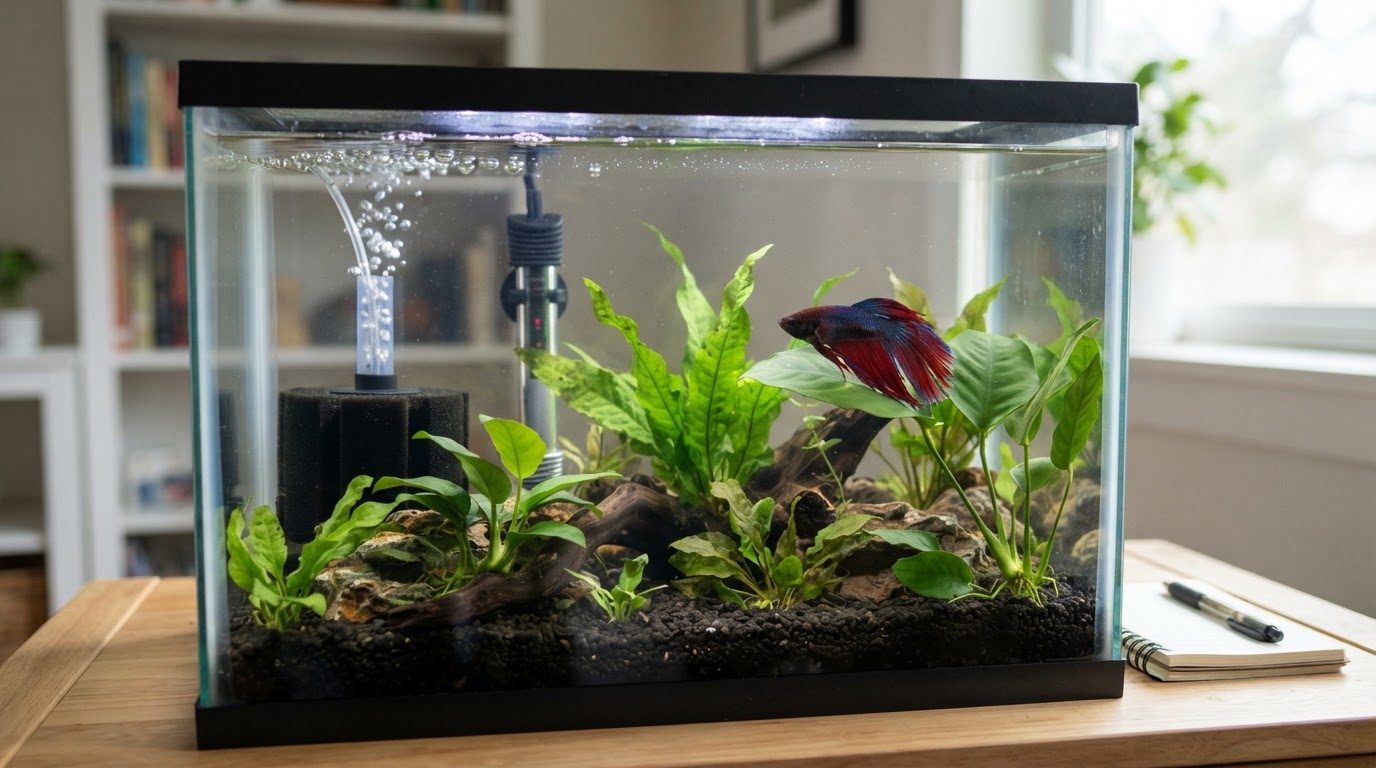
Default pick for most single-betta tanks (about 5–10 gallons / 19–38 L): an air-driven sponge filter sized for the tank, with the air valve turned down until the sponge moves water without creating a permanent “whitewater” surface or a fish that hides from one corner forever.
Better pick when you want simpler cartridge swaps and already own a gentle hang-on-back (HOB): a small HOB with a sponge prefilter and a baffle or outflow sponge—only if you can keep the outflow mild.
Better pick when you keep a planted nano and want mechanical polish without an airstone roar: a low-flow internal filter with coarse sponge media, again only if flow can be reduced.
Usually the wrong pick for a solo betta nano: unfiltered bowls or “no filter because bettas breathe air,” oversized canisters aimed at high-flow aquascapes, and any filter you cannot throttle without starving biological media of oxygenated flow.
The rest of this page is a decision framework—not a ranked SKU list. Specific model names, street prices, and review scores are omitted when they cannot be verified from sealed research inputs. Compare directions first; buy second.
What a betta actually needs from filtration
Bettas are labyrinth fish. They can gulp atmospheric air, which is why the old bowl myth refuses to die. Air breathing is a survival trait, not a substitute for the nitrogen cycle. Ammonia and nitrite still damage gills and stress the immune system whether or not the fish can surface for oxygen.
Useful filtration for a betta does three jobs:
- Biological filtration — colonized surface area that converts ammonia → nitrite → nitrate.
- Gentle water movement — enough turnover to mix the tank and feed the bacteria without pinning fins or exhausting the fish.
- Practical maintenance — media you can rinse in old tank water without throwing away the entire bacterial population every week.
Mechanical clarity (removing floating debris) and chemical media (carbon, purigen-style resins) are optional extras. For a lightly stocked betta tank, biology + mild flow almost always matter more than crystal-clear water the day after a big feed.
Species context still matters. A heated, filtered footprint around 5 gallons (19 L) is a widely used minimum for an adult betta in modern hobby guidance; smaller unheated containers make every filter choice harder because temperature swings and waste concentrate faster. Target water is typically warm and clean: roughly 76–82°F (24–28°C), ammonia and nitrite at 0 ppm, and nitrate kept low with water changes (often aiming under about 20 ppm in planted community practice). Those ranges are husbandry targets, not filter-brand marketing claims.
Evaluation checklist before you buy any betta filter
Walk this checklist once. If a product fails two or more hard checks, skip it—even if the box says “betta.”
Hard checks (pass/fail)
Check | Pass looks like | Fail looks like |
|---|---|---|
Flow control | Valve, baffle, sponge prefilter, or adjustable output you can set mild | Fixed high-speed outflow aimed across a short tank |
Intake safety | Guarded intake; shrimp/fry-safe if needed; no exposed impeller slot | Open intake that can trap a resting fish or long fins |
Media that can mature | Permanent sponge, ceramic, or bio rings you keep wet across cleanings | All media is disposable cartridges you replace weekly |
Fits the tank | Footprint and height leave swimming room and heater space | Filter body eats half a 5-gallon cube |
Noise and splash you can live with | Soft gurgle or quiet hum | Constant splash that stresses fish or household |
Power and air plan | You have a working air pump or a power filter outlet that stays dry | Plan depends on an overloaded USB brick or wet outlet |
Fit checks (scenario-based)
- Tank size: 3-gallon desktop kits need the smallest sponge heads and careful air dial-in; 10–20 gallon long tanks can handle dual sponges or a baffled HOB more easily.
- Stocking: solo betta is the baseline. Adding shrimp, snails, or a small community raises bioload and may justify more media surface—not necessarily more current.
- Decor and plants: dense silk or live plants break up flow; bare tanks make the same pump feel harsher.
- Lid and jump risk: bettas jump. Filters that force a large lid gap need a jump guard.
- Maintenance style: if you hate rinsing sponges, you will still need to; cartridge-only systems just move the chore to the store aisle and often discard bacteria with the cartridge.
Red flags on packaging and store aisles
- “Silent” claims with no flow adjustment.
- Photos of strong surface agitation in a nano tank.
- Bundles that pair a powerful internal filter with a 1–2 gallon bowl kit.
- Advice that a betta “does not need a filter” because it has a labyrinth organ.
Solution directions compared (not product SKUs)
Think in categories. Each direction solves a different constraint.
1) Air-driven sponge filter
How it works: An air pump pushes air through a lift tube. Rising bubbles draw water through open-cell sponge. The sponge is both mechanical and biological media.
Where it wins
- Lowest typical current among common powered options when the air valve is set low.
- Excellent permanent media: you rinse the sponge; you do not throw the colony away.
- Cheap to run, easy to keep a spare seeded sponge for emergencies or hospital tanks.
- Friendly to shrimp and fry when the sponge is coarse enough and the intake is the sponge itself.
Real trade-offs
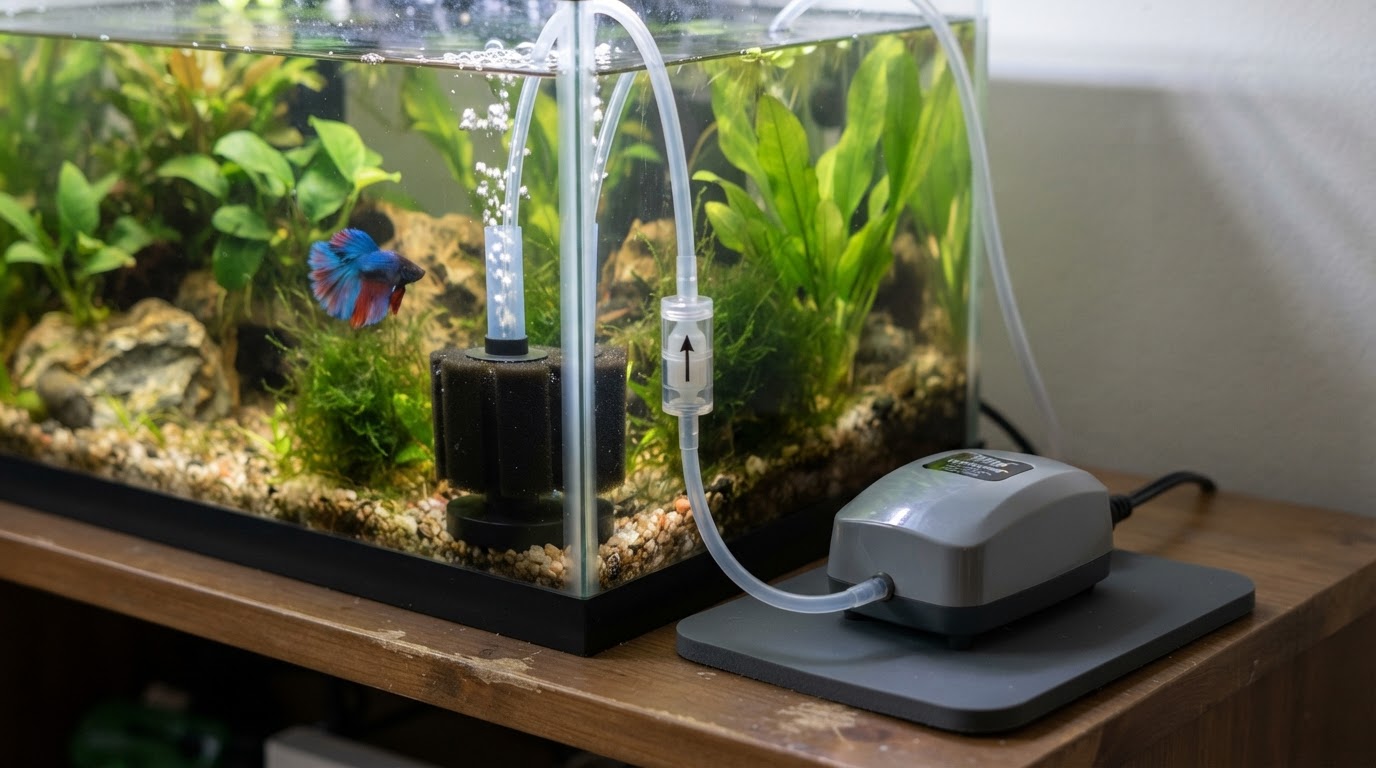
- Needs a separate air pump, tubing, and check valve (check valve orientation matters—install so water cannot siphon into the pump).
- Bubble noise and surface dimpling annoy some keepers and some fish if overdriven.
- Does not polish water as fast as a fine pad in a canister; tannins and micro-debris may linger until plants or water changes help.
- Lift-tube height and sponge diameter must match tank depth; a tall dual-sponge assembly can dominate a tiny cube.
Best for: heated 5–10 gallon single-betta tanks, breeding/grow-out boxes, quarantine, and anyone who wants biology first.
Skip when: you cannot place an air pump (shared walls, extreme noise sensitivity) or you refuse any bubbles on the surface aesthetic.
2) Hang-on-back (HOB) filter with flow tamed
How it works: A pump lifts water into a rear box of media and returns it over a spillway.
Where it wins
- Strong mechanical filtration and easy access to media trays.
- Good oxygen exchange at the return.
- Familiar form factor on many rimmed starter tanks.
Real trade-offs
- Stock outflow is often too strong for long-finned bettas unless you baffle it, add a prefilter sponge on the intake, sponge the outflow, lower the water level slightly to soften the spill, or choose a truly small model.
- Many HOBs lean on replaceable cartridges; if the cartridge is the only media, weekly swaps reset biology.
- Evaporation and salt creep on the hang-on body need wiping.
- Rimless tanks may need careful mounting.
Best for: keepers who already own a small HOB and are willing to baffle; tanks 10 gallons and up where a gentle return can be spread across width.
Skip when: the only HOB that fits is a high-GPH model with no practical way to soften return flow.
3) Internal / corner power filter (cartridge or sponge insert)
How it works: A submerged pump pulls water through foam or cartridges inside the tank.
Where it wins
- No hang-on body; works on odd lids and some acrylic kits.
- Some models accept sponge sleeves that improve biology and gentleize intake.
- Can be aimed at glass to reduce direct current on the fish.
Real trade-offs
- Impellers can be harsh and noisy if cheaply made.
- Takes swimming space in nanos.
- Cartridge-centric designs share the same biology problem as HOB cartridges.
- Heater + internal filter + decor crowding is real in 5-gallon cubes.
Best for: tanks where HOB mounting fails and an air-driven sponge is unwanted—if flow is adjustable and sponge media is permanent.
Skip when: the unit is sold as a sealed disposable cartridge brick with fixed high flow.
4) Canister filter
How it works: An external sealed canister pushes water through large media volumes and back via spray bars or outlets.
Where it wins
- Huge media capacity and polish for heavily planted or higher-bioload systems.
- Flexible plumbing: spray bars can diffuse flow along the back pane.
Real trade-offs
- Overkill cost and complexity for a solo betta nano.
- Priming, leaks, and tubing clutter are real maintenance costs.
- Easy to oversize flow if the outlet is a single jet.
Best for: larger community tanks that include a betta only when temperament and cover allow—not the typical first betta setup.
Skip when: your tank is a desktop 5-gallon and you do not already own the canister.
5) “No filter,” sponge-only air stone, or plant-only reliance
How it works: Heavy planting, frequent water changes, or bare air stones without media.
Where it can work
- Experienced keepers running mature planted tanks with disciplined water-change schedules and light stocking.
- Very short-term hospital observation (still usually better with a seeded sponge).
Real trade-offs
- No dedicated media means less buffer when you overfeed, miss a change, or the plant mass is not doing what Instagram implied.
- Air stone alone moves water but does not equal a colonized sponge.
- Beginners following “bettas don’t need filters” advice are the group this direction hurts most.
Best for: advanced planted-tank practice—not as a purchase default for a first betta.
Skip when: you want a forgiving safety margin.
Side-by-side decision matrix
Direction | Flow risk to betta | Biological stability | Maintenance feel | Typical fit |
|---|---|---|---|---|
Air-driven sponge | Low if air is throttled | High (permanent sponge) | Rinse sponge in tank water; wipe film | Default for 5–10 gal solo betta |
HOB + baffle/prefilter | Medium; depends on baffle skill | Medium–high if media is kept | Tray access; avoid tossing all media | Rimmed tanks, keepers OK tuning outflow |
Internal power filter | Medium–high unless adjustable | Medium if sponge retained | In-tank cleaning; space cost | Odd lids; no HOB lip |
Canister | Low–high depending on outlet | Very high capacity | External equipment overhead | Larger tanks, not first nanos |
No dedicated filter | N/A (other risks dominate) | Low buffer | More water changes, less gear | Experts only / temporary |
When a sponge filter for betta setups is the honest winner
Choose the sponge-filter direction when most of these are true:
- You keep one betta (maybe with shrimp/snails) in a heated nano or small community footprint.
- You can place a small air pump in a cabinet or on a soft pad to reduce vibration noise.
- You want media that matures for months, not a subscription to cartridges.
- You prefer to fail safe on flow: bubbles are easier to turn down than a sealed high-GPH impeller is to tame.
- You may need a hospital or quarantine box later—the same sponge style cross-trains well.
Sponge filters “win” their category on gentleness + biology per dollar + reseeding flexibility, not on silent high-tech polish. If your priority is a glass-smooth surface for photography with zero bubbles, a baffled HOB or carefully aimed internal filter may serve you better—even if the sponge remains the safer teacher for beginners.
How to set up a sponge filter so it stays betta-safe
- Match sponge size to tank volume. Small single sponges for desktop tanks; larger or dual sponges as volume and bioload rise. The sponge should not crowd the heater into one unsafe corner.
- Install tubing with a check valve. Place the check valve between tank and pump so water cannot siphon backward into the air pump during a power outage.
- Start the air low. Aim for a steady, soft stream of bubbles and visible gentle circulation—not a rolling boil. Watch the fish for 20–30 minutes: clamped fins, hiding only in the opposite corner, or struggling to hold position means turn the air down or add plant cover to break flow.
- Position for a circular path. Put the sponge so outflow runs along the glass, not straight at the betta’s favorite resting leaf.
- Seed when you can. If you already run another tank, squeeze a mature sponge into the new one or share a handful of media. Otherwise, expect a normal cycle: dose a pure ammonia source or use a hardy cycling method and test until ammonia and nitrite read zero.
- Rinse, do not bleach-replace, on a schedule. When flow slows, rinse the sponge in a bucket of removed tank water—not hot tap water. Replace the sponge body only when it falls apart; replace air stones when they clog.
Common setup mistakes
- Air on full from day one “to cycle faster,” which only trains the fish to hate the corner.
- No check valve, then a flooded air pump.
- Tossing the sponge every month because it looks brown—the brown biofilm is largely the point.
- Pairing a huge dual sponge with a 2–3 gallon kit until the fish has a hallway of plastic.
Trade-offs and limitations (read these before you order)
- Noise is personal. A sponge filter is quiet to one keeper and intolerable to another. Put the pump on a towel, inside a cabinet with ventilation, or on a vibration mat before you abandon the whole direction.
- Surface film. Gentle tanks can grow protein film. A slight increase in surface movement, paper-towel skim, or more plant mass usually beats installing a powerhead that is too strong.
- Not magic for overstocking. A sponge does not excuse two male bettas, an oversized goldfish, or skipped water changes.
- Aesthetics. Lift tubes and bubbles are visible. Hardscape and plants hide them better than denial does.
- Power outages. Air-driven sponges stop with electricity; battery air pumps exist for outage-prone areas, but plan deliberately.
- Medication and salt. Some treatments foul sponges or kill bacteria. Keep a spare sponge if you medicate often, and follow medication labels rather than filter-brand folklore.
Scenario-based recommendations
First adult betta in a heated 5–10 gallon tank
Start with an air-driven sponge filter, heater set in the mid–upper 70s °F range appropriate for your home, a lid, and a weekly testing habit. This is the path with the widest safety margin on flow.
You already own a small HOB
Do not throw it out on principle. Add an intake prefilter sponge, baffle the return, and keep permanent bio media in the box. If you still cannot get mild flow, switch directions rather than forcing a jet on a long-finned fish.
Shrimp with betta (temperament allowing)
Sponge filtration is usually the cleaner fit: no open impeller slot, continuous biofilm grazing surface. Still choose tank mates carefully—filter choice does not fix aggression.
Planted aquascape priority, low bubbles
Consider a low-flow internal filter with sponge, or a HOB with a sponge-filled media chamber and a heavily diffused return. Keep expectations honest: you are trading some sponge simplicity for aesthetics.
Quarantine or hospital container
A small seeded sponge filter is one of the most useful tools in the hobby. Bare air stones do not replace media after medications that disrupt bacteria.
Apartment noise constraints
Test pump placement before drilling lid holes everywhere. If air pumps are a hard no, a well-baffled HOB or adjustable internal filter is a rational alternative—not a reason to run zero filtration.
Buying notes without fake SKUs or prices
Because sealed competitive research was unavailable for this article, use store-agnostic specs instead of memorized “best of” brand charts:
- Prefer open-cell sponge you can rinse for years.
- Prefer adjustable air valves on the airline or pump.
- Prefer guarded or sponge-first intakes on any powered impeller design.
- Prefer media you keep over media you must repurchase weekly.
- Ignore vanity GPH numbers that assume unrestricted flow in an empty bucket.
If a retailer page leads with five interchangeable plastic cartridges and no permanent bio media, treat it as a consumable product, not a filtration strategy.
Maintenance rhythm that keeps the decision working
- Daily: glance for temperature, swimming behavior, and clogged air flow.
- Weekly (or as tests dictate): water change appropriate to bioload and nitrate; spot-clean waste; empty the prefilter sponge if you use one on a HOB.
- As needed: rinse the main sponge when output drops; never replace all media at once if multiple pieces exist.
- After any equipment change: re-watch flow against the fish for a full evening, not thirty seconds.
Stable filtration is boring when it works. That boredom is the goal.
Bottom line
For most people searching sponge filter for betta setups, the sponge-filter direction is the right first choice because it optimizes gentle flow and durable biological media—the two constraints that actually show up after the unboxing photo. HOB and internal filters can be excellent when flow is deliberately tamed and media is permanent. Canisters are tools for bigger systems. Unfiltered keeping is a discipline, not a beginner shortcut.
Pick the direction that matches your tank size, noise tolerance, and maintenance style. Then dial flow until the betta patrols the whole tank instead of living in the one calm corner. If a product cannot give you that calm corner without sacrificing the nitrogen cycle, it is the wrong product—regardless of what the box promises.