What Aquarium Water Quality Actually Measures
Aquarium water quality is the set of dissolved chemicals and physical conditions that determine whether your fish can breathe, regulate their body fluids, and recover from stress. A tank can look crystal clear and still be dangerous: ammonia, nitrite, and nitrate are colorless, so appearance is not evidence of safety.
The practical goal is not "perfect water." It is water that stays chemically stable between maintenance sessions. Fish tolerate a fairly wide range of conditions when those conditions change slowly, and they suffer when a parameter moves fast — even from one "acceptable" value to another. That is why the readings matter less than the pattern: what is rising, what is stuck above zero, and how quickly the numbers move.
The Parameters Worth Testing
Not every test kit earns its place on your shelf. These seven cover almost every problem a freshwater keeper will meet.
Parameter | What it indicates | Practical target for most freshwater community tanks |
|---|---|---|
Ammonia (NH3/NH4+) | Fish waste, uneaten food, or a filter that has stopped processing waste | 0 ppm at all times |
Nitrite (NO2-) | The first-stage product of ammonia breakdown; it interferes with oxygen transport in the blood | 0 ppm at all times |
Nitrate (NO3-) | The end product of the nitrogen cycle, removed mainly by water changes and plants | Below 20 ppm where practical; 20–40 ppm is common; above 40 ppm means act |
pH | Acidity or alkalinity, and how much of your ammonia reading is in the toxic form | Stable within the species' range; most community fish sit near 6.5–7.8 |
KH (carbonate hardness) | The buffer that keeps pH from swinging or crashing | Roughly 4–8 dKH for most community tanks |
GH (general hardness) | Dissolved calcium and magnesium; it matters for molting, shells, and plant growth | Match the species; 4–8 dGH suits many tropical fish |
Temperature | Oxygen solubility and how fast waste breaks down | Stable and species-appropriate; usually 72–82°F for tropical communities |
Chlorine and chloramine belong on the list too, but not as a recurring test: tap water must be dechlorinated before it touches the tank, because both substances damage gills and kill the bacteria your filter depends on.
How to Read the Result, Not Just the Number
A reading only becomes useful when you know what it implies. Ammonia is the clearest example. The EPA's ammonia module explains that ammonia exists in two forms — the ionized ammonium (NH4+) and the un-ionized form (NH3) — and that rising pH favors the more toxic un-ionized form, while temperature also affects toxicity (EPA). The practical consequence is blunt: the same 0.25 ppm total ammonia reading is more dangerous in a warm, alkaline tank than in a cool, slightly acidic one. Test kits that report total ammonia therefore give you a starting point, not a verdict.
Reading | What it usually means | First response |
|---|---|---|
Ammonia above 0 | The biofilter is overwhelmed, stalled, or damaged | Confirm with a second test, then a 25–50% water change and pause feeding |
Nitrite above 0 | The second stage of the cycle has not caught up | Same as ammonia; add surface agitation and retest within 24 hours |
Nitrate 20–40 ppm | Normal accumulation between water changes | Keep your existing schedule; more plants or a slightly larger change will hold it |
Nitrate above 40 ppm | Removal has fallen behind input | Increase water change volume or frequency and review feeding |
pH drifting or swinging | KH may be too low to buffer the water | Test KH before dosing anything to change pH |
pH stable but "wrong" | Likely fine for a species that evolved elsewhere | Adjust only if the species needs it, and change it slowly |
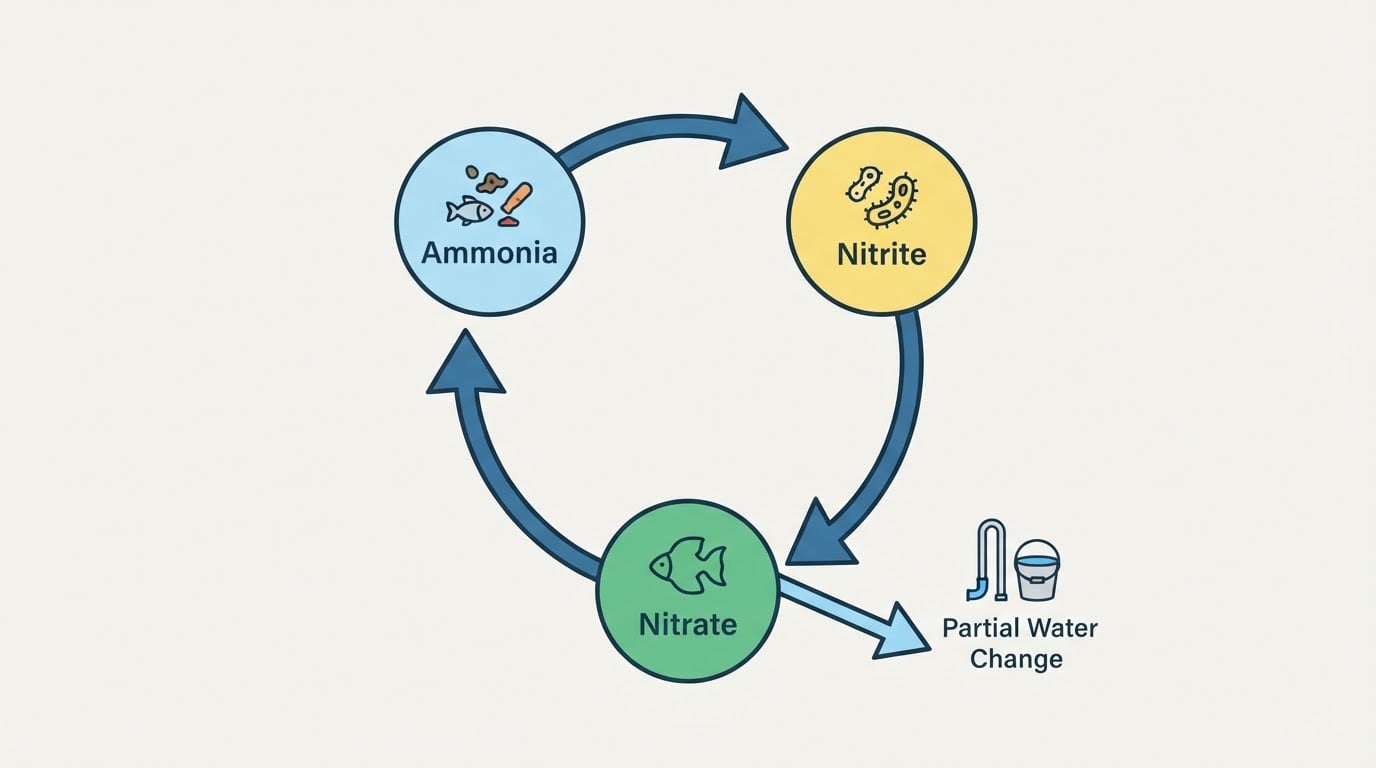
Nitrogen is a cycle, not a single number. The USGS explains that fixed nitrogen moves between forms — ammonium, nitrite, and nitrate — as bacteria oxidize it, and that nitrate forms through the oxidation of nitrite and ammonia (USGS). In a working tank, that means a healthy filter shows you a sequence: ammonia first, then nitrite, then nitrate. If ammonia or nitrite stalls above zero, the chain has a broken link — usually a filter problem, an overstocking problem, or an overfeeding problem, not a mysterious water issue.
Warning Signs and the Parameter They Point To
Fish behave before they look sick. By the time spots, frayed fins, or pale gills appear, the water has often been off for days. Read the behavior first, then confirm it with a test.
Warning sign | Most likely parameter | Why it points there |
|---|---|---|
Gasping at the surface or hovering under the filter outlet | Ammonia or low oxygen | Ammonia damages gills and reduces oxygen uptake; the EPA lists increased breathing, loss of equilibrium, and hyperexcitability among the behavioral effects of ammonia exposure |
Clamped fins, hiding, sudden appetite loss | Any parameter stress | These are general stress responses, so test the full panel before guessing |
Flashing or rubbing against decor | Ammonia or nitrite irritation | Irritated gills and skin make fish scrape; confirm ammonia and nitrite first, then consider parasites |
Cloudy or milky water | A bacterial bloom, often after overfeeding | The bloom itself consumes oxygen and signals excess organic waste |
Green water, sudden algae, or a snail population boom | Nitrate or phosphate rising | Excess nutrients feed algae, and the same waste that raises nitrate feeds the bloom |
Foul or musty odor | Decaying organic matter | Uneaten food, a dead fish, or clogged media are decomposing — test ammonia before it climbs |
One pattern separates water problems from social ones: when most or all fish in the tank show symptoms at once, the cause is environmental, and testing is the next step. When a single fish is affected while its tankmates behave normally, look at aggression, illness, or a recent introduction first.
A Troubleshooting Sequence That Ends With a Verified Fix
Random water changes fix the reading for a day and leave the cause in place. Work through these steps in order, and stop adjusting once the tank passes the completion check.
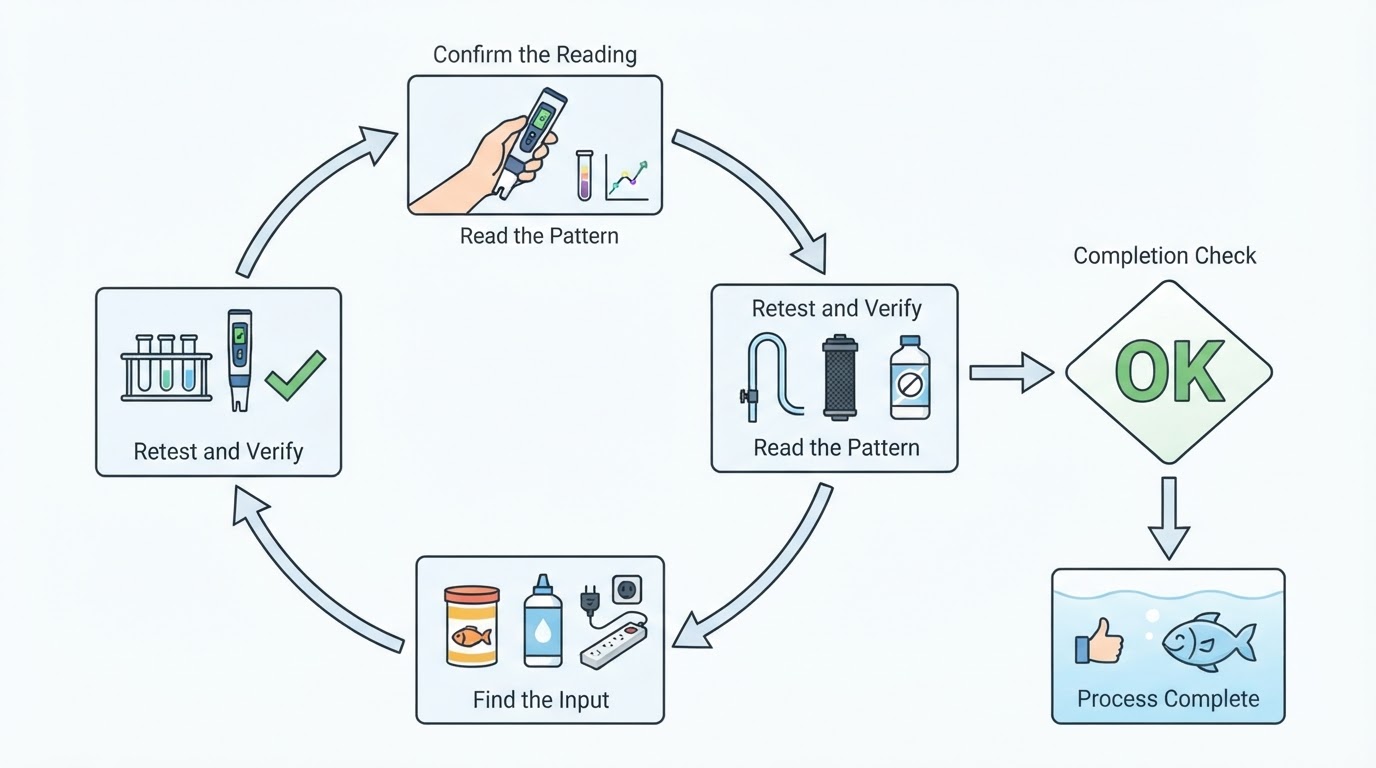
- Confirm the reading. Retest with fresh reagent, check the kit's expiry date, and test your tap water separately. A single bad vial or an expired strip can send you chasing a problem you do not have.
- Read the pattern. One parameter out of range is usually a maintenance problem. Ammonia and nitrite out of range together is a filter problem. A pH swing with low KH is a buffering problem. The pattern narrows the cause before you spend anything.
- Remove the immediate danger. For ammonia, nitrite, or a crashed pH, change 25–50% of the water with dechlorinated, temperature-matched water, increase surface agitation, and pause feeding for 24 hours. Never change more than half at once, because the swing itself stresses fish.
- Find the input. Walk the usual causes in order: overfeeding, overstocking, filter media rinsed under tap water, a clogged or stopped filter, a missed water change, a dead fish or decaying plant, and source water that already contains nitrate.
- Verify the fix. Repeat the test 24 hours later and again after the next water change.
The completion check is concrete: ammonia and nitrite both read 0, nitrate holds below your target without a second emergency change, pH moves less than about 0.3 units across a day, and fish behavior returns to normal for two consecutive days. If the same parameter drifts back after the next feeding or water change, you have found the cause rather than the symptom. Fix that, and the readings will stay put.
Look-Alike Problems, Compared
Several water problems produce similar symptoms but need different responses.
- Ammonia vs. nitrite vs. nitrate. Ammonia and nitrite are acutely toxic and should read zero; nitrate is the normal end product and is managed rather than eliminated. A tank with ammonia rising has a failing first bacterial stage. Nitrite rising means the second stage lags. Nitrate rising simply means removal has fallen behind, so the fix is water changes and plants, not panic.
- New-tank syndrome vs. old-tank syndrome. A new tank spikes ammonia, then nitrite, as the cycle establishes — expected, and handled with patience, small water changes, and light feeding. An old tank that suddenly shows ammonia usually has a broken biofilter: media cleaned too thoroughly, medication, a power outage, or a large livestock addition.
- Liquid reagent kits vs. test strips. Liquid kits cost more per test and take longer, but they are the standard for ammonia and nitrite decisions. Strips are faster for routine nitrate and pH checks, but they are easier to misread and degrade with humidity. Whichever you use, the retest that matters is the one that confirms a change.
- Stable-but-high pH vs. swinging pH. A steady 7.8 that suits your species is safer than a 7.0 that moves every day. Chase stability, not a number.
Keeping the Tank Stable After the Fix
Prevention is mostly rhythm, not equipment.
- Test weekly in a settled tank: ammonia, nitrite, and nitrate at minimum, plus pH and KH at least monthly.
- Change 20–30% of the water on a fixed schedule, and match temperature and dechlorination every time.
- Feed what the fish finish in a couple of minutes; leftover food is the most common hidden input.
- Rinse filter media in tank water, never under the tap, and only when flow drops.
- Test your source water once for nitrate and KH so you know what every water change is adding.
Water quality is a system you keep in balance, not a grade you pass. Once the tank holds zero ammonia, zero nitrite, a controlled nitrate level, and a stable pH, the routine that got it there is the routine that keeps it there.