The direct answer, in one list
If you skip the rest, buy this: the largest tank your space allows — 5 gallons (19 L) is the floor, 10 gallons (38 L) is easier for very little extra — and pair it with a filter you can slow down.
Four things need to be true:
- The tank holds at least 5 gallons (19 L). Smaller volumes swing in temperature and foul faster, and the filter doesn't change that.
- The flow can be reduced. A control knob, an air-line valve, a spray bar, or a baffle you add yourself. If the flow can't come down, the filter is wrong for a betta.
- The media is reusable. Sponge, ceramic rings, or bio-balls that you rinse and put back. Cartridge-only filters work, but the replacement habit costs money and throws away bacteria.
- You also have a lid and a heater. Bettas breathe at the surface and jump; warm water holds less oxygen, so you want gentle surface movement rather than a strong current.
Everything else — styling, lighting, the word "betta" on the box — is optional. None of it rescues a filter that pushes the fish around.
What the filter is actually doing
A filter does three jobs at once. It traps particles (mechanical), it houses the bacteria that turn ammonia into nitrite and then nitrate (biological), and if you run carbon it also pulls out some dissolved compounds (chemical). The biological job is the one that keeps a fish alive.
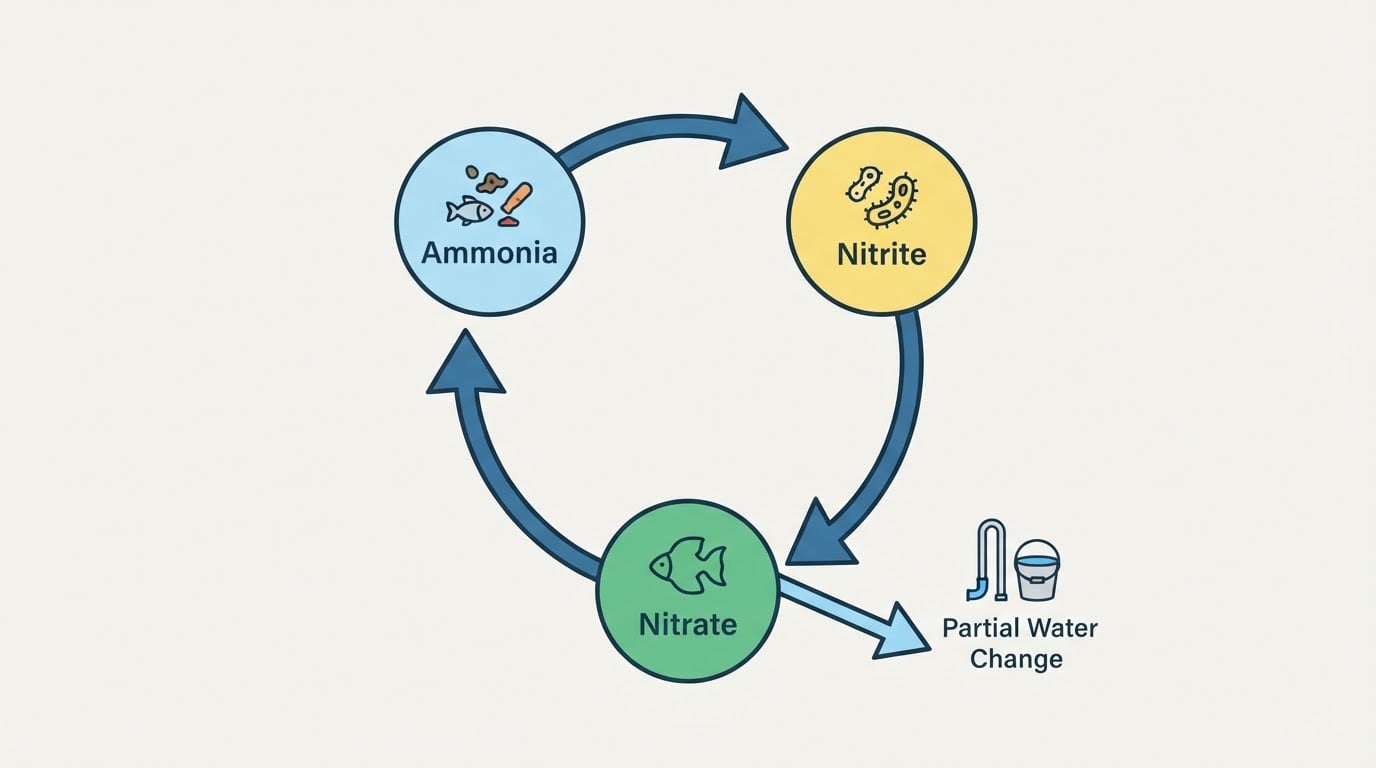
Your betta produces ammonia constantly, from waste and from its gills. Uneaten food adds more. In a new tank, ammonia climbs until it burns the gills; the bacteria that would consume it take weeks to establish, and they live in the filter media, not in the water column. Clear water tells you nothing about this. A tank can look immaculate and still be toxic.
That's why the media, not the housing, is the part you protect. It's also why the instruction to "replace the cartridge every month" is such bad advice: you're discarding the colony that keeps the water safe, and paying for the privilege.
The trade-off the product listing never mentions: a filter that moves more water is not automatically better for a betta. Betta splendens comes from shallow, slow, plant-choked water, and long-finned males swim like a flag in a breeze. A filter that turns the tank into a washing machine is a stress source — clamped fins, hiding, refusing food, and in bad cases a fish pinned to the glass behind the intake. You want enough flow to push water through the media and oxygenate the surface, not a current your betta has to fight for its whole life.
How to choose the tank and the filter together
Start with the tank, not the kit
Size buys forgiveness. A 5-gallon (19 L) tank dilutes waste better than a 2.5-gallon, holds temperature more steadily, and leaves room for a filter whose flow you can adjust. A 10-gallon (38 L) with the same gentle flow is easier still, and it opens the door to plants and, eventually, a tank mate or two. Long and low beats tall and narrow: more surface area for gas exchange, more floor for the fish to patrol.
Pick a filter you'll actually maintain
Filter type | Flow control | Media | Best fit |
|---|---|---|---|
Air-driven sponge | Excellent — a valve on the air line throttles it | Sponge, rinsed rather than replaced | Small betta tanks, shrimp, fry |
Hang-on-back (HOB) | Usually adjustable; plan on a baffle anyway | Reusable sponge and biomedia if you skip cartridges | 5-10 gallon tanks, easy access |
Internal or built-in rear chamber | Often fixed, sometimes strong | Usually proprietary cartridges | Tight lids and a built-in look |
Canister | Adjustable output, spray bar options | Whatever media you like | 20+ gallon tanks holding more than one fish |
The pattern: a sponge or a hang-on-back with reusable media gives you the most control for the least money. A built-in rear chamber looks tidy, but if the pump can't be slowed and cartridges are the only option, you've signed up for strong flow and recurring cost at the same time.
Slow the flow down before you add the fish
Set the tank up, deal with the flow, and watch the surface before anything lives in it. A sponge slipped over the outflow, a short spray bar, a strip of filter floss tucked into the return, or simply raising the water level so the waterfall has less distance to fall — all of these turn a harsh current into a gentle one. Keep some movement at the surface so oxygen keeps dissolving.
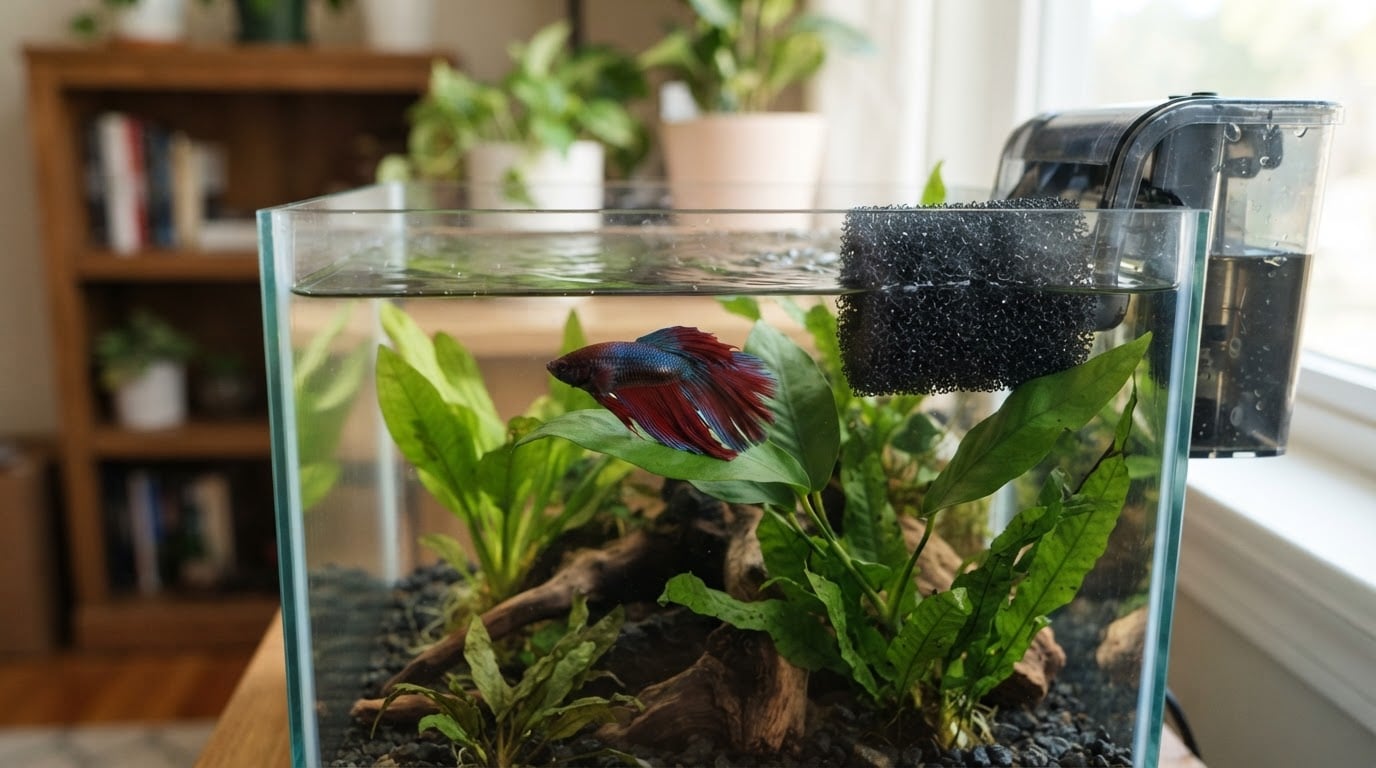
Judge the result by behaviour, not by numbers. A comfortable betta cruises the whole tank, including under the outflow, and rests on leaves or the bottom without being nudged. A betta that hides in a corner, flares at the glass, or swims constantly to hold position is telling you the flow is still too strong.
Keep media you can reuse
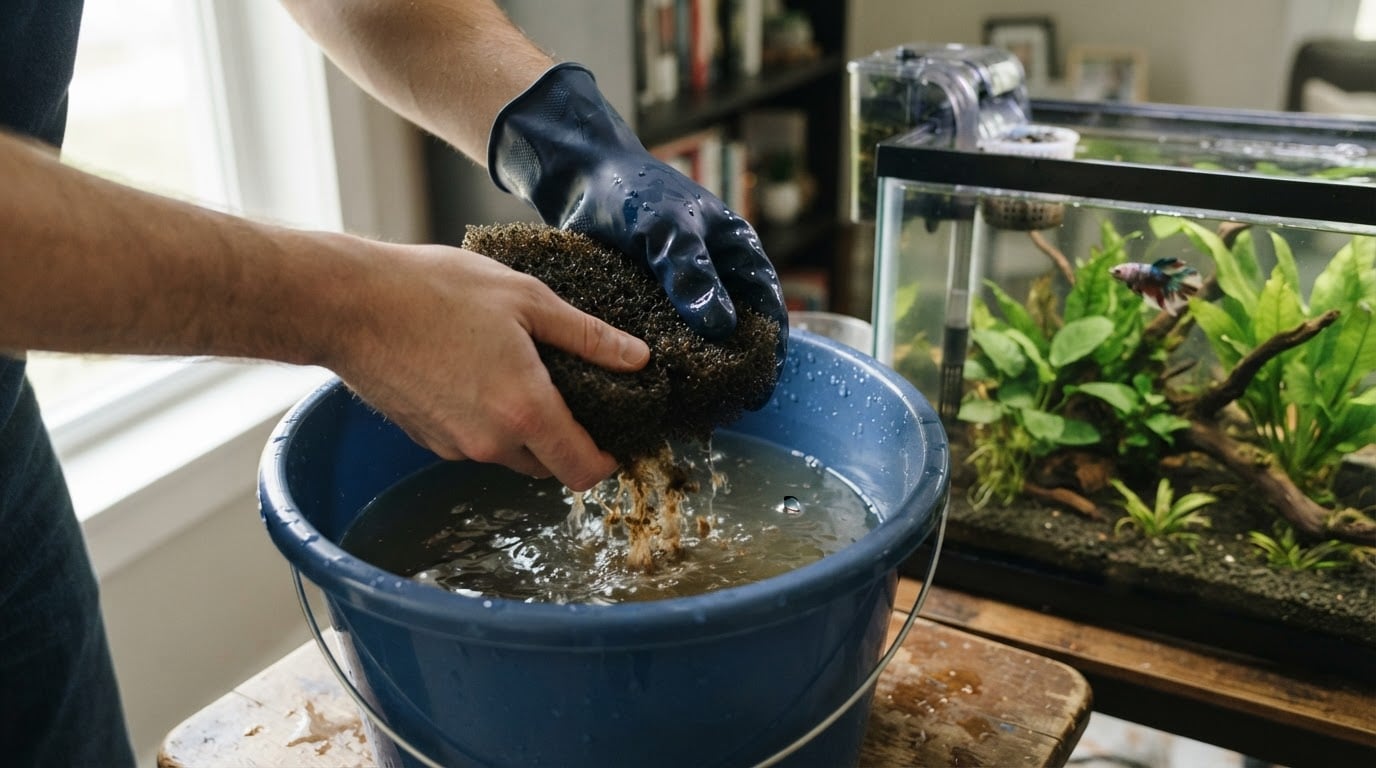
Layer coarse sponge first, then ceramic rings or bio-balls, and leave it alone. Rinse the sponge in the bucket of old tank water during a water change — never under the tap, where chlorine and chloramine kill the bacteria you spent weeks growing. Replace media only when it's falling apart, and never all of it at once.
A worked example: a 5-gallon desk tank
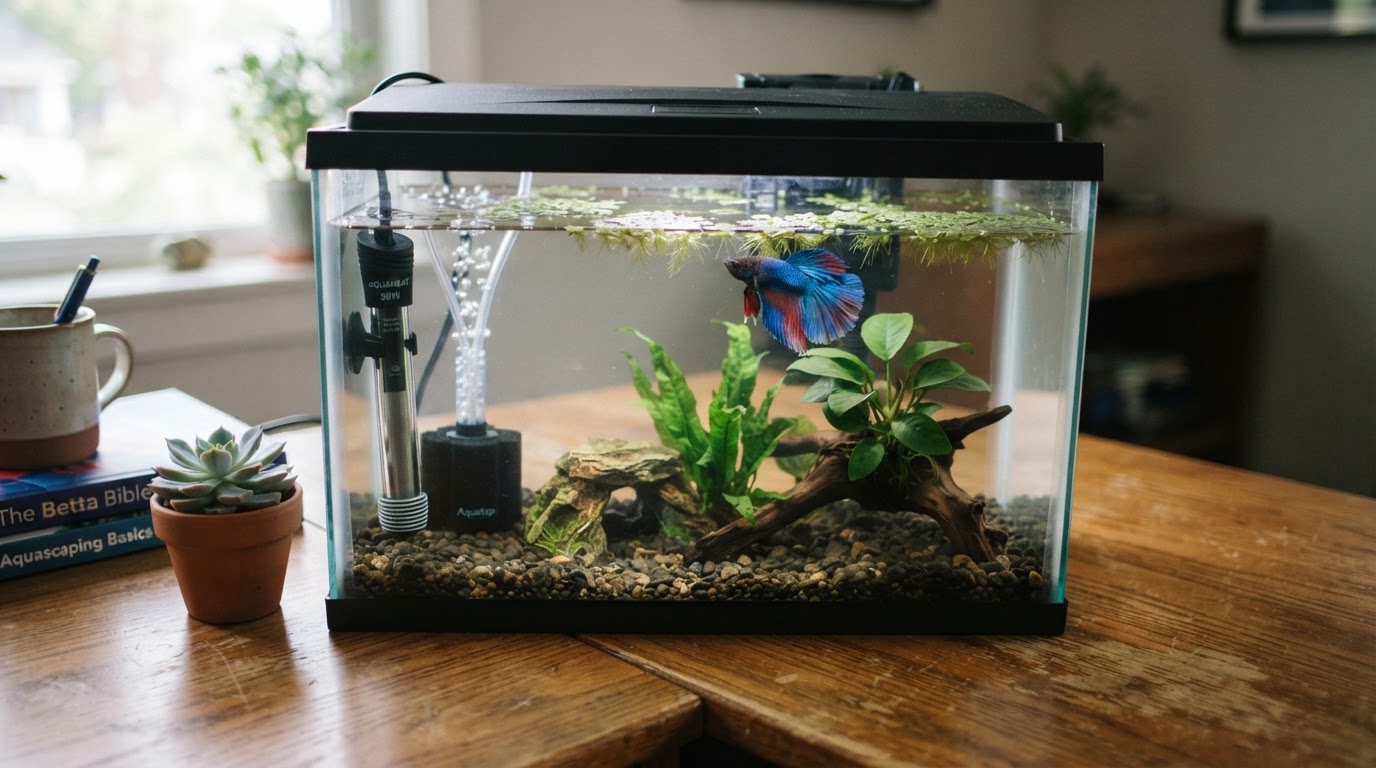
Say you have a 5-gallon (19 L) tank on a desk. Add a small heater set to 78-80°F (26-27°C), a lid with a feeding hatch, and either an air-driven sponge filter with a valve on the air line or a small hang-on-back with a pre-filter sponge over the intake and a baffle on the outflow. For decor, give the fish a broad-leafed plant or a resting ledge near the surface plus a cave or a piece of driftwood. Cycle it with an ammonia source for several weeks, add one betta, hold the temperature steady, and change 25-30% of the water weekly. Nothing else is required.
Setting it up so the filter keeps working
- Place the tank on a level surface, out of direct sun and away from heating vents, with room behind it for the filter and a socket you can reach without unplugging everything.
- Rinse everything — tank, gravel, decor, media — in warm water. No soap, ever. Residue harms fish and bacteria alike.
- Fill, dechlorinate, and heat. Set the heater to 78-80°F (26-27°C) and let the tank run overnight so the temperature settles before any fish goes in.
- Start the filter and fix the flow. Baffle, throttle, or reposition it now, while the tank is empty and you can see exactly what the current is doing.
- Cycle the tank. Add an ammonia source, or seed the filter with media from an established tank, and wait. Ammonia and nitrite should both read zero and nitrate should be present before you stock. That usually takes weeks, not days; a filter that is running is not the same as a filter that is cycled.
- Add the betta, then stop. One fish, no tank mates, for at least a month. Let the bacteria catch up with the bioload you just introduced.
- Test and change water weekly at first. A 25-30% water change removes nitrate and replenishes minerals. The filter never does that job for you.
Mistakes that undo a good filter
- Following the cartridge replacement schedule. You're throwing out the bacteria along with the floss. Rinse reusable media instead.
- Rinsing media under the tap. Chlorinated water sterilizes it in seconds.
- Switching the filter off at night or at feeding time. The bacteria need flowing, oxygenated water; when the pump stops, the colony suffers and ammonia builds.
- Choosing by the tank rating instead of the flow. A filter rated for 20 gallons can still be miserable in a 5-gallon betta tank.
- Treating the filter as a replacement for water changes. It converts ammonia. It doesn't remove nitrate, and it doesn't restore minerals.
- Buying a tiny built-in kit because the box says "betta." Small volume, fixed flow, and cartridges are three problems in one purchase.
- Adding tank mates to "use up" the filter capacity. More fish means more waste. Add them only when the tank is large, the filter is mature, and the extra bioload is planned for.
Common follow-up questions
How many gallons does a betta need with a filter?
Five gallons (19 L) is the practical minimum for a single betta in a filtered, heated tank; ten gallons (38 L) is better because temperature and water chemistry move more slowly and you have room for a filter with adjustable flow. A filter doesn't make a small volume behave like a large one — it processes waste, while dilution and stability still come from water volume.
Can a betta live in a 1- or 2.5-gallon filtered tank?
It can survive, but you're making daily maintenance the thing that keeps it alive. Small volumes swing in temperature, foul quickly, and the filters built into those kits are often too strong for the fish to be comfortable. If you already own one, run a gentle sponge filter or baffle the outflow, hold the temperature steady, and change part of the water more often. If you're buying new, put the difference into a 5-gallon.
What flow rate is too strong for a betta?
The printed gallons-per-hour rating won't tell you. Judge it in the tank: if the betta can rest on a leaf, cruise the whole tank, and eat at the surface without being pushed, the flow is fine. If it holds position against the glass, hides behind the filter, or flares constantly, throttle the flow or add a baffle. Stress shows up long before damage does.
Do I still need water changes if the filter is running?
Yes. The bacteria convert ammonia into nitrite and then nitrate, and nitrate keeps accumulating until a water change removes it. In a small betta tank, plan on 25-30% a week, adjusted for how heavily you feed and stock. Fresh water also returns the minerals that the fish and any plants consume.
Can I turn the filter off at night?
No. Nitrifying bacteria need oxygen and flow, so a filter that stops overnight slowly suffocates its own colony. If noise is the problem, fix the noise — a sponge filter on a quiet air pump, a seating impeller, or foam under the pump — instead of switching the pump off.
Can I add tank mates once the filter is established?
Once the tank is 10 gallons (38 L) or more and the filter is mature, yes — but stocking is a bioload decision before it's a compatibility decision, and both come before the fun part. Every new fish adds waste that the bacteria have to catch up with, so quarantine arrivals, add them one at a time, and check ammonia and nitrite for a week afterwards. A betta alone in a well-filtered tank is a perfectly good endpoint; you don't owe anyone a community tank.