The short answer
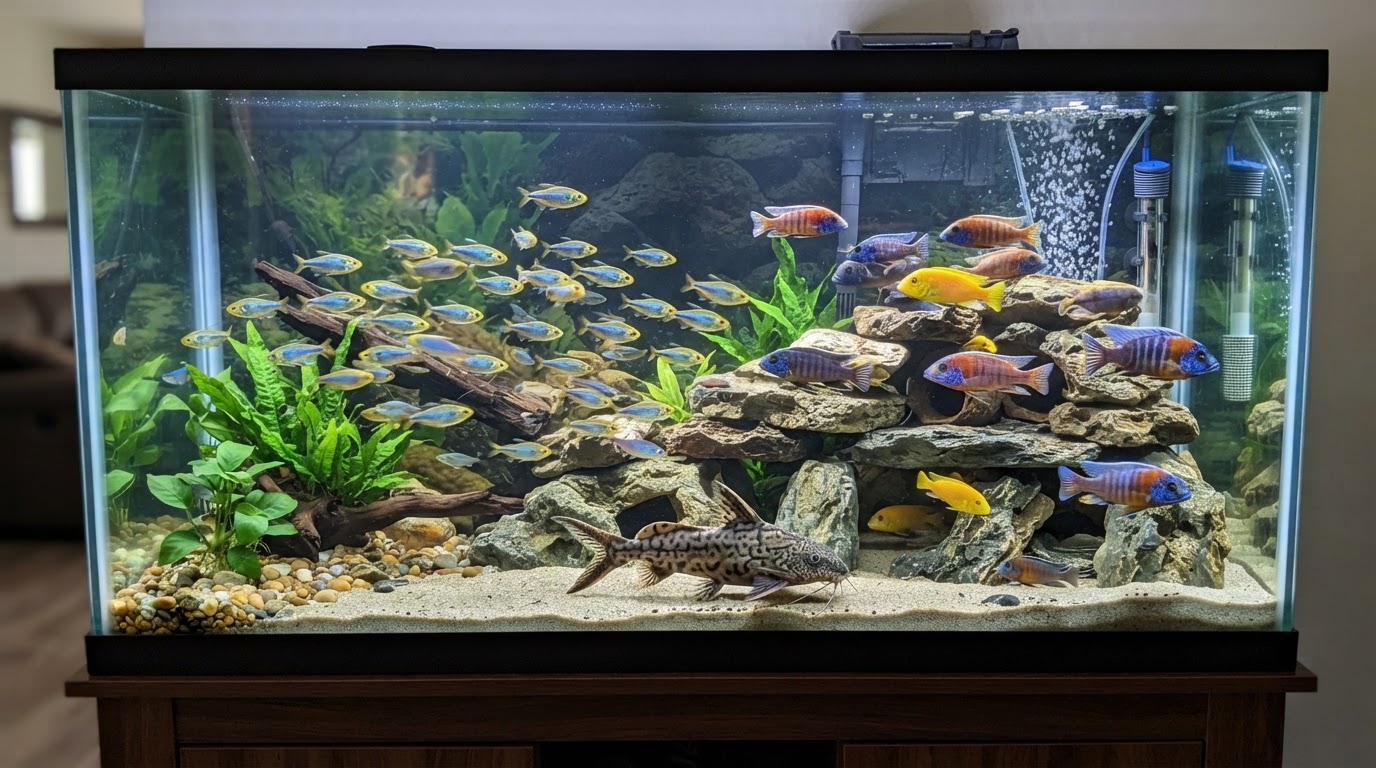
The most dependable cichlid tank mates are fish that share the cichlid's water chemistry, are too big to swallow, and use a different part of the tank. For African rift-lake cichlids that usually means Synodontis catfish, bristlenose plecos, and fast midwater schooling fish. For South American cichlids it usually means medium-bodied tetras, pencilfish, hatchetfish, Corydoras, and bristlenose plecos again.
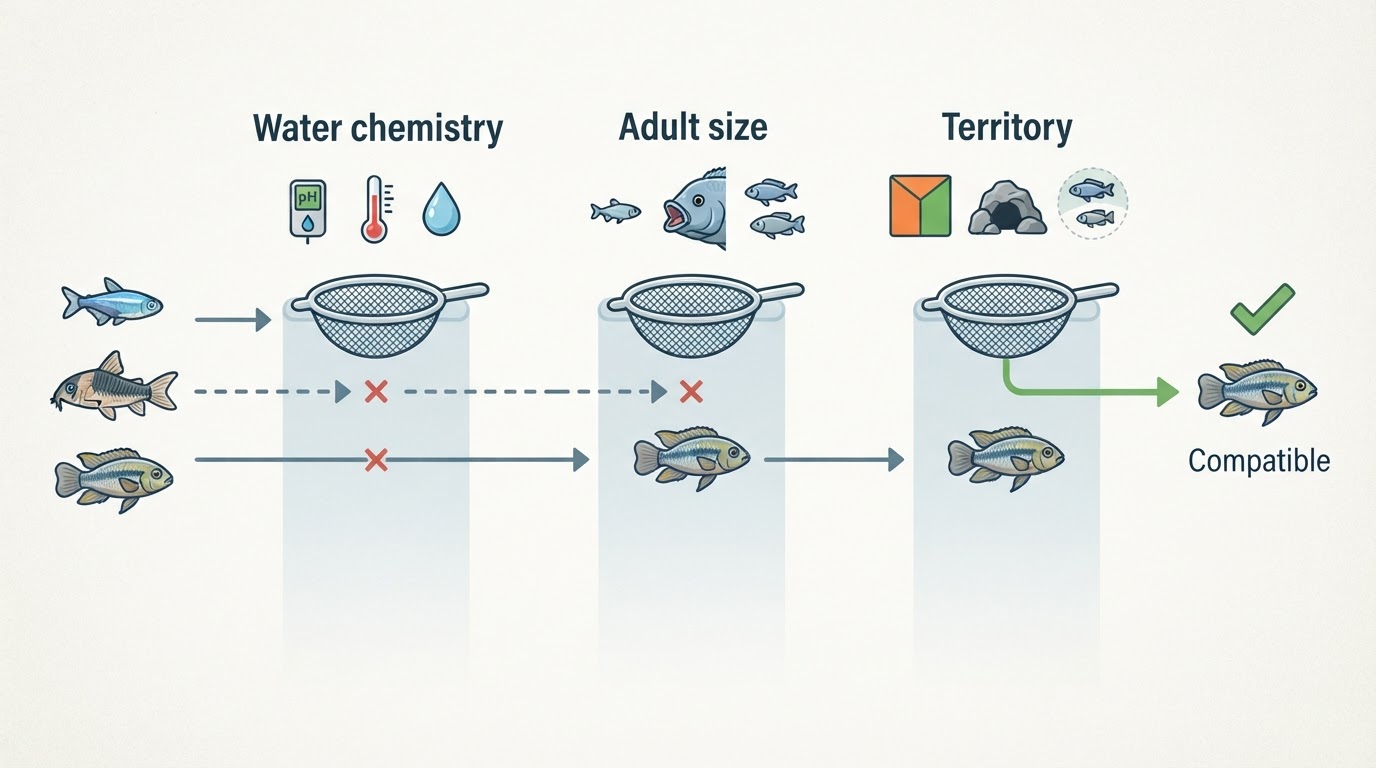
Cichlids are not one kind of fish with one set of needs. An mbuna from Lake Malawi and a discus from the Amazon sit at opposite ends of the water-chemistry scale, and a tank-mate list that ignores that difference is really a list of fish that will not thrive. Match the water first, then the size, then the territory — and the peaceful-looking fish at the store becomes a workable tank plan.
Key answers at a glance
Question | Short answer |
|---|---|
What are the best cichlid tank mates? | Synodontis catfish, bristlenose plecos, larger rainbowfish, and sturdy loaches for African cichlids; medium-bodied tetras, pencilfish, hatchetfish, and Corydoras for South American cichlids. |
Can cichlids live with tetras? | Yes with mild-mouthed cichlids such as discus and rams, or with medium-bodied tetras; neon-size fish in a tank with an adult angelfish, oscar, or jack dempsey usually become food. |
Can cichlids live with goldfish? | No. Goldfish are cool-water fish with a heavy waste load, and a goldfish kept warm in a cichlid tank is stressed on both counts. |
Can cichlids live with a pleco? | Yes with a bristlenose-sized pleco that has its own cave; a common pleco outgrows most tanks and adds a lot of waste for very little cleaning. |
Do cichlids eat shrimp and snails? | Most will eat or harass small shrimp; larger hard-shelled snails tend to survive better than soft-shelled ones. |
Can I mix African and South American cichlids? | Rarely. Their water requirements pull in opposite directions, so at least one group is always living in the wrong water. |
Can cichlids live with Corydoras? | With South American cichlids, usually yes — the catfish are armored, bottom-dwelling, and out of the midwater territories. |
Match the water before you match the fish
African rift-lake cichlids want hard, alkaline water, while most South American cichlids want soft, neutral-to-acidic water — a tank mate from the wrong side of that line will struggle even when nobody is chasing anybody.
Mbuna, peacocks, haps, and most Tanganyikan species come from mineral-rich lakes where the water is hard and stays above neutral, and they are active, oxygen-hungry swimmers. Angelfish, discus, rams, and severums come from softer, often acidic water, with discus wanting the warmest, calmest conditions of the group. Central American cichlids such as firemouths and convicts sit somewhere in the middle and are more forgiving, but "more forgiving" is not the same as "will thrive anywhere."
The word "African" is not a shortcut, either. Kribensis and other West African cichlids want soft, slightly acidic water, so geography alone will not tell you which list to read. What actually matters is the water the fish evolved in: hardness, pH, temperature, and flow. A store label that says "community fish" says nothing about any of them.
Tank mates that work with African cichlids
Synodontis catfish, bristlenose plecos, larger rainbowfish, and sturdy loaches are the most dependable companions for mbuna, peacocks, and haps — as long as the tank is roomy enough for a full-grown group.
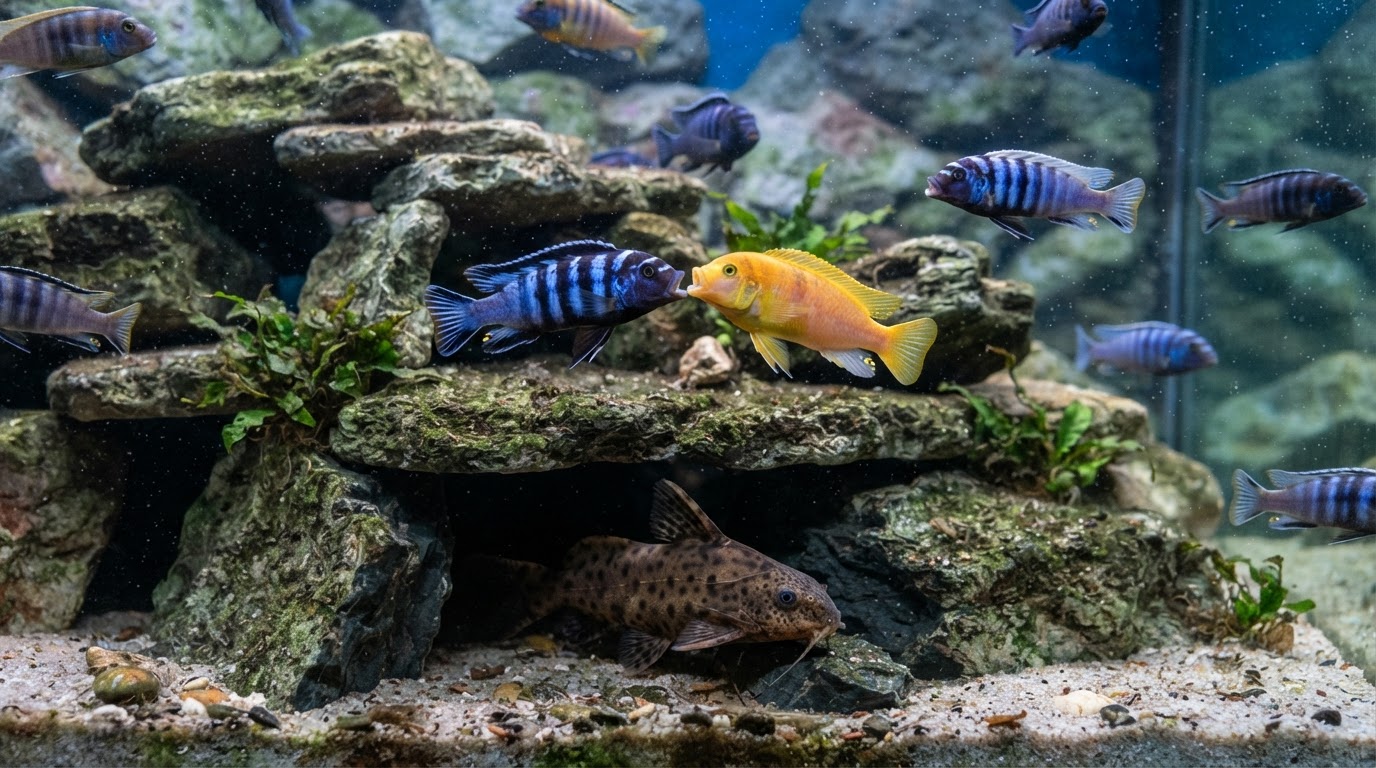
- Synodontis catfish. Armored, mostly nocturnal bottom-feeders from the same lakes. They do not compete for rock territories, they can absorb the occasional bump, and they spend the day out of the way. This is the closest thing the African cichlid world has to a default tank mate.
- Bristlenose plecos. Small enough to stay out of the argument, comfortable in mineral-rich water, and genuinely useful on algae and leftover food. Give each fish its own cave or piece of driftwood so it has somewhere to retreat.
- Larger rainbowfish. Fast, midwater schoolers that are too quick to bully and too big for most mbuna and peacocks to swallow. They suit the open-water species better than the rock-dwelling ones, and they need a group and a long tank.
- Giant danios. A classic dither fish for haps and other open-water cichlids. Their constant movement gives shy cichlids the confidence to stay visible instead of hiding.
- Loaches. Yoyo and clown loaches are tough and bottom-oriented, and they are sometimes kept with African cichlids, but they prefer softer water. Treat that as a compromise you accept, not a recommendation.
One more thing that matters more than any of these: keep the cichlids themselves in the right numbers and sex ratios. In most African cichlid tanks, the worst aggression problem is another cichlid, not a tank mate.
Tank mates that work with South American cichlids
For angelfish, discus, rams, and severums, the safest tank mates are schooling fish that stay out of the midwater territories: medium-bodied tetras, pencilfish, hatchetfish, Corydoras, and bristlenose plecos.
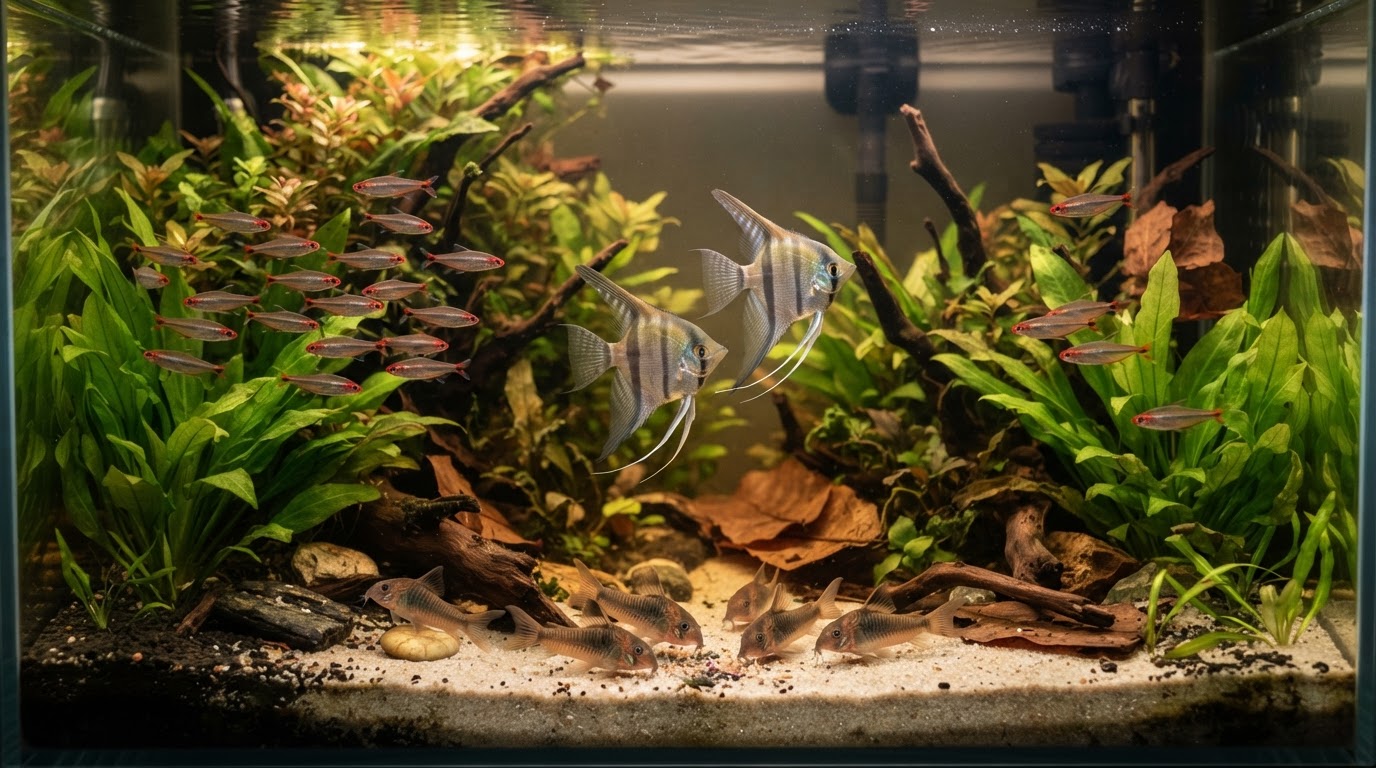
- Tetras. Cardinal and rummy-nose tetras are the classic discus companions, and medium-bodied species such as bleeding heart or black phantom tetras suit angelfish and rams. Keep them in a proper group so the schooling instinct does its work.
- Pencilfish and hatchetfish. Calm, soft-water fish that stay near the surface or among the plants, well away from the space a cichlid claims.
- Corydoras. Armored bottom-feeders that share the same warm, soft water and rarely clash with rams or angelfish. Like tetras, they do best in a group.
- Bristlenose plecos. The same cave-dwelling algae eater, and an even better fit for soft water.
- Silver dollars. A large, fast schooling fish for a big tank with big cichlids such as severums. They eat plants, so choose floating or tough-leaved species if you keep them.
The size gap is what makes or breaks this list. A cardinal tetra with a discus is a tank mate; the same fish with an adult oscar or jack dempsey is lunch. Breeding pairs change the math again, because a cichlid guarding eggs will claim far more space than usual and drive off fish it normally ignores.
Combinations that usually fail — and why
The pairings that fail most often are goldfish, tiny schooling fish, ornamental shrimp, small snails, and a second fish that wants the same territory — and each one fails for a predictable reason.
- Goldfish. They are cool-water fish with a large appetite and a heavy waste load. Warm cichlid water and their preferred temperature do not overlap, and fancy goldfish with long fins tend to get nipped.
- Neon-size fish with large cichlids. The rule is the mouth, not the species list. If a fish fits in the cichlid's mouth, it eventually will.
- Shrimp and small snails. Same rule. A cleanup crew that doubles as food is not a cleanup crew.
- African cichlids and South American cichlids in the same tank. You can keep either group healthy, but not both at once in the same water. One side always gets the wrong hardness, pH, or temperature.
- A second territorial species in the same zone. Two males of the same species is the fastest route to a dead fish. Two different species that want the same cave, the same corner, or the same patch of substrate usually end the same way, especially in a smaller tank.
- Large plecos as "cleanup crew". A common pleco grows big, produces a lot of waste, and eats algae and leftover food rather than fish waste. There are also repeated reports of large plecos attaching to slow, flat-bodied fish such as discus and angelfish, which is one more reason to keep the small species instead.
- Predatory tank-busters. An oscar, a big Central American cichlid, or a large predatory catfish will treat anything smaller than itself as food. These fish are best kept as the largest animal in a carefully chosen tank.
There is a real trade-off hiding in this list. The busier the tank, the more each fish spends on navigation and the less margin there is for error. If your priority is the widest possible tank-mate list, choose the mildest cichlid you can house properly and give the community as much space as you can. If your priority is the cichlid itself in top condition, a species-only tank with one or two compatible catfish is often the calmer, easier answer.
How to add cichlid tank mates without starting a war
Add the new fish before the cichlids when you can, add them in groups rather than one at a time, and move the rockwork around so the old territories stop existing.
- Quarantine every arrival. Keep new fish in a separate tank for a few weeks first. A cichlid tank is an expensive place to treat an infection, and the newcomer is the usual source.
- Let the peaceful fish settle first. Dither fish and bottom-feeders do better when they know the tank before the cichlids claim it. If you cannot add them first, add everyone on the same day.
- Rearrange the aquascape. Territory is learned, not inherent. Moving rocks and decor when you add fish forces every established fish to renegotiate at the same time.
- Introduce a group, not an individual. One new fish is a target; a school of new fish is part of the landscape. This applies most strongly to dither fish such as danios or rainbowfish.
- Feed at the same time, with the lights down. It redirects attention to food and takes the edge off the first hour.
- Watch the first few days closely. Occasional pushing is normal while the hierarchy settles. Torn fins, a fish pinned in a corner, or a fish that stops eating are not — have a spare tank or a divider ready before you need one.
If you would rather start from a curated list, Sea Life Planet's compatibility guides follow the same principle: they cover the combinations that don't work, not just the ones that do.
First-level category landing for freshwater fish: H1 and intro for freshwater care guides and tank setup.
Follow-up questions, grouped by intent
Mixing and compatibility
Can two different cichlid species live together? Usually yes, if they come from compatible water and claim different parts of the tank. The failure case is two fish of the same size, shape, and color competing for the same territory — especially two males of the same species.
Can cichlids live with tetras? Yes, when the cichlid is mild-mouthed and the tetras are medium-bodied and kept in a group. No, when a small tetra shares a tank with a large predatory cichlid.
Can cichlids live with Corydoras? With South American cichlids, yes. With large Central American cichlids, the catfish are usually too small to be safe for long.
Can cichlids live with a pleco? A bristlenose pleco with its own cave, yes. A common pleco, no — the size, waste, and reported behavior problems outweigh the algae cleaning.
Behavior and aggression
Why is my cichlid chasing everything? Because the tank is reading as its territory. Space, sight lines, sex ratio, and tank depth are the four levers that change it.
Do tank mates reduce cichlid aggression? Dither fish can make a shy cichlid bolder and more visible, but they do not remove territorial behavior. They change the atmosphere, not the instinct.
Can a cichlid live alone? Yes. A single cichlid, or a cichlid with one compatible catfish, is a valid and often calmer setup — and it is a much better outcome than a community tank that never settles.
Setup and stocking
How many tank mates can I add? Build the list from adult size, not store size. Every fish in the plan will grow, and the tank has to hold the adult versions of all of them at once.
Does aquascaping change compatibility? Yes. Broken sight lines, separate caves, and clearly divided zones reduce the number of disputes before they start.
Should tank mates go in before or after the cichlids? Before, if you are planning ahead. After is workable when you rearrange the rockwork and add the new fish in a group.
The short version: pick the water first, keep the mouth-size rule in mind, and give every fish a job in a different part of the tank. Do that and most cichlid tank mates work. Skip it and even the "easy" combinations turn into a running fight.