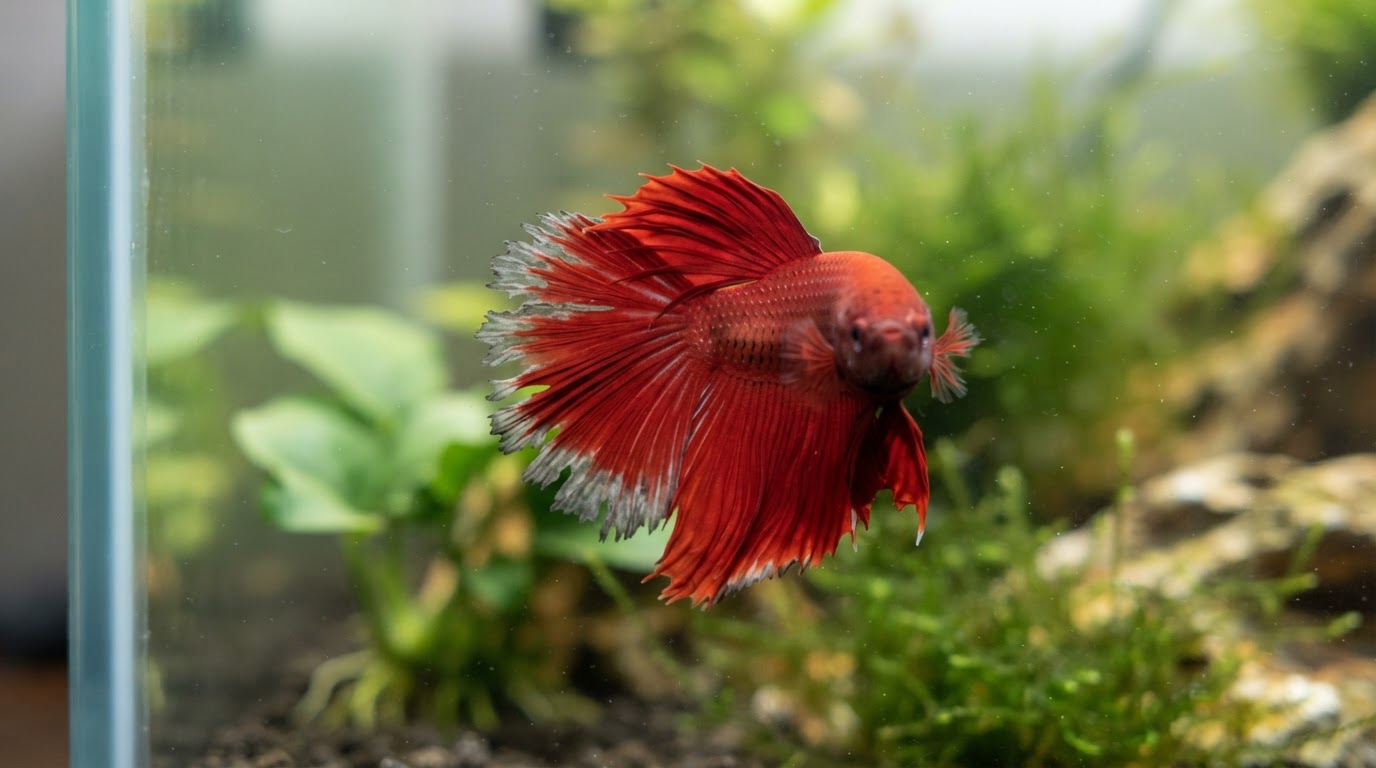
The Short Answer: 5 Gallons, Heated and Filtered
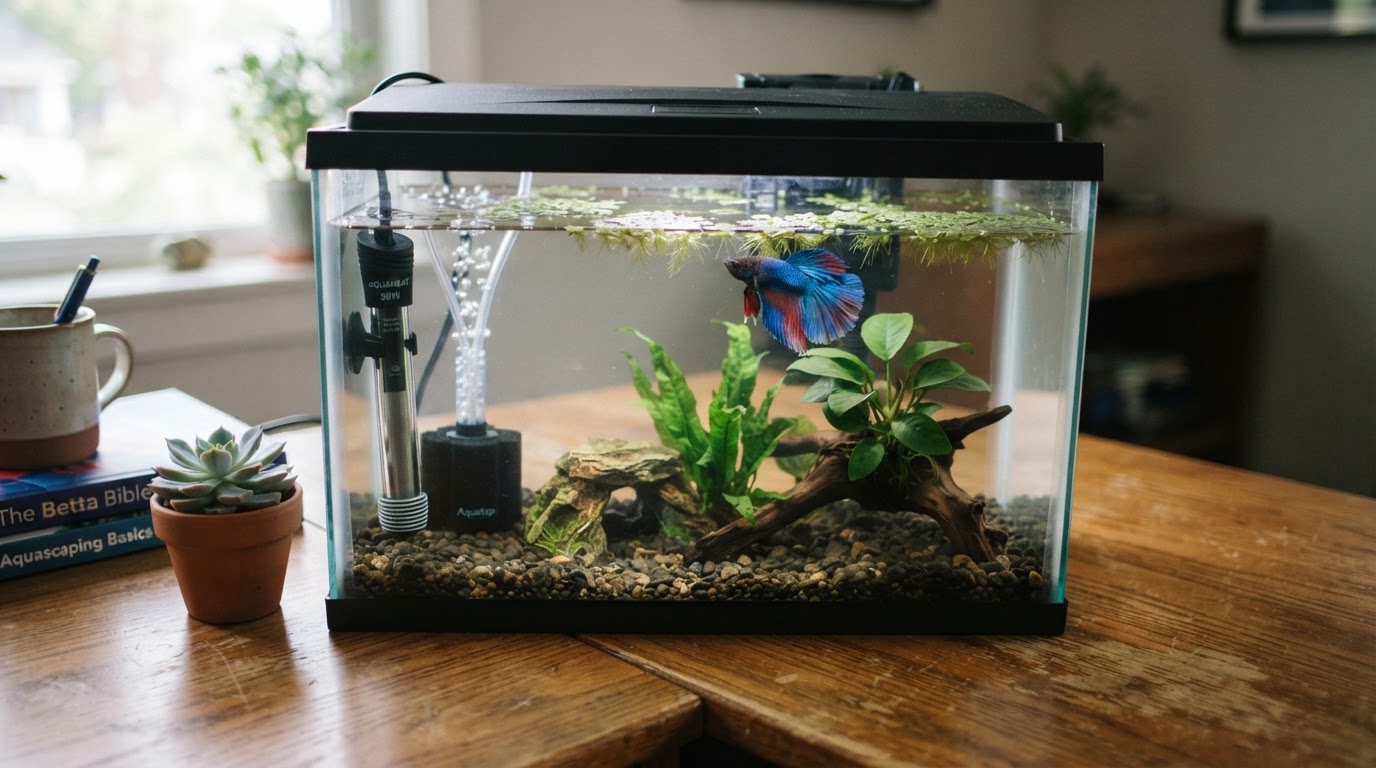
Plan for 5 gallons (19 L) with a filter and an adjustable heater. It isn't a luxury size, and it isn't about giving one small fish room to sprint. It's the smallest volume where the equipment a betta actually needs fits without fighting the tank.
At 5 gallons you can run a heater you can set, a filter you can turn down, a lid, and a plant or two, and still get water that behaves predictably between water changes. Below that you aren't keeping a smaller aquarium. You're keeping a more fragile one, and fragility is what shortens the life of a fish that should live for years.
Where the Baseline Comes From
Sea Life Planet's betta care guide lists 5 gallons (19 L), heated and filtered, as its minimum tank size for Betta splendens, alongside a temperature range of 76-82°F (24-28°C). Its Quick Facts panel lays the whole profile out in one block — scientific name, care level, minimum tank size, temperament, diet, water temperature, max size and lifespan — so you can hold a fish's requirements next to a specific tank before you commit to either.
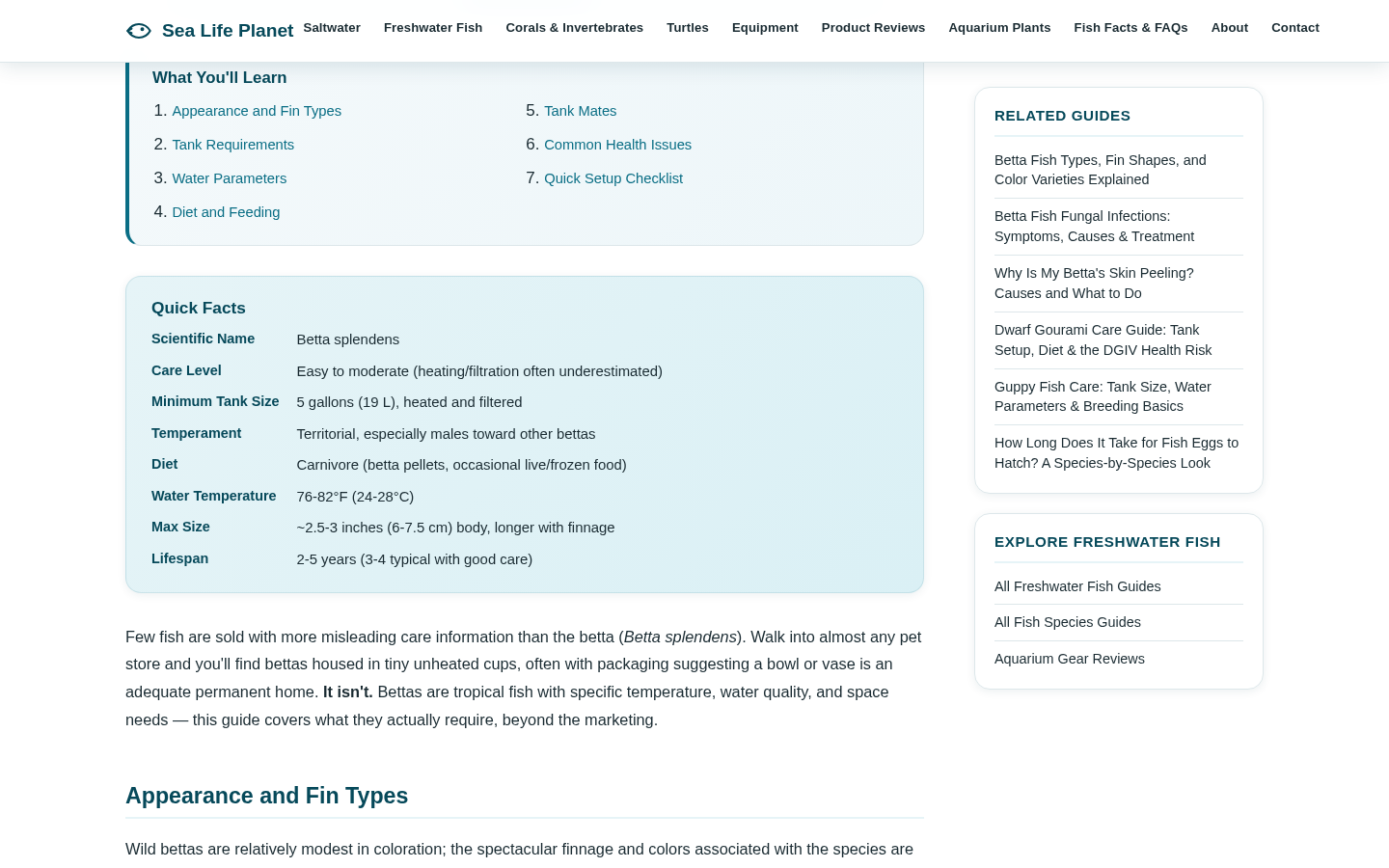
Flagship species guide framed mid-page: 'What You'll Learn' TOC edge above, full Quick Facts definition panel (Scientific Name, Care Level, Minimum Tank Size, Temperament, Diet, Wa
The same guide's water-parameter table gives you the targets to aim at: pH 6.5-7.5, ammonia and nitrite at 0 ppm, nitrate under 20 ppm, and 2-15 dGH. All of that is reachable in a 5-gallon tank. In a half-gallon bowl it's a full-time job with no days off.
Why Volume Matters: Stability, Not Swimming Space
Bettas don't patrol long distances the way a school of tetras does. A single male works a small territory and spends much of the day near the surface and along the edges of it. So the gallons aren't really about exercise — they're a buffer, and that buffer is doing four jobs at once.
The first is dilution. Waste and uneaten food break down into ammonia; more water spreads the same amount of waste thinner, so a small slip stays a small slip.
The second is temperature. A heater has to fight the room to hold 76-82°F (24-28°C). A larger body of water loses heat more slowly, so the heater cycles less and the temperature swings less — and temperature swings are behind a lot of the stress that shows up as illness in this species.
The third is flow. A gentle current is easier to arrange in a tank that doesn't need a powerful pump, and that matters most for long-finned bettas: a halfmoon or veiltail has to drag those fins everywhere it goes, while a plakat handles more movement without tiring.
The fourth is surface access. Bettas are labyrinth fish — they gulp air above the water line, not only oxygen from the water. A bigger footprint gives you more open surface, and a lid with a small air gap keeps the air above it warm and humid instead of cold and dry.
Choosing Between 5, 10, and 20 Gallons
All three sizes can work. They fail in different ways, so pick the one that fits your space and your habits rather than the one with the best-sounding number.
Setup | What you gain | What gets harder |
|---|---|---|
5 gallons (19 L) | The baseline: heater, small filter, lid, a plant or two, one betta. | Almost no margin. A missed water change or a dead snail shows up in the test kit fast. |
10 gallons | More dilution, more room for equipment, easier to hold temperature steady. | Takes noticeably more space, and it still holds one betta's territory. |
20 gallons (long) | The most stable of the three. Waste and temperature move slowly, so small mistakes stay small. | Heavier, so it needs a real stand, and every water change is more water to carry. |
Two dimensions matter more than the number on the label. Length and width beat height: a long, shallow tank gives a betta more surface area and more horizontal territory, while a tall, narrow column gives you fewer useful places to put equipment. Then measure the spot before you buy anything — tank, stand, filter and lid all have to fit, and a full tank weighs far more than the empty box suggests.
If you already own something smaller than 5 gallons, don't panic. Plan an upgrade when you can, and until then test more often, keep a spare heater, and treat every water change as non-negotiable.
Bowls, Cups, and the "They Live in Puddles" Argument
You've probably heard that bettas live in puddles, so a bowl will do. It won't.
The puddle story has a real root: these fish come from shallow, slow-moving water in Southeast Asia, and they can survive a shrinking pool for a while. Surviving is exactly the standard we're trying to avoid. A cup has no room for a heater, no space for a filter, and no buffer for anything that goes wrong overnight. A plant dies, food goes uneaten, the room warms up — in a bowl, each of those is an emergency. In a 5-gallon tank, each of those is a reading you correct at the next water change.
If there's a bowl or a 1-gallon tank in your cupboard, give it a better job. It makes a usable hospital or quarantine tank for watching a new arrival closely before it joins the main setup.
The Equipment That Makes the Size Work
The tank alone doesn't decide the outcome. Plan for these from the start:
- An adjustable heater sized for the tank, plus a separate thermometer. Trust the thermometer, not the dial.
- A filter with slow, adjustable flow. A sponge filter or a baffled outlet tames the current for long-finned fish.
- A lid with a small air gap. Bettas jump, and an open top also loses heat quickly.
- A liquid test kit for pH, ammonia, nitrite and nitrate. Old test strips will mislead you.
- A light on a timer if you keep plants, and a siphon for water changes.
None of that is exotic, and none of it is optional if you want the tank to hold the numbers in the species guide instead of drifting away from them.
Mistakes That Undo a Good Tank Size
Buying the tank before measuring the space is the classic one. A tank without a flat, supported, correctly sized spot becomes a problem you own.
Second: adding the fish before the filter has cycled. The finish line is ammonia and nitrite both reading 0 ppm — not a clear-looking tank.
Third: judging by gallons alone while ignoring dimensions and flow. A tall 10-gallon can be a worse betta home than a long 5-gallon.
Fourth: over-cleaning. Rinsing filter media under tap water kills the bacteria you spent weeks growing. Rinse it in tank water, gently.
Fifth: chasing an exact pH number with chemicals. Stability does more for a betta than hitting 7.0 for an afternoon.
Sixth: leaving the lid off and then finding the fish on the floor.
Seventh: treating a bigger tank as permission to add tank mates the fish shouldn't live with. Size and compatibility are different questions.
What to Do Next
- Measure the spot, including the stand and the headroom you need for the lid.
- Choose 5 gallons or larger, with a heater and filter, and set it up before shopping for the fish.
- Cycle the tank. Don't add a betta until ammonia and nitrite both read 0 ppm.
- Hold the range once the fish is in: 76-82°F (24-28°C), ammonia and nitrite at 0 ppm, nitrate under 20 ppm, pH 6.5-7.5.
- Keep a water-change rhythm you can actually sustain. The smaller the volume, the more often it has to happen.
Frequently Asked Questions
Is a 2.5-gallon tank too small for a betta?
Our baseline is 5 gallons (19 L), so 2.5 gallons is working below it. An experienced keeper with a heater, a filter and a strict testing routine can make a 2.5-gallon work for one betta. A first tank is a different question: the smaller the volume, the less room you have for a missed water change, a heater hiccup or a power cut — and a beginner is exactly the person who needs that room.
Can a betta live in a bowl or a vase?
It can survive in one for a while, which is why bowls keep selling. It can't be heated properly, can't be filtered properly, and can't absorb a mistake. Treat a bowl as a holding container, not a habitat.
Does a bigger tank mean more maintenance?
Usually less. More water dilutes waste and holds temperature, so you spend less time reacting and more time on a routine. The real trade is space and weight: more water to carry on change day and a sturdier stand to hold it.
How many bettas can one tank hold?
One male per tank, always — two males will fight, and that's true even in a large aquarium. Female groups are their own project with their own risks and aren't a first-tank setup. A single betta in a properly sized tank is a complete aquarium, not a compromise.