Why Tap Water Needs Treating Before It Reaches a Betta
Municipal water is disinfected with chlorine, chloramine, or both, and those chemicals do exactly what they are meant to do: keep drinking water safe for people by killing things that live in water. A betta is one of those things. At aquarium concentrations, chlorine and chloramine damage gill tissue, irritate the slime coat, and leave a fish breathing hard at the surface or sitting on the bottom.
A betta's labyrinth organ lets it gulp air, which is why it can survive water that would suffocate most fish. That trick does nothing for the gills still passing treated water across their surface, and nothing for the skin.
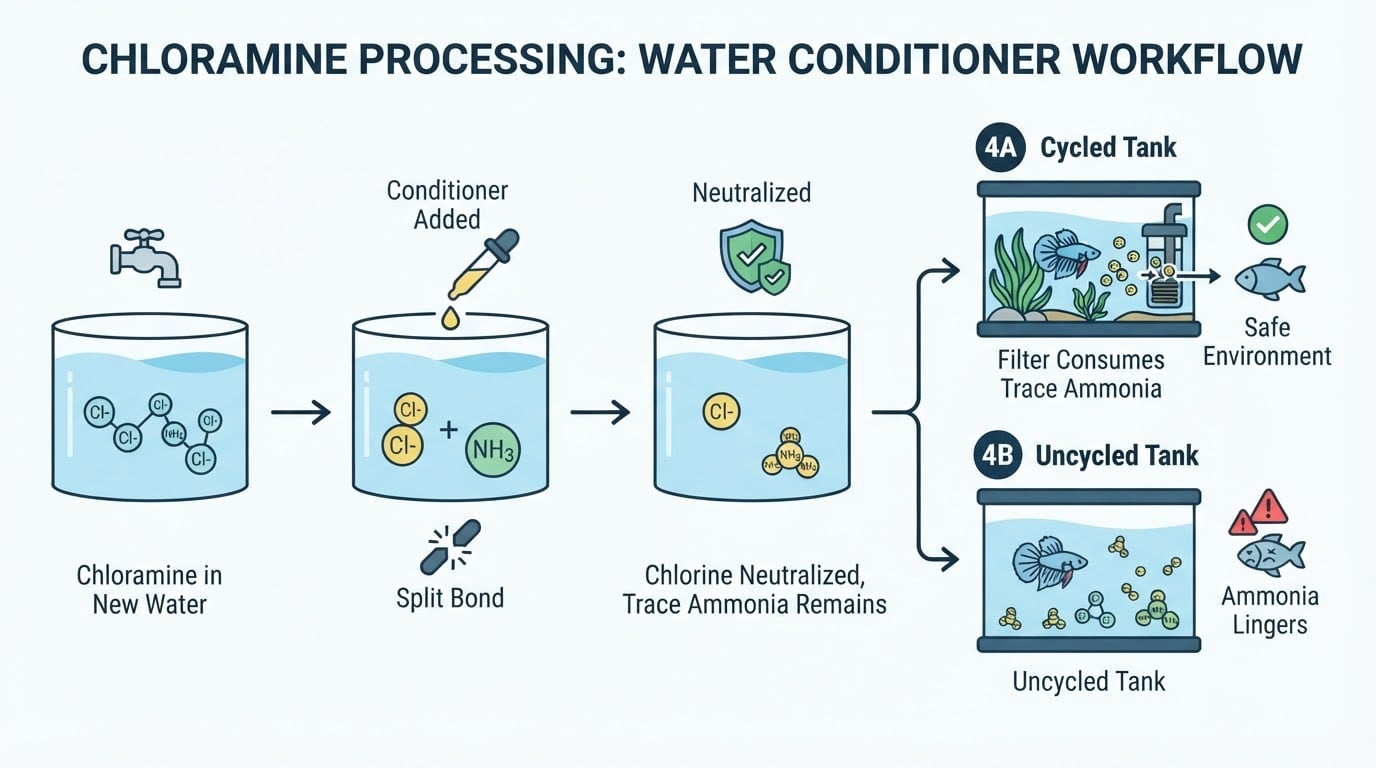
A water conditioner closes that gap. The working ingredient in most dechlorinators reduces free chlorine to chloride, which is harmless at tank concentrations, and formulas built for chloramine split the chlorine-ammonia bond so the chlorine can be neutralized. Many also bind copper and other metals that can leach from household plumbing. That is the core job. Everything else printed on the bottle is an extra.
Chlorine and Chloramine Are Not the Same Problem
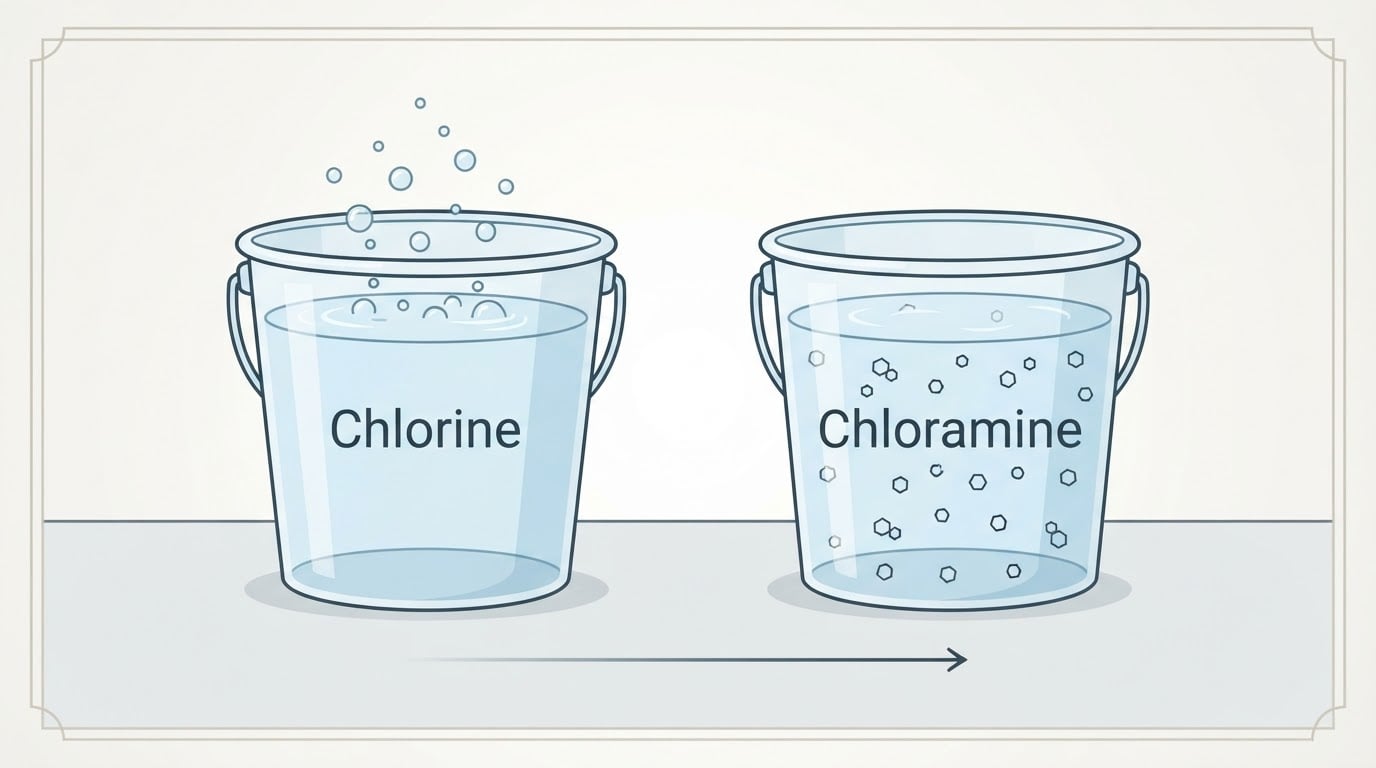
Both disinfectants are added at the treatment plant, but they behave differently in a bucket, and that difference decides how you treat your water.
Chlorine is a dissolved gas. Left standing with some surface movement, it will leave the water on its own over a day or so. That is where the old advice about "aging" tap water comes from, and for chlorine it still works.
Chloramine is chlorine chemically bound to ammonia. The bond makes it far more stable, which is exactly why water suppliers use it: chloramine stays active all the way through the pipes to your tap, and it stays active in your bucket. Standing water, an air stone, and a night on the counter do not reliably clear it.
So the old advice is half right. Chlorine will leave on its own. Chloramine will not.
You do not have to guess which one you have. Water suppliers publish an annual water quality report that names the disinfectant they use, and the treatment section is usually a page at most. Find your supplier's report, check that one word, and buy accordingly.
How to Choose a Water Conditioner for a Betta Tank
Choosing a water conditioner for betta fish comes down to two things: what your supply uses and how much water you change at a time. The word "betta" on the label tells you who the bottle is aimed at, not what the product does. Judge it on these points instead:
- It covers both chlorine and chloramine. If the label only promises to neutralize chlorine and your water uses chloramine, it is the wrong bottle.
- The dose suits the volume you actually change. A product measured in drops per gallon is easy to dose into a five-gallon bucket. A product measured by the capful for large systems is easy to mis-dose on a small water change.
- You know what the extras are. Many formulas also bind heavy metals such as copper. Others add aloe, herbal extracts, or a "slime coat" ingredient. Those additions are optional; they are not the part that dechlorinates.
- Liquid or powder. Liquid is easier to measure accurately in small volumes. Powder suits large water-change barrels and long-term storage.
- It is genuinely a conditioner. Bottles sold as bacteria starters, "cycle" products, or water clarifiers do different jobs. A bacterial supplement does not dechlorinate, even though a new tank usually needs both.
- It leaves parameters alone. A conditioner removes disinfectants; it does not set hardness, KH, or pH. If your tap water is very hard or your pH is high, that is a separate problem with separate solutions.
How to Dose and Add Treated Water Correctly
Dosing errors cause more harm than most people expect, and they are easy to avoid once you know what volume a dose is meant to treat.
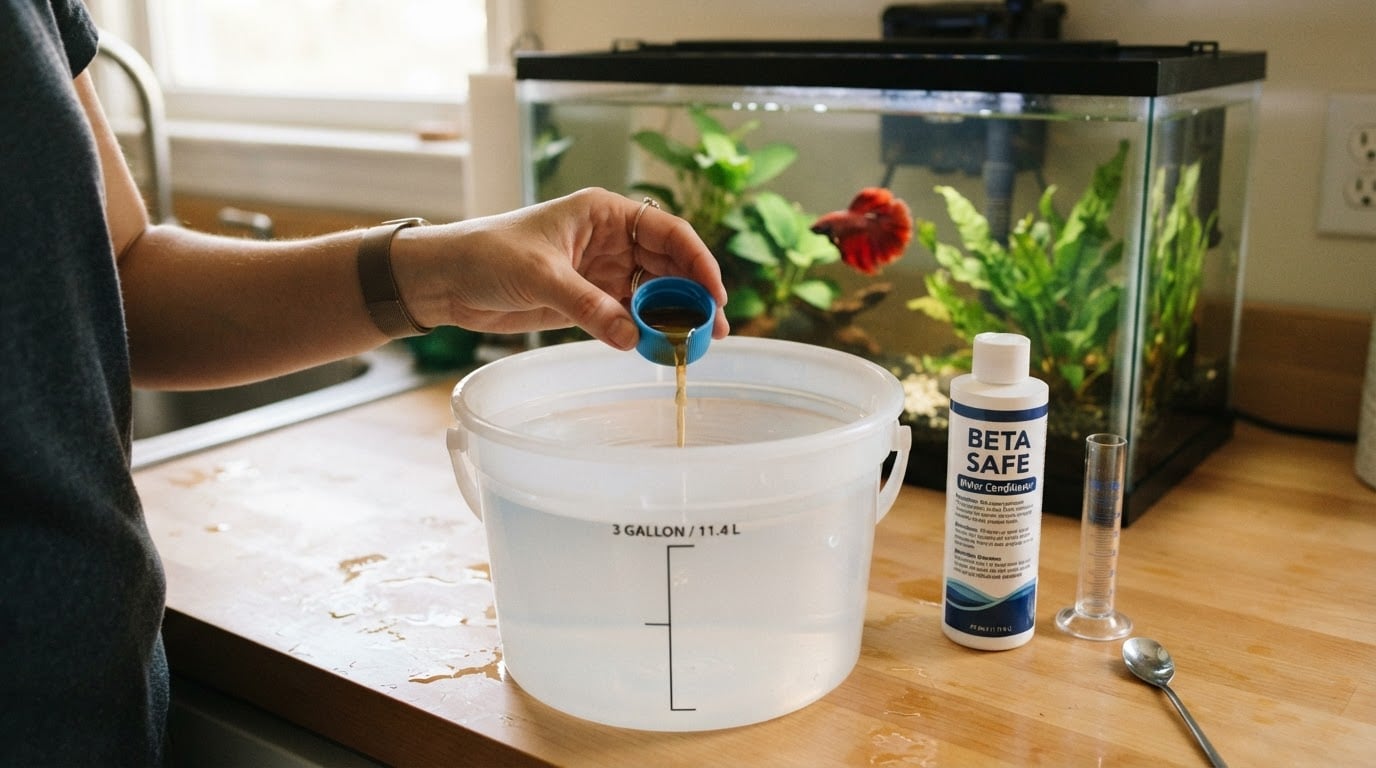
- Measure the water you are replacing, not the tank. Take out two gallons and you treat two gallons. If you refill from a hose or pour new water straight into the tank and then condition it, follow the label's instruction for treating the full tank volume, because the product is now diluted across everything in there.
- Treat in a bucket whenever you can. Fill the bucket, add the dose, stir, check the temperature against the tank, then pour. Untreated tap water never gets a path to the fish this way.
- Count top-offs as water changes. Evaporated water leaves its minerals behind, but the water you add back still carries chlorine or chloramine. Dose it the same way.
- Do not overthink the wait. The dechlorination reaction is fast, and a stir is normally enough. If your bottle prints a wait time, follow the bottle. Otherwise, matching temperature matters more than extra minutes.
- Use the labeled dose. More is not better. The dose is sized to a volume of water, not to a problem in the tank, and pouring in extra does not disinfect anything.
- Keep the bottle closed and out of the sun. Conditioners carry storage guidance on the label for a reason, and heat and light are not kind to them.
What a Water Conditioner Can't Fix
This is where most of the confusion about betta water lives. A conditioner handles disinfectants, and sometimes metals. It does not handle waste, and it does not replace maintenance.
It does not remove ammonia, nitrite, or nitrate. Those come from fish waste, uneaten food, and decaying plant matter. A working filter's nitrifying bacteria convert ammonia to nitrite and nitrite to nitrate, and nitrate leaves the system through water changes and hungry plants. No dechlorinator exports nitrogen from a tank.
Ammonia "detox" claims are temporary. Some formulas bind ammonia into a less toxic form. The nitrogen is still in the water, in a different shape, and the effect does not last. That buys time for a water change or for the filter to catch up. It is not a substitute for either one.
Chloramine leaves a trace of ammonia behind. When a conditioner breaks the chlorine-ammonia bond, the chlorine is neutralized and a small amount of ammonia is released. In a cycled tank, the filter usually consumes it quickly. In a brand-new tank with no established bacteria, that trace can matter, which is one reason a large chloraminated water change is a poor way to reset a tank that has not finished cycling.
It does not cycle a tank. The bacteria that make water safe to live in arrive from a starter culture, established filter media, or time. A conditioner's job is to keep chlorine from killing them while they settle in.
It does not treat disease or disinfect a tank. Fin rot, ich, and velvet need the right treatment. Extra conditioner will not sterilize a dirty tank; gravel vacuuming and water changes will.
It does not fix bad source water. If your tap water carries high nitrate, unusual hardness, or other contaminants, the answer is more testing, a different water source, or filtration, not a bigger dose. On a private well, conditioner is usually beside the point, because well water has its own list of things to check.
Common Mistakes That Cost Betta Keepers Fish
- Letting water sit overnight and calling it safe. True for chlorine, false for chloramine. If your supplier uses chloramine, standing water is untreated water.
- Dosing for the tank when you only top off. A half-gallon top-off does not need a full-tank dose, and a five-gallon change does not need a bowl-sized one.
- Adding water first and conditioner after. Even a short window of untreated water is exposure the fish did not need. Treat first when you can.
- Using a slime-coat bottle as the dechlorinator. A coating product that does not list chlorine and chloramine is not doing the essential job.
- Treating conditioner as a cure for an ammonia reading. If a test shows ammonia, the answers are a water change, filter maintenance, and patience with the cycle. Extra conditioner is not one of them.
- Buying by the fish on the label. What matters is the disinfectant the formula covers and the volume it treats.
Quick Answers About Betta Water Conditioners
Do you have to use water conditioner for betta fish?
If your tap water is disinfected with chlorine or chloramine, yes: every drop that enters the tank, including partial changes and top-offs. Bettas do not get an exemption because they can breathe air. Water that was never chlorinated, such as most private well water, and water that has already been treated, such as RO or distilled, does not need dechlorinating, though RO and distilled water need minerals added back before fish live in them.
How long do you wait after adding conditioner?
Long enough to mix it and match the temperature. The chemical reaction itself is quick. If the bottle prints a specific wait time, follow the bottle.
Can you add conditioner while the betta is in the tank?
Yes. That is how most partial water changes work: the new water is treated before it goes in. Do not pour concentrated conditioner directly onto the fish; mix it into the water you are adding instead.
What if you run out of conditioner?
Pause the water change until you have more, or use a known-safe alternative source for a small change. If your supply uses only chlorine, a bucket left standing with an air stone can work in a pinch. If it uses chloramine, waiting is the safer choice. Water passed slowly through a carbon filter can shed chlorine, but chloramine removal needs enough contact time to be reliable, so do not count on a quick pass.
Does boiling tap water make it safe?
No. Boiling drives off some free chlorine, but it does not remove chloramine, and because water evaporates as it boils, whatever remains in the pot ends up more concentrated. It also leaves you with water at the wrong temperature.
Does conditioner expire?
Check the bottle, because storage and date guidance differ by product. Capped, in a cupboard, out of direct sun is the safe habit either way.