Why The Same Tank Mate List Fails Different Bettas
Published compatibility lists describe an average betta, and few bettas are average. Two males of the same age, kept in the same style of tank, can behave nothing alike: one ignores a school of rasboras all day, the other spends its time chasing every fish that enters the upper water column. A betta's tolerance of tank mates follows from sex, genetics, age, tank footprint, planting density, and how long that individual has already treated the tank as its own territory.
Behavior also shifts. A young male that ignores tank mates can turn territorial at eighteen months. A fish that was relaxed in a bare quarantine tank can become defensive once it has built a bubble nest in a planted corner. Compatibility gets verified in your own tank over the first few weeks; no purchase can guarantee it.
What conditions make coexistence likely? Four matter more than species identity:
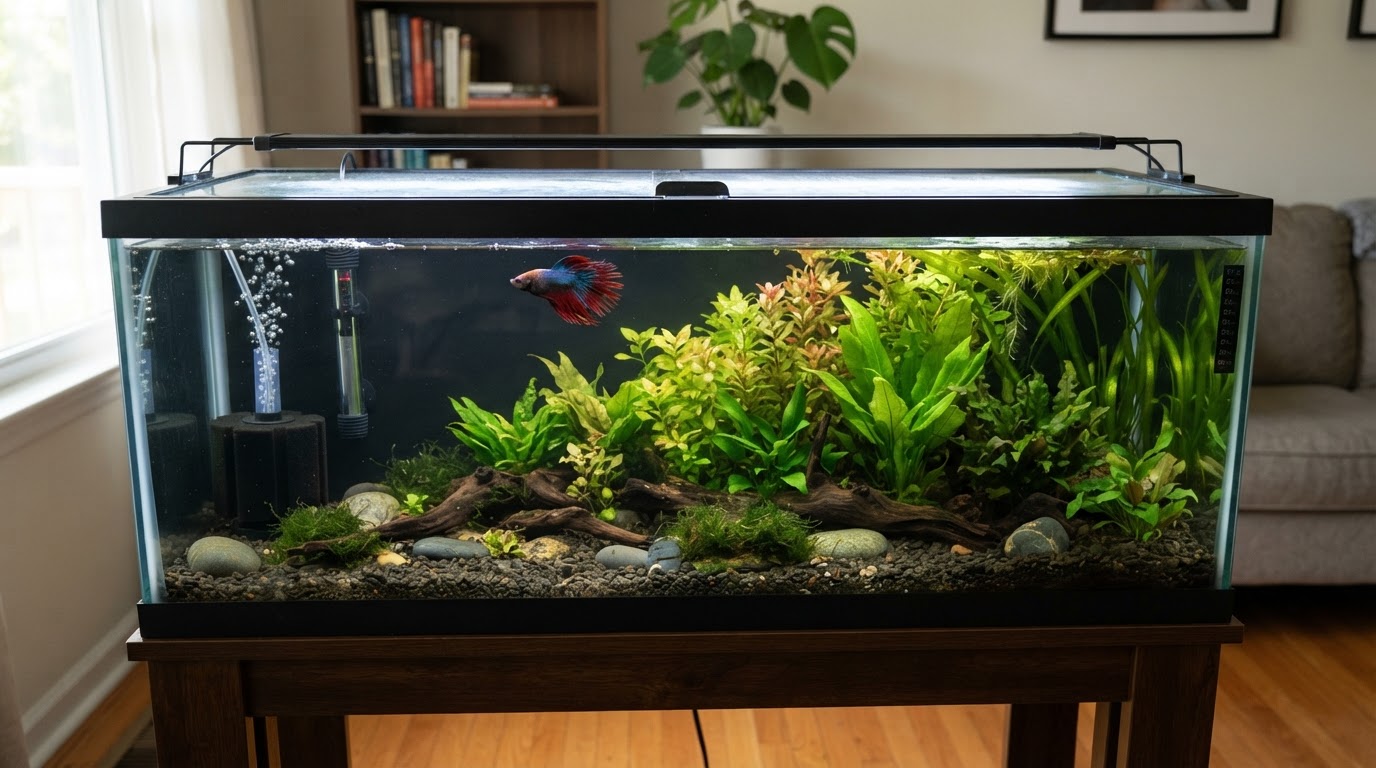
- Footprint. A long tank gives a betta a territory at one end and other fish somewhere to be. A tall tank with the same volume gives everyone the same few square inches of floor.
- Sightline breaks. Dense planting, driftwood, and floating cover let subordinate fish leave the betta's field of view. A tank with a clear middle is a tank where every encounter turns into a confrontation.
- Water and temperature. Betta splendens is a tropical species, typically kept at 78–82°F in neutral, soft-to-moderately-hard water. Tank mates should want that same water. Cold-water species and brackish or marine animals are out of scope regardless of temperament.
- An exit plan. A cycled 5-gallon tub or spare tank, ready before introduction day, turns a failed introduction into a ten-minute problem instead of a crisis.
Small Tanks: Under 10 Gallons
Below 10 gallons, few fish qualify. A 5-gallon or smaller tank has room for one betta's territory and little else, and most schooling fish need more horizontal swimming room than that footprint supplies.
What works in small volumes:
- Snails. Nerite snails graze glass and leaves without competing for swimming space, and they cannot breed in freshwater, so the population stays fixed. Malaysian trumpet snails burrow in the substrate and stay largely hidden; the trade-off is that they multiply quickly if you overfeed.
- Shrimp. Amano shrimp are the safer choice in a small tank because they are too large for most bettas to treat as food and their larvae need salt water to develop. Cherry shrimp are cheap, effective cleaners, and a betta in a small tank can eat through a colony in weeks.
What does not work: a small schooling fish in a 5-gallon. Ember tetras and chili rasboras stay under an inch, and their care still calls for a group of six or more plus swimming length. A 5-gallon cannot supply both at once.
The 10-Gallon Class
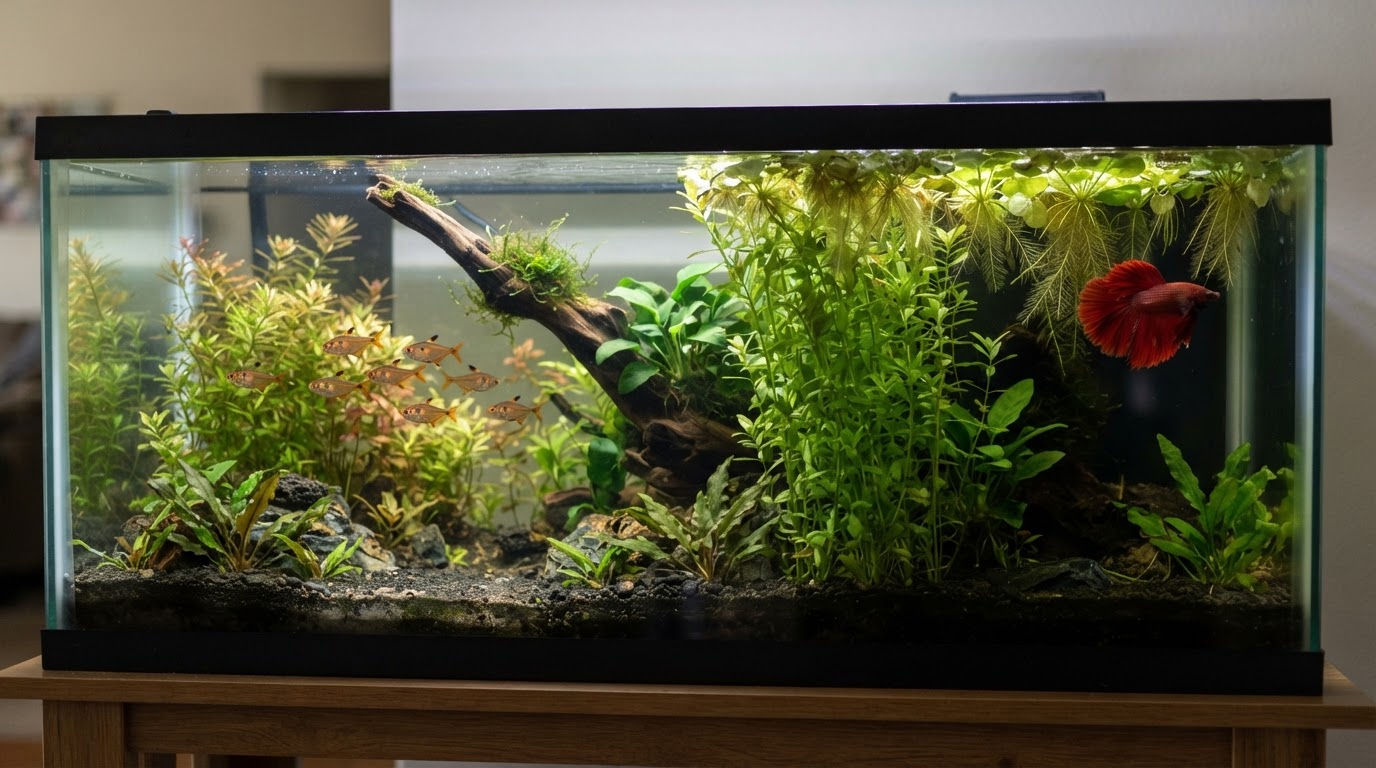
Ten gallons is where one real tank mate species becomes plausible. The working rule is one small species, added as a complete group, with the betta positioned as the newest arrival.
- Small schooling fish. Ember tetras (Hyphessobrycon amandae), chili and kubotai rasboras, and harlequin rasboras are the common recommendations. All stay small, all prefer that same warm neutral water, and all settle better in groups of six to eight. In a 10-gallon, that is the entire fish population: one school plus the betta, with nothing stacked on top.
- Bottom dwellers. Pygmy corydoras (Corydoras pygmaeus) and other dwarf cory species work the substrate and occupy a different layer than a betta does. They want a sand or fine-gravel bottom, a group of at least six, and food that actually reaches them; in a busy 10-gallon it is easy to underfeed them by accident.
- Otocinclus. Useful against soft algae, but they are wild-caught grazers that need an established, well-fed tank. A freshly cycled 10-gallon is the wrong home for them.
Two cautions for this size class. The smaller the school, the more the betta can single out one fish. And dwarf corydoras, kuhli loaches, and bettas themselves can leave a tank through gaps around the lid.
Larger Community Setups: 20 Gallons And Up
A 20-gallon long, a 29, or a 40 breeder changes the arithmetic. Footprint goes up, territories separate, and you can stock by layer: mid-water school, bottom group, invertebrates.
Suitable combinations at this size:
- Mid-water: harlequin or lambchop rasboras, ember tetras, rummy-nose tetras, pencilfish, or white cloud mountain minnows if the temperature range overlaps the betta's.
- Bottom: bronze or panda corydoras, kuhli loaches in a group of six or more, or a bristlenose pleco in a tank with driftwood to graze.
- Invertebrates: nerite snails, amano shrimp, and cherry shrimp in a heavily planted tank where the betta cannot patrol every corner.
Kuhli loaches deserve their own note. They are nocturnal, they hide for the first weeks, and they need smooth substrate and tight lids. Keepers who expect to see them during the day often conclude the introduction failed when nothing is wrong.
Species To Avoid, And The Reason
Some pairings fail predictably enough that the reason matters more than the species name.
Avoid | Why it goes wrong |
|---|---|
Other bettas, including females | Conspecific aggression defines the species. A sorority can work in a large, densely planted tank with a stable group, but it is an advanced setup with a real failure rate. |
Fin nippers: tiger barbs, serpae tetras, black skirt tetras, rosy barbs | Long betta fins are an easy target, and the damage compounds into fin rot. |
Guppies and other long-finned livebearers | Male guppies read as rival bettas. Fast-breeding livebearers also multiply faster than a betta can control. |
Gouramis, paradise fish, and other bubble nesters | They use the same niche, compete for the same surface space, and often escalate. |
Cichlids such as convicts, Jack Dempseys, and angelfish | Territorial, larger at maturity, and inclined to bully a fish that will not retreat. |
Goldfish | Different temperature range, much heavier waste load, and a habit of nipping at trailing fins. |
Rainbow sharks and red-tailed sharks | Aggressive toward similar-shaped fish and territorial about the bottom third of the tank. |
Frogs, crabs, and crayfish | Not reliable tank mates for a fish with long fins; crayfish in particular are opportunistic. |
Two further categories worth flagging: species that look like a betta (female bettas, wild betta species, Betta imbellis types) and species that grow much larger than the tank can support. Both produce the same outcome, chronic stress that shows up as clamped fins, hiding, or appetite loss long before visible injury.
Introduction Order And The First Two Weeks
Introduce the least territorial animals first and the betta last, so the betta enters a tank that already has structure and established residents. If the betta is already settled, rearrange the decor before adding anything: moving plants and driftwood forces the fish to re-map the tank and reduces the chance that it defends the exact corner it has been patrolling.
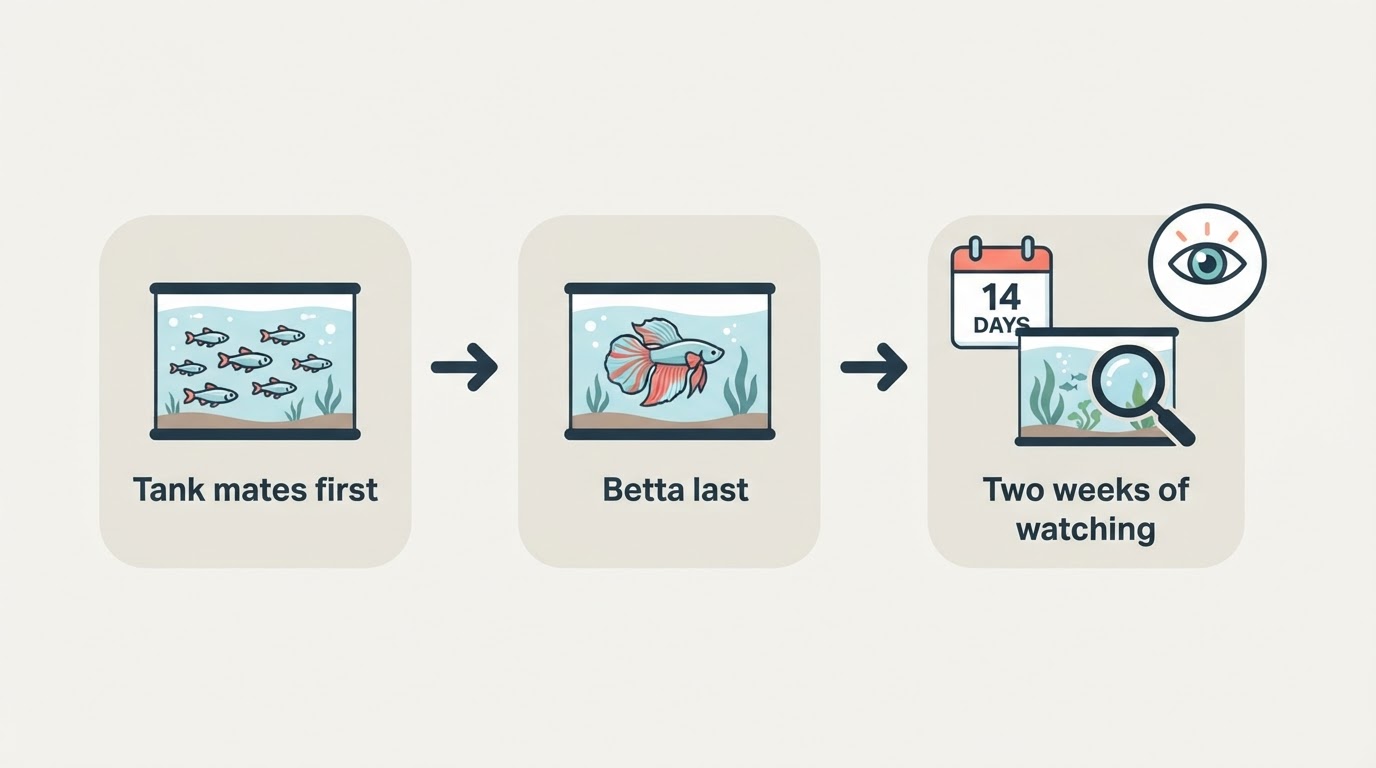
On introduction day:
- Quarantine new fish for two to four weeks. Adding a sick school to a betta's tank is the most common way a compatibility plan ends badly.
- Turn the lights off, float the bag, and acclimate over 30–45 minutes, adding tank water gradually.
- Release the new fish at the opposite end from the betta and leave the lights off for the rest of the day.
- Feed a small amount within an hour so the newcomers settle with a meal rather than as intruders.
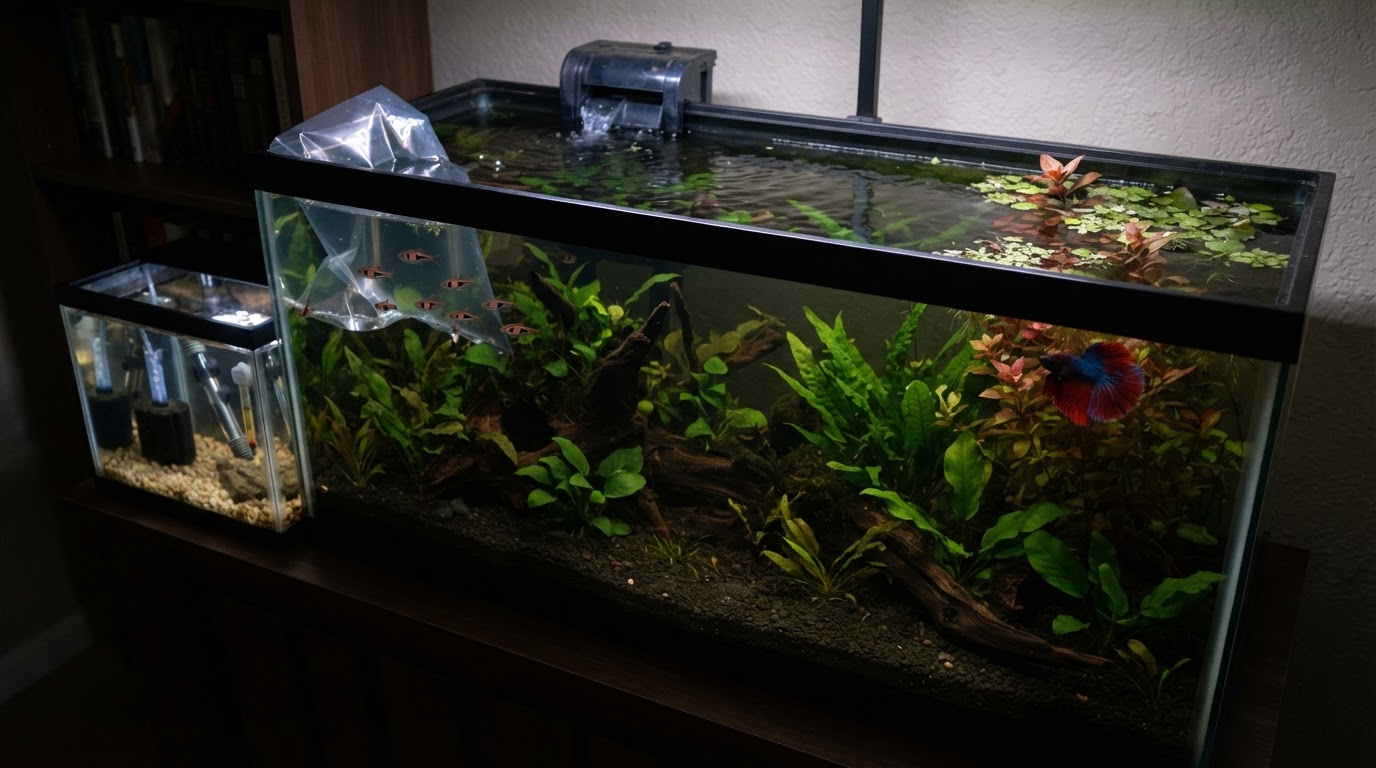
Then watch, daily, at feeding time:
- Chasing that ends within seconds is normal. Chasing that continues for minutes, or pins a fish against the glass, is a failure.
- Check fins for nips, especially on long-finned males and on the schooling fish.
- Confirm the newcomers are eating. A fish that hides through two feeding sessions is losing the contest.
- Treat clamped fins, color loss, or a betta that stops patrolling as evidence the balance is wrong.
- Keep the spare tank cycled and ready for the first two weeks. Most failures surface within the first ten days.
If the introduction fails, separate the fish and reassess. Leaving them to sort it out is how a tetra loses its fins and a betta loses half its tail to a fish it cannot outswim.
When One Betta Alone Is The Right Answer
A single betta in a planted 5- or 10-gallon tank is a complete setup. It is also the setup with the lowest risk of disease transfer, the widest margin for water quality mistakes, and the least chance that the fish spends its day defending territory. If your tank is small, your betta has already shown aggression, or your maintenance schedule is still being worked out, tank mates add work without adding much for the fish.
Compatibility works out for plenty of bettas. It works out predictably when the tank has footprint and cover, the tank mates occupy a different layer, and the keeper is ready to separate the fish at the first sign of real trouble.