The direct answer
A healthy betta setup is a cycled tank of at least 5 gallons (19 L) with a lid, an adjustable heater set between 76 and 82°F (24–28°C), gentle filtration, cover plants, and a weekly partial water change with a liquid test kit on the shelf. Everything below either builds that baseline or maintains it. Remove one of the four parts — volume, heat, filtration, clean water — and the fish pays for it within weeks, usually as clamped fins, appetite loss or fin rot.
Tank size and setup: volume first, decorations second
Five gallons is the floor for a single betta; ten gallons is where care gets easier. A larger volume warms and cools more slowly, dilutes waste between water changes, and gives you room for plants and a filter that does not overwhelm a slow swimmer. Ten gallons is the version of this setup that forgives a missed water change.
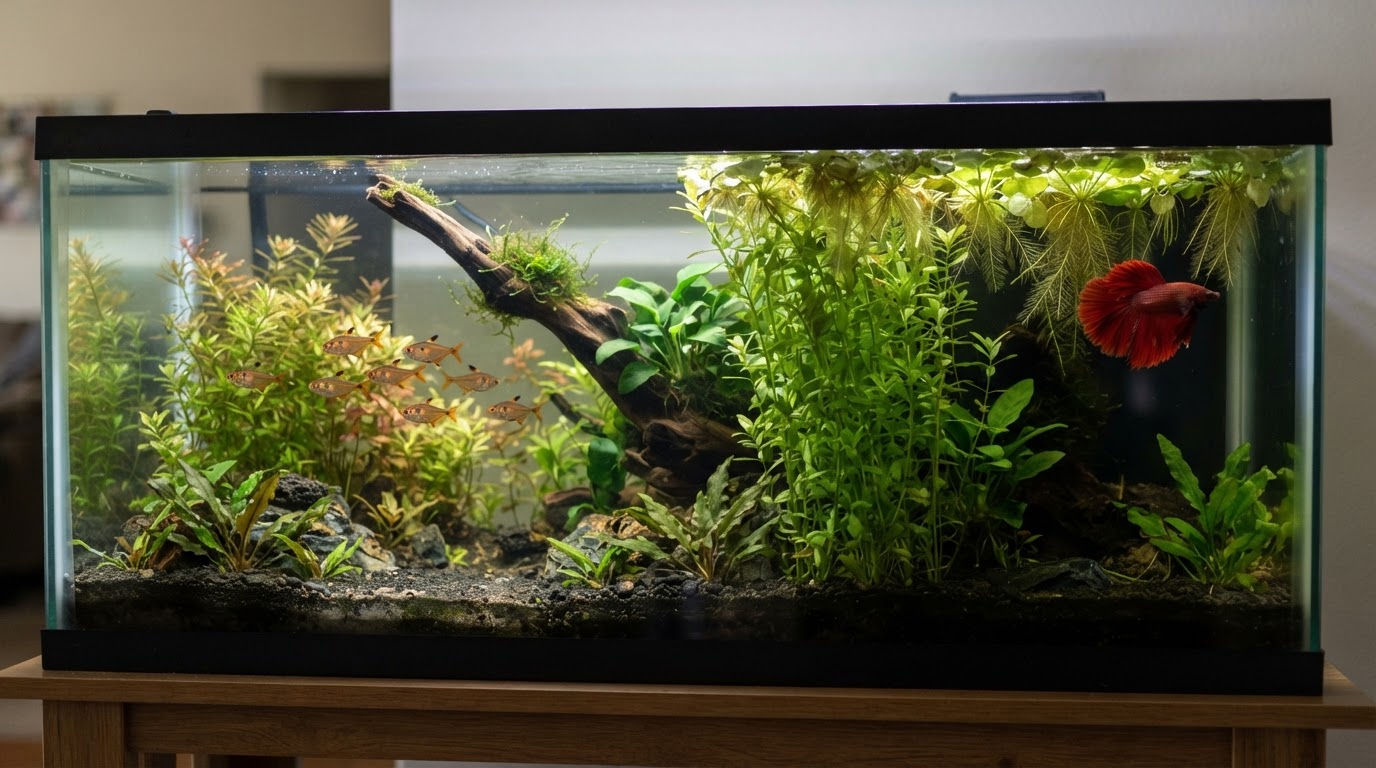
Within the same volume, choose a longer, lower tank over a tall narrow one. Bettas swim horizontally near the surface and need regular access to air, so a wide footprint gives more usable swimming space than a tall column holding the same gallon count.
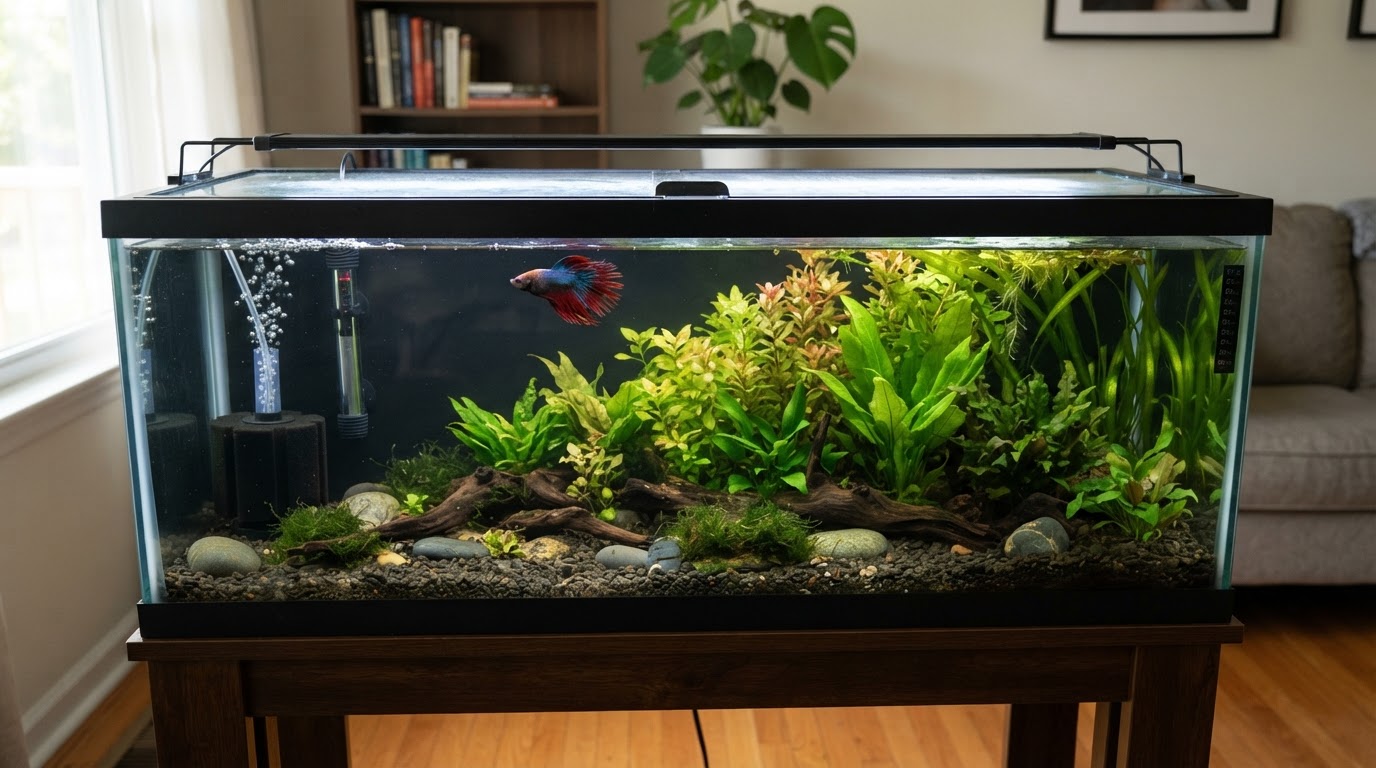
Setup order matters more than the equipment list:
- Put the tank on a level stand that carries the filled weight, away from direct sun and draughty doors and windows.
- Rinse the substrate and new decor under warm water. No soap, ever.
- Install the heater and filter, fill, then treat the water with a dechlorinator.
- Cycle the tank before the fish arrives: add an ammonia source, test daily, and wait until ammonia and nitrite both read zero while nitrate appears.
- Add the betta, fit the lid, and leave the light off for the first day.
Fit a lid with a small gap for air. Bettas jump, and a lid also holds heat and limits evaporation. Choose soft-leaved plants or silk substitutes, and skip sharp plastic or rough ceramic decor; fins tear on edges that feel rough to a fingertip.
Heating and filtration: the two settings that decide comfort
A betta kept at room temperature sits in water that swings several degrees between day and night, and those swings show up as stress, digestive trouble and infections. Use an adjustable heater rated for the tank volume — roughly 25 to 50 watts for five gallons — set to 78–80°F so the water stays inside the 76–82°F range, then place a separate thermometer at the opposite end of the tank. Preset heaters and unheated bowls take away your ability to correct a failure, and heaters do fail.
Filtration should be biological first and mechanical second. A sponge filter on a small air pump, or a hang-on-back filter with a baffle, gives nitrifying bacteria a home without turning the tank into a washing machine. Betta fins are large and the fish is a weak swimmer compared with danios or barbs. If the current presses the fish against glass or holds it in one spot, the flow is too strong and needs a baffle, a spray bar or a smaller pump.
The trade-off most new keepers get wrong: an oversized filter does not compensate for missed water changes, and a filter cleaned too thoroughly can crash the cycle you spent a month building. Rinse biological media in water removed during a water change, replace only the fine mechanical pad, and cover the intake so fins cannot be drawn in.
Water parameters and the maintenance schedule
Use a liquid test kit rather than strips. The ranges you are managing are narrow enough that approximate readings mislead, and ammonia is the reading you most need to trust.
Parameter | Target range |
|---|---|
Temperature | 76–82°F (24–28°C) |
pH | 6.5–7.5 |
Ammonia | 0 ppm |
Nitrite | 0 ppm |
Nitrate | below 20 ppm |
General hardness | 2–15 dGH |
Ammonia and nitrite at zero are the two readings that matter most. Anything above zero means the cycle has broken or the tank was stocked too fast, and the response is a water change plus a pause on feeding, not a bottled fix.
A workable schedule:
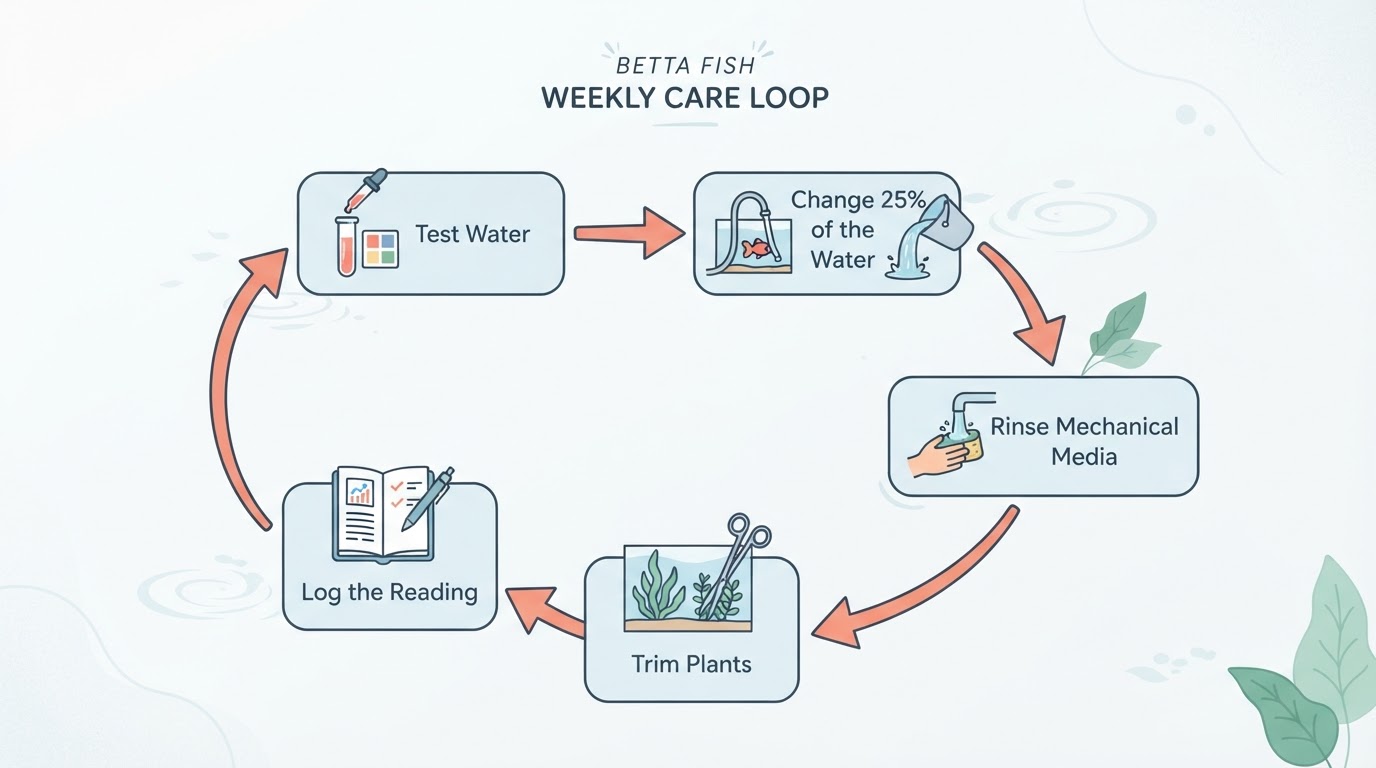
- Daily: feed, watch the fish swim and breathe, remove uneaten food, top off evaporation with treated water.
- Weekly: change 25% of the water with temperature-matched, dechlorinated water; test ammonia, nitrite and nitrate; trim plants; check the thermometer against the heater setting.
- Monthly: rinse mechanical media, clean the lid and light, check the filter intake and impeller, look for algae patterns that signal too much light or too much nitrate.
- During the first month: test every two or three days, because a new tank is still balancing and small volumes shift quickly.
Diet and feeding
Bettas are insect eaters with a short digestive tract and a small stomach, so portion size matters more than variety at first. A staple betta pellet, softened briefly, covers the base. Add frozen or freeze-dried bloodworm, brine shrimp or daphnia two or three times a week for variety, and thaw frozen food in a little tank water before adding it.
Feed two or three pellets once or twice a day, or roughly what the fish clears in two minutes. Skip one day a week; a short fast is easier on the fish than a full stomach, and it reduces the constipation and buoyancy problems that come from overfeeding. Remove anything still floating after a few minutes, because uneaten food breaks down into exactly the ammonia you are testing for.
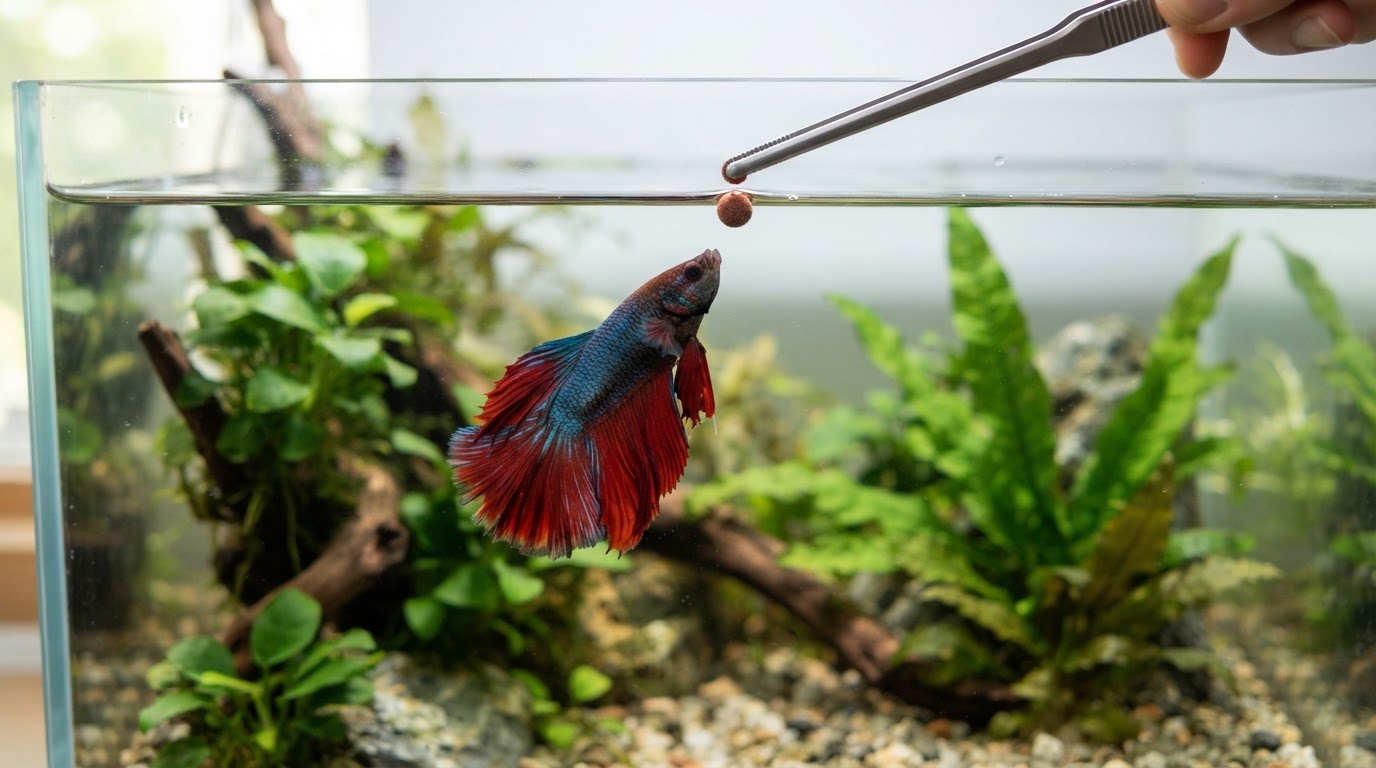
Freeze-dried foods should be soaked before they go in; dry blocks swell inside the fish. Live food is useful enrichment when you can get it, but it does not replace a complete pellet.
Enrichment and tank mates
A betta with nothing to explore often patrols the glass, which is usually boredom, a reflection, or both. Give it structure: rooted and floating plants, a cave or betta log, a leaf hammock near the surface, and a couple of sight breaks so the fish can disappear from view. Rearranging decor during a water change creates something new to inspect, and a mirror held up for a few seconds a day provides a short burst of exercise. Long mirror sessions create stress rather than enrichment.
Tank mates are the part of betta care where the honest answer is that many bettas should live alone. In a planted ten-gallon tank, a nerite snail or a small group of cherry shrimp is the lowest-risk addition, and even those can be hunted. Avoid other bettas, avoid fin-nippers such as serpae tetras and tiger barbs, and avoid fast fish that will outcompete a slow feeder in a small volume. A sorority of female bettas needs 20 gallons or more, dense planting and an owner who can read aggression early; it is not a beginner arrangement.
The trade-off is real: every tank mate adds waste, competes for the same footprint and can become food. Stock the tank for the betta first, and treat any companion as a bonus that may need rehoming.
Warning signs and common illnesses
Check the fish, not just the water, every day. The signals worth acting on:
- Fins clamped close to the body instead of fanned out
- Refusing food for more than two days
- Gasping at the surface while the filter is running
- White spots (ich), gold dust (velvet) or cottony patches (fungus)
- Frayed, receding or black-edged fins (fin rot)
- A swollen body with raised scales (dropsy)
- Sinking, floating or a curved posture (swim bladder trouble)
- Stringy white faeces, colour loss or a sudden change in activity
The first response to almost every one of these is the same: test ammonia and nitrite, check the heater and thermometer, and do a temperature-matched water change. Early fin rot and clamped fins usually resolve once water quality and temperature return to range. Do not dose medication into an unheated, uncycled tank; treat the cause first, then the symptom. Dropsy with raised scales rarely responds to treatment, and a fish at that stage needs isolation rather than a series of guesswork remedies.
Quarantine matters even for a single-fish tank. A new plant, snail or fish can carry parasites, so keep new arrivals separate for two to four weeks when you have somewhere suitable to do it.
Lifespan expectations
Two to five years is the realistic range for a betta kept in heated, filtered water with weekly changes. Many bettas are already six months to a year old when they reach a store, so part of that lifespan is spent before you buy the fish, and a thin, listless juvenile in a shop cup is a harder start than a fish with clear eyes and a full belly.
Where a betta lands in that range depends on stable temperature, zero ammonia and nitrite, a varied diet and genetics, in roughly that order of things you control. Older bettas fade in colour, swim more slowly, may thin despite eating, and rest more often. A betta that reaches five years is the exception rather than the target, and a fish that stops eating for a week at any age needs the water tested before anything else.
Keeping the key numbers in one place
Sea Life Planet's species care guides put the essentials in a Quick Facts panel at the top of each guide — scientific name, care level, minimum tank size, temperament, diet, water temperature, maximum size and lifespan — then continue with a water-parameter table and a common health issues section. For a betta, that layout places the figures used here, a 5-gallon heated and filtered tank, 76–82°F, pH 6.5–7.5 and a 2–5 year lifespan, next to the fish's Latin name. It is a useful format when you are comparing a new species and want the environment constraints before the description.
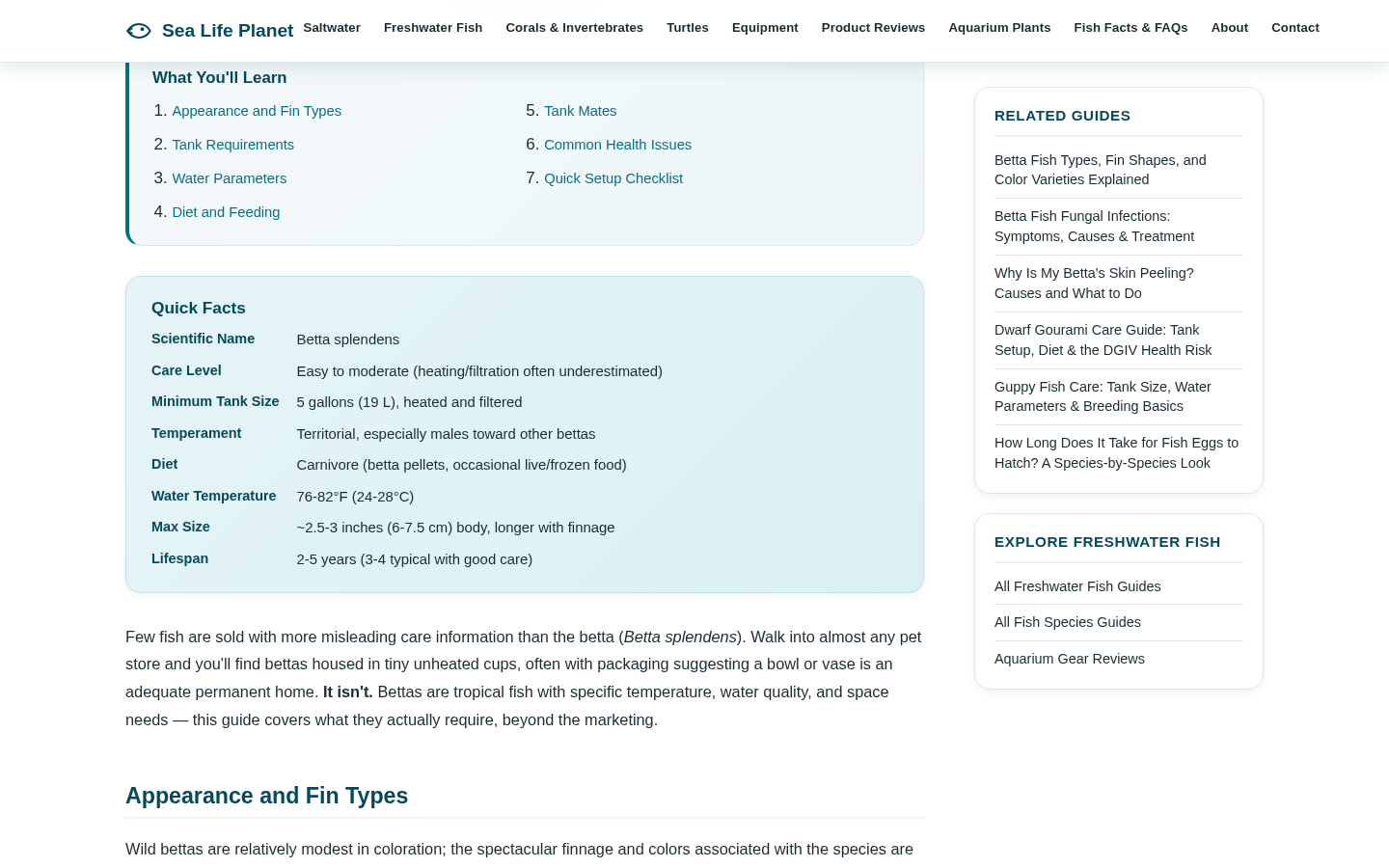
Flagship species guide framed mid-page: 'What You'll Learn' TOC edge above, full Quick Facts definition panel (Scientific Name, Care Level, Minimum Tank Size, Temperament, Diet, Wa
Myths about bowls and small containers
"Bettas live in puddles." Wild bettas are found in shallow, slow-moving water such as rice paddies and drainage channels, where vegetation, rain and a connected volume keep conditions stable. A bowl reproduces the shallow part and none of the rest.
"They breathe air, so water quality matters less." The labyrinth organ lets a betta gulp air when dissolved oxygen is low. It does not process ammonia, and it does not make a stale bowl safe.
"Small tanks are easier for beginners." Small volumes change temperature faster, concentrate waste and leave no room for a filter or plants. A ten-gallon tank with a heater and weekly changes is less work than a bowl with daily changes.
"A vase with a plant is a complete setup." A plant uses some nitrate. It does not replace filtration, heat or water changes, and an unfiltered vase has nowhere for the bacteria that convert ammonia.
"Bettas don't need a heater." They are tropical fish. Water below the mid-70s slows digestion and immunity, and room-temperature swings are the most common avoidable cause of illness.
"A bigger tank is too much for one fish." Volume is stability, not swimming distance. A betta in a ten-gallon tank uses the footprint, explores the plants and spends less time exposed to waste between changes.
Questions that come up in the first month
Can I skip the filter? You can keep a betta without one only by changing water far more often, and even then the fish has no established bacterial colony. A sponge filter costs little, runs quietly and makes weekly maintenance shorter.
How often should I change the water? Twenty-five percent weekly in a cycled five- or ten-gallon tank. If ammonia or nitrite shows up, change more and feed less until both read zero.
Does the tank need a lid? Yes. Bettas jump, and an open top loses heat and speeds evaporation, which concentrates minerals and waste.
Can I add a snail straight away? Wait until the tank has cycled and the betta has settled for two to four weeks. Adding livestock to an unfinished cycle usually ends with a spike you then have to fix.
My betta built a bubble nest — does that mean the tank is right? A nest is normal behaviour and a sign of maturity. It does not confirm water quality, so keep testing on schedule.