How much does a saltwater aquarium setup cost?
The total is built from four layers you can price in order, not from one sticker price you can look up.
Almost every saltwater build breaks into the same four groups: the system that holds and moves water, the gear that keeps chemistry stable, the living stock, and the running cost that continues after the first month. Sellers quote very different totals because they are quoting different layers — a bare tank, a plug-and-play kit, or a full reef with coral.
The useful answer is a structure you fill with your own local prices, starting with one decision: how much water you want to manage. Volume drives the variable costs, and the equipment count drives the fixed ones.
Key answers at a glance
- The cheapest honest entry point is a small all-in-one system. One purchase covers the tank, filtration, and return flow, so you are not buying a sump, plumbing parts, and a separate pump on top of it.
- The tank itself is rarely the largest line. Rock, sand, lighting, salt, and livestock climb faster than the glass does.
- Water volume is the main multiplier. Rock, sand, water-change salt, heating capacity, and stocking room all scale with the number of gallons you choose.
- The most-forgotten costs are the boring ones. Test kits, a purified water source, quarantine gear, replacement media, electricity, and salt for routine water changes.
- Lighting is decided by what you want to keep. A fish-only system needs far less light than a coral system, and that single choice moves the total more than any accessory.
- Setup is a one-time build; maintenance is a permanent line. Budget the monthly flow before you commit, not after.
- DIY saves on hardware and spends on time and risk. Self-sourced parts can cost less up front, but a mismatched component gets replaced.
- Cheaping out on filtration is the most expensive saving. An undersized filter, skimmer, or flow pump usually ends in a re-buy plus a livestock loss.
The system layer: what you buy once
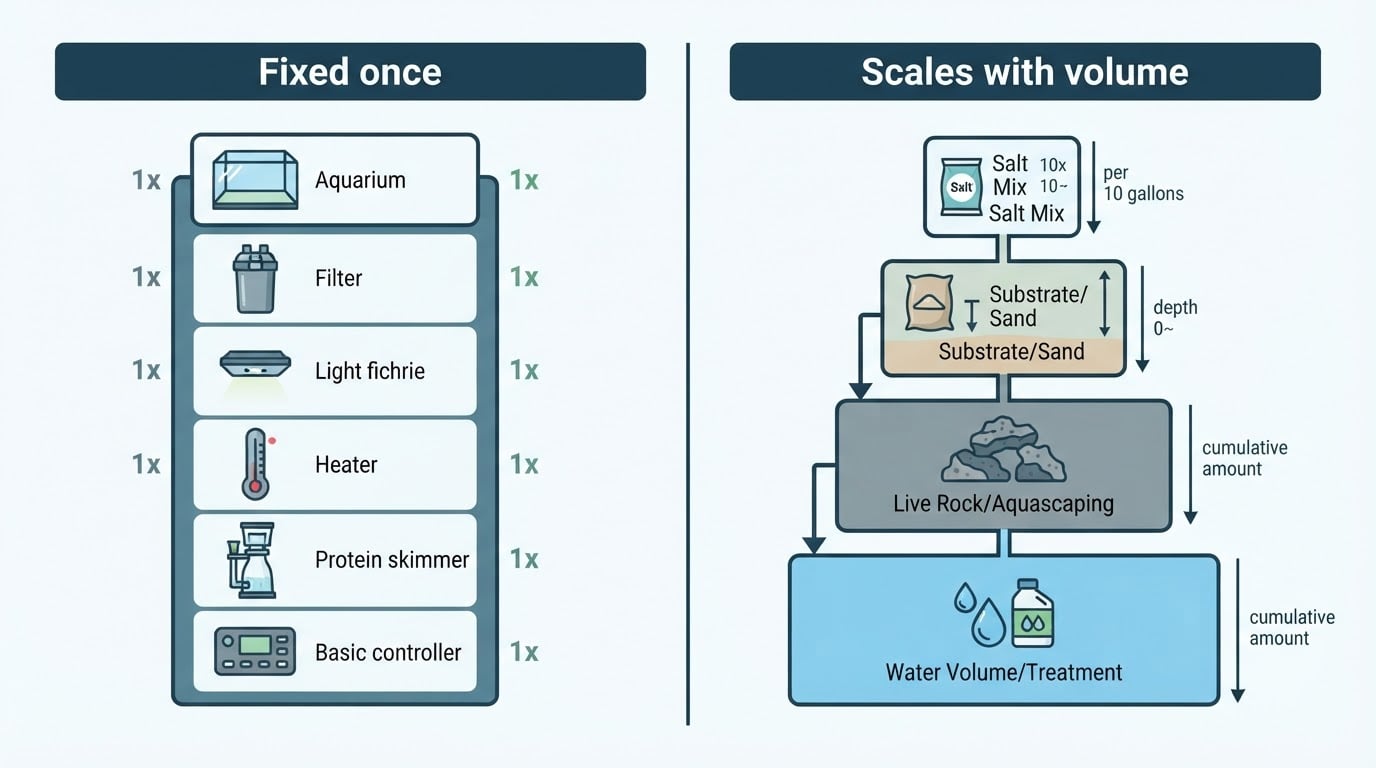
The system layer is fixed: you buy it once, and its size barely changes whether you run twenty gallons or two hundred.
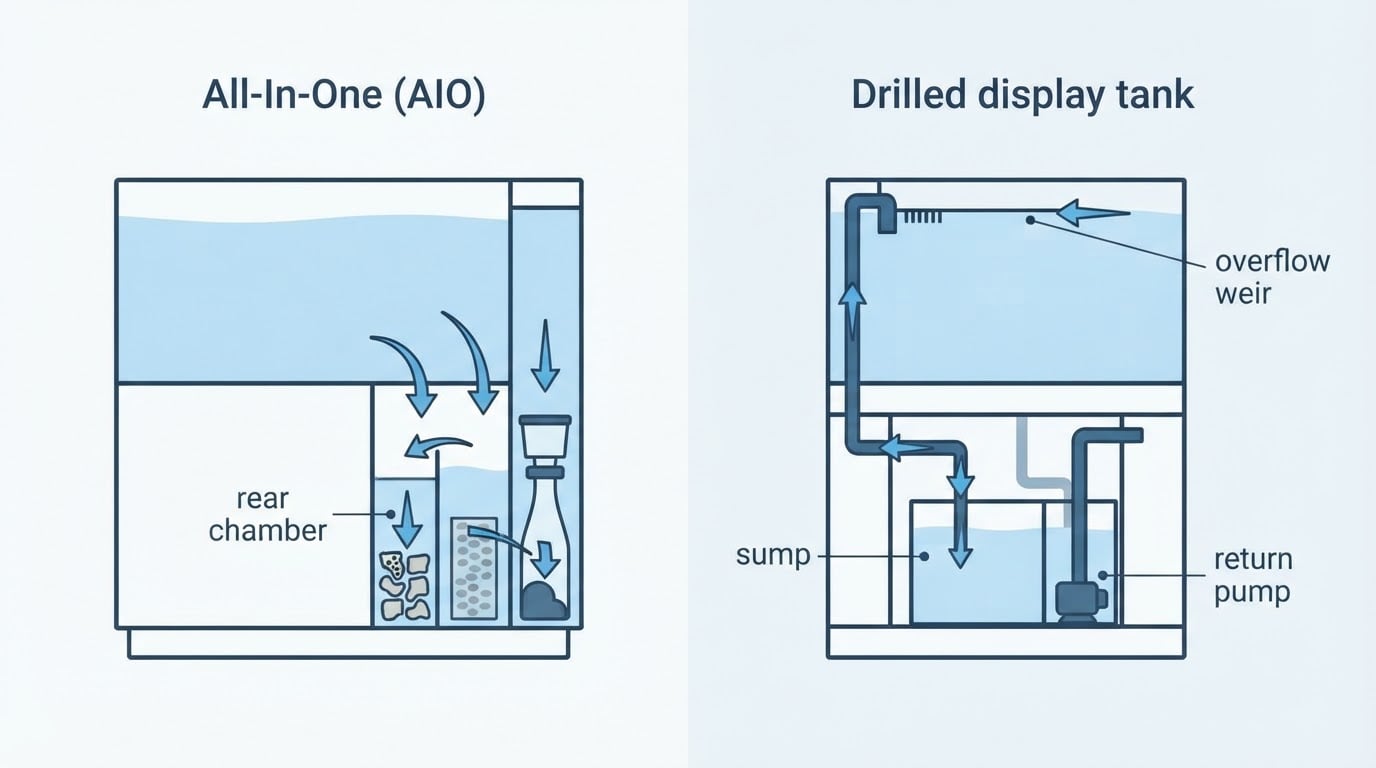
That is the layer that includes the tank, the stand, the return pump, and whichever filtration approach you choose: a rear chamber in an all-in-one, a hang-on filter, or a drilled tank feeding a sump. Because these are discrete purchases rather than per-gallon multipliers, they are the part of the budget that a small tank makes relatively expensive and a large tank makes relatively cheap.
Two trade-offs decide this layer.
All-in-one versus sump. An all-in-one tank bundles filtration, pump, and often a lid into one unit. It is quicker to start and cheaper to complete. A drilled tank with a sump costs more in parts and plumbing, but it leaves room for a larger skimmer, more media, and equipment you can change without replacing the display tank.
New versus used. Used tanks, stands, and rock can reduce the purchase price substantially. The trade-off is age and history: seams, scratched glass or acrylic, pumps of unknown runtime, and rock that may carry pests or residual medication. Inspect the seams, ask what was treated in the system, and price the replacement risk into your offer.
The support layer: chemistry, light, and heat
The support layer is where a saltwater build pulls away from a freshwater budget, because salinity, water chemistry, and lighting all need dedicated equipment.
Filtration and flow
Filtration is not one product; it is mechanical, biological, and chemical jobs spread across equipment. You need something to trap particles, a large surface for nitrifying bacteria, gas exchange at the surface, and enough water movement that waste does not settle on the rock.
Budget for flow as its own line. A return pump rarely delivers the in-tank movement a reef display needs, so most systems add one or more circulation pumps.
Lighting
Lighting is the most elastic line in the budget. A fish-only tank can run on modest output; a coral system needs spectrum and intensity that cost more per unit and are usually replaced sooner.
Decide the coral ambition before the fixture. Buying a light for the fish-only tank you own today, then upgrading for the corals you want next year, is one of the most common ways a saltwater budget doubles.
Heating
A heater and a thermometer are inexpensive individually, but the control question matters: a second heater or a controller protects the whole system when one unit sticks on or fails off. In a large system with a sump, heating is a small fraction of the total. In a nano, it is a fixed cost carried by very few gallons.
Rock and sand
Rock and sand are volume costs. The deeper the sand bed and the more rock you place, the more you buy, and both scale with the footprint of the tank rather than with its price.
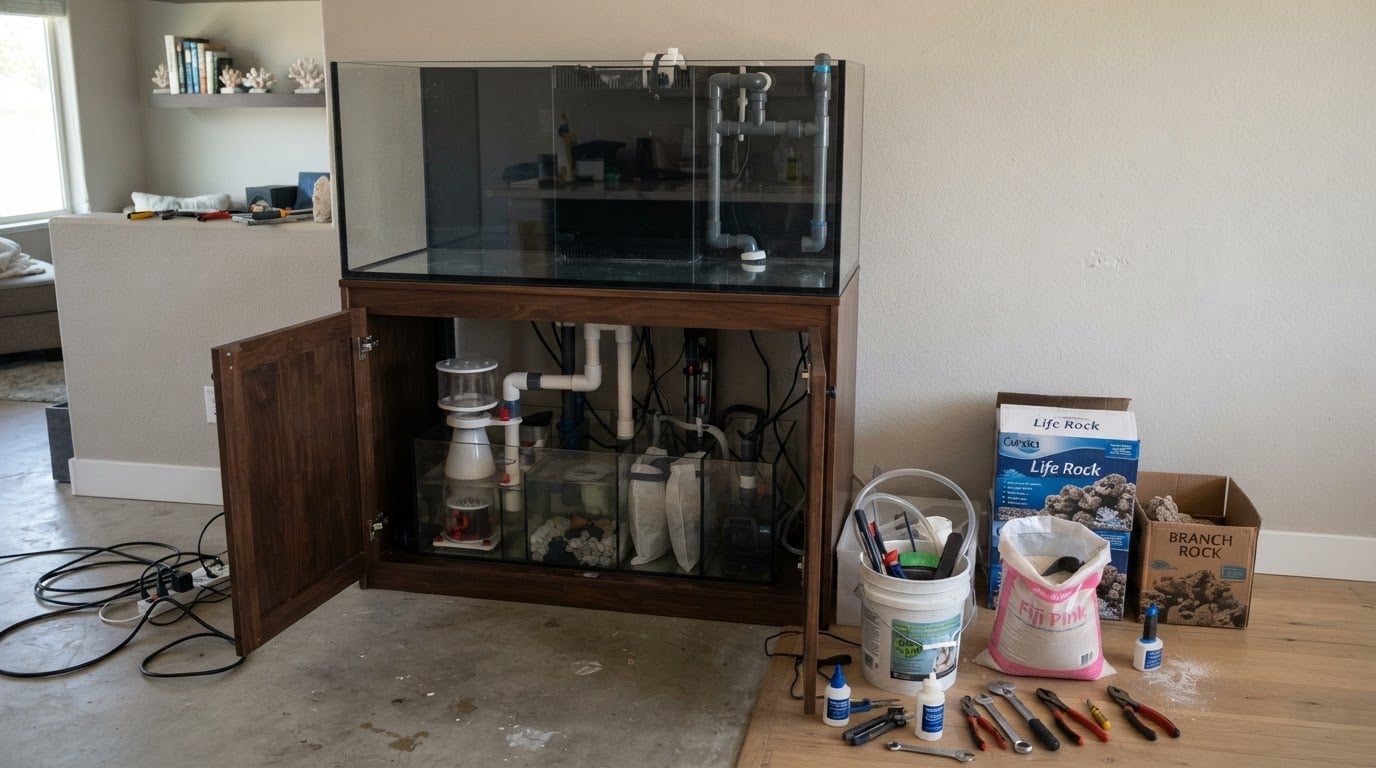
Dry rock is cheaper than live rock; live rock carries the biology but also the hitchhikers. That is a genuine trade-off between cost, time-to-stable, and pest risk, not a settled preference.
Salt and water
Salt and a pure water source belong in the setup budget, not only the running one, because the first fill and the cycling water changes both consume salt.
Most marine keepers use a reverse-osmosis unit or buy purified water. The unit and its replacement cartridges are a setup cost; buying water by the container is a running cost that grows with volume and becomes inconvenient quickly on a large system.
Test kits
Test kits are a startup cost that never fully stops. Salinity, alkalinity, pH, ammonia, nitrite, and nitrate are the baseline set for a new system; a reef adds calcium, magnesium, and phosphate. Refill reagents are a recurring line.
The living-stock layer
Livestock is the last line you should price and the first one that a rushed build loses.
Fish, cleanup crew, and corals are priced individually, so the total depends on how heavily you stock and how patient you are. Two budgets with identical equipment can differ widely on stocking choices alone.
The honest way to plan this line is to set a replacement allowance. New systems lose stock to cycling mistakes, acclimation errors, and disease; a quarantine setup and a slower stocking order reduce that loss. Quarantine gear — a small spare tank, a heater, a filter, and test kits — is a cost you pay once to avoid paying repeatedly in livestock.
Corals are the largest variable inside this layer, because price is set by species and rarity rather than by tank size.
The running-cost layer
The running cost is the part of saltwater aquarium setup cost that never finishes: salt, water, food, test reagents, replacement media, electricity, and hardware.
The predictable portion is easy to estimate. Salt and purified water scale with the volume you change each week or month. Filter cartridges, media, and reagents are consumables on a fixed cycle. Electricity scales with pump, light, and heater runtime, and lighting and heating are usually the two largest draws.
The unpredictable portion is a reserve, not a guess. Pumps fail, heaters stick, and a light fixture may need service or replacement. A maintenance reserve is part of a realistic budget; treating it as zero is how a hobby turns into a surprise expense.
How nano, mid-size, and large systems shift the total
Size does not multiply every line equally, which is why estimates built by scaling a small build upward fail.
Nano systems
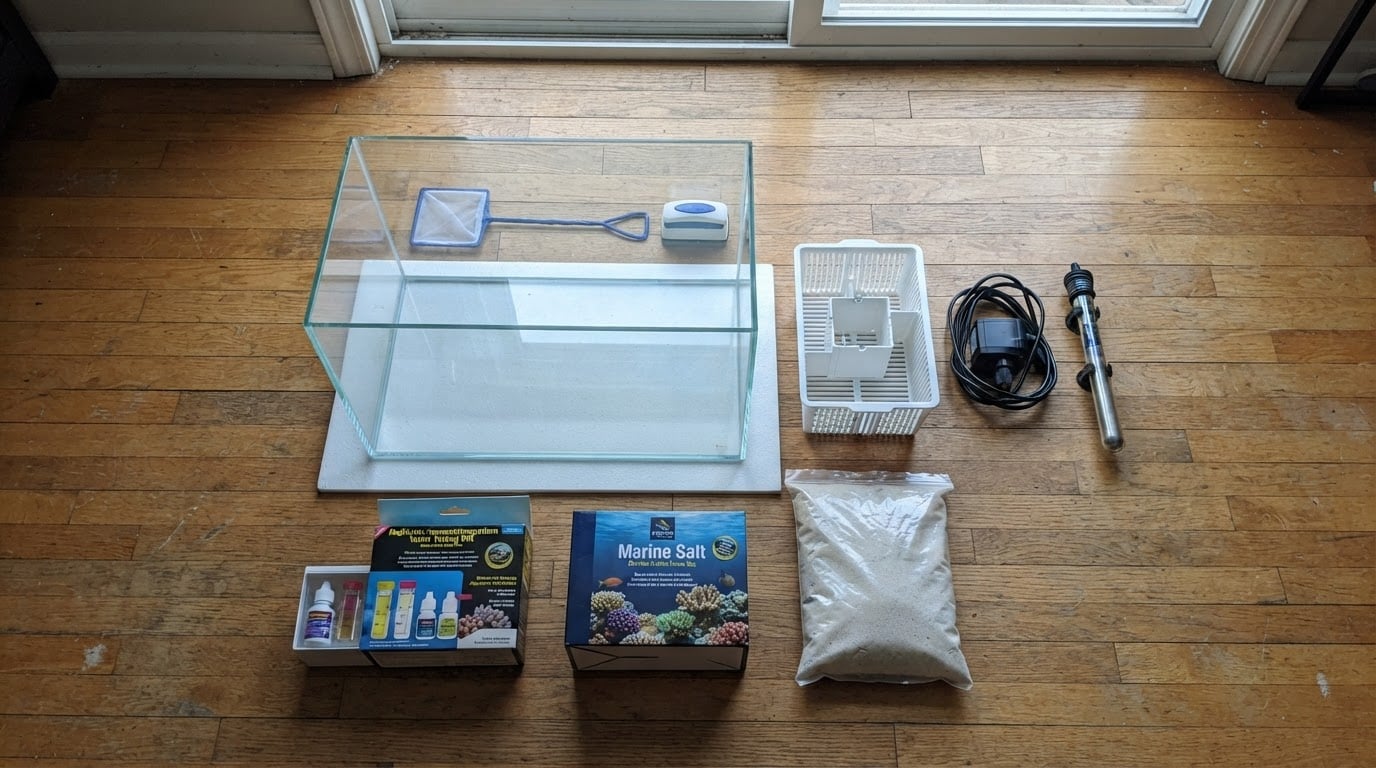
Nano systems carry the lowest total and the highest cost per gallon, because the fixed equipment — filter, pump, heater, test kits, water source — is spread across very few gallons.
Their trade-off is stability. Small water volume changes chemistry quickly, so a nano forgives less: a missed top-off, an overfeeding, or a temperature swing moves parameters in hours rather than days. Money saved on hardware often returns as time and attention.
Mid-size systems
A mid-size system is where fixed costs start to amortize. Rock, sand, salt, and livestock scale upward, while the equipment list grows by category rather than by count: a larger skimmer, one more circulation pump, a light sized for the footprint.
This is the band where an all-in-one unit often stops being adequate and a sump starts paying for itself.
Large systems
Large systems are priced by plumbing and support infrastructure, not by the display tank. Water volume pushes rock, sand, salt, and livestock up in a straight line, while the system adds a sump, return plumbing, more flow, more heating capacity, and a water-production and storage setup that a nano can usually skip.
The trade-off at this size is commitment. Everything costs more to change once it is filled, so planning — equipment selection, electrical capacity, floor support, and water access — is where the money is saved or lost.
The trade-offs that move the number most
- Coral ambition versus light budget. Buying for fish-only and upgrading later usually costs more in total than choosing the final coral goal first.
- Purchase price versus replacement risk. Used gear and cheap pumps save today and can cost a second purchase plus livestock.
- Simplicity versus upgrade path. All-in-one systems are cheaper to complete and harder to expand; sump systems cost more up front and accept upgrades.
- Speed versus livestock loss. Rushing the nitrogen cycle and skipping quarantine is the fastest way to convert equipment money into replacement fish.
How to build an estimate you can actually use
- Fix volume and system type first. Write down the tank size and whether it is all-in-one, hang-on, or sump-fed. Every later line depends on that decision.
- List fixed equipment once. Return pump, heater, controller, test kit, water-production unit, and quarantine setup are the same purchases whether the tank is small or large.
- Price the volume-driven items per gallon. Rock, sand, salt for the first fill and cycling changes, and purified water. Multiply your local prices by your actual gallons.
- Choose the lighting class from the coral goal, then price it. Fish-only and coral systems are different budgets, and the light is where the gap shows up.
- Set livestock and the replacement allowance separately. Price the planned stock, then add a reserve for losses plus a quarantine tank instead of assuming neither happens.
- Add the monthly flow as its own number. Salt, water, food, reagents, media, electricity, and a hardware reserve.
Complete when you can state three figures: the one-time build cost, the monthly running cost, and the replacement reserve. If you have only one total, you have a quote, not a budget.
Follow-up questions people actually ask
Budget planning
Is a saltwater aquarium setup cost calculator worth using?
Only as a checklist, not as an answer. A calculator returns whatever its input categories and default prices produce, so it helps confirm that no line is missing — rock, salt, test kits, quarantine gear — and stays unreliable for a number you have not verified against your own suppliers.
How does DIY change a saltwater aquarium setup cost?
DIY moves money from the assembled product into parts, tools, and time. It saves on a stand, rock, and plumbing you can source yourself, and it costs more when a cheap component does not match the rest of the system and has to be replaced. DIY pays when you enjoy the build and know the specification; it backfires while you are still learning the basics.
How much should a beginner budget for a first saltwater aquarium?
Beginner budgets are better set by the smallest system you can keep stable than by the cheapest kit available. A simple all-in-one, a reliable heater, a proper water source, and a test kit cost more than a discount bundle but remove the most common reasons beginners lose livestock and re-buy.
Size and scope
How much does a 100-gallon saltwater tank cost to set up?
At that size the tank is a minor line. The total is set by rock and sand volume, sump and return plumbing, lighting spread across a large surface, salt and purified water for initial and routine changes, heating capacity, and electricity. A 100-gallon build also needs water production and storage that a nano can usually skip.
Does location change a saltwater aquarium setup cost?
Yes, through electricity rates, tap water quality and purification needs, local livestock availability, and delivery charges for heavy items. Two keepers buying the same equipment list can end up with different totals without doing anything differently.
Running cost
How much does it cost to maintain a saltwater aquarium?
Maintenance is the sum of consumables plus reserves: salt and water for changes, food, test reagents, filter media, electricity, and a hardware replacement fund. Salt and water scale with volume, while electricity scales with light and heater runtime. It is easier — and more honest — to estimate monthly than yearly.