The Direct Answer: Corals Need Stability Before They Need Numbers
Search coral care and you'll get a wall of parameter ranges. The ranges matter — but they are rarely what kills corals. A tank that drifts from 8 dKH to 11 dKH over a weekend will hurt its corals even though both readings sit inside the "correct" band. Two systems can post identical test results on Saturday and only one of them grows coral, because one drifts and the other doesn't.
Four things decide whether corals live:
- Water chemistry held in narrow, steady bands — alkalinity, calcium, magnesium, temperature, and salinity.
- Light matched to the coral type and raised slowly, not dropped on the frag at full strength.
- Flow strong enough to feed and clean, shaped so it doesn't sand-blast tissue.
- Placement and compatibility — the right spot, with room from neighbors that sting, smother, or chemically attack.
Get those four right and most "difficult" corals become ordinary ones. Get them wrong and even a beginner coral like a mushroom or a leather will slowly decline.
Reef Tank Parameters: Working Ranges, Not a Scoreboard
No single set of numbers fits every tank. A soft-coral nano, a mixed reef, and an SPS-dominated system run different targets, and your salt mix is formulated for a specific set. Treat this table as a working band and confirm your mix's expected values before you chase a reading.
Parameter | Common reef target | What it controls |
|---|---|---|
Temperature | 76-82°F (24-28°C) | Metabolism and bleaching risk; sustained readings above roughly 84°F stress most corals |
Salinity | 1.024-1.026 SG (about 35 ppt) | Every other reading you take, because evaporation raises it |
pH | 8.1-8.4 | Calcification; swings follow alkalinity and carbon dioxide |
Alkalinity | 7-9 dKH for a mixed reef | The most swing-prone parameter, consumed by coral growth all day |
Calcium | 400-450 ppm | Skeleton building, consumed more slowly than alkalinity |
Magnesium | 1250-1400 ppm | Keeps calcium and alkalinity from precipitating out together |
Nitrate | 1-10 ppm | Coral food in trace amounts, algae fuel in excess |
Phosphate | 0.03-0.10 ppm | Same story; near-zero is not automatically better |
Ammonia and nitrite | 0 ppm | A cycle that isn't finished — a tank problem, not a coral problem |
Alkalinity deserves more attention than the rest. It is consumed continuously by calcifying corals and coralline algae, so it is the parameter most likely to move between tests, and corals respond badly to moving alkalinity even when the absolute value looks fine. Test it every two or three days in a young tank or while dialing in dosing, and don't "fix" a low reading by dumping buffer into the sump. Raise it slowly, over hours, and let it settle before testing again.
Two habits prevent most chemistry problems. Top off evaporation with fresh RO/DI water rather than saltwater so salinity doesn't creep upward, and change roughly 10 percent of the water weekly or every other week — water changes are the cheapest way to correct the ionic balance that individual additives cannot.
Light: Match the Coral Type, Then Ramp Slowly
Corals are sold by type, and each type expects a different amount of light. These are starting bands, not exact prescriptions: PAR meters measure differently, and rockwork, shadowing, and water clarity change what a coral actually receives.
- Soft corals — zoanthids, mushrooms, leathers, Kenya tree: roughly 50-100 PAR. They can live low in the tank and often color up better in moderate light than under a spotlight.
- LPS — Euphyllia, Acans, Favia, Duncans, candy cane: roughly 100-150 PAR, with room to expand.
- SPS — Acropora, Montipora, Seriatopora, Stylophora: 200-350+ PAR, plus the stability to match. These are the corals that punish a half-finished setup.
The practical fix is to treat your rockwork as zones: low light near the sand bed, moderate light along the mid-rock face, and the strongest light on the top rock. That way a new frag has somewhere to start and somewhere to graduate to.
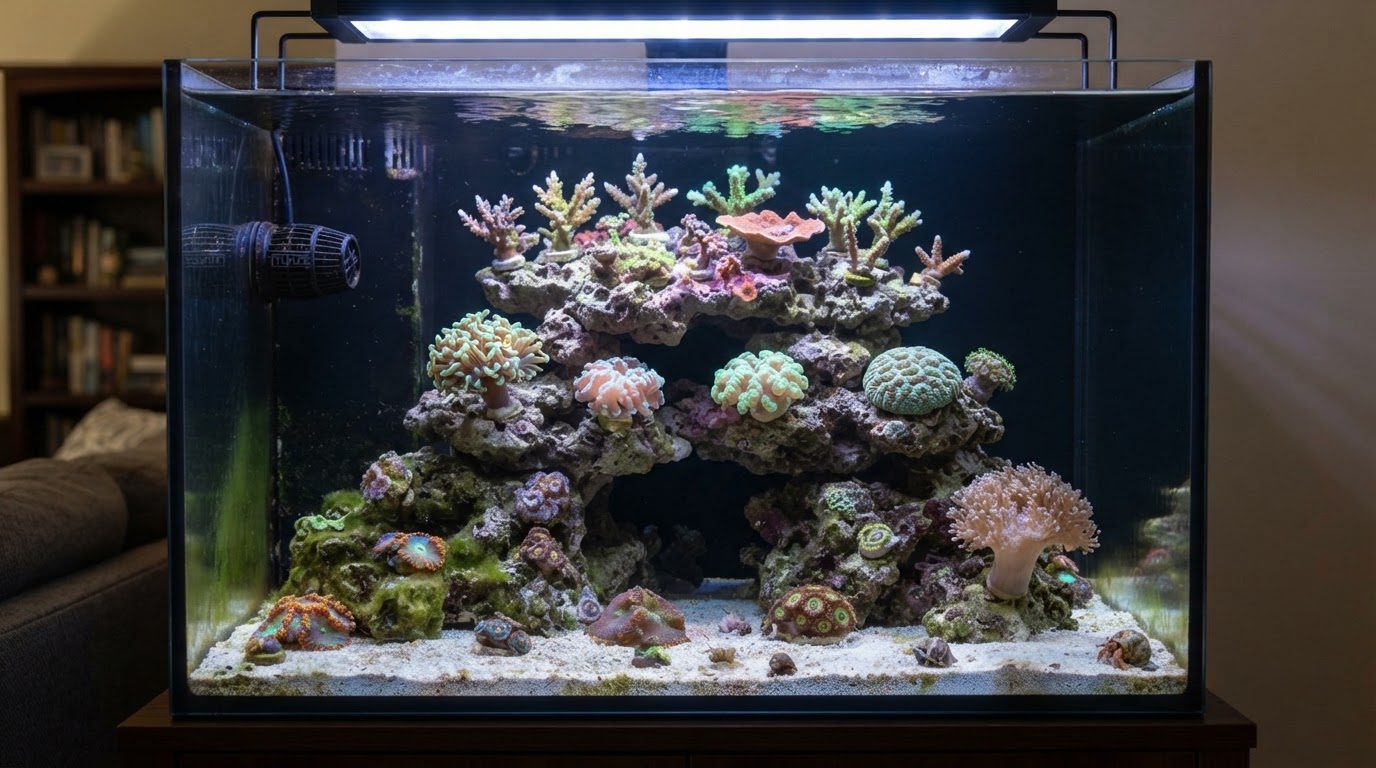
Then ramp. Start any new coral lower and dimmer than you think it needs, and raise it — physically or by increasing intensity 10 to 20 percent a week — over two to four weeks. Watch the coral, not the calendar. Expanded polyps, obvious growth tips, and stable color mean the placement is working. A coral that bleaches or retracts its polyps after a light change is telling you the move was too fast; dial the intensity back and hold it there for a week.
Run a photoperiod of about 8 to 12 hours of meaningful intensity, with ramps on either end. Longer is not better: it adds algae growth without adding much coral growth, and it gives the tank more time to overheat.
Flow: The Parameter That Never Shows Up on a Test Kit
Flow does three jobs: it carries food and dissolved gas to the coral, moves waste away, and keeps detritus suspended long enough for the filter and skimmer to catch it. Surface agitation also drives gas exchange, which keeps pH from sagging overnight.
Most reef tanks target turnover of roughly 20 to 40 times the display volume per hour. Soft coral systems do fine at the low end, and SPS systems generally want more. But turnover is a rough proxy, and the shape of the flow matters more than its total. Random, alternating current from two or more directions beats a single pump aimed at the rock pile, because it clears dead spots without pinning any one coral in a jet.
Read the corals:
- Polyps extended, swaying, and opening fully: flow is in the right range.
- Polyps retracted, tissue pushed flat to one side, or flesh receding on the side facing a pump: too much direct flow.
- Polyps barely moving, detritus settling on the rock, a film building on the sand: too little.
One caution: a coral that suddenly starts receding on one side often has a flow problem, not a disease. Check the pump before you reach for a dip.
Placement and Acclimation: Where Most Corals Get Lost
The order is what matters: match temperature, dip, place it low, then raise it toward its permanent spot over two to four weeks. Skipping the low-light step is the most common reason a healthy frag fades in its first month.
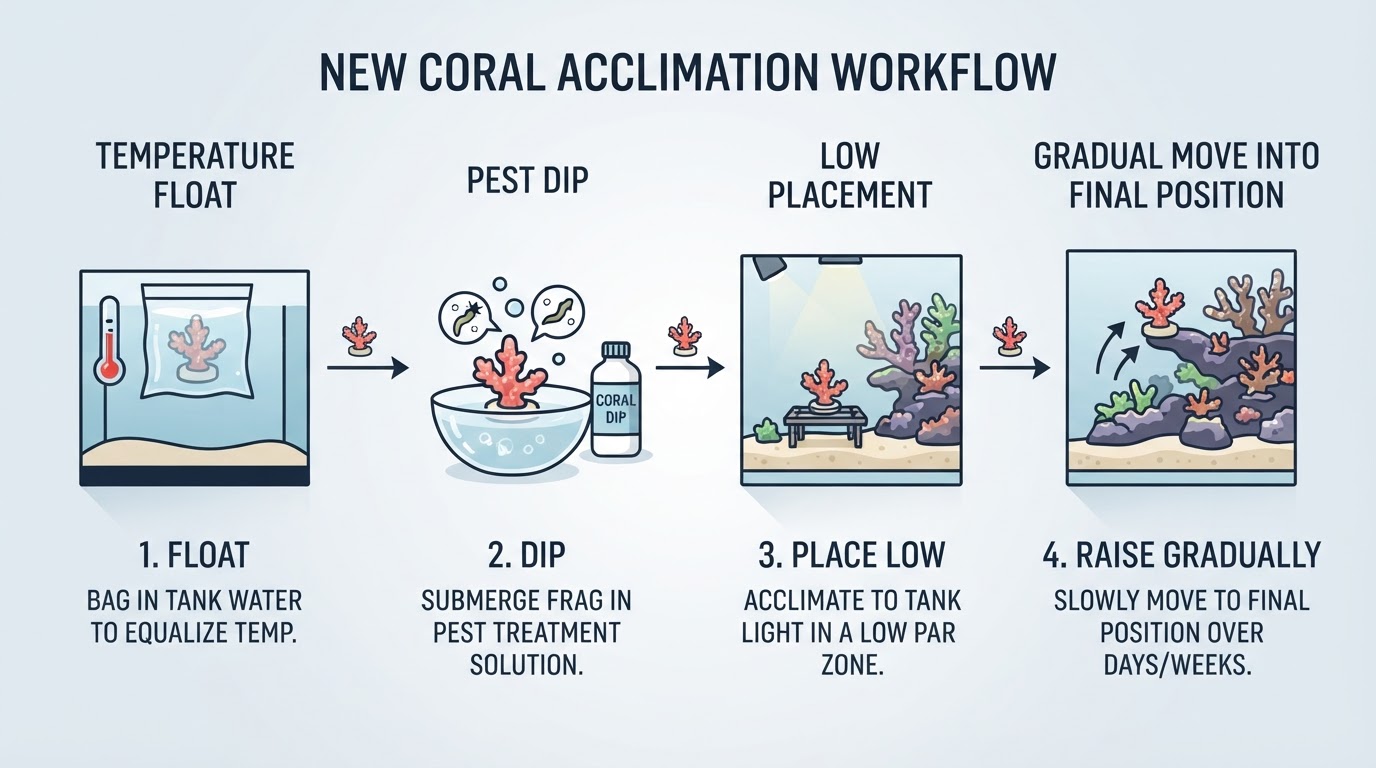
- Float the bag for 15 to 20 minutes so the water temperature matches before you open it.
- Acclimate to your water with a drip line or a few small exchanges over 30 to 45 minutes.
- Dip following the product instructions exactly. Dips target pests and bacteria; they are not a cure for a coral that is already dying, and some corals are more sensitive than others.
- Inspect for pests before the coral goes in. Flatworms, nudibranchs, red bugs, and Aiptasia hitchhike on frags, and they are far easier to deal with in a dip container than in a stocked tank.
- Start low on the sand bed or a shaded rack for one to two weeks.
- Move it up in steps until it sits in the light and flow zone its type expects.
Placement decisions matter as much as acclimation:
- Give aggressive corals their own island. Galaxea, Hydnophora, and other heavy stingers can reach across several inches, and Euphyllia sweepers extend at night. Put them downcurrent of delicate corals so stinging and chemical attacks drift away from your prized pieces.
- Respect chemical warfare. Corals compete with dissolved compounds as well as tentacles. Running fresh carbon and keeping up with water changes blunts the effect when a new addition makes a nearby coral close for days.
- Leave room to grow. A frag on a plug looks tiny today; an encrusting Montipora or branching Acropora will claim that space within a year. Space placements so neighboring colonies will not touch when mature.
- Match mounting to the coral. Gel superglue for frag plugs and small bases, epoxy putty for irregular rock, and rock rather than sand for corals that encrust or branch. Never bury living tissue in glue or substrate.
- Mind the fish. Dwarf angelfish and many butterflyfish are known coral nippers, and some blennies perch on colonies. If a coral stays closed while everything tests fine, watch the tank after lights out.
Feeding Corals: A Supplement, Not the Main Course
Healthy corals get most of their energy from their symbiotic algae and the light you provide. Feeding adds growth and color for corals that can capture food — it does not replace adequate lighting, and it is not a rescue treatment for a bleaching coral.
- Target feed LPS with visible mouths — Acans, Trachyphyllia, Duncans, candy cane, Euphyllia — one to three times a week with mysis, brine shrimp, chopped krill, or a quality pellet. Turn the flow off briefly or use a feeding cylinder so the food lands on the coral instead of the overflow.
- Feed SPS and soft corals fine foods if you want faster growth, but keep expectations honest. Amino acid and fine-particulate foods can help; they cannot compensate for unstable alkalinity.
- Feed filter feeders like gorgonians and feather dusters frequently and finely. These are the corals where regular small feedings make the clearest visible difference.
- Let the coral tell you when. Many LPS extend feeding tentacles after lights out. Feeding then means less food is stolen by fish and less of it rots in the water.
Overfeeding is the classic beginner mistake, and it shows up on the test kit before it shows up in the coral: uneaten food decays into nitrate and phosphate, and the algae that follows smothers frags. Judge feeding by test results and polyp response, not by how generous you feel.
When Something Goes Wrong: Symptom, Cause, First Move
What you see | Likely cause | First move |
|---|---|---|
Coral turns white (bleaching) | Temperature spike, light shock, or an abrupt parameter change | Fix the cause, keep the coral's placement stable, and do not dose anything as a reaction |
Tissue peeling from the base and moving up (STN/RTN) | Alkalinity swing, bacterial infection, or shipping stress | Test alkalinity and temperature immediately, and frag healthy branches away from dead tissue |
Brown, jelly-like mass on an LPS head | Bacterial infection, usually after injury or shipping | Siphon or cut away the affected head, follow the dip instructions you have, and improve flow around the colony |
Polyps stay closed for days | Flow that is too strong, a neighboring coral, a nipping fish, pests, or a parameter swing | Test everything, inspect after dark with a flashlight, and move the coral to a calmer spot before treating anything |
Algae growing over rock and frag bases | Excess nitrate and phosphate, weak flow, too few grazers | Remove it manually, correct nutrients with water changes, and add a grazer that is safe with corals |
A coral loses color and stops growing but does not bleach | Starvation or chronically low light | Move it up in the tank gradually, and start target feeding if it has a mouth |
Notice how few of these end with "add a product." The fastest repair in almost every row is restoring stability — correcting the cause, then leaving the tank alone long enough for the coral to respond. Corals recover slowly, and a tank that gets a new additive every day never gives them that chance.
A Coral Care Routine That Takes Twenty Minutes a Week
The work is front-loaded: get the system stable, then spend your time observing rather than adjusting.
- Daily: glance at temperature, water clarity, and polyp extension, and top off evaporation with RO/DI water.
- Every two to three days: test alkalinity if you are dosing, running SPS, or breaking in a young tank.
- Weekly: test salinity, calcium, magnesium, nitrate, and phosphate; empty the skimmer cup; clean the glass; change about 10 percent of the water if nutrients are trending up.
- Monthly: clean pumps and check that flow paths have not narrowed; look for pests; calibrate your refractometer.
- Every change: make one adjustment at a time and wait two weeks. Two changes at once teach you nothing about either.
Before You Buy a Coral: A Sixty-Second Check
Run this before you hand over your money:
- Is the tank stable? A month of steady test results plus visible coralline growth is a better signal than the calendar. If ammonia or nitrite ever reads above zero, wait.
- Can my light and flow support this coral type at the spot I have open?
- Is there room for it to grow without touching a neighbor?
- Will my fish leave it alone? Research the specific species you keep rather than trusting a general "reef safe" label.
- Do I have the dip, the glue or putty, and the time to acclimate it properly?
For species-level starting points, Sea Life Planet publishes species care guides built around a Quick Facts panel — scientific name, care level, minimum tank size, and water-parameter target ranges — including entries aimed at checking a coral's realistic tank requirements before you stock it. Use them to set your starting bands, then let your own test results and the coral in front of you decide whether the placement is working.
First-level category landing for corals and invertebrates: H1, intro, and section overview for reef tank care guides.
Common Coral Care Questions
Can I keep corals in a brand-new tank? Wait until the tank has finished cycling and held stable readings for several weeks. Fast, forgiving corals such as mushrooms, zoanthids, and leathers handle a young system better than SPS, but none of them thrive in a tank that is still swinging.
Do corals need to be fed? Not the way fish do. Photosynthetic corals feed themselves through their algae and your lighting; feeding is a supplement that improves growth and color, especially for LPS with large mouths.
Why is my coral turning white? Bleaching means the coral has expelled its symbiotic algae. Check temperature first, then recent light changes, then salinity and alkalinity. If the tissue is still intact, the coral can recover once conditions stabilize. If the tissue is peeling away, that is a different problem with a different response.
What temperature is safe for corals? Most hobby systems run 76-82°F. Sustained temperatures above roughly 84°F are a bleaching risk, and the spike matters more than the average.
Do I need a sump or a skimmer? A sump makes stability easier, and a skimmer removes organic waste before it becomes nitrate and phosphate, but neither is magic. A simple tank with consistent water changes can grow soft corals and many LPS without a skimmer.
How do I know a coral is happy? It opens fully during the day, holds its color, extends feeding tentacles at night if its species does, and shows new growth at the edges or tips. An open coral that never grows is surviving, not thriving.
The Honest Verdict
Corals are not fragile. Reef tanks are. A colony that has grown on a reef for years can survive shipping, dipping, and mounting — what it struggles with is a system that changes faster than it can adapt. Pick your target ranges, test on a schedule, change one thing at a time, and let the corals tell you whether it is working. That is coral care, and it is less about the numbers than about how steadily you hold them.