What Reef Cleaners Actually Do (and What They Can't)
"Reef cleaners" is the hobby's shorthand for a cleanup crew, usually shortened to CUC: the snails, crabs, shrimp, stars, and cucumbers that graze algae and eat leftover food before it rots.
That is the entire job description. A cleanup crew is not filtration and it is not nutrient export, and treating it as either one is how tanks end up carrying more animals than the system can feed.
The distinction that decides every purchase is this. A snail eats algae, digests it, and releases waste. The nitrogen and phosphate are still in the tank; they leave through water changes, a protein skimmer, harvested macroalgae, or media. Add ten snails to a tank with rising nitrate and you have added ten more animals producing ammonia. High numbers on a test kit are a nutrient problem, not a staffing problem.
It helps to think in four roles, because you are hiring for one of them.
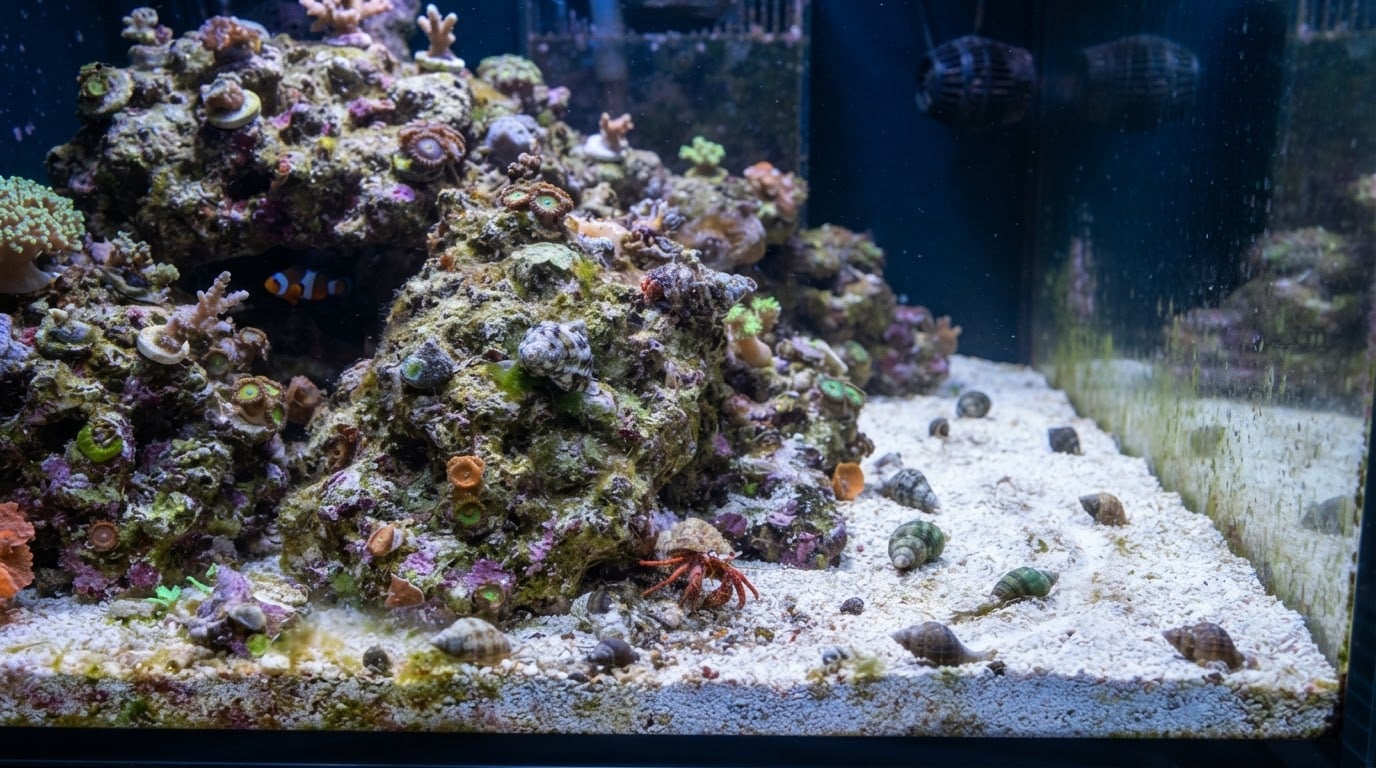
- Grazers work surfaces: rock, glass, and the back wall. Trochus, Astraea and turbo snails, nerites, and most urchins.
- Sediment feeders work the sand bed and the base of the rock: cerith snails, fighting conches, Nassarius snails, and a few cucumbers.
- Scavengers work food that never reached a fish: hermits, shrimp, serpent stars, emerald crabs.
- Biofilm grazers you will rarely see: copepods and amphipods feeding on film and, in turn, feeding your fish.
Most cleanup crew regret traces back to buying for a role the tank did not need, or buying an animal that eats something you wanted to keep.
Match the Species to the Job You Actually Have
Name the problem in plain language first, then buy the animal that solves it.
What you see | What usually fits | What to watch |
|---|---|---|
Film algae on glass and rock | Trochus, turbo, and nerite snails | Turban-type snails struggle to right themselves if they fall onto sand |
Diatom film on sand and glass | Cerith snails, small conches | They need a sand bed that is not compacted or cemented |
Leftover food and detritus | Nassarius snails, cerith snails, serpent stars | Feeding more means stocking more; stop when the sand stays clean |
Bubble algae | Emerald crabs, some urchins | Inconsistent eaters; remove what you can by hand first |
Aiptasia anemones | Peppermint shrimp | Many individuals ignore them, and some nip soft corals |
Long hair algae on rock | Urchins, large trochus | Most animals will not touch long strands; nutrient control is the real fix |
Pod diversity as fish food | Copepods, amphipods | A refugium or rubble zone gives them somewhere to multiply |
Three caveats matter more than the table.
First, "reef safe" is a probability, not a promise. Emerald crabs often eat bubble algae and occasionally eat something you did not want eaten. A peppermint shrimp that cleared Aiptasia in one tank gets blamed for coral damage in another. Hermit crabs are excellent scavengers that will kill a snail for its shell when the fit is right.
Second, a crew cannot fix what it does not eat. Cyanobacteria is bacteria, not an algae. Dinoflagellates are not on the menu. Long hair algae is a symptom of light and nutrient supply, and a crew will hold the edges at best while the underlying imbalance continues.
Third, sand-sifting stars and sea cucumbers deserve a separate warning. Both can do real work on a mature sand bed, and both fail badly in the wrong tank: the stars often starve in small systems, and a stressed or dying cucumber can release compounds that harm everything else in the water. If you are not confident about that risk, skip them.
How Many Reef Cleaners Should You Add?
Count the food, not the animals. That is the whole method, and it is worth more than any stocking chart.
Most tanks need fewer animals than the package deals suggest. The classic failure is not undergrazing; it is starvation. The crew cleans up the problem, has nothing left to eat, and then the snails stop moving while the hermits start working through every shell in reach.
A common starting scaffold is one grazing snail per 5 to 10 gallons of display volume. Use it as a hypothesis to test in your own tank, not a target to hit. Four variables move the number up or down:
- Rock surface area. More rock means more grazing surface and more food.
- How much you feed. Heavy feeding supports a larger crew and requires one.
- Light and nutrients. More light plus available nitrogen and phosphate grow more algae, which feeds more animals.
- Whether anything eats the crew. A wrasse or hawkfish can thin the population faster than you can add to it.
Add in waves instead of one order. Put in a small group, watch for two to three weeks, and add the next group only if the first one is still working and still in place. If the glass grows film faster than it gets cleared, add. If shells start piling up, stop and feed.
The Mistakes That Wipe Out a Crew
- Ignoring the fish. Many wrasses, hawkfish, triggers, puffers, and larger angelfish treat the crew as food. Even a fish that only nips keeps snails hiding, and hidden snails do not graze.
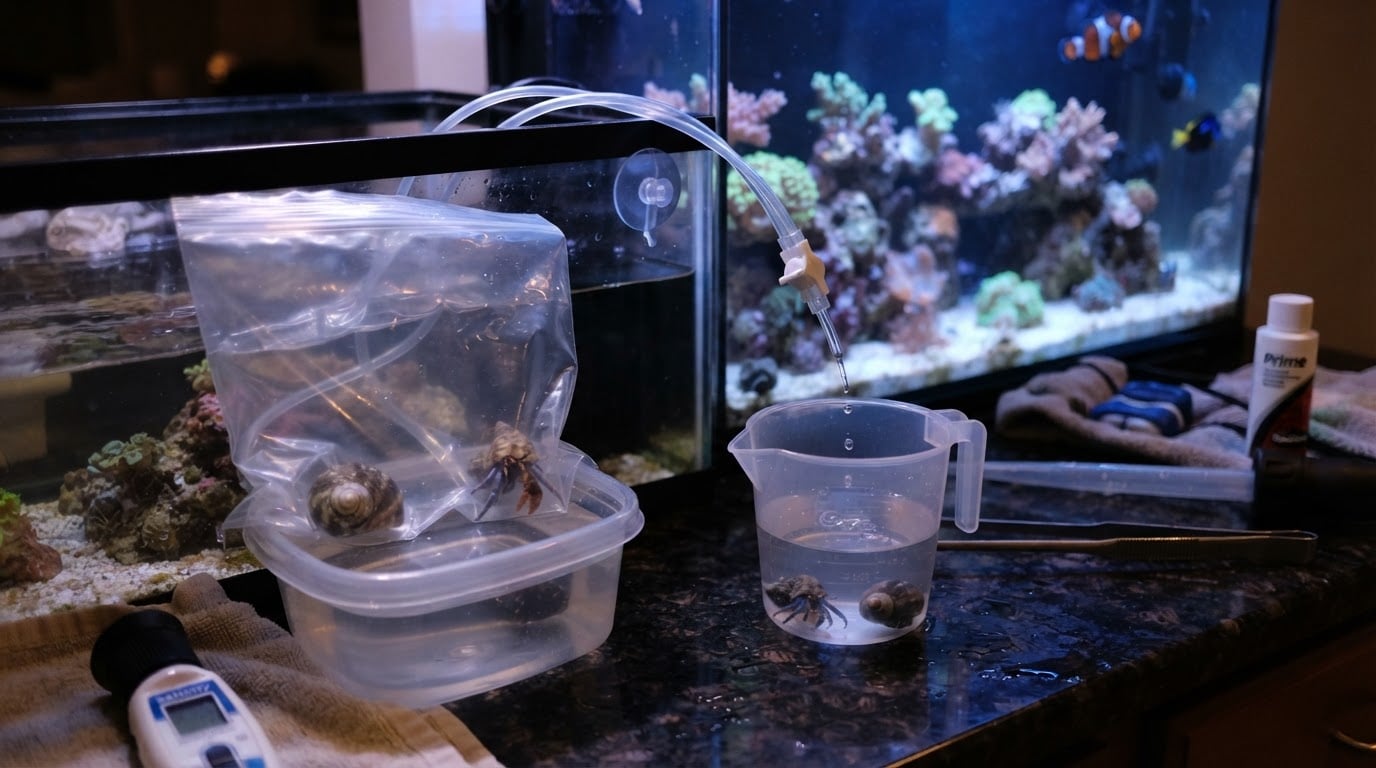
- Skipping acclimation. Invertebrates handle temperature and salinity swings poorly. Float the bag, drip tank water in slowly, and place the animals in the tank without pouring in the store water.
- Copper exposure. Copper is the standard treatment for several fish diseases and it is lethal to snails, shrimp, and crabs. Keep inverts out of treated systems and be careful with shared equipment.
- No spare shells for hermits. Hermits need larger shells as they grow. Without them, the nearest snail becomes the upgrade.
- Buying before the tank can feed them. Wait until ammonia and nitrite hold at zero for a full week, salinity and alkalinity are steady, and there is visible food for the crew to eat.
- Expecting nutrient control. The crew recycles nutrients. It does not remove them.
A Build Order That Works
- Stabilize the tank. Cycle complete, ammonia and nitrite at zero, temperature and salinity steady for at least a week.
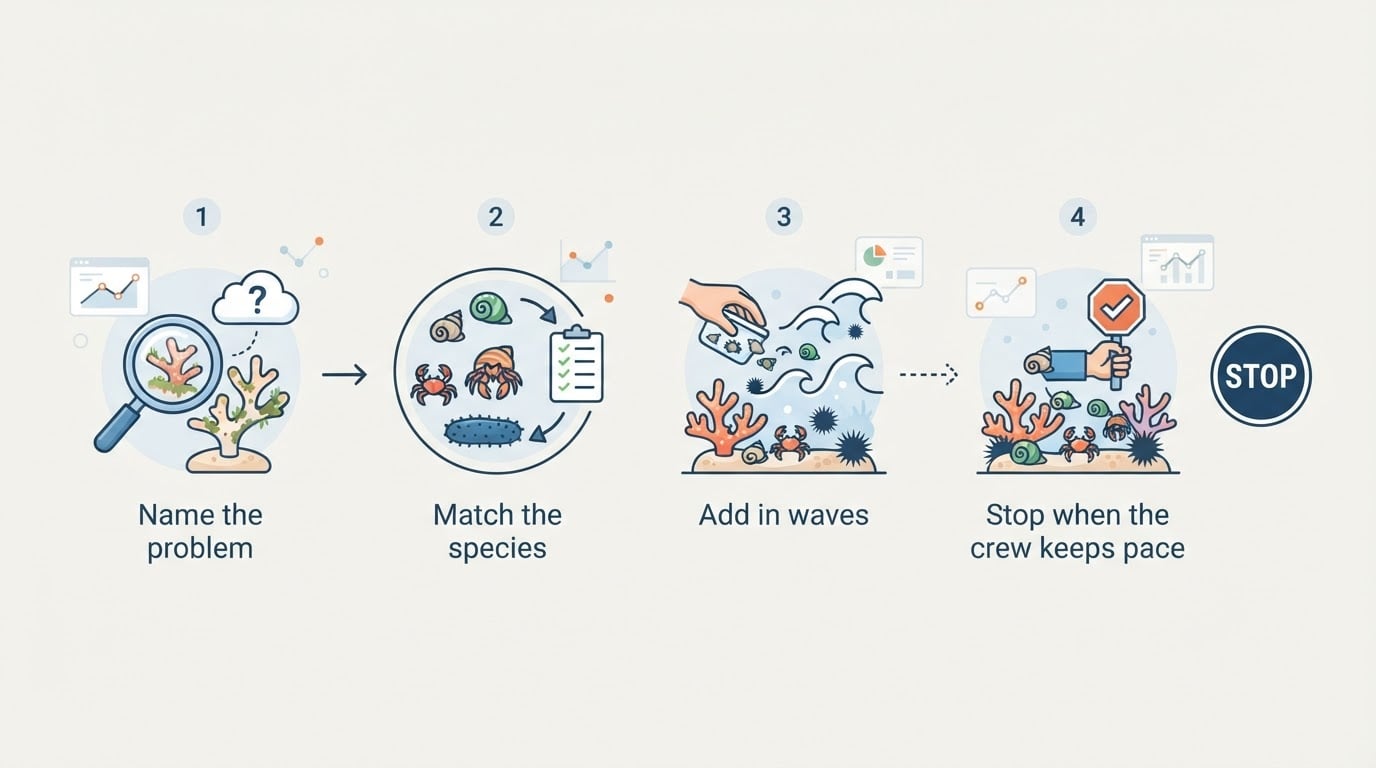
- Name the dominant problem. Film algae, hair algae, leftover food, detritus on sand, bubble algae, or Aiptasia. Pick one.
- Match one species group to that problem. Buy the smallest useful group, not the biggest package.
- Acclimate properly. Float, drip, place gently. Snails are not meant to be dropped in.
- Add in waves. Two to three weeks between groups, so you can see what each one actually does.
- Checkpoint after every wave. Is the problem area shrinking? Is every animal moving? Any empty shells or uneaten food?
- Adjust once. Move animals to where the problem is, feed if the tank is too clean, or add a species for the next problem.
- Stop when the crew keeps pace. The nuisance stays at a low baseline without scrubbing for a few weeks, the animals stay active, and nitrate and phosphate stay level or fall. Then stop buying.
Common Questions About Reef Cleaners
Are hermit crabs reef safe?
Mostly, with one expensive habit. They eat algae and leftover food, and they kill snails for shells. Provide spare shells and accept a few losses, or run a snail-only crew.
Do I need a cleanup crew in a brand-new tank?
Not on day one, and not until there is food for them. Add the first small group after the cycle, then let the tank tell you what else is needed.
What actually eats bubble algae?
Emerald crabs and some urchins eat it, unreliably. The most dependable method is still to remove the affected rock, scrub the patches off in a separate container of tank water, and rinse before it goes back.
Can I mix snails and hermits?
Yes. Expect some hermit-versus-snail conflict and plan for the shell supply.
Is an urchin worth adding?
If you have filamentous algae across rock and you can secure loose frags, an urchin is one of the few animals that will clear it. Expect it to bulldoze small pieces and graze coralline algae along with the nuisance growth.
Will a cleaner shrimp cure my fish of parasites?
Cleaner shrimp pick at dead tissue and external parasites, but they are not a treatment. Quarantine and the right medication are the tools that work.
Do I need to feed the crew?
Yes. If the tank is clean enough for the crew to starve, feed it directly. A piece of nori or a sinking pellet keeps animals alive between algae blooms.