Key answers at a glance
- Small species with narrow, pointed claws are the reef-safe ones. Blue-leg, scarlet reef and similar small hermits scrape algae and scavenge without breaking into coral or snail shells.
- Adult size matters more than the label on the bag. A crab sold at half an inch can reach two inches or more, and its appetite and claw strength grow with it.
- Spare shells prevent most snail deaths. Two or three shells per crab, slightly larger than the one it wears, remove the main reason a hermit attacks a snail.
- Large species with crushing claws are the ones to avoid. White-spotted and other big Dardanus hermits can open snail shells and take coral tissue.
- Reef safe means low risk, not zero risk. Any hermit can topple a frag, steal coral food, or nip a soft coral when it is hungry.
- Drip acclimation and stable salinity protect the animal you bought. Match temperature and 1.023–1.025 specific gravity over 45–60 minutes before release.
- Weekly snail counts catch predation early. A hermit wearing a snail-shaped shell, or a shell with a chipped lip, is the evidence you need.
- Cleanup crews remove waste; nutrients still come from feeding. Hermits eat uneaten food and film algae, while nitrate and phosphate follow feeding and stocking.
What "reef safe" means in practice
Reef safe means the animal can live in a coral system without routinely eating coral tissue or killing the snails and other invertebrates around it.
Sellers use the phrase as shorthand for three separate questions: what the crab eats, how much damage its claws can do, and how large it grows in your tank. A species can pass two of those questions and fail the third, which is why one keeper calls the same crab harmless and another calls it a menace.
In practice, hermit crab risk appears in four forms:
- Coral flesh nipped from soft corals and LPS polyps, usually after dark
- Frags and small colonies toppled, dragged, or wedged into rock
- Snail shells opened from the lip, leaving an empty shell or a hermit inside it
- Food pulled out of LPS polyps before the coral can ingest it
Reef safety is therefore a judgment about one species at one size. A blue-leg at half an inch and a white-spotted hermit at four inches are both hermit crabs and are not comparable aquarium animals.
Size class and claw shape decide the risk
Adult size and claw shape predict damage better than any species list on a sale page.
Three size classes cover almost every hermit sold for reef tanks:
- Small, up to roughly 1.5 inches. This is the class that earns the reef-safe label: small hermits graze algae film and pick through detritus, and their claws are too weak to open a healthy snail.
- Medium, roughly 1.5 to 2.5 inches. These still clean rock, but they take meaty food readily, investigate coral food, and can shift small colonies.
- Large, 3 inches and up. Large hermits eat a broad omnivorous diet and their claws are built for breaking shellfish, which includes the snails in your cleanup crew.
Claw shape tells you how a crab feeds:
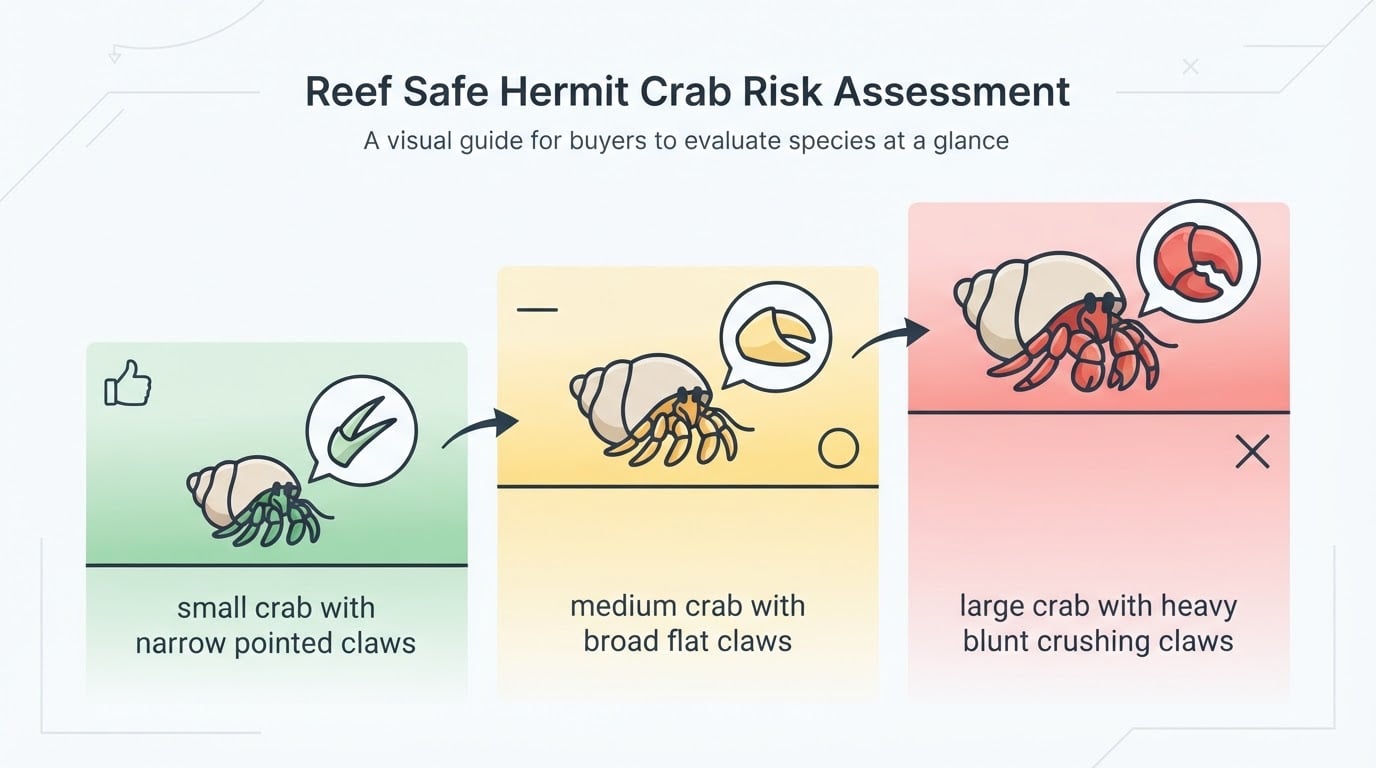
- Narrow, pointed pincers scrape film algae from glass and rock.
- Broad, flat claws scoop detritus and can grip coral flesh and food.
- Heavy, blunt claws crush shell and skeleton, and belong to the species that cause the losses people complain about.
Judge size by the shell opening rather than the body you can see. A hermit in a shell with a one-inch opening is a substantial crab, while one in a half-inch cerith shell is still small; a crab whose legs bulge out from a shell that sits tipped upward has outgrown it and will be looking for a replacement. Leg span at purchase is a snapshot, not a limit. Most hermits are sold as juveniles, and the animal that fits your aquascape this month can be a problem in a year.
Which species carry the reef-safe label
Blue-leg and scarlet reef hermits are the two most consistently recommended species; a few others qualify with caveats.
Species and trade name | Typical adult size | Claws | Practical verdict for a coral tank |
|---|---|---|---|
Blue-leg hermit, Clibanarius tricolor | About 0.5–1 inch | Small, pointed | Usually safe; the default choice for small tanks |
Scarlet reef hermit, Paguristes cadenati | About 1–1.5 inches | Small | Usually safe; grazes rock and glass |
Electric blue or "janitor" hermit, Calcinus species | About 1.5–2 inches | Short, broad | Usually safe, but stronger and bolder than the size suggests |
Orange-leg cone-shell hermit, Ciliopagurus strigatus | About 1.5–2 inches | Flat, scoop-like | Mixed reports; watch it near soft coral and LPS |
Thin-striped hermit, Clibanarius vittatus | 2–3 inches | Narrow but large | Useful algae eater when small; risk climbs with size |
White-spotted hermit, Dardanus species | 3 inches and up | Heavy, crushing | Not reef safe; opens snail shells and takes coral |
Trade names are not reliable. The same crab may be sold as a blue-leg, a dwarf, or a reef hermit, and mixed "cleanup crew" bundles sometimes include species from two different risk classes. Ask for the scientific name, or at least confirm the adult size and the claw type before you buy.
Shell supply is the main control on snail predation
A hermit crab attacks snails when it needs a bigger shell and cannot find one.
Hermits inspect shells constantly: they measure the opening, test the weight, and check the fit. When the shell they wear becomes tight, the next suitable shell in the tank is often on a living snail, and the crab will take it. That is why the same crab can live peacefully for months and then kill a snail in a night.
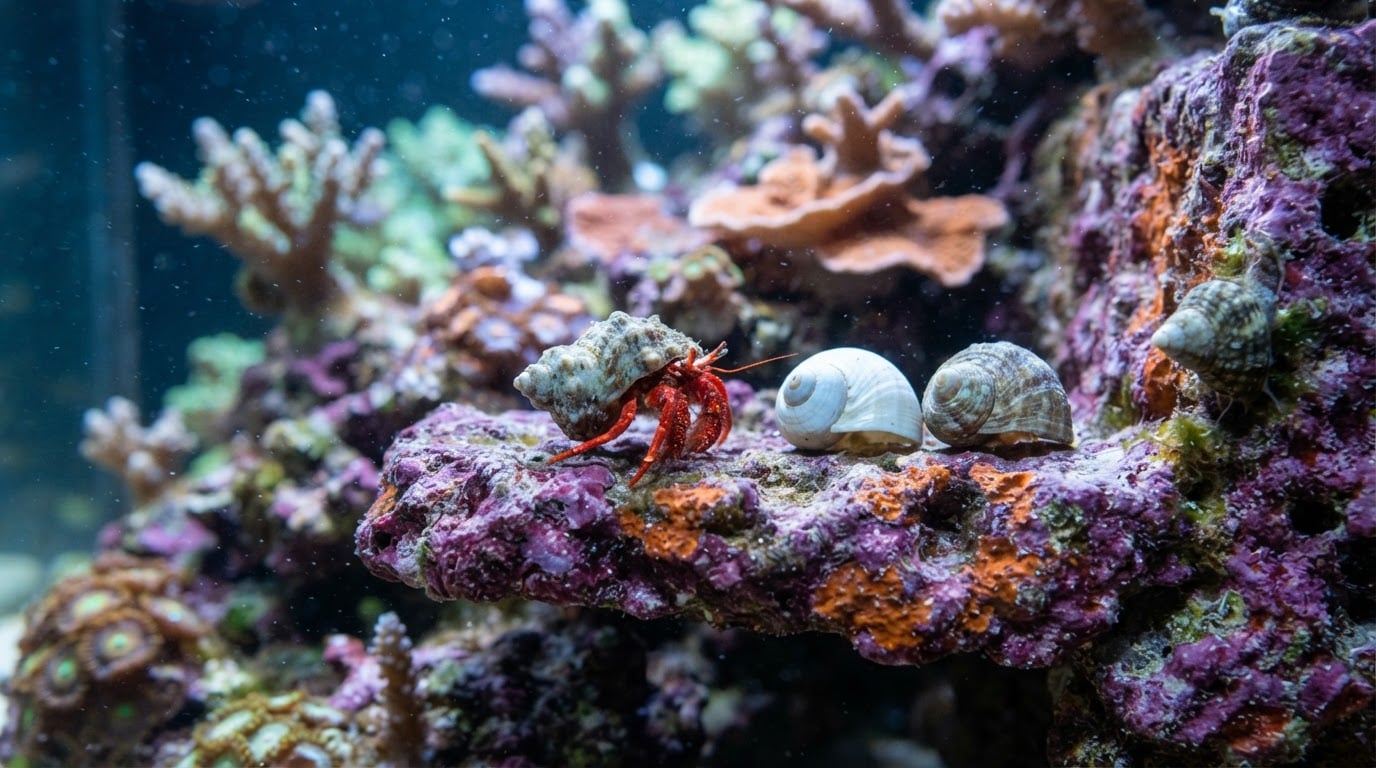
A workable shell policy:
- Two or three spare shells per crab. More than that is harmless; fewer guarantees competition.
- Slightly larger openings than the current shell. Skip shells so large the crab cannot carry them, and skip ones that are already too small.
- Mixed shapes. Provide narrow openings such as cerith and nassa types for the small species, plus a couple of wider openings for the larger hermits.
- Placed on sand or a low ledge away from coral. A crab dragging a shell through a coral head damages tissue on the way.
- Replaced as the crab grows. A shell that fitted in spring is a tight shell by autumn.
Shell fights between hermits follow the same logic. A crab without a suitable shell will try to evict another, and a large hermit can kill a smaller one for its shell. Keep the surplus ahead of demand and the aggression drops.
What hermits actually contribute to a cleanup crew
Hermits eat algae film, detritus, and uneaten food, and that is the whole of their job.
Their useful work:
- Grazing film algae from glass, rock, and equipment surfaces
- Picking food out of the sand bed and rock crevices before it decays
- Working the dead spots where detritus collects
- Adding some hair-algae pressure, particularly the thin-striped and blue-leg species
Their limits matter as much as their work. Hermits do not lower nitrate or phosphate, they do not replace water changes, and they do not fix an overfed tank. They also compete directly with snails and corals for food, and a hermit that carries nuisance algae on its shell can move it around the rockwork. When a tank is very clean, a hungry hermit is more likely to pick at coral food and soft tissue, so target-feed corals and drop sinking food for the crabs rather than letting them forage for it.
Stocking stays modest. A small group of small hermits suits a young reef; adding a larger species to the same tank rarely ends well for the smaller ones.
Acclimation, drip method, and the first two weeks
Drip-acclimate marine hermits over 45–60 minutes into matched water, then release them below the waterline and watch the tank closely for two weeks.
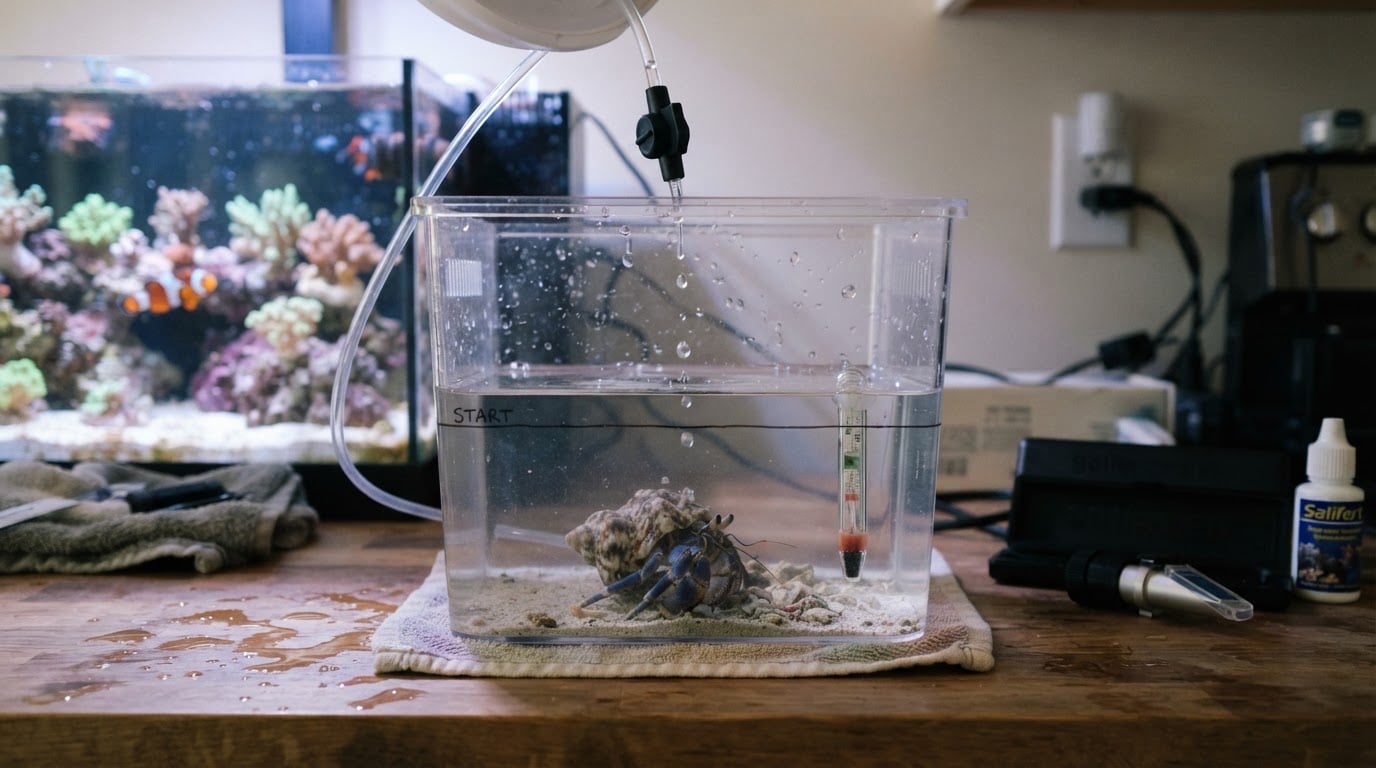
A sequence that works:
- Float the bag for 15 minutes with the lights off to equalize temperature.
- Start a slow drip with airline and a valve or knot, aiming for roughly one to two drops per second.
- Let the water volume roughly double over 45–60 minutes. Speeding this up defeats the purpose.
- Discard the shipping water. Do not pour it into the display tank.
- Release the crab onto rock or sand below the waterline, and leave the shell alone so it can settle.
- Match the system to 1.023–1.025 specific gravity at 72–78°F, and keep both stable rather than chasing a target number.
- Keep the animal out of copper. Copper-based medications are lethal to hermits, so never place one in a tank or holding container that has been treated with copper.
If you run an observation or quarantine tank, use it. Two weeks of observation shows you shell swaps, feeding behaviour, and any aggression before the crab meets your snails.
Tank mates and compatibility
Peaceful reef fish and small invertebrates are fine; ambush predators and other crabs are where the risk sits.
- Predatory and ambush fish. Groupers, lionfish, eels, larger wrasses, triggers, hawkfish, anglerfish, and puffers can all treat a hermit as food. The Valentini puffer in particular is sold as reef safe but will eat small invertebrates. The working test is mouth size: if a fish can take the crab's leg or body, it eventually will.
- Other hermit crabs. Larger species prey on smaller ones, and shell competition turns tank mates into rivals. Keep to one size class where possible.
- Other crabs. Emerald and other scavenging crabs compete for the same food and can bully a hermit away from a meal; decorator crabs add their own frag-moving habits.
- Snails. Heavy-shelled trochus and turbo snails usually survive; thin-shelled cerith and nassa snails are the vulnerable ones, which is another reason to keep spare shells in stock.
- Corals. Soft corals and LPS are disturbed physically and sometimes nipped; small SPS frags get toppled. Mount frags on plugs or racks rather than balancing them on rock.
Marine hermit crabs versus land hermit crabs
Marine hermits live submerged in saltwater; land hermits live on land and drown in a reef tank.
- Marine species such as Clibanarius, Calcinus, Paguristes, and Dardanus need full-strength saltwater for their whole lives. Freshwater is fatal to them.
- Land species such as the Caribbean land hermit, Coenobita clypeatus, need humid air, deep substrate, and separate freshwater and saltwater dishes. They are not reef animals and cannot be kept underwater.
- Brackish species such as fiddler crabs belong in a brackish setup, not a coral system.
This matters most at the point of sale. Beach shops and general pet stores sell land hermits, and a marine hermit should arrive in saltwater rather than in a damp bag. If a listing does not name the species, ask before paying.
Monitoring for snail predation and coral damage
Count your snails weekly and check shells after dark; that is how you catch predation before the cleanup crew disappears.
A short monitoring routine:
- Record a baseline. Note the snail species and counts when you add the crab.
- Count snails weekly. A falling count with no dead bodies is the classic sign of shell theft.
- Inspect shells on the sand bed. A hermit wearing a snail-shaped shell, or a shell with a chipped or opened lip, is direct evidence.
- Look after dark. Hermits are bolder at night, and a red light lets you watch without disturbing the tank.
- Separate the causes. Neat round holes drilled through a shell point to a predatory whelk rather than a hermit, while a crushed or opened lip points to a crab.
- Check coral margins. Fresh white edges on LPS or soft coral near the crab's route, and toppled frags, are the coral-side signals.
The response ladder is simple: add shells first, feed more deliberately second, move the crab to the sump or refugium third, and return it to the store if the behaviour continues. Dosing the tank is not part of the sequence.
Questions reef keepers ask next
Species and identification
Are blue-leg hermit crabs reef safe? Yes. They stay small, their claws are weak, and they spend most of their time on algae film and detritus, which makes them the safest common choice for a coral tank.
Are electric blue hermit crabs reef safe? Usually, with one caveat: they grow larger than most buyers expect. Keep them with spare shells and watch them around soft corals once they are fully grown.
Which hermit crabs are not reef safe? White-spotted and other large Dardanus species are the clear cases, along with any large hermit that carries heavy crushing claws. Adult thin-striped hermits also become risky as they grow.
Will hermit crabs eat my snails? Not by preference. They attack snails when they need a shell, which is why shell supply changes the outcome more than species choice does.
Can I mix hermit crab species? In small numbers and with surplus shells, usually yes. Mixing a large species with small ones is the combination to avoid, because the large crab will prey on the small ones.
Care, tank setup, and diet
What does a marine hermit crab need in a reef tank? Established live rock and sand, spare shells in the right sizes, stable salinity at 1.023–1.025, a temperature of 72–78°F, and no copper exposure.
What do hermit crabs eat? Algae film, detritus, and uneaten food, plus whatever they can scavenge. In a very clean tank they need sinking food or a strip of nori to keep them from foraging on coral food.
Are hermit crabs sensitive to copper? Yes. Copper-based treatments kill them, and residue in a used tank or container is enough to cause losses.
Can marine hermit crabs live in freshwater? No. They need full-strength saltwater, and freshwater or a low-salinity dip causes osmotic stress that they usually do not survive.
Buying and stocking
What should I check when buying saltwater hermit crabs? The scientific name, the adult size, the claw type, and whether the animal is being held in saltwater. A reef-safe label without a species name tells you very little.
How many hermit crabs should I add? A small group, sized to the tank and to the shell supply you can maintain. Competition for shells and food increases with density, so add a few and observe before adding more.
Do hermit crabs need quarantine? An observation period is worth the effort. Two weeks in a separate tank reveals shell swapping, feeding, and aggression before your display snails are involved.
A five-minute decision checklist
Run this list before you buy; if any line fails, wait.
- Species is named, and adult size stays near or below 1.5 inches with narrow claws
- Two or three spare shells per crab, in the openings that species actually uses
- Snail baseline counted and written down
- Drip line, container, and matched water ready
- No copper exposure anywhere in the system or the holding container
- Predatory fish and larger crabs ruled out as tank mates
- A night check scheduled for the first two weeks
When every line is true, add a small group and recount the snails at day 14. That single follow-up count tells you whether the risk you accepted was priced correctly.