The short answer: fix the water before you name the disease
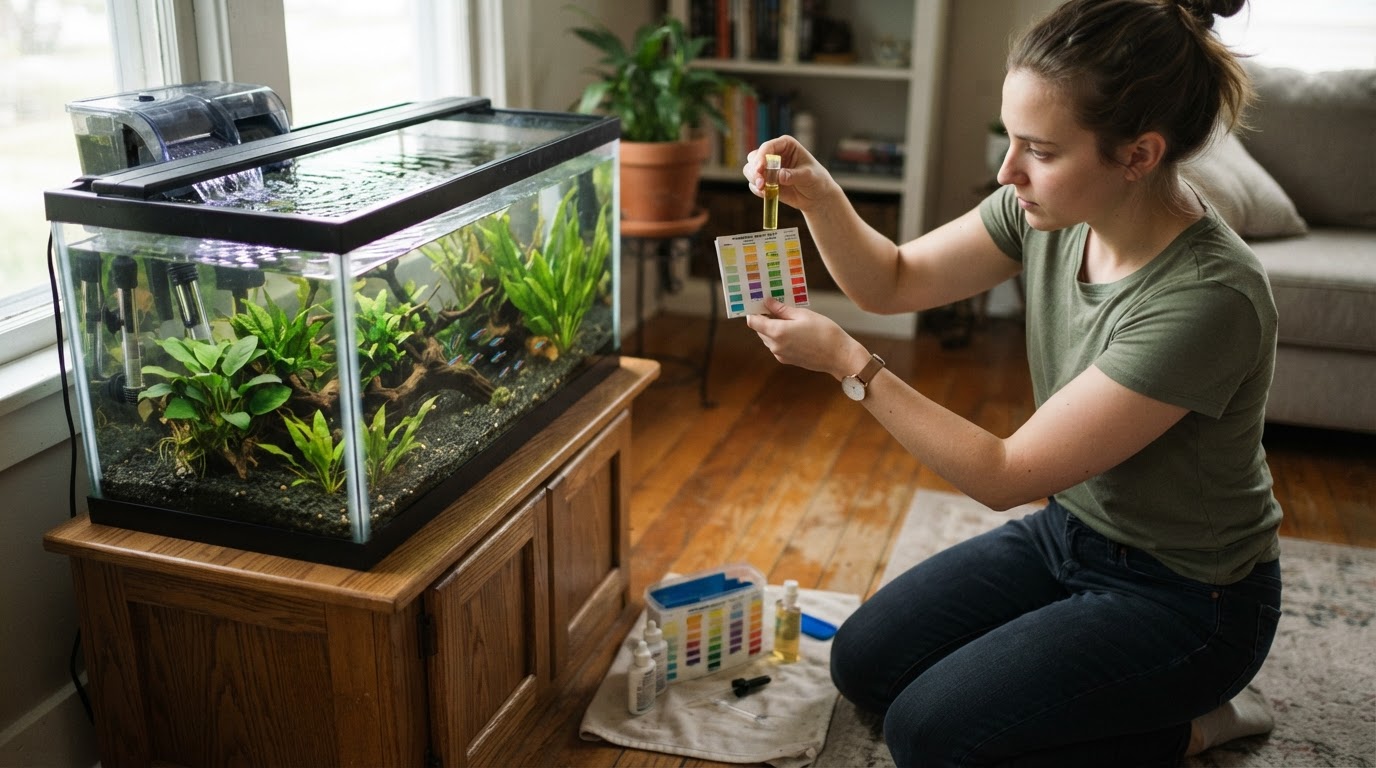
When a fish starts behaving differently, the instinct is to reach for a bottle of medicine. Most of the time, the more useful first move is to test the water and remove the stress that let the problem take hold. Ammonia and nitrite are the readings that matter most: both are toxic to fish at any detectable level, and both build up in new tanks, overstocked tanks, and tanks whose filter was cleaned too thoroughly. An untreated tap-water top-up, a heater that has drifted, or a filter that stopped overnight can produce the same sudden collapse.
That is why nearly every fish health guide starts with the same few actions: test the water; correct what is wrong with a partial water change using conditioned water matched to the tank temperature; and move the affected fish to a quieter tank if that can be done without adding stress. Surface agitation matters as well, because a fish that is gasping at the top is often short of oxygen rather than carrying an infection.
One sick fish is rarely only one sick fish. A single fish with white spots or a frayed fin usually means the cause has already reached the shared water, so acting on day one is far easier than acting on day five. Wherever possible, work out what you are dealing with before you dose anything, because no single medicine treats every condition, and the wrong one costs you the days that matter most.
Read the symptoms before you name a disease
Fish cannot tell you where it hurts, so the diagnosis starts with observation. Watch the fish before you name the problem: how it breathes, where it holds in the tank, how it swims, and whether it still feeds will tell you more than any single spot. Use the table below as a starting point rather than a verdict, because several conditions share the same visible sign and a few of them need opposite treatments.
What you see | Most likely direction | First move |
|---|---|---|
White spots like grains of salt or sand | Ich or marine white spot | Isolate if practical and start a treatment plan that covers the whole tank |
Fine gold or rust-coloured dust, clearest under direct light | Velvet | Treat urgently; velvet moves faster than ich |
White cotton-like tufts | Fungal infection or columnaris | Improve the water first, then identify which of the two you have |
Ragged, receding fin edges | Fin rot | Water change and water-quality correction; medicate if it keeps spreading |
Red streaks at the fin base or along the body | Bacterial septicemia | Treat as urgent; this group often needs targeted antibiotics |
Bloated body with scales standing out | Dropsy | Supportive care; expect a guarded outcome |
Cloudy eyes | Water quality, injury, or bacterial infection | Test the water and treat the underlying cause |
Pale patches or peeling skin | Slime-coat shedding, a chemical burn, or columnaris | Look at both sides of the fish and the history before treating |
Gasping at the surface or hanging at the filter outlet | Low oxygen or gill damage | Increase surface movement and test the water immediately |
Clamped fins, hiding, refusing food | General stress or early disease | Check temperature, water, and what changed recently |
White, stringy faeces | Internal parasites | Consider medicated food and confirm the cause |
Weight loss despite eating | Internal parasites or fish tuberculosis | Handle with gloves and keep the fish isolated |
Several deaths with no obvious symptoms | Environmental cause or toxin | Test the water, check the heater and filter, and review the last week |
Not every change is a disease, and two of the most common mistakes are treating a healthy fish and treating the wrong condition. Angelfish and several cichlids show dark stress bars as normal colouration, many species fade at night or during courtship, and a fish that has been netted or moved can shed its slime coat for a day or two. A hungry fish can look hollow, and a shy fish can look clamped for reasons that have nothing to do with illness.
At Sea Life Planet, the health and disease library follows this symptom-first order on purpose: begin with the visible sign, rule out the look-alikes, and only then name the condition and choose a treatment. It sounds slower than guessing, but it saves the time that a wrong diagnosis wastes.
The conditions you are most likely to be looking at
Parasitic infections
Ich, or white spot disease. The classic sign is a scattering of white spots no bigger than grains of salt or sand, often with flicking and rubbing against décor. Freshwater ich is caused by Ichthyophthirius multifiliis; the marine version, usually called marine white spot, is caused by Cryptocaryon irritans. The spots you can see are only one stage of a life cycle that continues in the water and the substrate, and the free-swimming stage is the one most treatments can reach. That is why a single dose that clears the spots can be followed by a second wave: the treatment has to cover the whole cycle, and temperature changes how long that cycle lasts.
Velvet. Velvet shows up as a fine gold or rust-coloured dust rather than distinct spots, and it is easy to miss unless you look at the fish from the side under a direct light. It behaves like ich but often moves faster and kills sooner, so the same urgency applies with less room for delay.
Flukes, anchor worms, and fish lice. Flukes on the gills or skin cause flashing, rubbing, rapid gill movement, and sometimes yawning or coughing motions. Anchor worms and fish lice are large enough to see if you look closely at fins, gill covers, and the base of the fins. Praziquantel-based products are widely used against flukes; follow the label rather than a remembered dose, and watch the attachment wounds afterwards, because secondary infection is common.
Internal parasites. White, stringy faeces, a sunken belly, and a fish that eats but still loses weight point towards internal parasites. Some respond to medicated food; others are difficult to identify without a microscope, which is one of the situations where a veterinarian or an experienced fish-health specialist earns their fee.
Bacterial infections
Fin rot. Fin rot usually starts at the edges, which look ragged, shortened, and sometimes dark or white-rimmed. It is common after cold stress, poor water quality, or an injury from a tank mate. Mild cases often improve with clean water and less stress; cases that keep spreading need an antibiotic product, and the water-quality problem still has to be fixed or the rot returns.
Columnaris. Often mistaken for a fungus because of the white or grey patches around the mouth, columnaris is a bacterial infection that can also appear on fins, gills, and skin. It can progress quickly in warm, crowded, or low-oxygen water, and it is one of the conditions where a delay of a day or two changes the outcome. Compared with a true fungus, columnaris patches tend to look flatter and more defined, but the two can be difficult to separate without a microscope.
Septicemia and ulcers. Red streaks at the fin base, open ulcers, a swollen body, and bulging eyes suggest that bacteria have moved into the fish's system. Treat this group as serious: it often needs targeted antibiotics, and a veterinarian is worth involving early.
Pop-eye. One eye usually means an injury, especially after netting or a fight. Both eyes at once usually point to something systemic, such as poor water quality or an internal bacterial infection, and the whole tank needs checking.
Fungal infections
Cotton-wool fungus. Saprolegnia and related water moulds grow as white or grey cotton-like tufts on skin, fins, and eggs. They are usually opportunistic: the fungus arrives after an injury, a handling incident, or a period of poor water quality, so the fix has to include the environment and not only an antifungal treatment. In a breeding tank, unfertilised eggs are the usual anchor for fungus and are best removed.
Viral conditions
Lymphocystis. Cauliflower-like white or pink growths on fins and skin are the signature of lymphocystis, a viral condition that is often self-limiting and usually clears over weeks with good care. Most viral fish diseases cannot be cured with the medicines sold for parasites, bacteria, or fungus. The practical response is to support the fish, isolate it where possible, and keep the environment stable rather than cycling through products that will not help.
Environment, diet, and equipment
Ammonia and nitrite poisoning. These look like an infection: gasping, dark or reddened gills, clamped fins, listlessness, and loss of appetite. Test immediately, change water with conditioned water, and do not add more fish until the filter has fully cycled. Binder products only buy time; they do not reset a filter.
pH and temperature shock. A large water change with very different water, a heater failure, or a tank that overheated in summer can produce listlessness, rapid breathing, pale colour, and sudden death. Match temperature and parameters during water changes, and check the heater before assuming an infection.
Bloat and constipation. A swollen belly without raised scales is often digestive. Overfeeding, a dry or low-fibre diet, and cold water that slows digestion are common causes. Fasting and an appropriate diet are the first steps. Epsom salt is sometimes used as supportive care for bloat-like symptoms, but it is not a cure and should not be treated as one.
Dropsy. Dropsy is not a disease in itself; it is a visible sign that fluid is collecting in the body, with scales standing out like a pinecone. It usually reflects kidney or organ failure, the outcome is often poor, and treatment is supportive rather than curative. Correcting water quality and reducing stress gives the fish the best chance available.
Hole-in-the-head. Pitting around the head and along the lateral line is usually linked to long-term water quality problems and sometimes to internal parasites such as Hexamita. Correcting the environment comes first; targeted treatment may help when an internal parasite is genuinely involved.
Before you treat: the checks that save the most fish
The sequence that works is short: observe, test, isolate, then treat — and only after you have identified what you are treating.
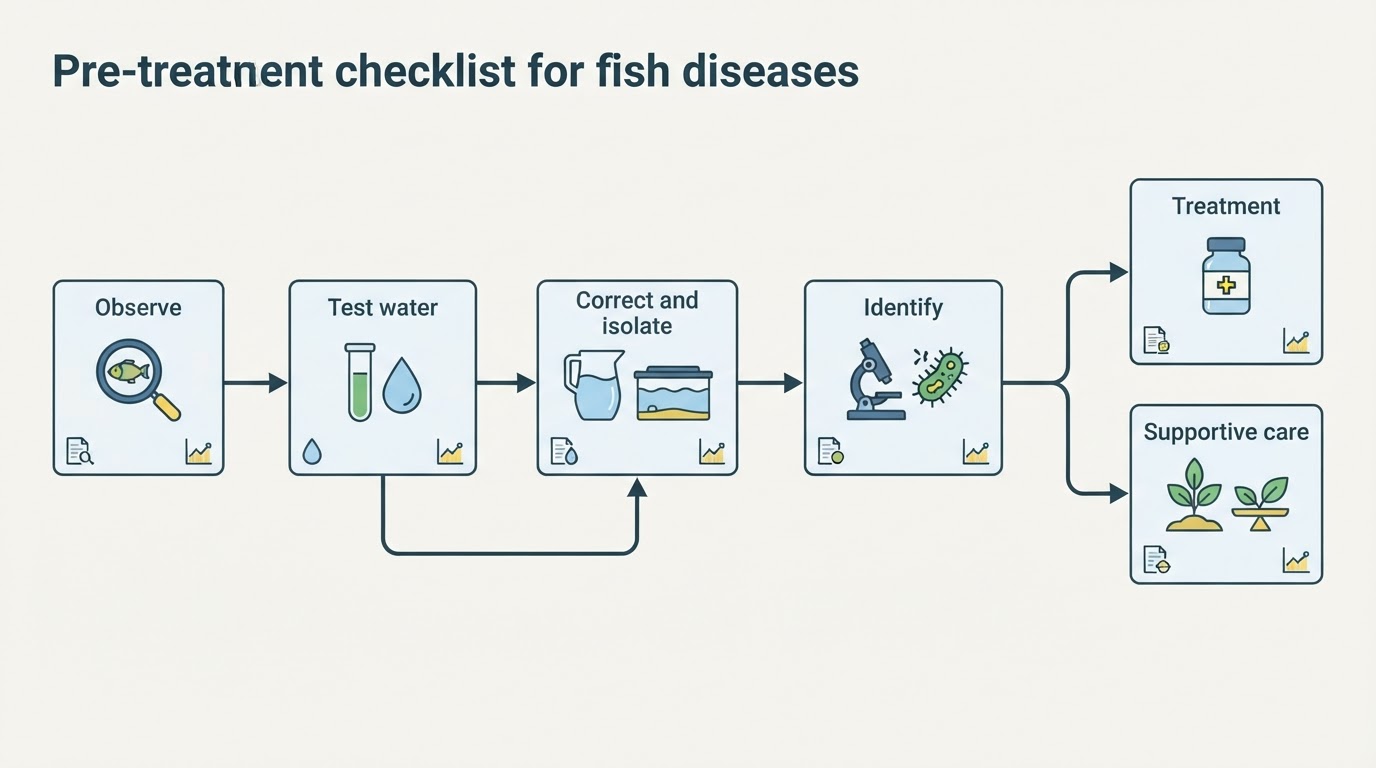
- Test the water. Ammonia and nitrite should read zero in a healthy cycled tank. Nitrate is the reading that accumulates between water changes. pH, temperature, and hardness tell you whether something has changed suddenly.
- Check the equipment. Heater, filter, air pump, and power supply. A small temperature drift or a filter that stopped overnight explains a surprising number of outbreaks.
- Review the last two weeks. New fish, new plants, a deep clean, a large water change, a new food, a temperature swing. Outbreaks have a trigger more often than they have a mystery.
- Decide who gets treated. Waterborne parasites usually mean treating the whole tank. A single fish with an injury or a localised infection can be treated in a hospital tank. Remember that antibiotics and some other medications can damage the filter bacteria, so test ammonia while treating.
- Remove carbon and read the label. Carbon removes many medications from the water, some products are light-sensitive, and some are not safe with invertebrates, plants, or scaleless fish. Medication rules also differ by country and change over time, so check what is allowed where you live.
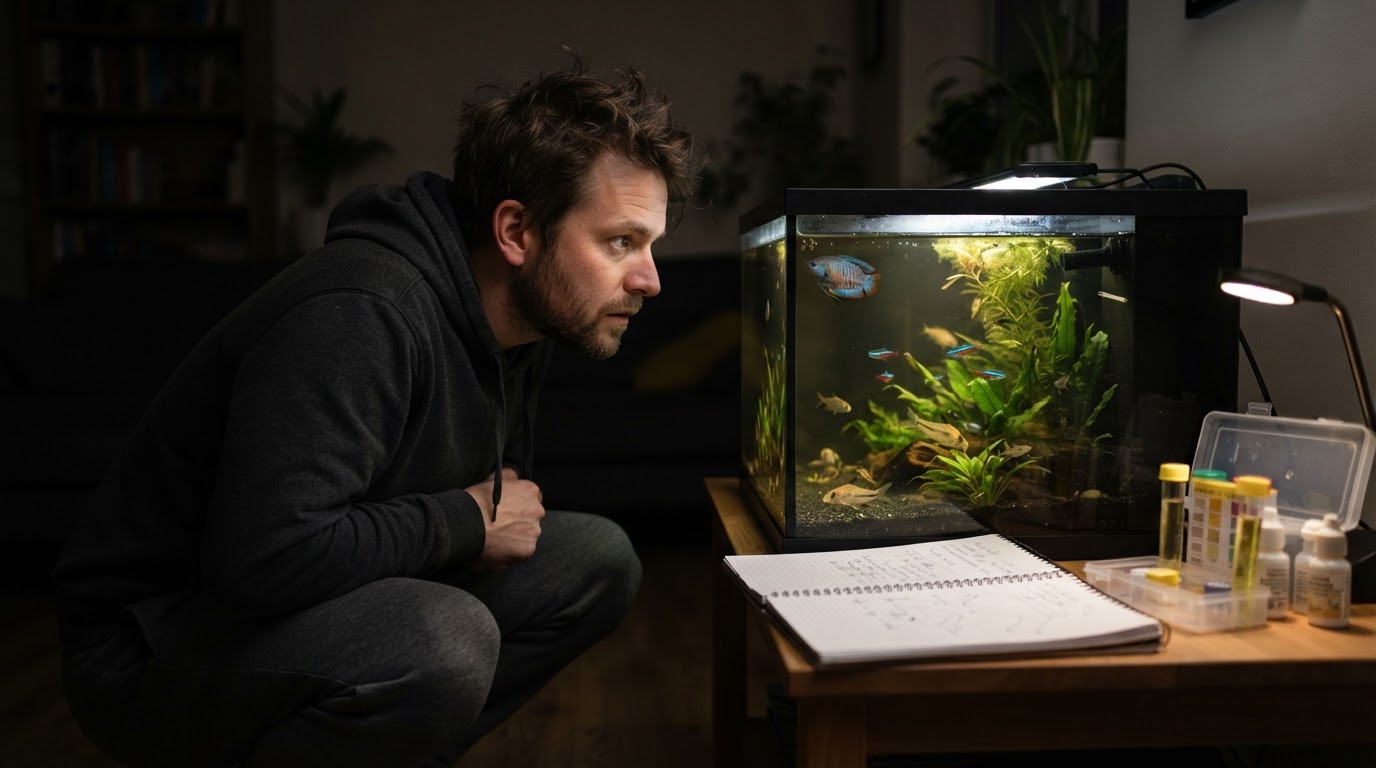
- Keep a simple log. The date, what you saw, the readings, the product, and the dose. If the fish does not improve, that record is what lets you or a veterinarian change course intelligently.
Treatment principles that keep more fish alive
- Fix the environment first. Treatment works far better when the water, temperature, and oxygen are already correct; without that, medicines are fighting a losing battle.
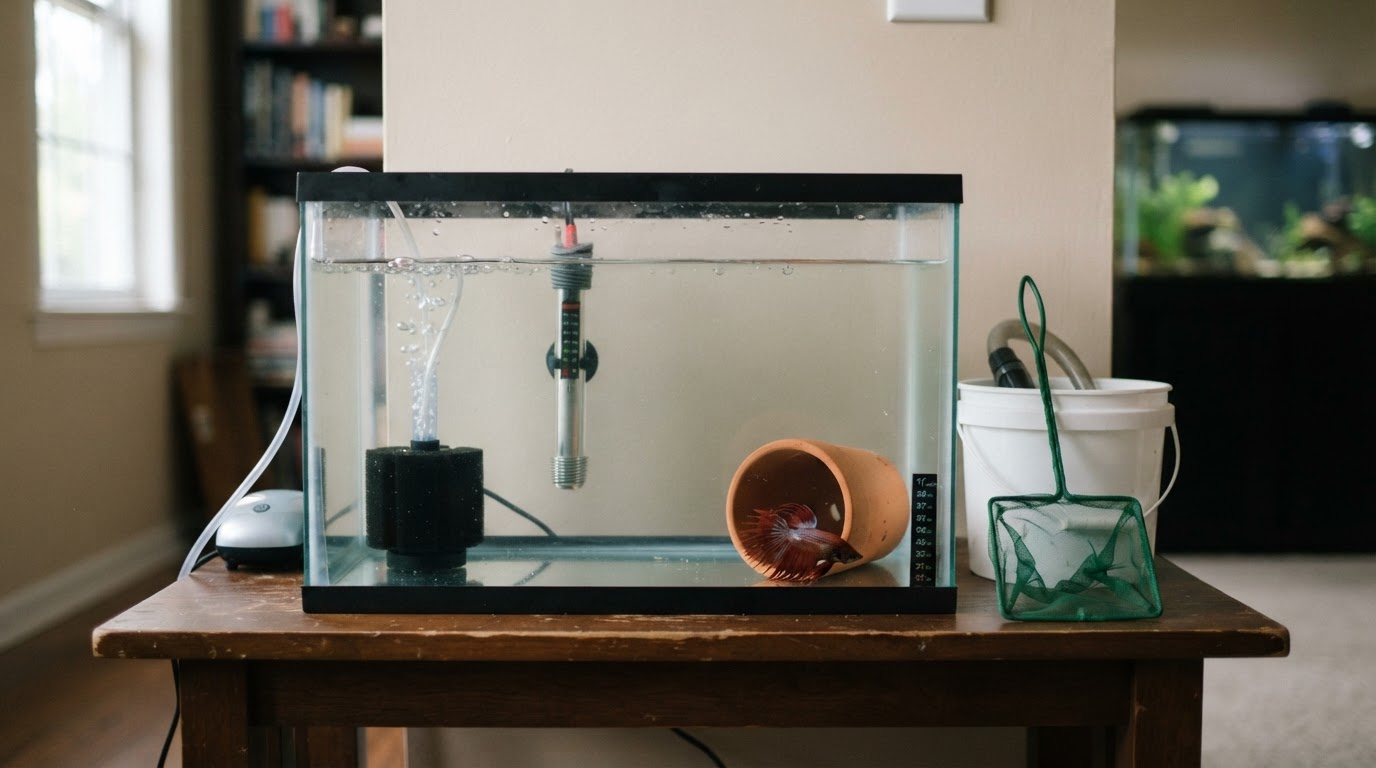
- Use a hospital tank. A bare hospital tank kept cycled with a sponge filter, a heater, a hide, and nothing else is easier to observe and easier to keep clean than the display tank. Never share nets, siphons, or buckets between the hospital tank and the main tank.
- Support the fish. A stable temperature, good surface movement, lower lighting, and a quiet corner reduce the stress that slows recovery.
- Be careful with salt. Aquarium salt is sometimes used to support osmoregulation in freshwater fish, and Epsom salt is used as supportive care for bloat-like symptoms. Neither treats the underlying cause, both can harm plants and sensitive species, and neither belongs in a reef tank.
- Follow the label exactly. Dose by the volume of water actually in the tank rather than the tank's rated size, do not combine products unless the label says to, and finish the course instead of stopping when the fish looks better.
- Do not use human medicines. Products made for people are not dosed for fish, and some are outright toxic to aquatic life.
Quarantine and prevention: the habits that stop outbreaks
- Quarantine every new fish for two to four weeks and observe it before it goes into the display tank.
- Keep separate nets, buckets, and siphons for the quarantine tank, and wash your hands between tanks.
- Buy from a seller whose tanks look healthy, and avoid any fish from a tank that contains dead or obviously sick animals.
- Keep stocking within the tank's real capacity, and choose tank mates that match the water parameters and temperament you can actually provide.
- Feed a varied, appropriate diet and avoid overfeeding, which degrades water quality faster than almost anything else.
- Keep temperature and pH stable rather than chasing an exact number, and check equipment before it fails.
- Rinse or quarantine new plants, and remember that snails, live food, and shared tools can carry parasites and their eggs.
- Reduce chronic stress with cover, hiding spots, compatible company, and appropriate current.
When a veterinarian is worth the time
- Several deaths or ongoing losses without a clear cause.
- Systemic signs such as red streaks, ulcers, dropsy, or bulging eyes.
- A condition that needs a microscope, a culture, or a prescription to treat properly.
- A valuable or irreplaceable collection, where the cost of a wrong guess is high.
- Any suspicion of fish tuberculosis, because this one can affect people.
Fish tuberculosis, caused by Mycobacterium marinum and related bacteria, can infect people through broken skin and typically produces stubborn skin lesions on the hands or forearms. Wear gloves when handling a fish with wasting disease or open wounds, wash your hands afterwards, and talk to a doctor about any skin sore that does not heal.
Frequently asked questions
Can fish diseases spread to humans?
Most of them cannot. The main exception worth knowing is fish tuberculosis, which can pass to people through broken skin and cause persistent skin infections. Wear gloves when handling a fish with unexplained weight loss or open wounds, cover cuts before putting your hands in the tank, and wash up afterwards. Anyone with a weakened immune system should be especially careful and ask a doctor about unusual skin lesions.
Should I treat the whole tank or just the sick fish?
If the condition has a waterborne stage — ich, velvet, and many external parasites — assume the whole tank is involved and follow a plan that covers it. For an injury, a localised fungal patch, or one fish with early fin rot, a hospital tank lets you treat that fish without exposing plants, invertebrates, and filter bacteria. Either way, fix the water in the display tank, because that is usually where the problem started.
Do aquarium salt and Epsom salt cure disease?
No. Aquarium salt can support a freshwater fish's osmoregulation during illness, and Epsom salt is sometimes used to ease bloat-like symptoms, but neither removes the parasite or bacterium causing the problem. Dose carefully, keep both out of reef tanks, and skip them for species that do not tolerate salt.
How long does treatment take?
Longer than the visible symptoms. Parasite treatments usually have to cover the full life cycle, which can take a week or more at normal tropical temperatures and longer in cooler water, so the schedule matters more than the first good day. Bacterial treatments run for the full course on the label. Stopping early because the fish looks better is one of the most reliable ways to get a relapse.
Why did my fish die with no warning at all?
Sudden death without a slow decline usually points to an environmental event: an ammonia or nitrite spike, untreated tap water, a heater that failed, an oxygen drop after dark, or a large temperature swing. Test the water, check every piece of equipment, and look hard at what changed during the previous week, because the remaining fish may be next.
Can a fish recover without medication?
Sometimes, yes. Lymphocystis, minor fin fraying, and small injuries often heal with clean water and reduced stress. Frank parasitic infections and systemic bacterial disease rarely resolve on their own, and waiting tends to turn a treatable problem into a fatal one.
None of this requires a laboratory. The pattern that works is unglamorous: stable water, quarantined newcomers, a hospital tank ready to go, and enough patience to identify the problem before treating it.