The direct answer: 35 ppt is a checkpoint, not every instrument's zero
A 35 ppt standard is useful, but it is not automatically the adjustment point for every aquarium refractometer; the correct point depends on what the instrument measures and what its maker specifies.
Three instrument families cover most aquariums:
- Mechanical seawater refractometers. D-D's ATC natural seawater refractometer, for example, is calibrated at 20 °C and zeroed with pure or reverse-osmosis water per its instructions. D-D also allows a 35 ppt reference that states its calibration temperature (D-D instructions, page 2).
- Digital seawater refractometers. Hanna specifies one-point calibration for the HI96822 with distilled or deionized water. A 35 ppt reference can verify accuracy near the working range, but it is not that instrument's ZERO fluid (Hanna HI96822).
- NaCl/brine and Brix refractometers. Brix is a sugar-concentration scale and an NaCl/brine scale is calibrated for salt solutions; both differ from a natural-seawater calibration, so neither reading is a drop-in seawater salinity result. D-D explains that its refractometers are calibrated for true seawater (D-D on TDS solutions).
One qualification applies to all: a 35 ppt standard sold for conductivity meters is not automatically an approved optical reference. Use a fresh, labeled reference intended for your instrument, keep it sealed against evaporation and contamination, and follow its stated temperature.
Match the step to the exact model
Instrument (named example) | Maker's guidance | First step |
|---|---|---|
D-D seawater refractometer (mechanical, ATC) | 20 °C calibration point; zero with pure or RO water; a 35 ppt reference is possible when it states its calibration temperature | Follow your model's manual revision, clean the prism, set the zero |
Hanna HI96822 (digital seawater) | One-point calibration with distilled or deionized water; 35 ppt reference for verification only | Follow the HI96822 sample-well and button procedure; no prism cover or screw |
Brix or NaCl/brine refractometer | A scale calibrated for other solutions, not natural seawater | Do not read it as seawater salinity; use a seawater instrument or reference |
Run the loop: identify, manual, clean, sample, equilibrate, read, verify
- Identify. Note what the instrument is calibrated for, at what temperature, and the exact model.
- Manual. Follow that model's procedure; do not mix steps between instruments. A hinged cover, daylight boundary reading, and adjustment screw belong to a mechanical prism instrument such as the D-D example; the HI96822 uses its own sample well and buttons.
- Clean. Rinse the prism or sample well with pure or reverse-osmosis water and dry it, so salt residue cannot shift the reading.
- Sample. For a mechanical instrument such as the D-D example, place enough sample on the prism and close the cover so excess is pushed away. For the HI96822, follow the manual's sample-well procedure.
- Equilibrate. D-D's instructions give their own instrument and sample waiting steps, and the current D-D FAQ gives a 30-second sample-equilibration example. Follow the exact figure in your model's manual revision rather than a universal time; ATC does not remove the need to equilibrate.
- Read. On a mechanical prism instrument such as the D-D example, point it toward bright light close to daylight and read the boundary at the bottom of the blue-to-clear transition as its instructions describe. A digital model displays the value; do not apply the optical-boundary technique.
- Verify. Measure a fresh labeled 35 ppt reference again without touching the adjustment screw or re-running ZERO. That reading is the validation step.
Adjustment and verification are different actions
Adjusting a mechanical screw or running a digital ZERO routine changes the scale. Verification asks whether the instrument agrees with a reference after that change. If standards or instruments disagree, do not keep adjusting or change aquarium salinity to match one uncertain reading; check the reference's freshness and stated temperature, then measure again.
Why TDS solutions and mismatched scales mislead
D-D explains that salinity and TDS are different quantities: its refractometers measure refractive index and are calibrated for true seawater, so a TDS solution is not a reliable calibration standard (D-D on TDS solutions). Homemade salt mixes and unapproved solutions are poor substitutes for a labeled refractometer reference, and no single conversion factor makes a Brix or NaCl instrument valid for seawater.
What ATC does and does not remove
ATC moves the reading scale with temperature, so a calibrated instrument can work across its stated ambient range. D-D stresses that the instrument's temperature, not just the water's, matters, and its instructions give model-specific equilibration steps. Keep the refractometer at a stable room temperature before trusting a reading.
After the number is trustworthy
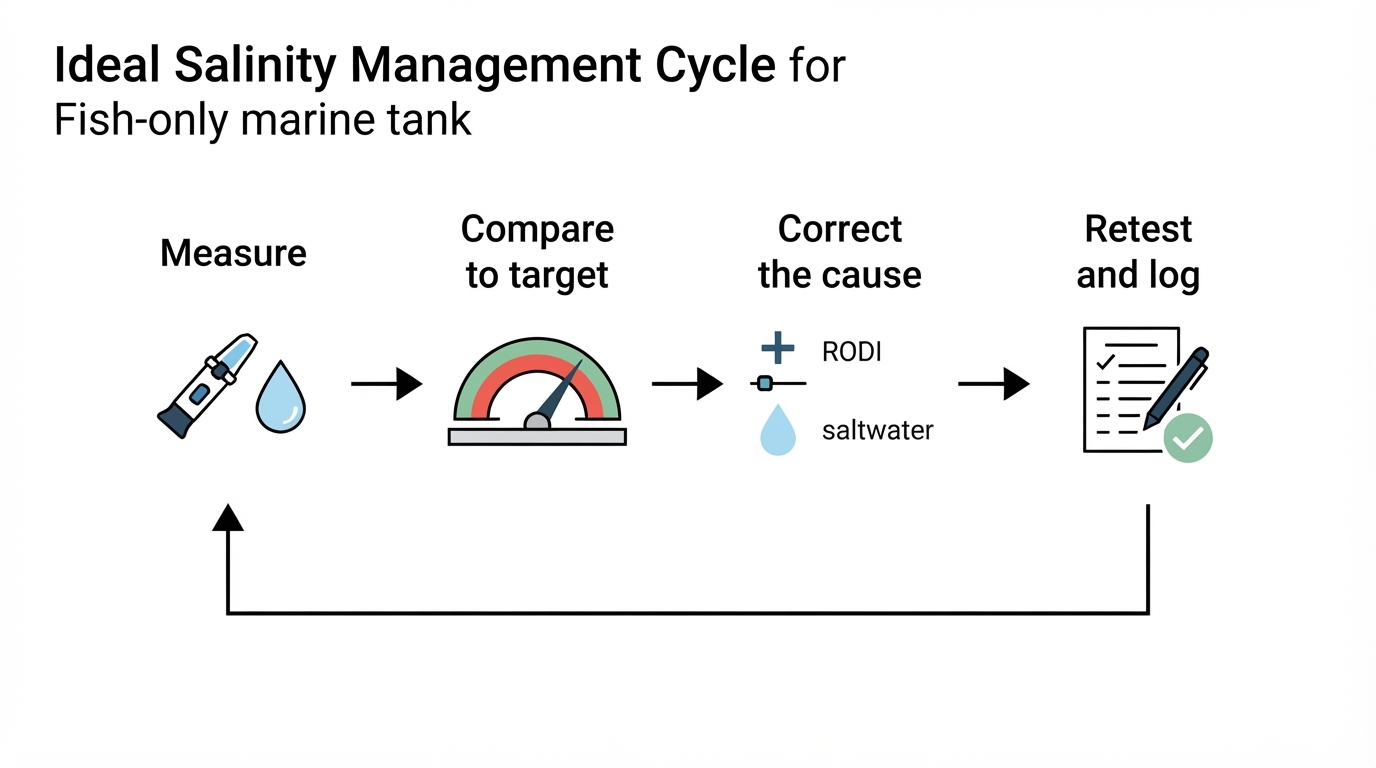
Once the reading is valid, treat it as a measurement, not permission for a large, fast change. If salinity is high and you need to lower it, that is its own livestock-management task: how to lower salinity in an aquarium. Fish-only systems are often held at a different salinity target than reefs, a separate decision with its own trade-offs: fish-only saltwater tank salinity.
The practical rule: use the calibration point your manufacturer specifies for that exact model, verify with a suitable 35 ppt reference, and pause when your references disagree.