Start With the Reading, Not the Remedy
Start with an order of operations: verify the reading, look for ongoing phosphate inputs, then adjust export gradually if the trend and animals' condition call for it. Bulk Reef Supply's nutrient-control guide warns that a drastic drop can stress corals and invertebrates. The target is stability and a controlled trend, not the fastest possible decrease.
A single result is not a trend. Hanna Instruments' phosphate testing guide discusses low-range monitoring and warns against stripping phosphate completely. Its suggested range is guidance, not a universal target for every reef or species; compare repeat readings, other nutrients, and the condition of the animals before changing a system.
This is a lowering routine, not a diagnosis from one number. If you are still deciding whether phosphate is actually high for your tank, read the site's high-phosphate signs guide. Persistently low readings are the opposite problem; the site has a separate guide to raising phosphate.
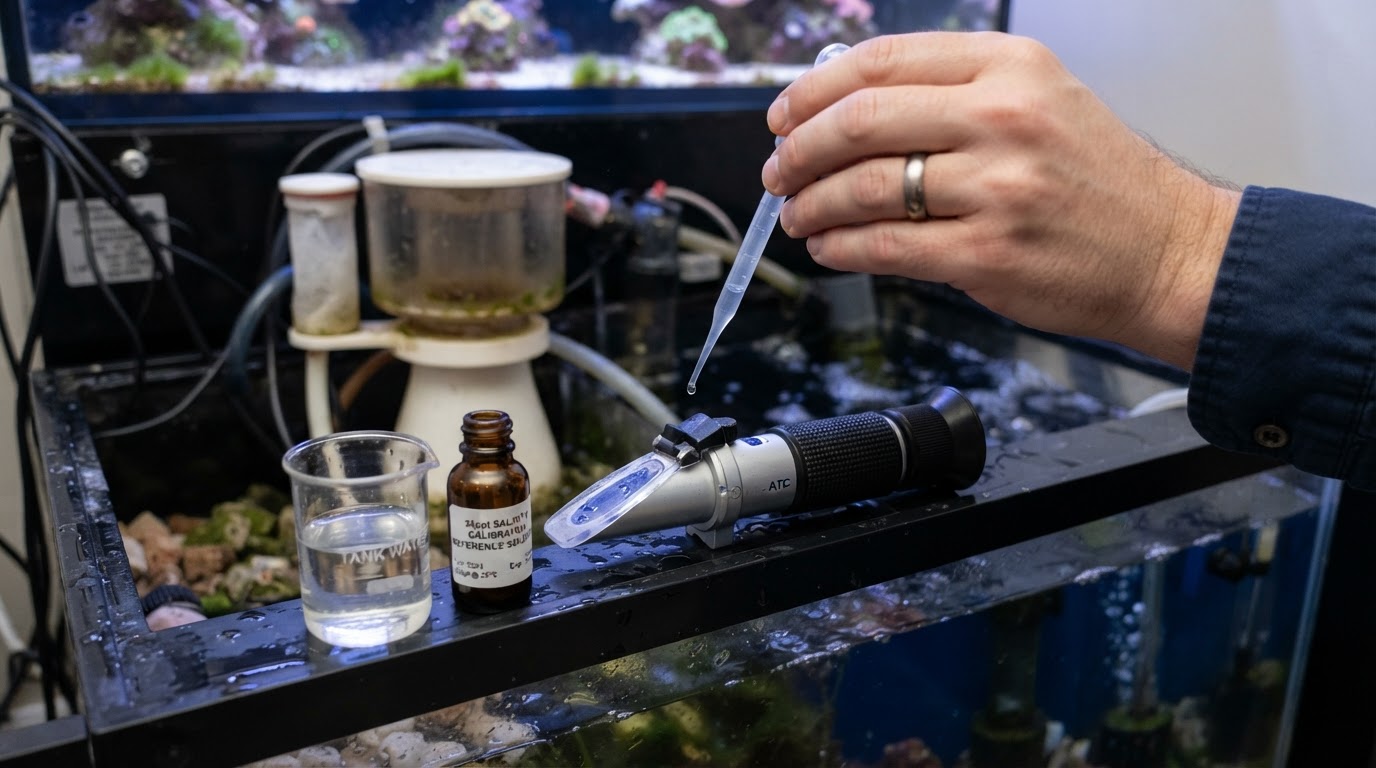
Before comparing readings, confirm what your particular test reports. Some meters display phosphate (PO4) in ppm while others display phosphorus (P) in ppb; they are not the same number. Follow your exact meter's instructions for reagents, timing, conversion and clean cuvettes rather than applying another model's procedure. Re-test an unexpected result before treating it as a trend.
Find the Input Side First
Almost everything organic in a tank can break down and release phosphate. Bulk Reef Supply lists fish waste, coral slime, leftover food, detritus and dead algae cells as the common natural sources, and its GFO guidance is direct that food and the waste it produces is the main input in most systems.
Source water is the quiet second input. Underground minerals leach phosphate into many municipal supplies, and water treatment plants often add phosphates to protect pipes from corrosion, which is why BRS stresses RO/DI water for both top-off and saltwater mixing. Hanna's guide lists tap water alongside overfeeding, weak skimming and a poor water change schedule among the contributors to high phosphate.
Excess food can be a major input, but cutting feeding indiscriminately can harm fish. Observe how much food is uneaten and where waste collects, then adjust feeding and cleanup routines without compromising the animals' needs.
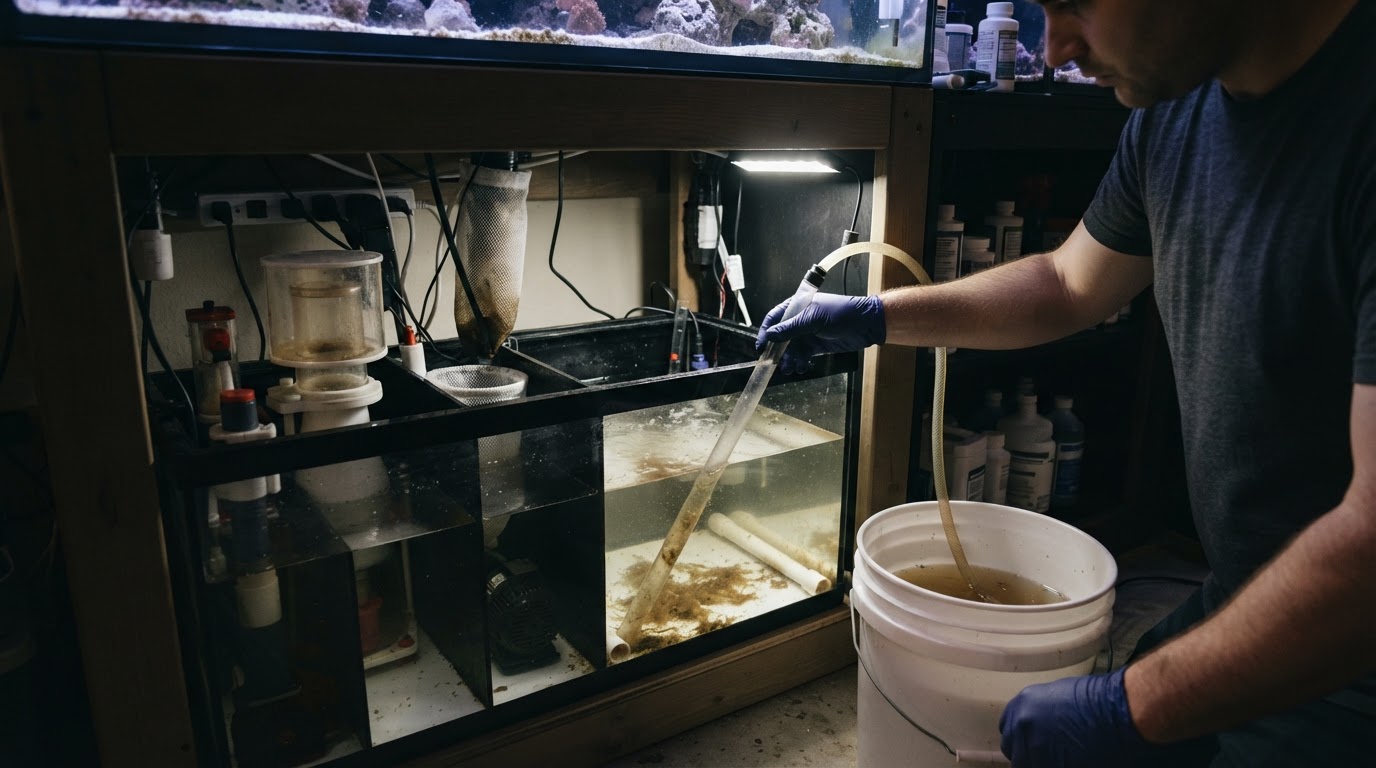
Then audit the places waste collects. Managing filtration so that leftover food and fish waste are removed is the primary focus of phosphate control, ahead of any media, and the checklist is short: what goes in as food, what fails to get eaten, and what your mechanical filtration is currently holding.
Shrink the Input Without Starving the Tank
Reducing input is not the same as feeding as little as possible. Keep feeding enough to keep fish healthy, use RO/DI water that measures clean, and improve the routine that removes leftovers and detritus before they decay. A good protein skimmer belongs in this category too: BRS describes one as stripping dissolved and particulate organics out of the water before they can release phosphate.
Do not let the correction overshoot. BRS's own media guidance warns that if a tank is stripped of phosphate altogether, bacterial imbalances can follow and corals can be starved of a nutrient they need. Pair every reduction step with a reading, so you can see the decline rather than assume it.
Build Export Capacity Before You Reach for Media
Water changes help, but may not solve a chronic input problem on their own. BRS explains that phosphate can enter a stocked reef faster than routine water changes remove it, so first inspect inputs and then choose an export method appropriate to the system.
Two natural options do that job. A refugium with fast-growing macroalgae such as Chaetomorpha removes phosphate, nitrate and other nutrients, and the harvest is what makes it an export: the algae that absorbed the phosphate leaves the system when you prune it. An algae scrubber works on the same principle with turf algae growing on an illuminated screen, provided you harvest the growth.
If both nitrate and phosphate are elevated, BRS suggests looking at carbon dosing or biopellets, which feed bacteria that consume both nutrients; the bacteria are then removed by protein skimming. Treat that as a system change rather than a quick fix, and keep testing while it settles in.
If Readings Stay High, Use GFO Deliberately
Granular ferric oxide, or GFO, is the most popular phosphate-specific medium because it binds inorganic phosphate as water flows past it. BRS describes it as slower-acting than some alternatives and recommends running it in a fluidized media reactor so water contacts the media evenly. Its line on timing is worth repeating: regular reliance on media and chemicals is a slippery slope that gets expensive, so media belongs after the input side is under control.
Use the instructions for the particular GFO product and system, begin conservatively, and re-test before increasing it. There is no universal amount or replacement interval: media type, tank volume, existing phosphate load, and animal response all matter. BRS's GFO instructions explain the product-specific setup and caution against excessive flow.
In a reactor, flush the fines to waste first, then reduce flow until the media barely tumbles at the surface. BRS warns explicitly against letting it tumble vigorously. If you use a media bag instead, rinse it until the water runs clear and place it in a high-flow area. Keep expectations honest as well: GFO will not solve an algae outbreak by itself.
A simple decision path
What you are seeing | First move | Media step |
|---|---|---|
Readings stable in the low range, corals growing, algae under control | Keep the current routine and test weekly | None |
Repeated readings rising above the tank's normal range | Audit feeding, leftovers and detritus; verify source water | Consider media only after the input and livestock response are understood |
Readings somewhat elevated but stable, with algae under control | Check the long-term trend and husbandry | No automatic GFO step from one value |
Phosphate at or near zero | Stop stripping and restore measurable phosphate | Reduce or remove media, then re-test |
How You Know It Is Working
Set a completion standard before you change anything, because "lower" is not a finish line. A working plan looks like this: two readings taken with the same meter and the same units, a trend that is falling rather than flat or spiking, and a number settling into the low range your tank tolerates without sitting at zero. BRS frames the real goal well — not chasing a figure, but keeping surfaces and rockwork clean and algae-free while corals keep growing.
Then check your work on a schedule. Test again a few days after each change, and again the following week, then keep testing weekly once readings hold. If the decline looks abrupt, or corals and invertebrates respond poorly, that is the signal the BRS guide describes: the drop itself is the stressor, so pause, re-test and back the change off.
What Not to Do
- Do not chase zero. Phosphate above zero is part of a healthy system, and removing all of it can cause its own imbalance.
- Do not respond to one reading. Confirm the method, the unit and the trend first.
- Do not force a fast drop. Sudden phosphate reductions stress corals, especially those kept at high levels for a long time.
- Do not start with a dosing routine. Fix the input side first; BRS only recommends ongoing GFO, aluminium-based media or lanthanum-based liquid removers when phosphate is continually problematic.