What turf algae actually is
"Turf" describes a growth form, not a single species. On natural reefs these turfs are mixed assemblages of small filamentous algae — red, green and brown taxa growing together as a low, bristly carpet on hard surfaces. A Florida reef survey found red turf algae (Digenea nana) dominating the most sediment-loaded patches while green filamentous algae sat at low abundance, so color tells you which mix you happen to have, not what the growth is.
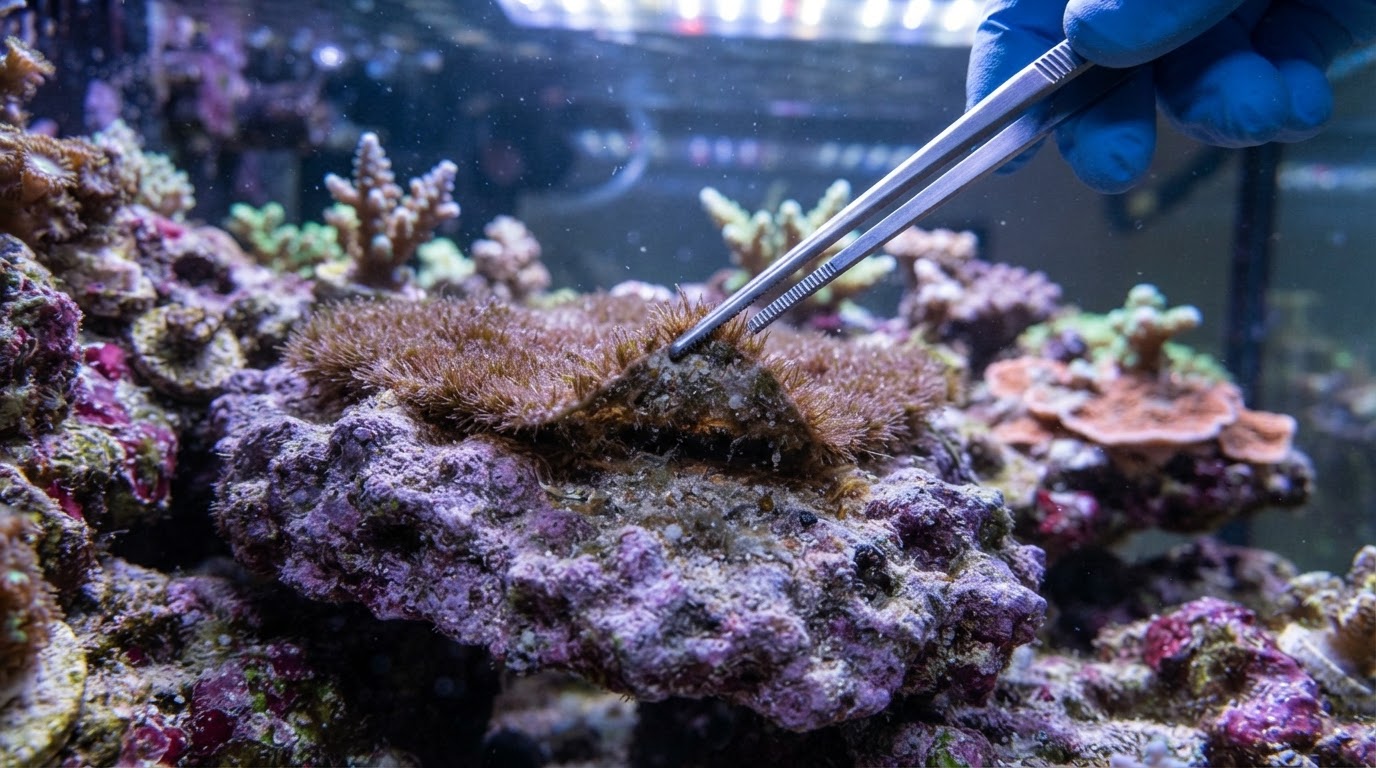
The structure is what matters in a tank. Turf forms a short, densely packed mat — often only a few millimeters tall — that grips the surface and holds fine sediment and detritus the way a carpet holds sand. That trapped debris is the practical difference between turf and the loose algae most reef keepers expect.
Sort the look-alikes first
"Green growth on rock" has several possible owners, and telling them apart is the first conservative step.
- Film algae — a thin, even haze that wipes off glass or rock and returns over days.
- Hair algae — longer, stringy strands that lift and pull away with moderate resistance.
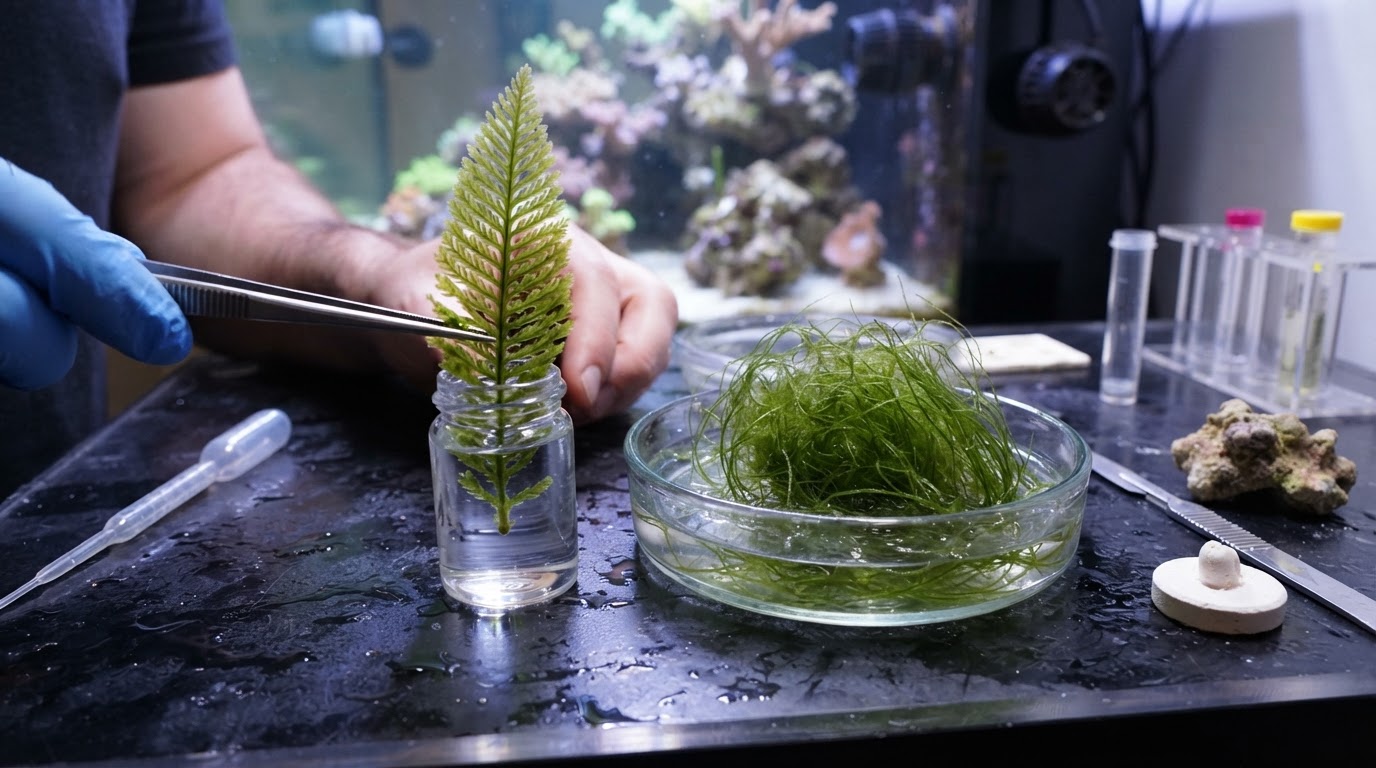
- Bryopsis — feathery, fern-like tufts that break easily and regrow quickly.
- Cyanobacteria — a slimy sheet that can lift in one piece, often smells earthy and shifts over the photoperiod.
- Diatoms — brown dust that usually fades as a tank matures.
- Turf growth — short, coarse, bristly patches that feel rough and hold on hard when you pull.
This is a different problem from a thin film on the glass or fern-like bryopsis, and each one calls for different handling. See the separate bryopsis identification guide if the tufts look feathery. Red and green turf forms follow the same logic: both are growth forms built from different small algae, and neither color proves a species.
A conservative identification checklist
Work through these five checks before removing anything.
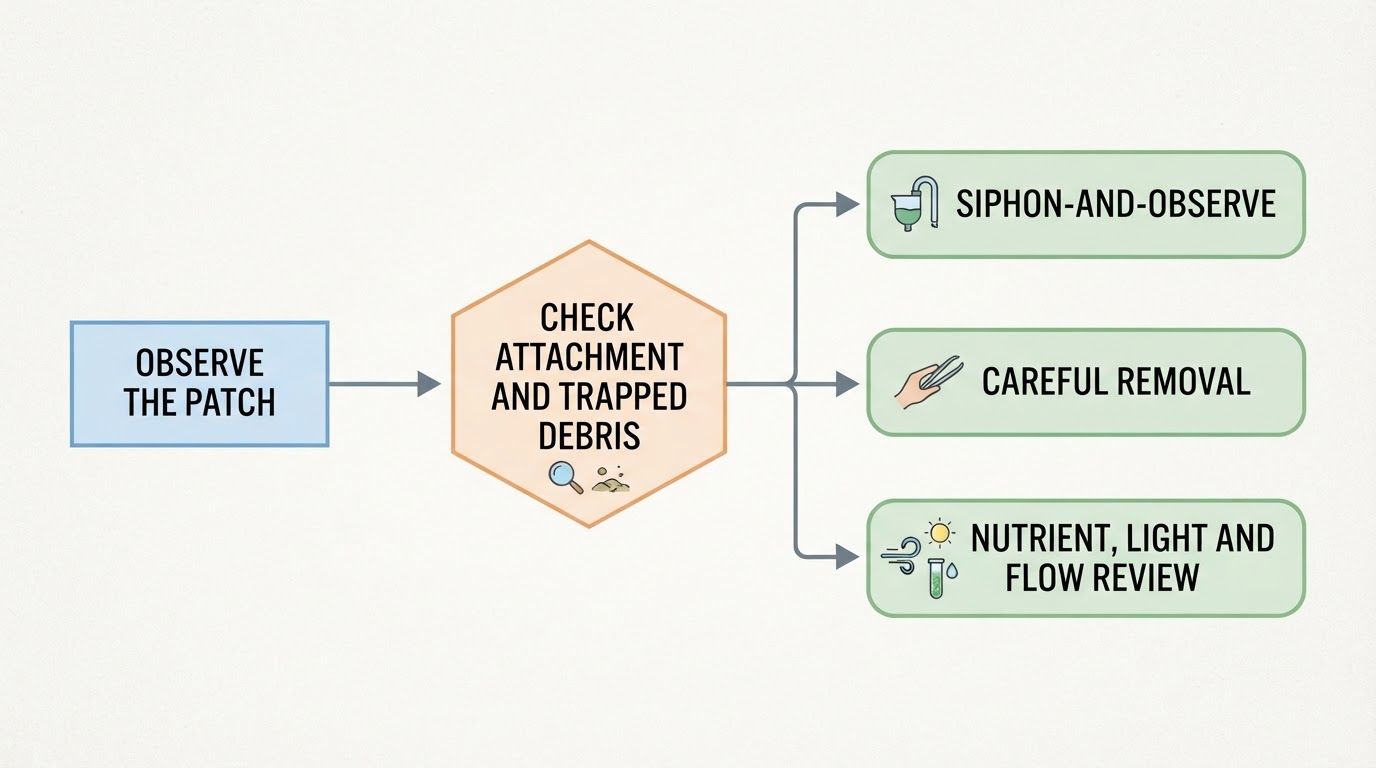
- Where it grows. Turf favors rock, frag plugs, overflow edges and crevices where flow is weaker and debris settles.
- How it holds. Turf is anchored. If a patch lifts away in one piece, look again — that behavior fits cyanobacteria better.
- Texture and trapped debris. Rub a small edge with a gloved finger. A wiry, bristly, gritty feel points to turf; the grit is trapped sediment.
- What it does after lights-out. Turf looks the same morning and evening. Mats that retreat at night and return with the lights are more likely something else.
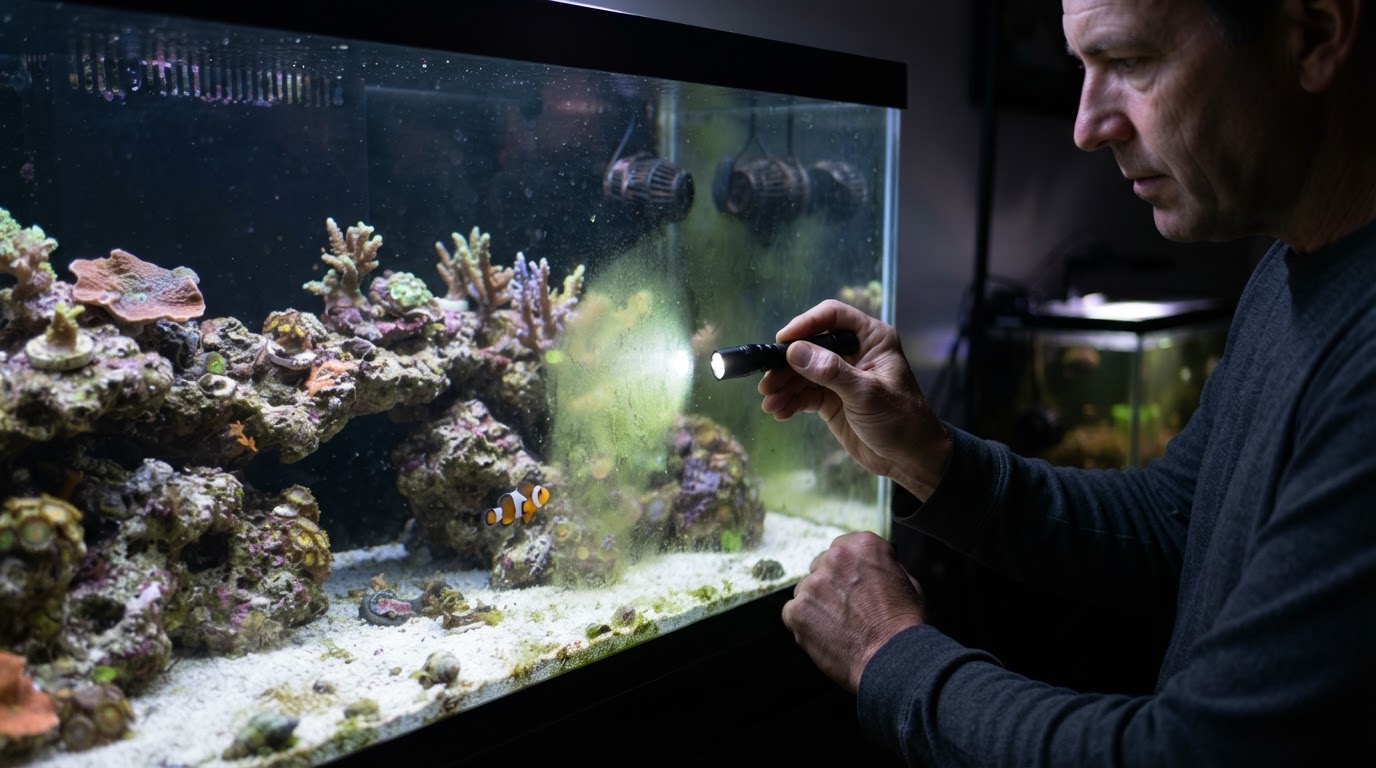
- Document it. Photograph the same patch in the morning and at peak lighting, with a ruler or a known object for scale. A photo records location, size and texture over time; it does not confirm an identity, and a hobby microscope often only narrows the field to a family or growth form.
Why manual removal is riskier than it looks
Pulling turf away usually leaves the anchored base behind, and the fragments that break free can resettle somewhere else. The debris released while you work — including anything you stir out of the substrate — feeds whatever grows next.
There is a deeper caution from reef research. A field study on Florida's reefs found that turf algal presence and height enhance sediment retention and that sediment-laden turf can re-establish rapidly after removal (Guzman et al., 2026, Frontiers in Marine Science). That is wild-reef evidence, not a measurement of your tank, but it illustrates why removing visible growth without addressing trapped debris may not be enough.
If you do remove it: switch off the flow, work on one small area at a time, siphon loose debris as you go, and keep tools away from coral tissue.
Check nutrients, light and flow before treating
Identification only helps if the fix matches the cause. Record these before changing anything.
- Nutrients. Test nitrate and phosphate with a real kit and write down the units. ppm and mg/L are numerically equivalent here, but nitrate-nitrogen is not the same as nitrate. A trend over several weeks beats any single reading.
- Feeding and detritus. Uneaten food, decaying matter in rock pockets and a neglected filter area all end up as the fine debris turf traps.
- Flow. Dead spots behind rockwork and along the back glass are where patches establish first. Aim for flow that lifts debris rather than blasting one spot.
- Light. Note your photoperiod and spectrum before touching the schedule. Chasing algae by cutting light can also slow the corals you are trying to protect.
- Source water. If you mix your own, check the source for dissolved solids; if you buy it, ask about the same thing.
- Recent changes. New dry rock, large water changes, carbon dosing or a filter change can all shift which organisms win.
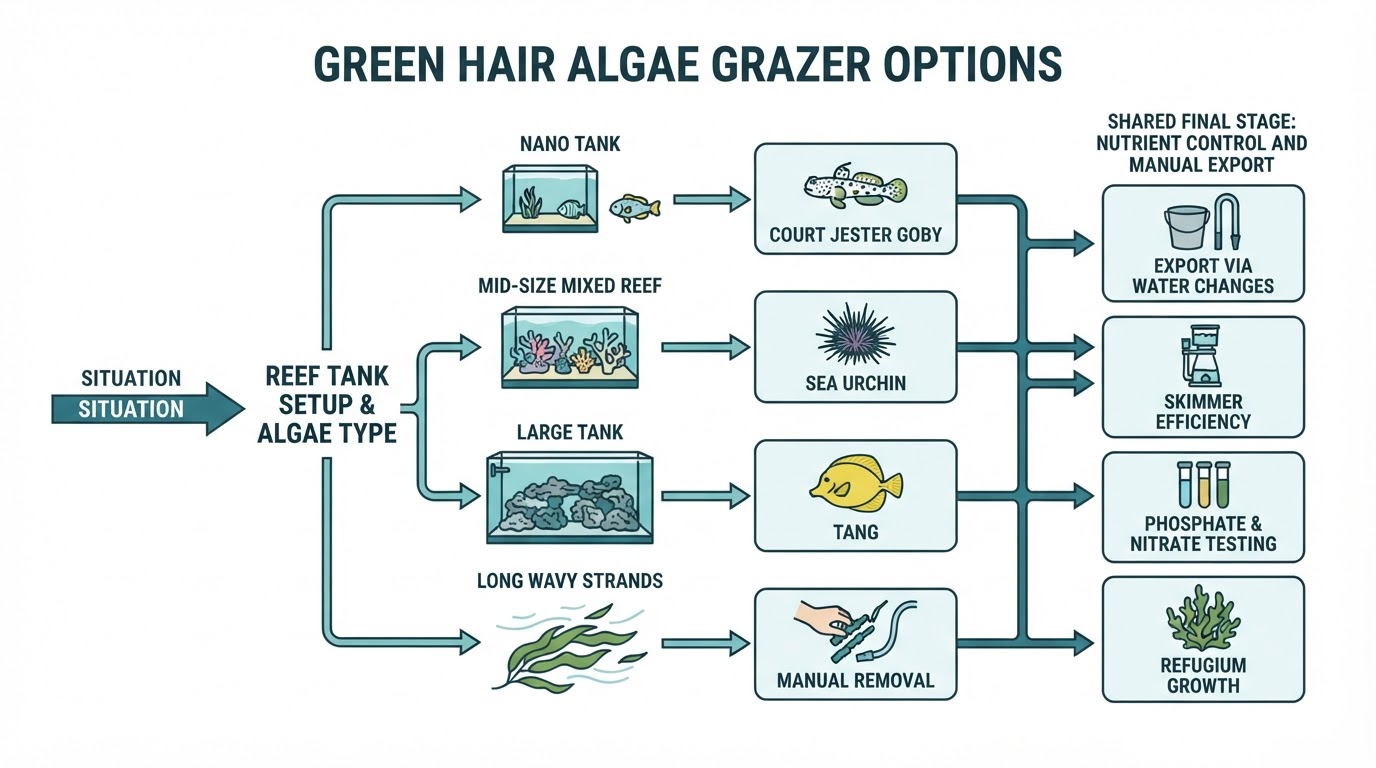
Community observations from the hobby side add one honest caveat: many grazers ignore established turf because it is too tough, and which animals are even suitable depends on tank size and compatibility (Manta Systems, turf algae guide). A cleanup crew is a supporting factor, not a fix on its own.
A decision table for the patch in front of you
What you see | What it points to | First conservative step |
|---|---|---|
Even haze that wipes off and returns in days | Film algae | Wipe or scrape; review feeding, light and nutrients |
Short, bristly, firmly anchored mat that traps grit | Turf growth | Photograph and measure it; siphon debris; read the removal limits above |
Long strands that lift and pull away | Hair algae | Remove what lifts; check nutrients and flow |
Feathery, fern-like tufts that break easily | Bryopsis | Identify carefully before acting; avoid scrubbing it apart |
Slimy sheet that lifts and changes overnight | Cyanobacteria | Siphon it out; improve flow and remove detritus |
Brown dust that settles and fades | Diatoms | Usually settles as the tank matures; keep records |
Prevention that changes the outcome
- Inspect and quarantine imports. New rock, frags and plugs are the usual way turf arrives. Quarantine — or at least inspect and clean — before anything enters the display.
- Keep export steady. Protein skimming, regular water changes and a refugium or algae scrubber all remove the raw material. Stable beats aggressive, because a sudden swing creates the open surface turf exploits.
- Hold flow where it matters. Rearranging one powerhead can end a recurring dead spot.
- Remove what lifts, leave the rest stable. Aggressive scrubbing near coral tissue usually costs more than it fixes.
- Keep a simple log. Patch size, photos and test readings over a month tell you whether your changes are working.
The limits of this guidance
None of this confirms a species, and no chemical treatment is offered here — dosing decisions belong to product labels and, for safety-sensitive choices, to a qualified source. The reef evidence describes open reef systems, not closed aquariums, so treat it as a model rather than a guarantee. Test kits have error ranges, and identification from a photo stays provisional.
FAQs
Does turf algae go away on its own?
Rarely. Unlike diatoms that fade as a tank settles, turf is anchored and regrows from its base and from fragments. Without changing what feeds it, the patch usually persists.
Can I just pull it off the rock?
You can remove what lifts easily, but expect fragments, released debris and regrowth. Work in small areas with the flow off, siphon as you go, and check nutrients, flow and light rather than repeating the same removal every week.
Is red turf algae different from green turf algae?
They are different mixes of small algae, and both count as turf growth forms. Color alone will not identify a species, and the practical checklist — location, attachment, texture, trapped debris and behavior — works the same for both.