Start with the surface, not the colour
On the front glass, a thin green coating that wipes off and returns over days may be ordinary film algae. On rock and sand, a similar-looking layer can have a different origin. Color alone cannot identify the organism. Start with where it grows, whether it forms a sheet or loose dust, and whether it changes through the light cycle.
Look and feel by surface
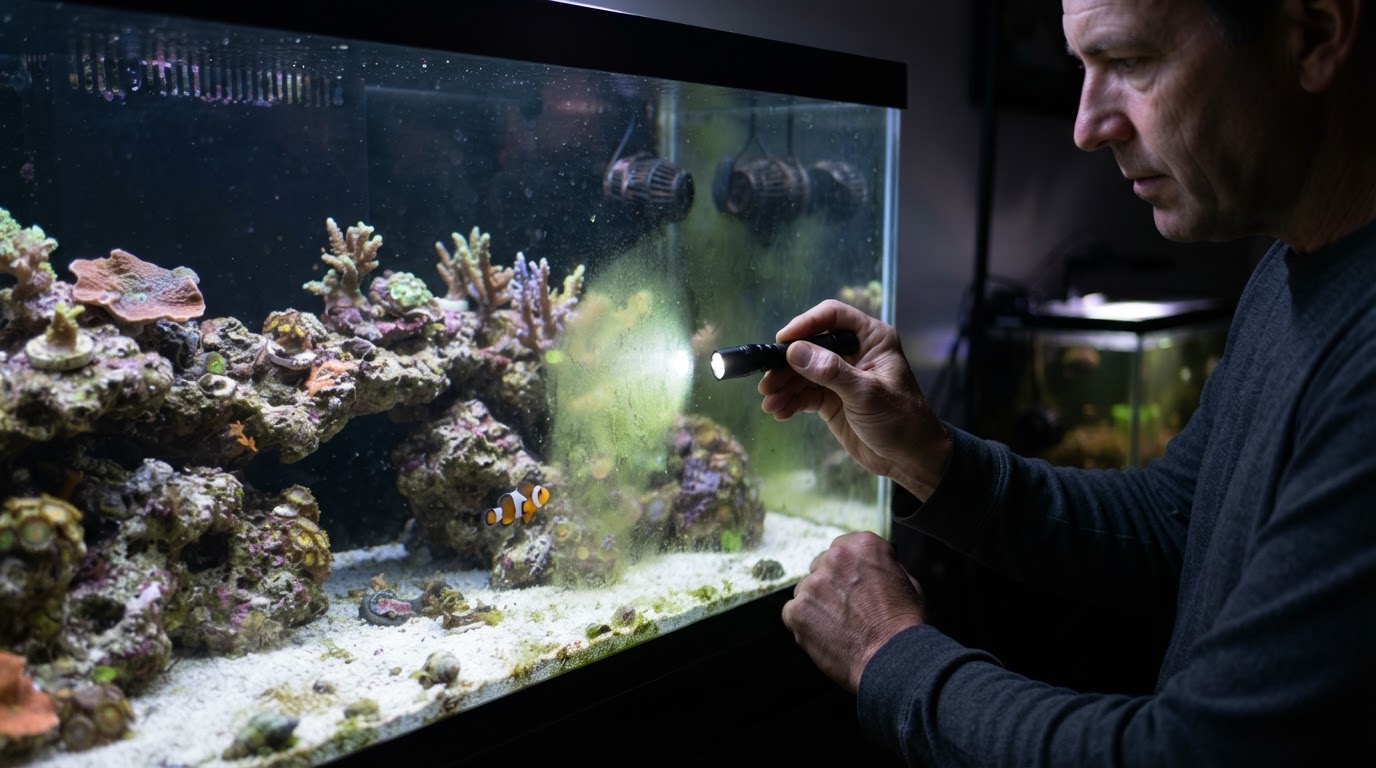
Glass. A thin green haze that wipes away and returns in a few days is classic film algae — normal in a lit reef tank and manageable with routine cleaning plus a check on light and nutrients.
Rock. A coating that lifts as a slimy sheet may suggest a microbial mat, including cyanobacteria, but that appearance is not a diagnosis. Strings and trapped bubbles are also clues to record, not proof of a dinoflagellate species.
Sand. Note whether the layer is a loose dusting, a coherent mat, or a stringy coating. Photograph the same spot before lights on and near the end of the photoperiod; these observations are more useful than guessing from color.
Use the day-night and return pattern
Note what the film does across a full photoperiod.
- Some mats expand under light and become less obvious overnight; that pattern can narrow possibilities but is not unique to one organism.
- Stringy patches with trapped bubbles deserve closer examination, especially if they return daily.
- A thin film that looks similar morning and evening may be ordinary maintenance growth, but persistence alone cannot prove what it is.
Do not rely on an improvised bottle test or one photograph to identify a bloom. Mixed films are common, and a clear microscope image reviewed by an experienced reef keeper can be more useful if the issue persists.
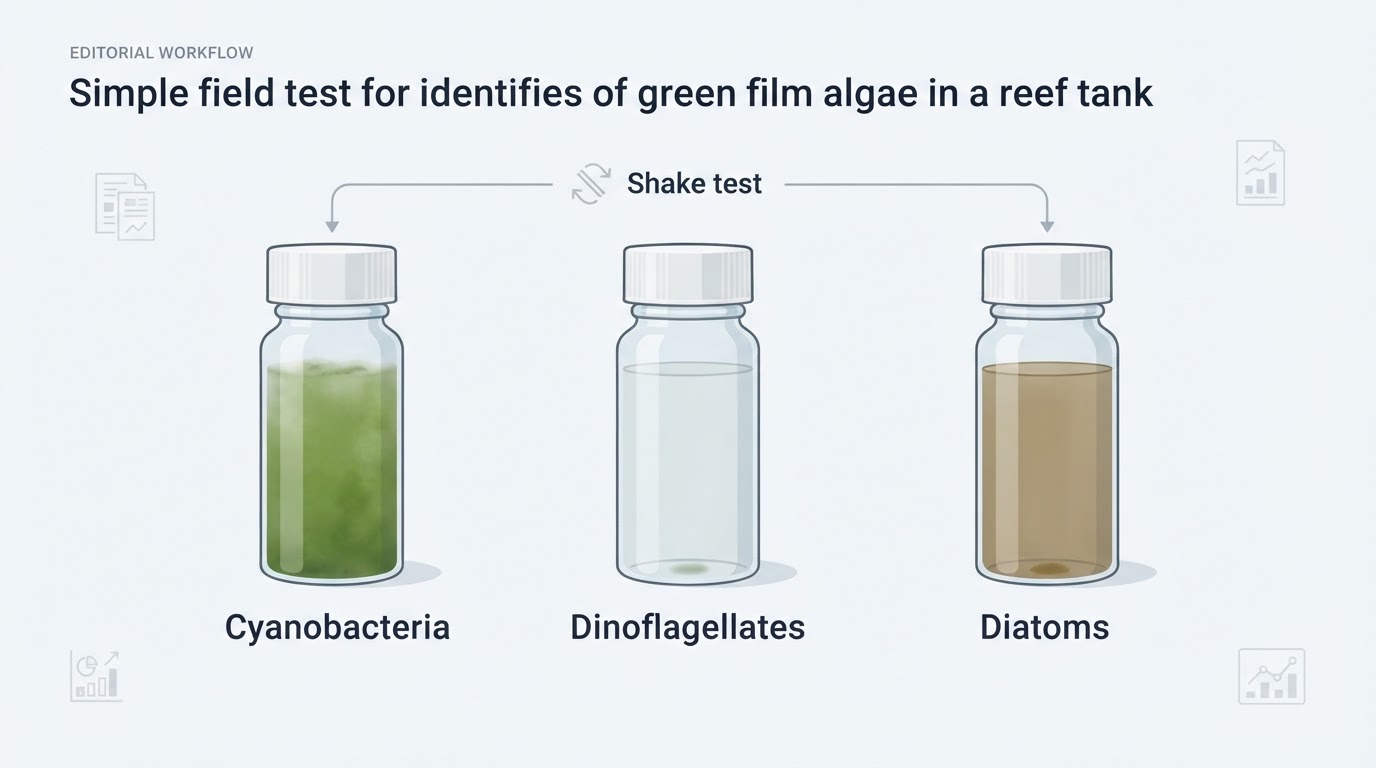
What a photo or microscope can settle
Shoot the same spot in the morning and at peak lighting: a photo documents colour, location and bubble pattern, but it cannot reliably separate an alga from a bacterium or a protist.
Microscopy can reveal cell shapes and movement that a tank photo cannot. Hobby-level identification can still be provisional; seek an experienced second opinion before a species-specific treatment.
Check the context that feeds regrowth
Identification only matters if the fix matches the cause.
- Flow. Note whether growth clusters in areas with little circulation, and review the tank's flow pattern without disturbing livestock.
- Detritus. Decaying matter in sand, rock pockets and filter areas creates the conditions these organisms prefer.
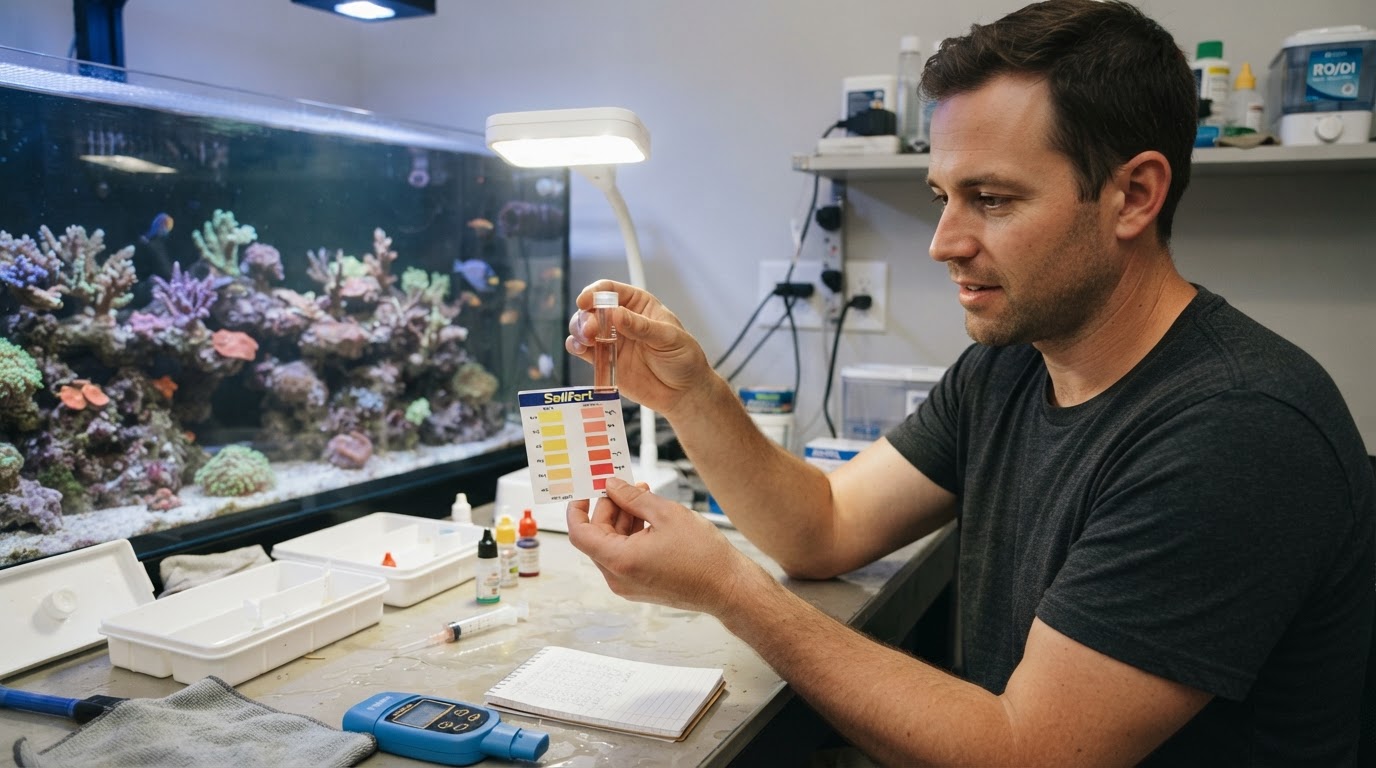
- Nutrients. Test nitrate and phosphate with a reliable kit, record the kit's units and compare trends over time. Nitrate reported as nitrate-nitrogen is not the same number as nitrate. Do not infer an organism or a treatment from one low or high reading.
- Recent changes. Carbon dosing, GFO, large water changes, antibiotic use and new dry rock shift which organisms win.
Diagnostic matrix
What you see | Where and how it behaves | More likely | First conservative step |
|---|---|---|---|
Even green haze, wipes off, returns in days | Glass, sometimes rock or equipment | Film algae | Wipe or scrape; review photoperiod, light and feeding |
Slimy sheet that can lift in one piece | Rock, sand, low-flow pockets; may expand in light | Possible microbial mat | Carefully siphon a small area; review flow and detritus |
Brown-golden strings with trapped bubbles; changes overnight | Sand and rock | Possible dinoflagellates or other mixed growth | Seek a microscope review before species-specific treatment; avoid abrupt nutrient changes |
Dusty brown film that wipes away easily | Glass, sand, rock; stable day to night | Diatoms | Clean and siphon; check source water if the tank is mature |
Two rows can be true at once, so recheck after each change instead of stacking treatments.
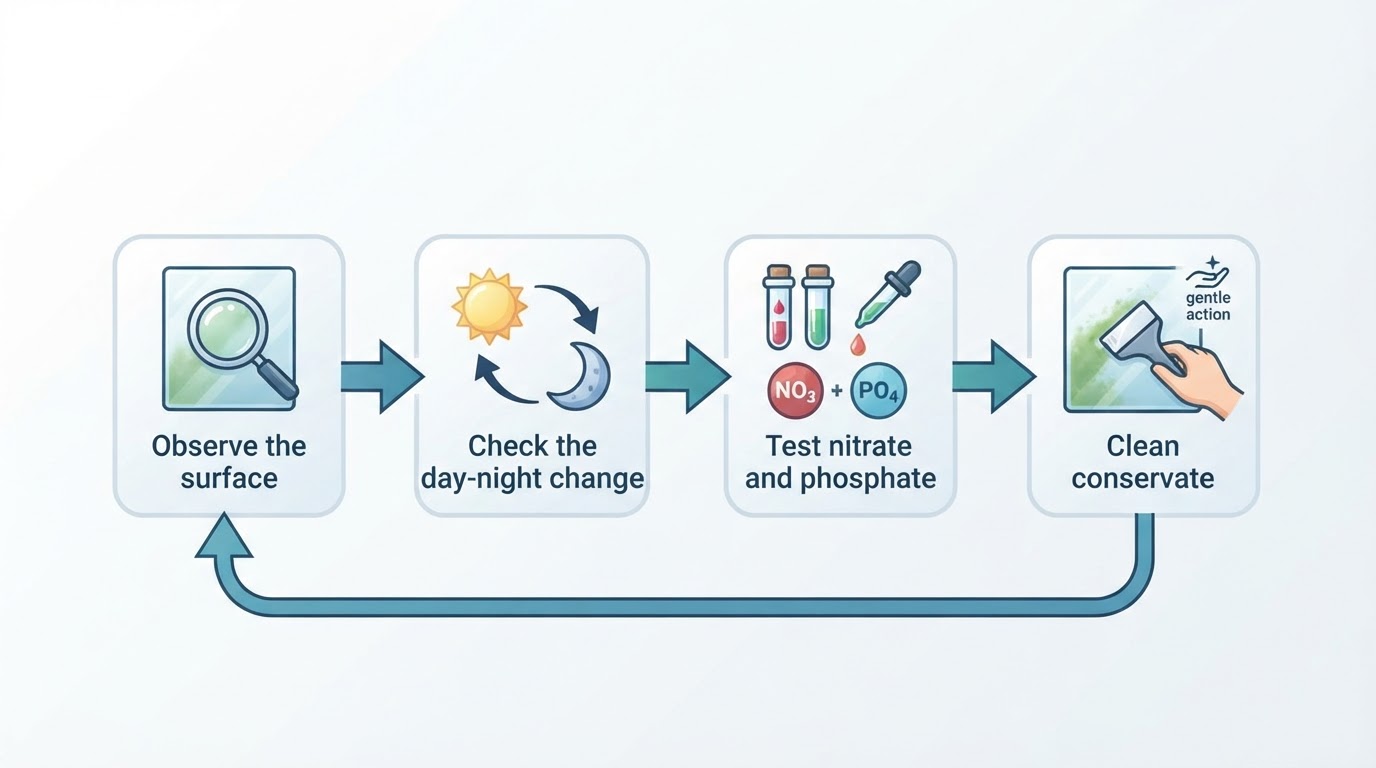
Clean conservatively before you dose
For a limited film with healthy livestock, start with ordinary glass cleaning and careful siphoning of loose material during maintenance. Avoid vigorously dispersing an unknown bloom, use gloves, and avoid inhaling aerosols. Review flow, remove detritus, and change feeding or lighting only modestly; re-test before a second change so you can tell which one mattered.
Chemicals deserve restraint: use any product only as its label directs, and no universal dose fits every tank. Do not choose an antibiotic, peroxide or other treatment from color alone. If a bloom causes respiratory symptoms while you work, stop handling it, leave the area and seek medical advice.
Honest limitations
Appearance checks narrow the field but cannot confirm identity; a microscope may be needed before a species-specific plan, and test kits have units and detection limits that can mislead. This is an appearance-and-observation guide; bubble algae and bryopsis are different problems with their own guidance. If a bloom spreads fast or livestock reacts, document it in photos, act conservatively on flow and detritus, and get a second opinion from an experienced reef keeper or aquatic veterinarian before using anything stronger.
FAQ
Is green film on reef tank glass always a problem?
No. A thin film that wipes off and returns over days is typical maintenance. It matters when it thickens quickly, spreads to rock and sand, or the water turns green — then find what changed.
Can I tell cyanobacteria from dinoflagellates without a microscope?
Appearance can suggest possibilities, but it cannot confirm them. A microscope and experienced review are useful before choosing a species-specific treatment. Start with conservative maintenance while you investigate. For a narrower visual comparison, see our diatoms versus dinoflagellates guide.
Should I raise or lower my nutrients?
Neither is a universal answer. Measure first, record the units, and fix the cause the reading points to. Cyanobacteria can grow with low nitrate, and dinoflagellates often follow nutrient collapse, so aggressive stripping can make a bad situation worse.