Start With the Reading, Not With a Product
Nitrate is where the nitrogen cycle ends: bacteria convert ammonia to nitrite and then to nitrate, which builds up whenever production outpaces removal. A low result is therefore a system question, not a missing bottle on a shelf. Fish tolerate nitrate far better than ammonia or nitrite, though higher readings can still fuel nuisance algae; corals and other invertebrates are usually why the number matters. On natural reefs, elevated nitrogen has been linked to more macroalgae, more coral disease and bleaching, and slower calcification (NOAA coral-reef monitoring guidance).
Make Sure the Zero Is Real
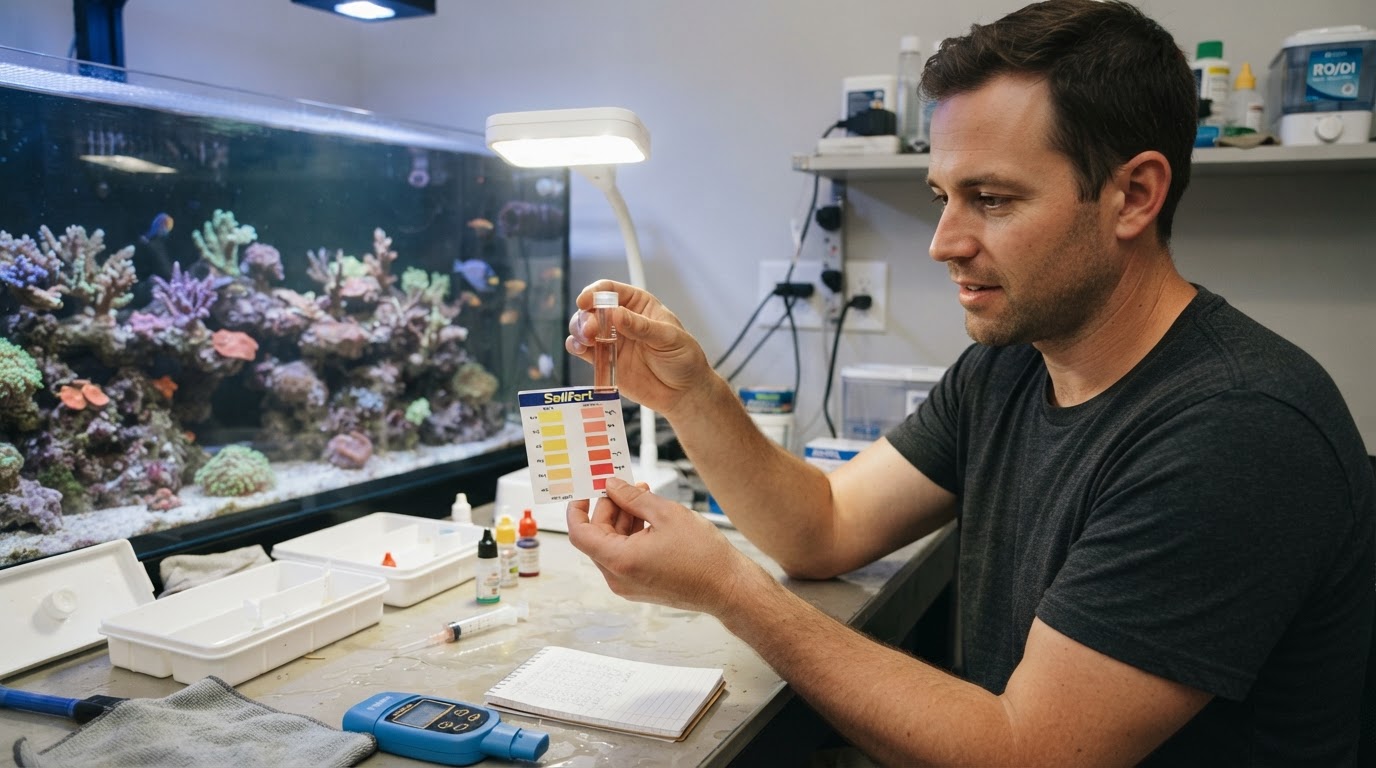
Two unit conventions dominate nitrate testing. Some kits report nitrate as the whole ion, NO3-. Others, including much of the scientific literature, report nitrate-nitrogen, NO3-N. The same water can look like 2 ppm in one convention and about 8.9 ppm in the other, because NO3-N multiplied by 4.43 gives the ionic NO3- figure. NT Labs states that its marine nitrate test reports NO3-N and that users should multiply by 4.43 for the ionic value (kit instructions).
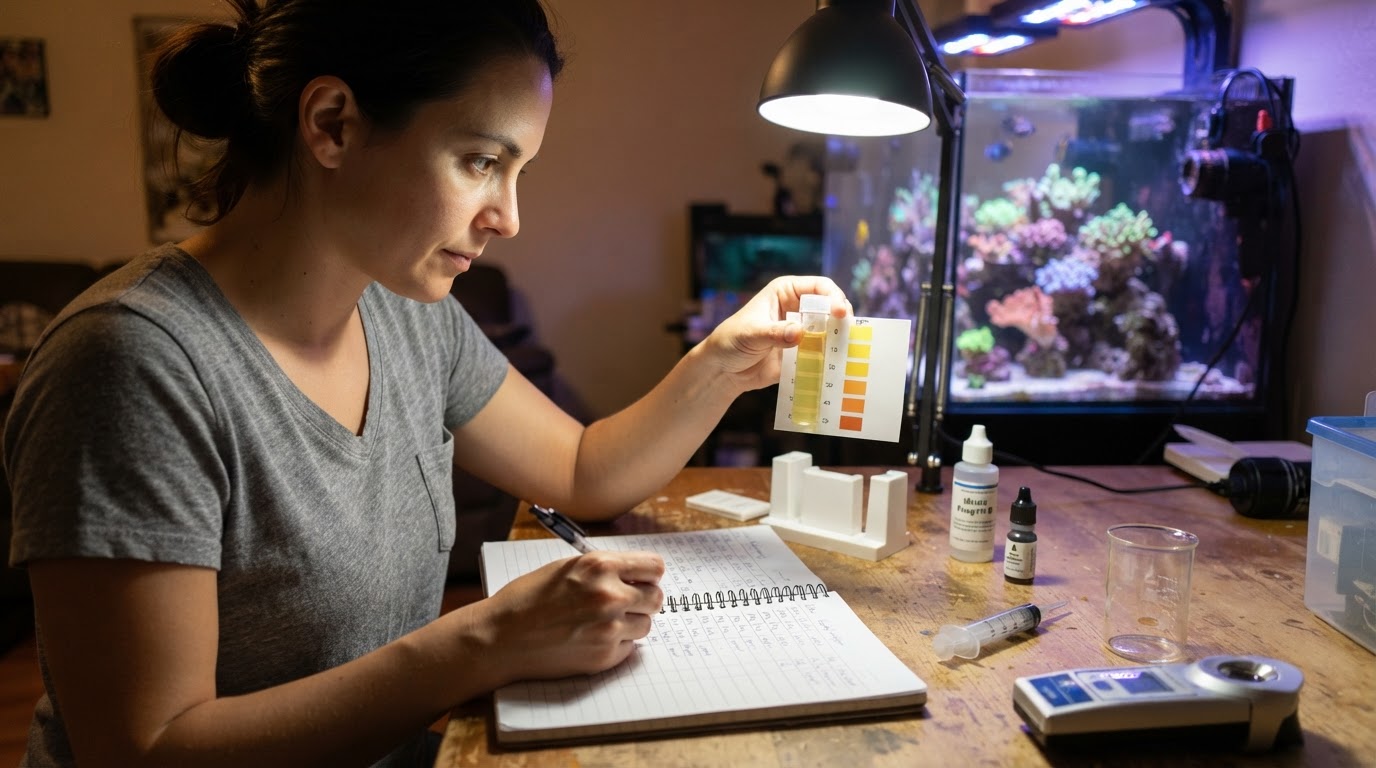
Before treating a low reading as a problem, check four things:
- Unit convention. Which scale is your kit actually reporting?
- Detection limit. Where does the colour chart or meter genuinely stop? A kit whose lowest step is 2 ppm cannot tell 0.2 ppm from zero.
- Procedure. Reagent age, mixing, timing, cuvette rinsing, and reading under consistent light all shift the result.
- Repeatability. Test the same water twice. If the two results disagree, fix the technique first.
An out-of-range reading is a reason to repeat the test, not to add something; use a second kit where one is available.
A Decision Path for a Low Reading
A practical decision path looks like this.
What you see | What it may mean | Best next step |
|---|---|---|
Below the kit's lowest step, after a repeat | Genuinely low nitrate for your system | Review import and export before considering any product |
Zero on a mid-range kit, not repeatable | Test error, old reagent, or dirty cuvette | Repeat with fresh reagent, the same technique, and the same time of day |
A number that jumps between tests | Procedure drift, or a real shift after feeding or a water change | Test twice more at a consistent time before acting |
Low nitrate plus pale or stalled corals | Nutrient limitation is plausible, but nitrate alone does not prove it | Verify other parameters and flow first, then decide whether a product is warranted |
Work through the table before you buy anything.
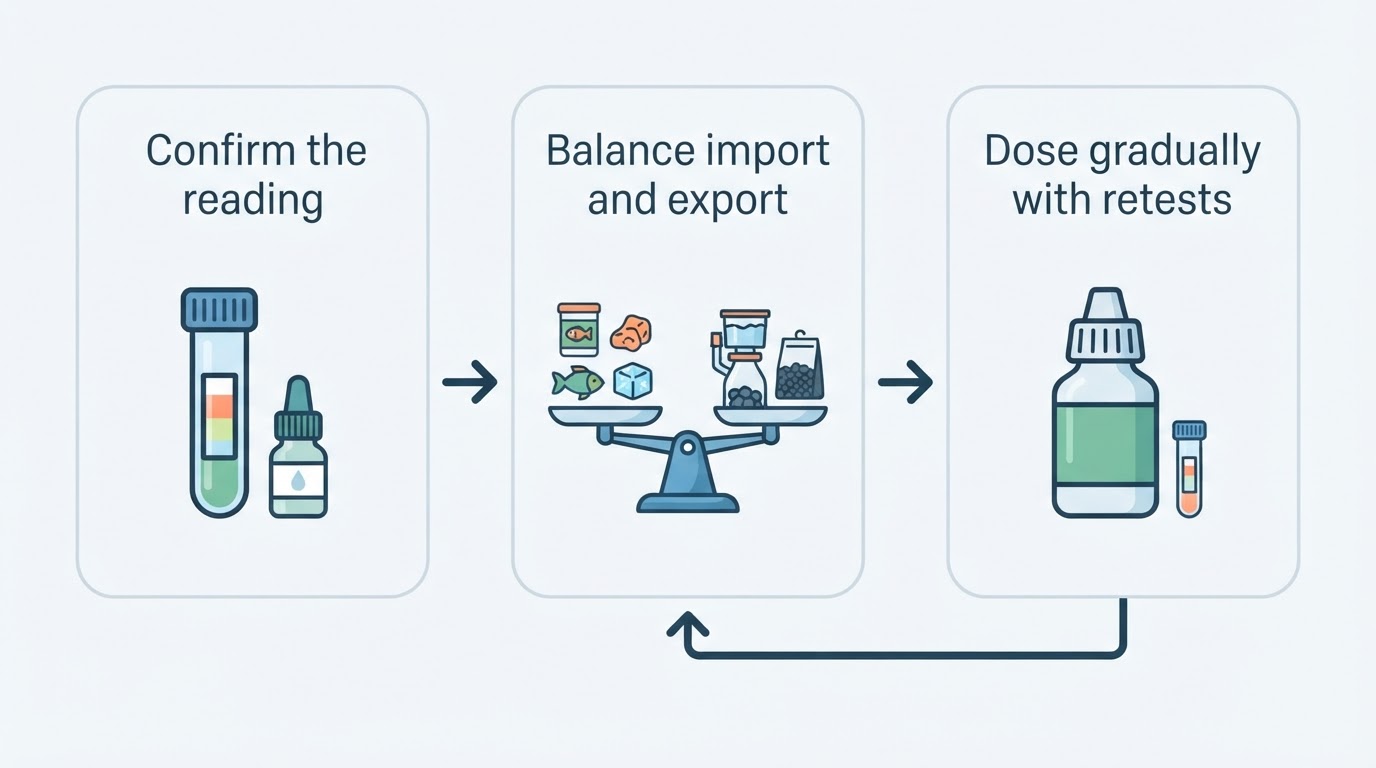
Rebalance Import and Export Before You Dose
Every tank has nutrient imports and exports. Feeding and fish waste add nitrogen; water changes, protein skimming, refugium and macroalgae growth, denitrification in live rock and substrate, and uptake by corals and bacteria remove it. Nitrate rises when imports win and falls when exports win, so the reading is a balance sheet rather than a defect.
Before adding a product, decide which side of that balance you are actually changing:
- If nitrate is stripped by an aggressive refugium or export routine, easing that export — harvesting macroalgae less often, shortening a refugium photoperiod, or changing media less aggressively — may lift the reading without adding anything. Keep waste processing and oxygen safety intact.
- If the reading is low because the tank is lightly fed or lightly stocked, feeding volume or frequency is another import lever, but it also changes phosphate and waste load, so measure it the same way.
- If neither lever suits your system, a labelled nitrate product is the remaining option.
If You Use a Product, Follow Its Label
Use only products sold for aquarium use, and follow the product's own label or dosing calculator. There is no single dose or target number that fits every tank: the right amount depends on water volume, the current reading, the product's concentration, and what else lives in the system. Use the product's instructions for dose size and retest timing; begin conservatively, then record both the dose and the next measured result before deciding on another change. Stop adding if the reading or livestock response is not what you expected. If you overshoot, verify the test and use appropriately matched replacement saltwater for any water change; avoid an abrupt salinity or temperature swing.
Three habits keep this safe:
- Keep each dose small and leave enough time to measure its effect.
- Log every reading with its time and dose, so a trend replaces a number.
- Pause dosing if any animal shows stress; livestock comes first.
Also check phosphate alongside nitrate: a tank with unusually low readings for both nutrients calls for a broader nutrient-balance review. The site's high-phosphate signs guide explains the other side of that balance.
What You Cannot Know From One Test
Three limitations are worth stating plainly. First, no universally correct nitrate number exists for a reef tank. NOAA's coral-reef monitoring guidance states that optimum nitrogen concentrations and thresholds specific to U.S. coral reefs are not known, and a home aquarium is a different system again (NOAA guidance). Second, published reef values are ecosystem references, not aquarium instructions: a NOAA study of 26 Guam watersheds associated negative effects on reef assemblages with dissolved inorganic nitrogen above roughly 0.10 mg/L, with nitrate dominant in the discharge, but DIN also includes nitrite and ammonium, so it does not map directly onto a home kit (NOAA research). Third, a reading is only a snapshot: it moves with feeding, time of day, and recent water changes, so one number rarely justifies a permanent change.
Frequently Asked Questions
Can a zero nitrate reading be trusted? Only after the kit's range, unit convention, reagent condition, and procedure have been checked and the result repeats. A reading below the kit's lowest step is not the same as zero, and a mid-range kit may not resolve the difference.
How fast can nitrate be raised safely? There is no fixed safe rate; it depends on the product and how closely you monitor it. Raise it in small steps, retest between them, and let the readings — not a calendar — set the pace. If any animal reacts badly, stop and correct with a water change.
Is feeding more enough to raise nitrate in a reef tank? Sometimes, but it is an indirect lever. More food adds nitrogen and phosphate, increases waste, and does not guarantee the reading moves the way you want. Treat it as a measured change you verify with tests, not a default fix.