Check the unit before you assume the worst
Two readings can both be called "40 ppm nitrate" and still describe very different tanks. Nitrate is reported either as the whole nitrate ion (NO3) or as nitrate nitrogen (NO3-N). Both conventions exist; do not assume which one your kit uses. NT Labs' marine nitrate test is one example that reports nitrate-N and explains the 4.43 conversion.
The difference is a factor of 4.43: multiply a nitrate-N result by 4.43 to express it as nitrate (NO3), or divide a nitrate (NO3) result by 4.43. That single step decides what your 40 actually means.
What the kit says | What it measures | What "40" means |
|---|---|---|
Nitrate (NO3) | The whole ion, nitrogen plus oxygen | About 9 ppm as nitrate-N |
Nitrate-N (NO3-N) | Only the nitrogen in the nitrate | About 177 ppm as nitrate (NO3) |
No unit given | Unknown | Treat the reading as unconfirmed |
Before you react, check the label, the leaflet, and the unit printed beside the color chart; low-range and high-range kits can use different scales.
Repeat the test before you change the tank
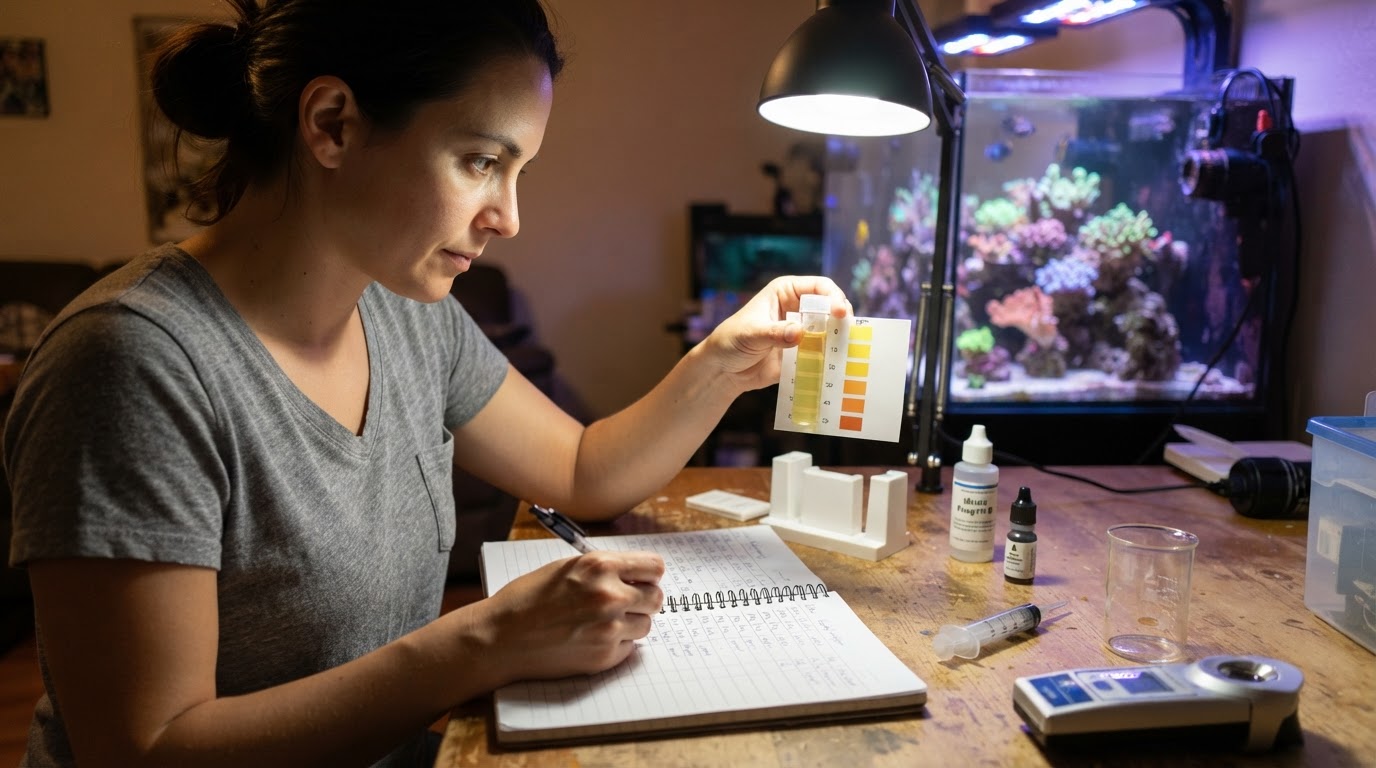
A single result is a hypothesis, not a diagnosis. Test the same water again the same way: rinse the vial with tank water, match the sample volume to the mark, keep the lighting and background consistent, and read the chart the same way.
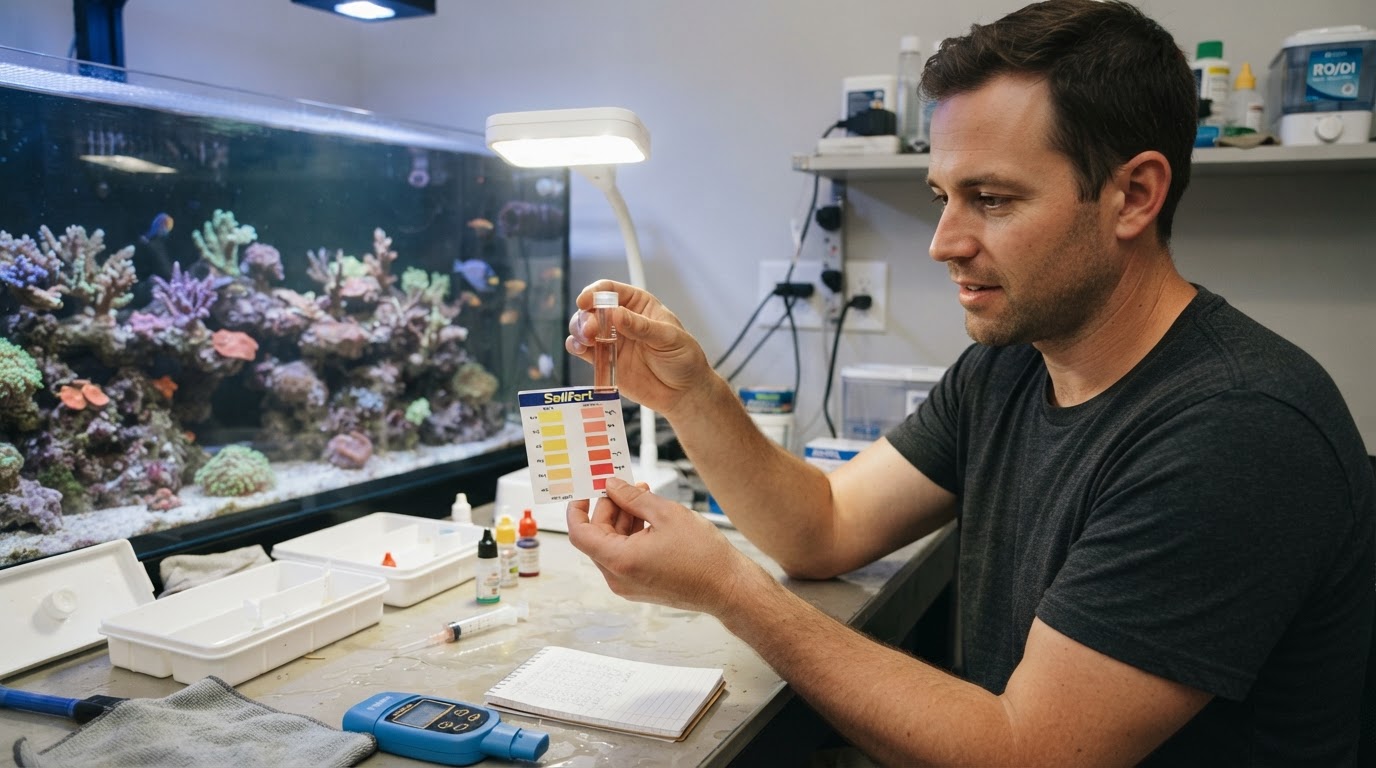
Then check the kit itself. Expired reagents, contaminated vials, or a sample diluted to fit a high-range chart can distort the number, and a color near the top of the scale is hard to resolve. If the second result lands in the same place, treat the reading as real. If it swings, you have a measurement problem to settle before you touch the tank.
Judge by the corals, not the number alone
Forty ppm is not a verdict. The same value can coexist with healthy soft corals and with stony corals that are clearly unhappy, which is why no honest source calls it universally safe or universally dangerous.
Coral type is one filter, but individual species and other tank conditions matter. Nutrient enrichment can affect coral communities, as described in NOAA's reef-monitoring guidance. That ecosystem evidence does not establish a home-aquarium threshold. Watch your own livestock rather than assuming a particular coral group tolerates a particular number.
Speed of change matters just as much. Nitrate that drifted up over months in a stable tank is a different situation from a jump that appeared in a week after a feeding change, new stock, or a filtration failure. Trend plus visible condition tells you more than either one alone. The symptoms worth acting on are paling or bleaching tissue, recession, stalled growth, and animals that behave differently; heavy algae growth is a trend to manage, not an emergency by itself.
Decision table for a 40 ppm reading
Situation | What it suggests | Next step |
|---|---|---|
The kit reports nitrate-N | Your real nitrate (NO3) is near 177 ppm | Re-read the unit, then treat the reading as high and confirm with a second test |
Kit reports nitrate (NO3), stable for weeks, corals growing and colored | A tank that is tolerating its nutrient level | Keep observing; re-check the kit from time to time |
Rising fast, stony corals pale, receding, or stalled | A trend that deserves priority | Confirm the reading, then fix the cause without an abrupt swing |
One high result after feeding more or adding stock | A shift in nutrient import | Retest, then correct feeding and stocking load |
Repeat tests disagree | A measurement problem | Fix testing before treating the tank |
Concrete steps: confirm, find the cause, act proportionally
Forty ppm is high enough to take seriously, but the right response depends on the unit, the trend and the corals in front of you. For the wider testing context, see the site's aquarium water-quality guide.
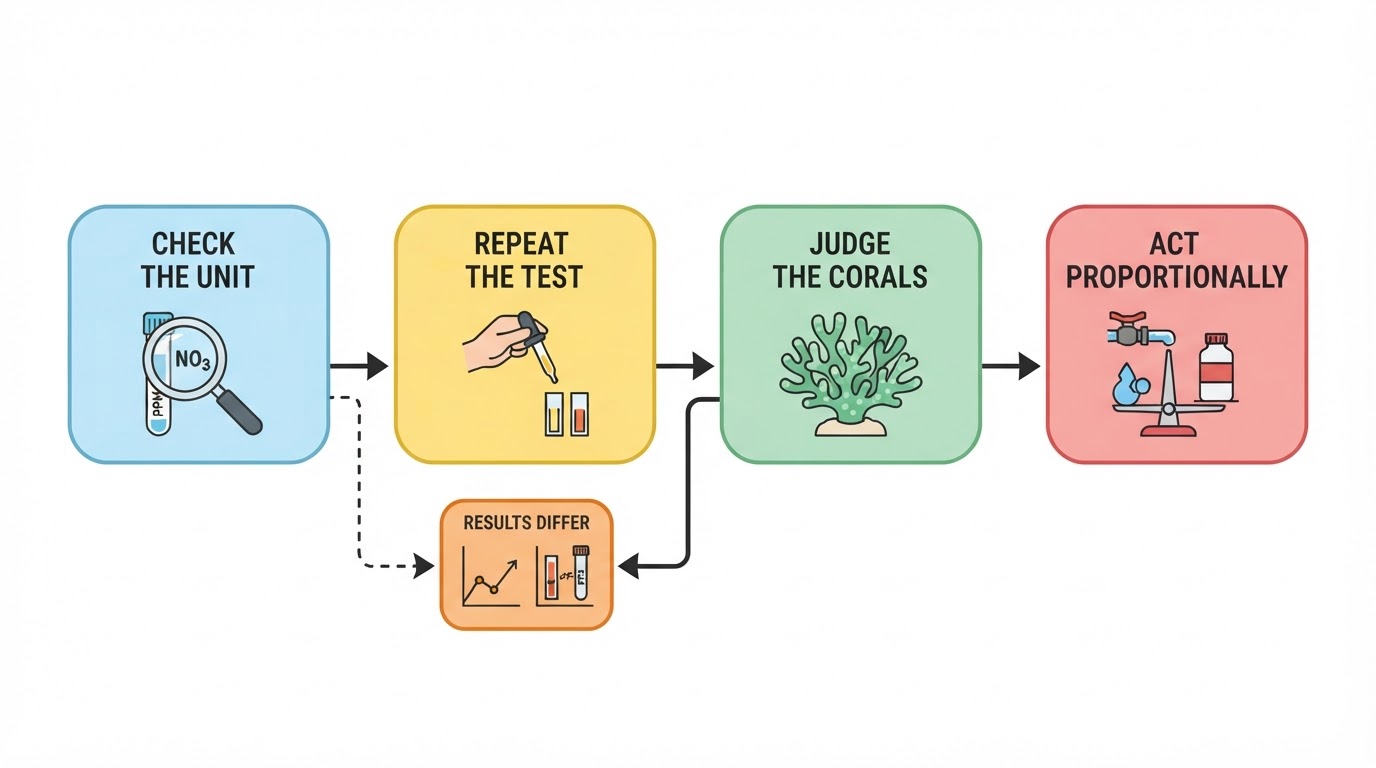
- Confirm the reading, including the unit, before you change anything.
- Find where the nitrate comes from: uneaten food, stocking load, accumulated detritus, filter maintenance and source water are the usual inputs; skimmers, water changes and refugium or algae growth are the usual exports.
- Choose the mildest response that fits your system. Step up water changes, clean detritus without stirring a mature sand bed, review feeding, and confirm that export equipment is running. Avoid one huge correction that swings salinity, temperature or alkalinity.
- Change one thing at a time and retest the same way, or you will not know whether the number moved because of the tank or because of the test.
What a 40 ppm reading cannot tell you
There is no single best nitrate level for every reef tank, and no hobby kit answers the question by itself: a reading is an approximate bucket of dissolved nitrogen, not a measure of what your corals do with it. Alkalinity, phosphate, light, flow, species mix and time all shape the outcome, and the long-term effects of sustained high nitrate in home systems are not settled. Work from your tank's trend and condition, not the number alone.
Questions people ask about 40 ppm
Is 40 ppm nitrate dangerous for fish?
Fish usually tolerate far higher nitrate than corals, but "usually tolerated" is not "safe in every system," and a unit mix-up can mean the true concentration is several times higher than the number you read. Judge by behavior and feeding, and repeat the test.
How do I tell whether 40 ppm is nitrate or nitrate-N?
Read the unit, not the number. If the kit says nitrate-N or "as nitrogen," multiply by 4.43 to express it as nitrate (NO3); if it says nitrate (NO3), divide by 4.43 to compare with nitrogen-based data. The same 40 becomes about 9 ppm in one direction and about 177 ppm in the other.
Do I need a big water change right now?
Not automatically. Confirm the reading and check the trend and the corals first. If you do act, a measured series of moderate water changes with a retest between steps tells you more than one abrupt reset.