The Short Answer: What Eats Bubble Algae in a Reef Tank?
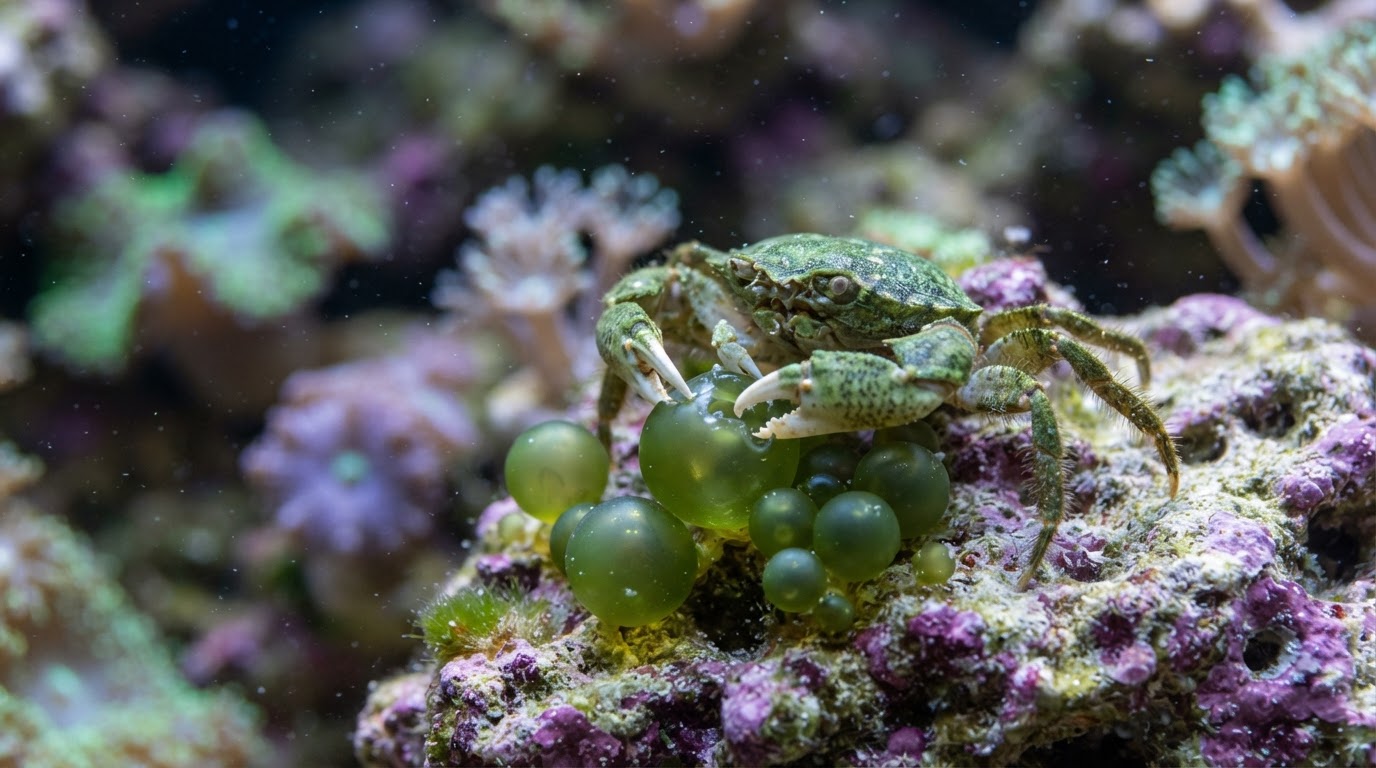
Emerald crabs (Mithraculus sculptus) are the species most often recommended for bubble algae, and they do eat it. "Eats it" is not the same as "solves it," though. In a peer-reviewed aquarium study, emerald crabs chose commercial pellets 77% of the time and frozen mysids 69% of the time when those alternatives were offered alongside bubble algae, and their algae consumption dropped significantly once pellets were part of the diet (Figueiredo et al., 2008). A well-fed crab is even less likely to bother with nuisance algae at all (Reef Builders).
Two fish are also worth knowing about, with a caveat: tank size.
- Foxface rabbitfish — reported to tackle Valonia, but they grow to roughly 8 inches and are best housed in large aquariums (Bulk Reef Supply); reefkeepers generally report success in tanks five feet long or more, around 100 gallons and up (Reef Builders).
- Vlamingi tangs — impressive grazers that grow to about 24 inches and belong in 200-gallon-plus systems (Bulk Reef Supply).
For many smaller home reef tanks, an emerald crab is a more practical candidate than either of those large fish — and only as a helper, not a cure. Check compatibility with the animals you already keep before adding one.
Emerald Crabs: The Default Answer, With Limits
The same study that confirmed emerald crabs eat Ventricaria ventricosa (previously Valonia ventricosa) also explained why results are so uneven. Medium and large crabs ate more bubble algae than small ones, and crabs did not ignore algae entirely when frozen food was around — pellet feeding was what really crowded the algae out of the menu (Figueiredo et al., 2008).
Their feeding method matters too. Emerald crabs have spoon-shaped claw tips with razor edges, and they tear the bubbles apart rather than popping them cleanly (Reef Builders). High-speed video in the study showed that tearing a cell releases liquid containing juvenile cytoplasmic spheres, which may help the algae disperse (Figueiredo et al., 2008). That is not the same as the old claim that popping bubbles releases "spores," but it does mean removal is never perfectly tidy.
Practical implications:
- Expect hidden work. Emerald crabs are opportunists that often hide and feed at night, so you may see less predation than is actually happening (Reef Builders).
- Keep feeding appropriate for the animals already in the tank; do not starve livestock to make a crab eat algae. Excess prepared food may also reduce how much bubble algae a crab chooses to graze (Figueiredo et al., 2008).
- Treat them as maintenance, not a cure. Larger tanks with fewer crabs will always leave some bubbles unchecked (Reef Builders).
Why No Eater Guarantees Eradication
Individual variation is the rule. A species that grazes bubble algae in one tank may ignore it in another, and food preference shifts the outcome more than species reputation does. Nutrient conditions matter as well: algae generally grows faster when nitrate and phosphate run high, so reducing those levels within a safe range for corals slows new growth without eliminating existing bubbles (Bulk Reef Supply).
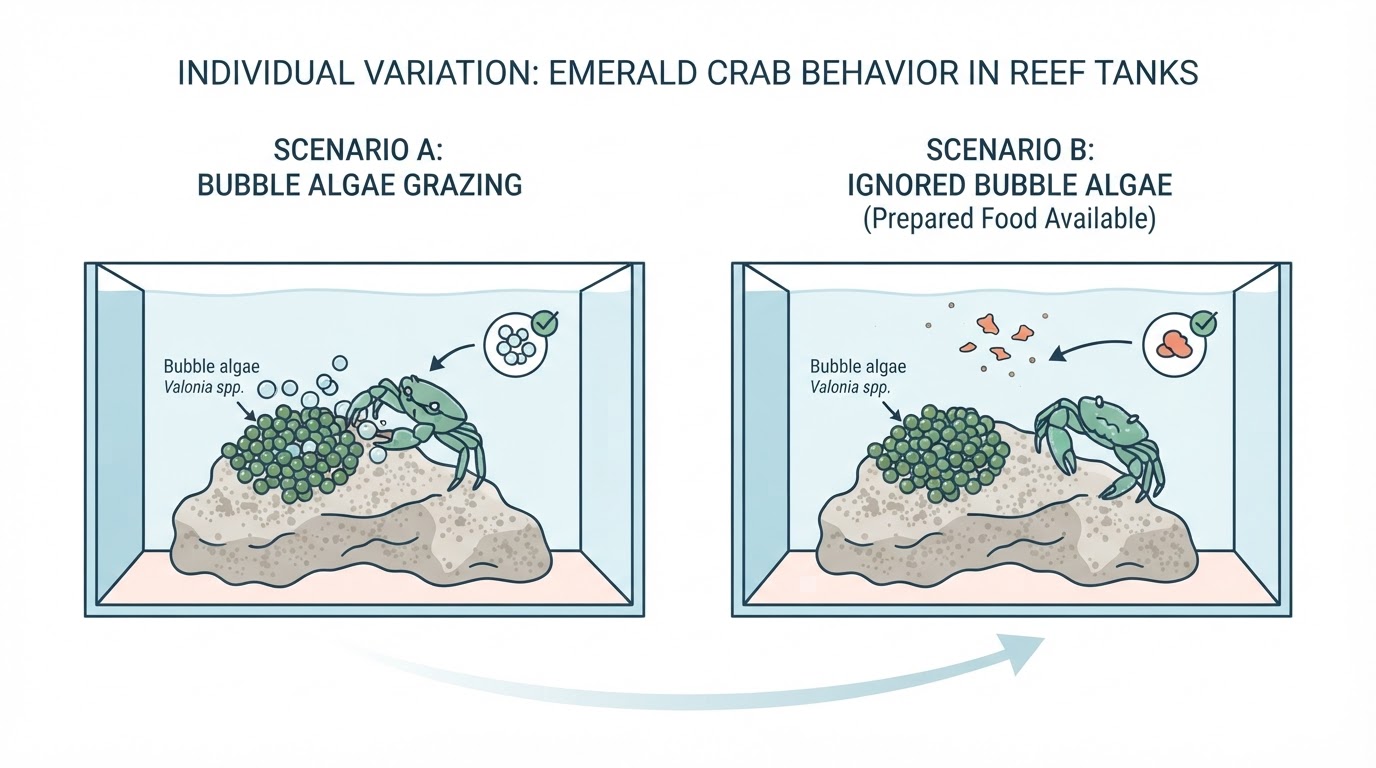
Nothing in the study or long-term hobby observations supports a guarantee. Add an eater to reduce a population over time, and keep a manual removal routine running alongside it. For broader clean-up-crew choices, see our reef cleaners guide; it is not a bubble-algae-specific treatment plan.
A Practical Decision Table
Your situation | First move | Candidate livestock | Main limit |
|---|---|---|---|
A few accessible bubbles | Remove with tweezers or a siphon during a water change (Reef Builders) | None needed yet | Must be repeated; missed bubbles settle elsewhere |
Scattered bubbles on established rock, small or medium tank | Manual removal plus tighter feeding and nutrient control | One or more emerald crabs | Crabs may prefer prepared food and hide at night |
100+ gallons and at least five feet long | Manual removal, then review fish stocking | Foxface rabbitfish | Adults reach about 8 inches (Bulk Reef Supply) |
200+ gallons | Manual removal, then review stocking | Vlamingi tang | Adults reach about 24 inches (Bulk Reef Supply) |
Any tank with corals or small fish | Check compatibility before adding anything | — | Crabs are opportunistic, and eaters do not fix the cause |
Manual Removal And Prevention, Step By Step
Manual removal is still the most reliable first step, and it works alongside any animal you add.
- Remove what you can see. Gently detach accessible bubbles with suitable tweezers while siphoning loose pieces out rather than letting them drift (Bulk Reef Supply). Avoid scraping nearby coral tissue or scratching the tank.
- Turn off the pumps. Free-floating bubbles will otherwise attach to pump cages and spread (Reef Builders).
- Don't fear popping, but clean up. The bubbles are single cells and do not contain reproductive spores, so popping one is not the disaster many hobbyists assume — just make sure no fragment is left behind (Bulk Reef Supply).
- Scrub the leftovers. A toothbrush removes burst remnants from rock (Reef Builders).
- Slow the regrowth. Inspect new rock and coral frags before they go in, and monitor nitrate and phosphate without stripping nutrients to zero (Bulk Reef Supply). Bubble algae can also grow in tanks with otherwise good water quality, so nutrients are only part of the picture.
Skip harsh chemical fixes as a first response. One retailer notes that products used against bubble algae can also kill other algae, including macroalgae, and have been known to irritate corals (Bulk Reef Supply) — a treatment to consider as a last resort, if at all.
FAQ
Will an emerald crab always eat the bubble algae in my tank?
No. Crabs vary as individuals, and when pellets or other prepared foods are available, bubble algae often stops being their first choice (Figueiredo et al., 2008). A crab is a slow, partial helper, not a guaranteed solution.
Does popping bubble algae make it spread?
Popping does not release reproductive spores — that common warning is a myth (Bulk Reef Supply). The real risk is mechanical: loose cells float and settle elsewhere, and tearing the algae can release cell contents that may aid dispersal (Figueiredo et al., 2008). Pop and remove with a siphon running.
Can a foxface live in a smaller reef tank?
Adults reach about 8 inches (Bulk Reef Supply) and are generally recommended for tanks of five feet and 100 gallons or more (Reef Builders). In smaller systems, manual removal plus emerald crabs is the realistic combination.
The Honest Bottom Line
The animals most likely to eat bubble algae in a reef tank are emerald crabs, with foxface rabbitfish and large tangs as options only for big systems. None of them guarantees eradication, and all of them do better when you keep removing bubbles by hand and keep nutrient levels and feeding in check.