Start By Treating The Number, Not The Tank
Specific gravity (SG) is a density ratio rather than a direct salt measurement, and its relationship to salinity in parts per thousand (ppt) depends on the reference conditions and the instrument. Do not treat a bare reading such as "1.025" as an exact, universal ppt conversion. Check the unit, temperature reference, and calibration instructions for the meter you actually use. Hanna's saltwater parameter guide gives reef salinity ranges, but a single tank reading is not a diagnosis by itself.
Mixed reefs are commonly kept within a narrow, stable salinity range, but the right target depends on the system. An unexpectedly high reading deserves confirmation and a look at the animals; closed polyps or labored breathing can have several causes and cannot be assigned to salinity alone.
Step 1: Confirm The Reading
Before you remove a single drop of tank water, prove the measurement.
- Calibrate or verify the instrument as its own manufacturer instructs. Some instruments use distilled or deionized water for a zero-point calibration; others use a 35 ppt standard. Do not substitute one method for another because of a generic aquarium article. For example, Hanna's HI96822 seawater refractometer documentation specifies its own procedure.
- Read the unit and temperature reference on the display or in the manual. If the instrument offers SG and ppt, record which one you are following rather than switching scales mid-correction.
- Take a second reading after the sample and instrument have stabilized according to the manual. If results remain inconsistent, check against a suitable reference solution or another properly calibrated instrument before changing the tank.
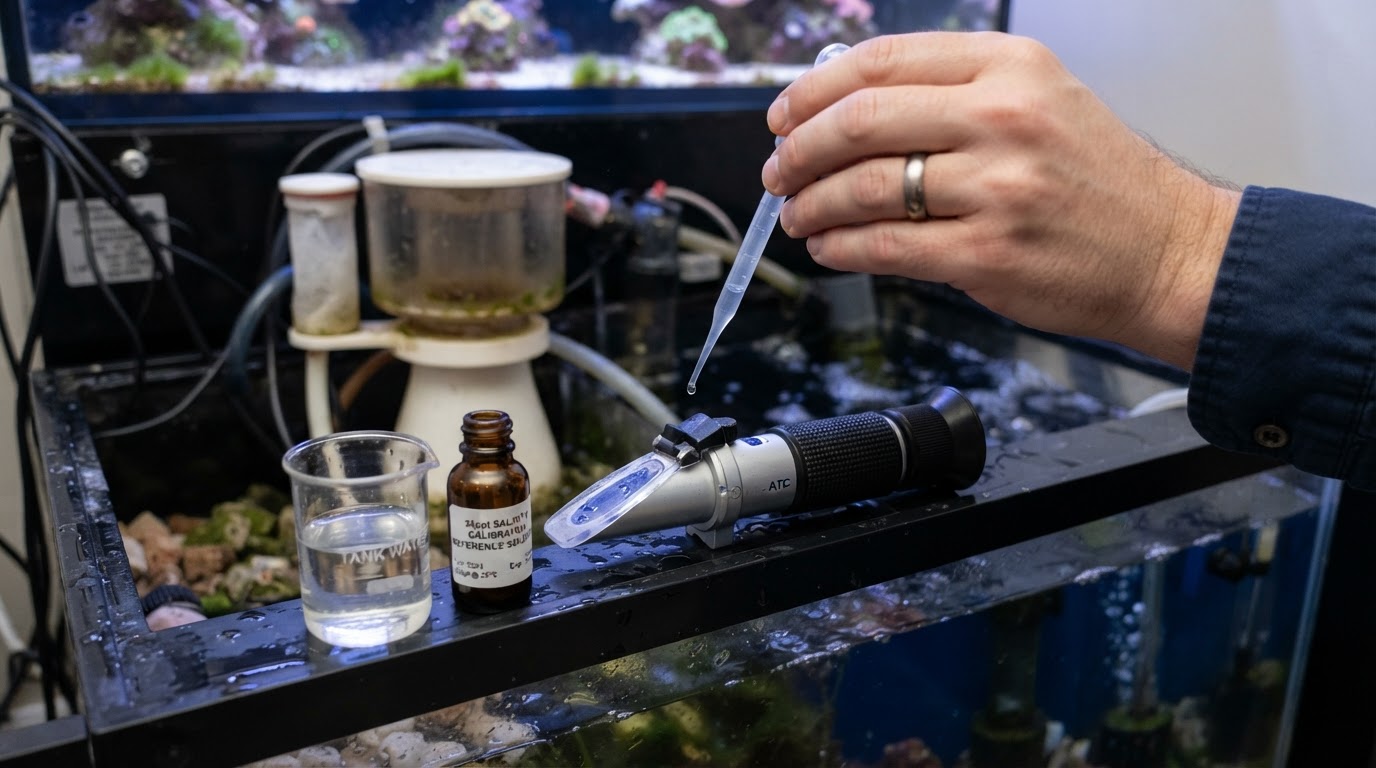
A useful checkpoint: if two readings of the same sample disagree, resolve the measurement problem before you change the water.
Step 2: Work Out Why It Climbed
Evaporation removes water and leaves the salt behind, so salinity drifts upward in every open system. That is normal, and ordinary top-off with fresh RO/DI water is what keeps it stable. When the reading is genuinely high, the usual suspects are:
- Top-off water that was accidentally saltwater, or an ATO reservoir filled from the wrong container.
- A faulty auto top-off unit, a stuck sensor, or a reservoir that ran dry.
- Replacement water for a water change that was mixed too strong.
- A low operating water level that was never restored, so the remaining water is more concentrated.
- Plain measurement error.
Check the water level in the display and the sump first. If it is below the normal mark, restore it with fresh RO/DI water, let the system mix, and measure again. That may return a temporarily concentrated tank to its usual salinity. If the water is already at its normal level and the reading is still high, ordinary top-off is not the fix: inspect the last saltwater batch, the ATO reservoir, and the instrument before choosing a correction.
Step 3: Top-Off And Correction Are Not The Same Job
Topping off replaces water that evaporated: it restores the normal water level, and it should use fresh water. Once the tank is at that level, deliberately lowering an excessively high salinity requires removing some saltwater and replacing it with fresh water, or using replacement saltwater mixed below the tank's current salinity. If you remove tank water during cleaning and replace it with RO/DI, you lower salinity rather than merely topping off. The reverse mistake, topping off with saltwater after evaporation, pushes the reading higher.
Step 4: Run The Correction In Small Rounds
Once the reading is confirmed and the cause is understood, dilution becomes a repeatable loop rather than a single dramatic fix.
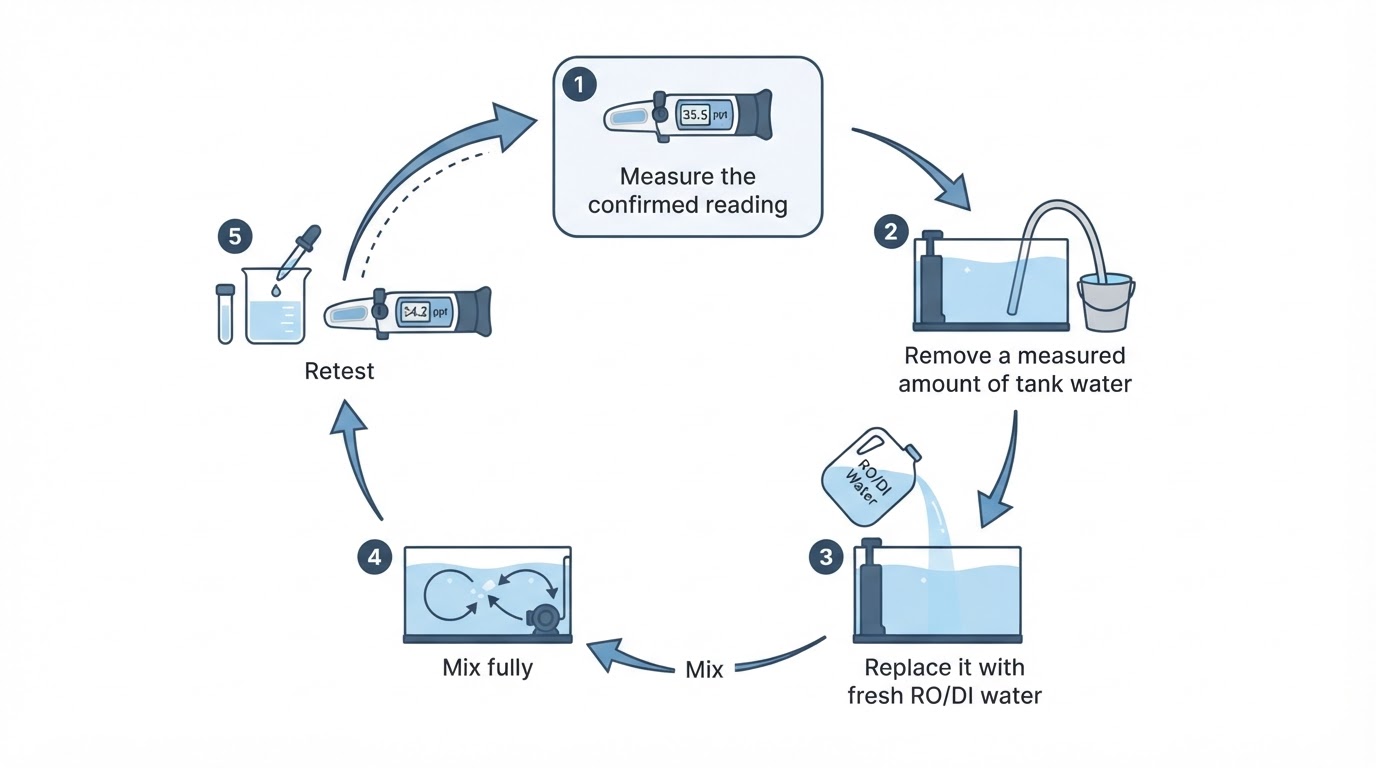
- Work out your approximate system volume, including the sump, so you are thinking in fractions rather than guesses.
- Remove a measured, modest amount of tank water into a bucket. Keep track of exactly how much you took out.
- Replace that same volume with fresh RO/DI water at about tank temperature. Add it into the sump or another high-flow area. Never pour fresh water directly onto corals, fish, or anemones, and never dump it into one corner of the display.
- Let the system circulate long enough to mix fully. This is not instant, so give the pump time to move the new water through the whole system.
- Retest with the calibrated instrument and write the reading down.
- Repeat only if the reading is still high, and keep every round conservative. Avoid a large, abrupt shift; Reefco's aquarium-care guidance also emphasizes slow changes and observation of the animals.
Some keepers prefer a gentler variant: perform a normal partial water change, but mix the replacement saltwater slightly below the tank's current reading instead of at the target. That still dilutes the system, just more slowly. If you go that route, measure the mix with the same calibrated instrument and keep the batches consistent so you are not chasing a moving number.
Completion standard: you are finished when the reading sits inside the range you intend for your system, at the reference conditions you have been using, and two readings taken after full mixing agree. After that, resume normal fresh-water top-off and routine testing rather than continuing to "improve" the number.
Troubleshooting The Common Cases
What you see | Likely cause | First check | Next step |
|---|---|---|---|
High reading, low water level | Evaporation outpacing top-off | Sump level, ATO sensor, reservoir | Restore the level with fresh RO/DI, mix, retest, then repair the top-off routine |
High reading, level normal, recent water change | Replacement water mixed too strong | Test a sample of the new batch | Run small exchange rounds with correctly mixed water and retest |
High reading after topping off | Saltwater used as top-off, or an ATO fed from the wrong reservoir | The ATO source container | Label the reservoirs, then correct slowly with small exchanges |
Reading jumps between tests | Measurement or temperature-handling problem | Instrument manual, sample handling, suitable standard | Verify the instrument by its specified method, then retest before changing water |
Reading high on just one device | Possible calibration or device disagreement | Manufacturer-specified calibration and a second reliable measurement | Resolve the discrepancy before making a large correction |
Livestock visibly stressed while the reading is high | Prolonged or rapid osmotic stress | Behavior, breathing, polyp extension, and the reading trend | Pause aggressive corrections, stabilize gradually, and seek professional aquarium advice |
What To Do If Animals Are Already Struggling
Even a modest salinity change can be too much for a sensitive specimen. Watch for labored breathing, lost appetite, unusual hiding, tissue recession in corals, and polyps that stay closed. These signs are not specific to salinity. If the animals are clearly unwell or the discrepancy is large, seek advice from an aquatic veterinarian or experienced reef professional rather than pushing through a schedule on your own. There is no universal correction rate or volume that fits every tank.
If a recent water change coincided with cloudiness or animal stress, use the site's water-change cloudiness checklist to separate salinity mismatch from other causes. A high magnesium test result can also prompt a salinity check; see the distinct high-magnesium guide instead of dosing against one reading.
FAQ
Will topping off with fresh water lower salinity? If the tank is below its normal water level because water evaporated, fresh-water top-off can bring a temporarily concentrated reading back toward its previous level. If the tank is already at its normal level and salinity is still high, do not overfill it: confirm the reading, then plan a measured exchange.
Can I lower salinity with a regular water change? Yes, if the replacement water is mixed below the current tank reading. It is a slower route than a fresh-water exchange, but it is also a gentler one, and it fits naturally into a normal maintenance routine.
How quickly is it safe to bring the number down? There is no universal answer. Tolerance varies by species and system, so work in small steps, retest between them, and slow down at the first sign of stress. A slow correction that never shocks the tank beats a fast one that hits the target by lunchtime.