The Short Answer Is a Band, Not a Number
If you want a starting point for a fish-only saltwater tank, specific gravity 1.020-1.025 is the range most commonly published, and it is what Bulk Reef Supply lists for fish-only systems in its saltwater parameter table. Many keepers settle near the middle of it, verify the reading, and then leave the number alone.
It is not the only figure in circulation, and it is worth seeing the disagreement instead of pretending it does not exist. In its own guide to measuring salinity in a saltwater aquarium, BRS lists fish-only-with-live-rock systems at 1.017-1.023, lower than the fish-only row in its testing article. A veterinary practice writing for FOWLR owners lists 1.020-1.025. Three reputable sources, three slightly different fish-only targets, and every one of them defensible.
The practical lesson is not that anything goes. It is that the fish-only range is wide enough for a keeper to choose a target that fits the actual livestock and then hold it. Avoid large swings caused by chasing a chart number; keep a record of the chosen target.
Why Fish-Only Sits Lower Than a Reef Tank
Natural seawater is the anchor. BRS puts it at 35 ppt, which corresponds to a specific gravity of about 1.0264 and a conductivity of 53 mS/cm. Its testing table gives natural coral-reef water as 1.025-1.027 (34-36 ppt) and reef aquariums as 1.023-1.026 (32-35 ppt).
Corals, clams, and many other reef invertebrates evolved around that narrow ocean chemistry, which is why the ideal salinity for a reef tank stays close to it. Fish are generally more forgiving, so the fish-only row in the same table is broader, and the salinity guide's FOWLR figure reaches down to 1.017. Lower salinity can also be a deliberate management choice in a fish-focused system, although the same source is careful to note that the common belief about lower salinity reducing stress "may or may not be true."
That caveat matters because a fish-only tank is rarely fish only. Cleanup-crew snails, hermit crabs, shrimp, and the organisms living in live rock are invertebrates too, and some of them are less tolerant than the fish. If your fish-only system has a healthy invertebrate population, you are usually safer near the middle or upper part of the fish-only band than at the very bottom of it.
The Variables That Move Your Setpoint
A published range is only the outside boundary of the decision. Inside it, several things move the target:
- The livestock itself. Different species come from waters of different salinity, from higher-salinity regions such as the Red Sea to brackish estuaries, as BRS notes. A tank built around animals from one habitat is easier to justify at one end of the band.
- Invertebrates. Snails, shrimp, urchins, and anything living in the rock pull the safe zone toward reef values. So does any coral you keep, even if you think of the system as a fish tank.
- Source water. Salt is only as accurate as the water it is mixed into. Purified RO/DI water is the starting point that BRS's mixing and top-off guidance assumes; mineral-heavy tap water changes what the same measure of salt actually produces.
- Measurement temperature and calibration. Specific gravity and instrument readings can depend on temperature and calibration. Check your device's stated reference conditions before comparing its reading to a chart.
- Current acclimation. The safest target is usually close to where an established, healthy tank already runs, not the middle of a chart. A large jump in salinity is a stress event of its own.
Those variables are the reason there is no single answer. A tank with one hardy fish may be perfectly stable at 1.021. The same fish with a cleanup crew and live rock may do better held at 1.024.
A Compact Decision Table
System | Example target (specific gravity) | Why |
|---|---|---|
Fish-only or FOWLR | 1.017-1.023 (BRS salinity guide); 1.020-1.025 (BRS testing table; veterinary FOWLR guide) | Fish tolerate a wider range, and lower targets are sometimes chosen deliberately |
Reef or mixed reef | 1.023-1.026 (32-35 ppt) | Corals, clams, and sensitive invertebrates run best near ocean strength |
Natural coral-reef seawater | 1.025-1.027 (34-36 ppt) | The open-ocean reference, not a maintenance target |
Treat the table as the outside boundary, then use the variables above to pick the line you will hold. Write that target down where you will see it, because "about 1.023" drifts when nobody is checking.
Measure First, Change Second
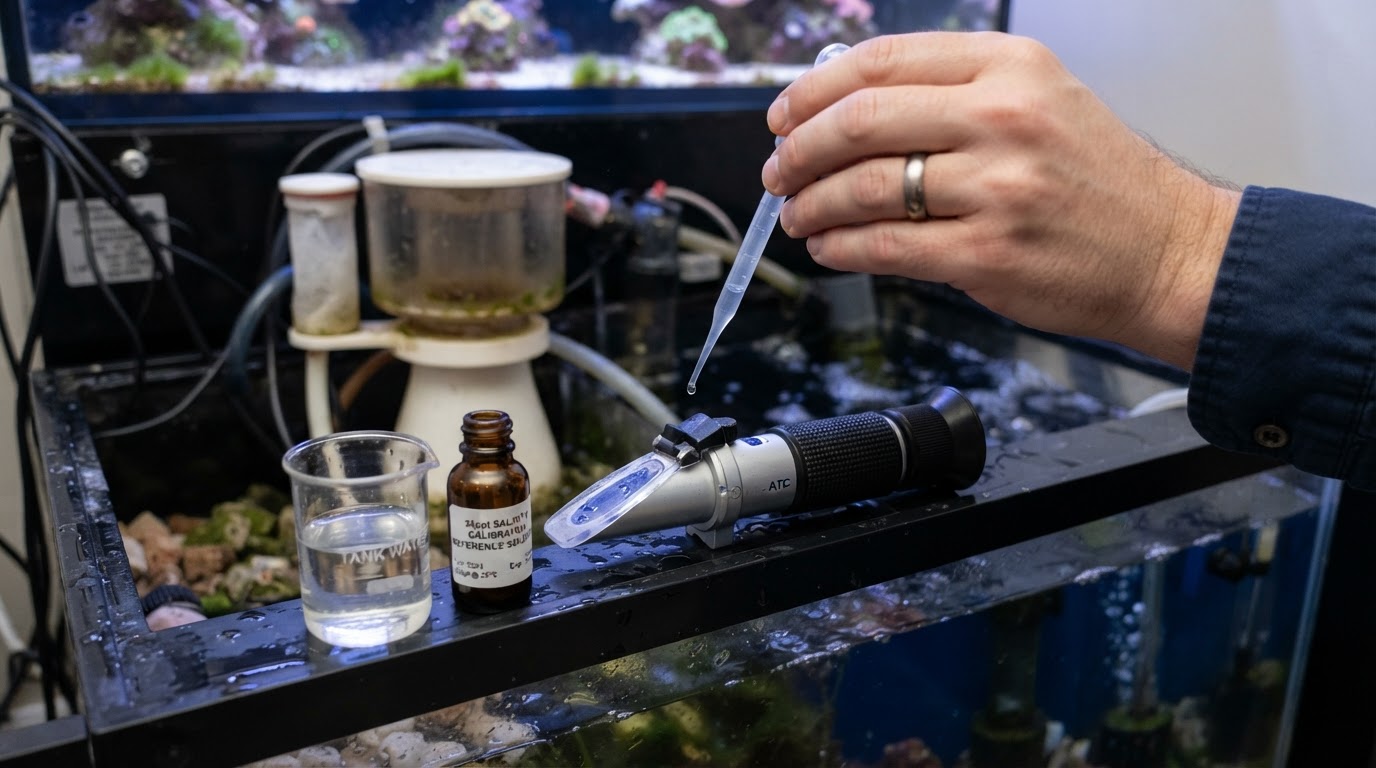
Most salinity scares are measurement problems before they are water problems. BRS warns that inexpensive swing-arm hydrometers are often inaccurate and cannot be calibrated, and that corrosion or dried salt on the arm makes a reading worse. Floating glass hydrometers are more reliable but need a still sample in a separate container. Refractometers are the popular middle ground, and the BRS instruction is blunt: check calibration before each use with a 35 ppt reference solution, then read the tank sample.
Three habits keep the number honest:
- Use the right unit. Salinity is normally reported as specific gravity or parts per thousand (ppt), while conductivity meters report mS/cm. A saltwater aquarium salinity value quoted in ppm is simply ppt multiplied by 1,000, so 35 ppt equals 35,000 ppm. Chasing "36 ppm" instead of "1.026 SG" is a unit error, not a target.
- Fix the reference temperature. A refractometer or hydrometer reading is tied to the temperature at which it was calibrated and read. Let the sample settle to the instrument's reference temperature, or use a device that compensates for temperature properly.
- Read the tank, not the mix. Test the display one to three times a week and around water changes, as BRS recommends, and keep a written trend rather than a memory of the last number.
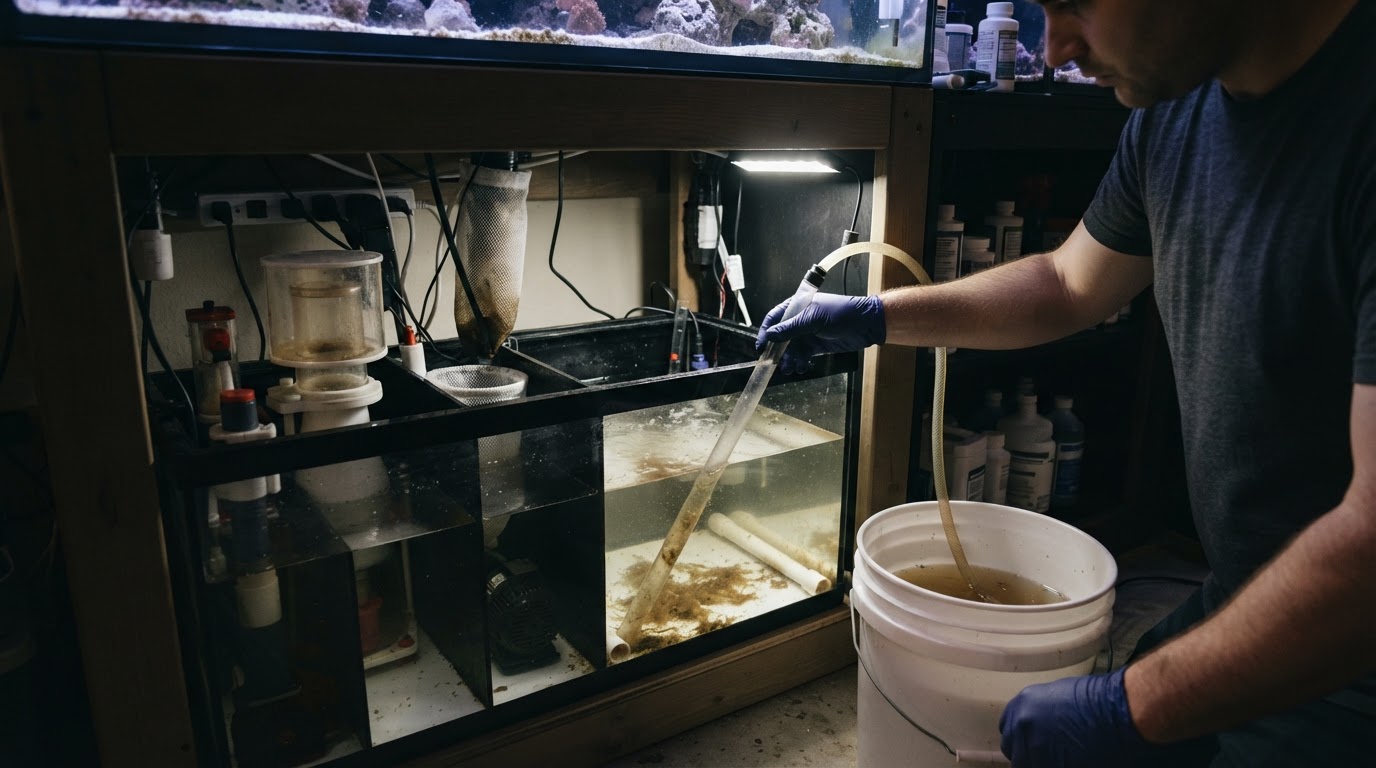
If those habits are in place and the display still reads high, the cause is usually mechanical: evaporation concentrating the water because top-off did not happen, a replacement batch mixed too strong, an automatic top-off system stuck on or off, or salt creep throwing off the sample. BRS's explanation is simple: fresh water evaporates, salt stays behind, and salinity climbs until fresh water is replaced. That replacement water should be RO/DI, not more saltwater.
Is 1.030 Salinity Too High for Fish?
Even allowing for temperature and reference effects, an SG reading of 1.030 is above the natural-seawater reference of about 1.0264 that BRS uses, and above every fish-only band listed here, so yes, it is a reading worth acting on - after you confirm that it is real. Recount the basics first: is the refractometer calibrated against a 35 ppt standard, is the hydrometer clean, and was the sample read at the instrument's reference temperature? A miscalibrated device can turn a normal tank into an alarming number.
If the reading holds up, the correction is not dramatic. BRS notes that fish can respond negatively to even small changes in salinity and advises gradual correction. Find out why the tank drifted, then move slowly toward your chosen target, mixing and retesting at each step. There is no universal schedule or dose for this, and a rushed correction is more likely to stress the fish than the original reading. Large, fast swings are the part to avoid.
Hold the Target, Not the Number
Stability is the outcome worth managing. Once the measurement is trustworthy and the target fits the livestock, the work is holding it:
- Keep a written target and a log of readings with dates and, where it matters, the temperature.
- Test on a fixed cadence - one to three times a week and before or after water changes is the range BRS gives - so drift is caught while it is still small.
- Correct the cause before the number. Top off evaporation with fresh RO/DI water, mix replacement water to the same target, and service the device that failed.
- Correct in small steps and retest after mixing, rather than treating the display as a dial.
- Recheck the target when the tank changes. A new fish, a new invertebrate, a coral, or a switch to a different salt mix all justify a review.
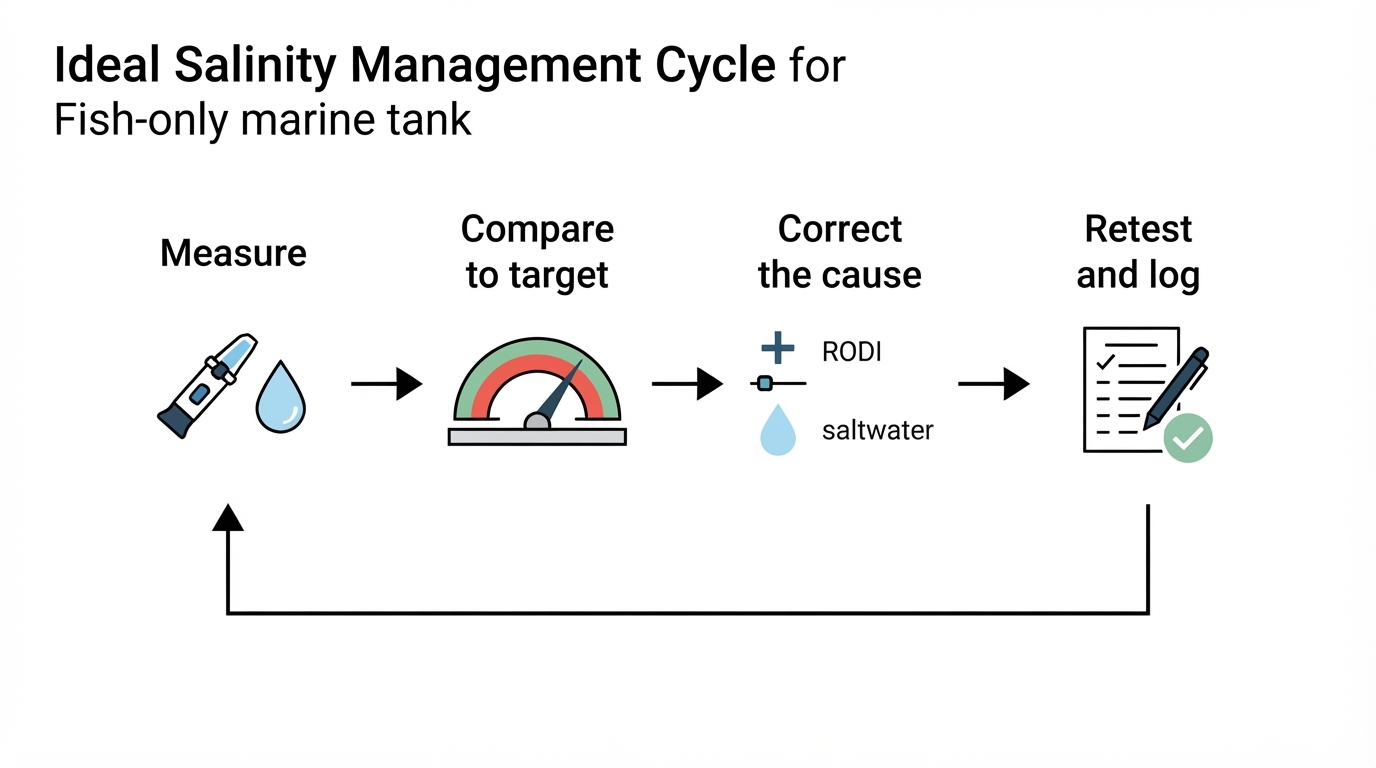
A useful habit is to log repeated readings alongside a one-line note explaining why you chose the target. That makes a trend easier to interpret than one isolated reading. If salinity is already high, see our separate guide to lowering aquarium salinity; if you keep clownfish, review the broader clownfish tank requirements too.
What a Salinity Chart Can and Cannot Do
A saltwater salinity chart is a reference table, not a measurement, and it is only as useful as the conditions it assumes. Charts disagree because they are written for different systems, reference temperatures, and units: some list specific gravity, some ppt, some both. Use a chart to pick a defensible band for your livestock mix, then use a calibrated instrument and your own trend line to decide what the tank actually needs.
If a fish looks sick, do not treat salinity as a diagnosis or a cure. The question here is what a fish-only tank should hold on a normal day. A sudden change made in the hope of treating a symptom usually adds a second problem on top of the first; water quality, quarantine practice, and condition-specific advice from a qualified source are separate subjects.