Stop Stocking — Not All Corrective Work
After an ammonia reading with new livestock, add no more fish, snails, or corals. That stops stocking, not all corrective work: promptly confirm the reading, watch every animal, and get experienced aquatic help if fish are distressed — gasping at the surface, breathing fast, or refusing food. Restore interrupted flow or aeration, locate decay and uneaten food, and prepare a matched partial water change when the situation calls for one.
A detectable reading in an established aquarium, where the API ammonia test should read 0 ppm, is not a harmless mini-cycle to wave off: it points to over-feeding, too many animals for the current biofilter, or filtration that is not keeping up.
Confirm the Reading the Way Your Kit Intends
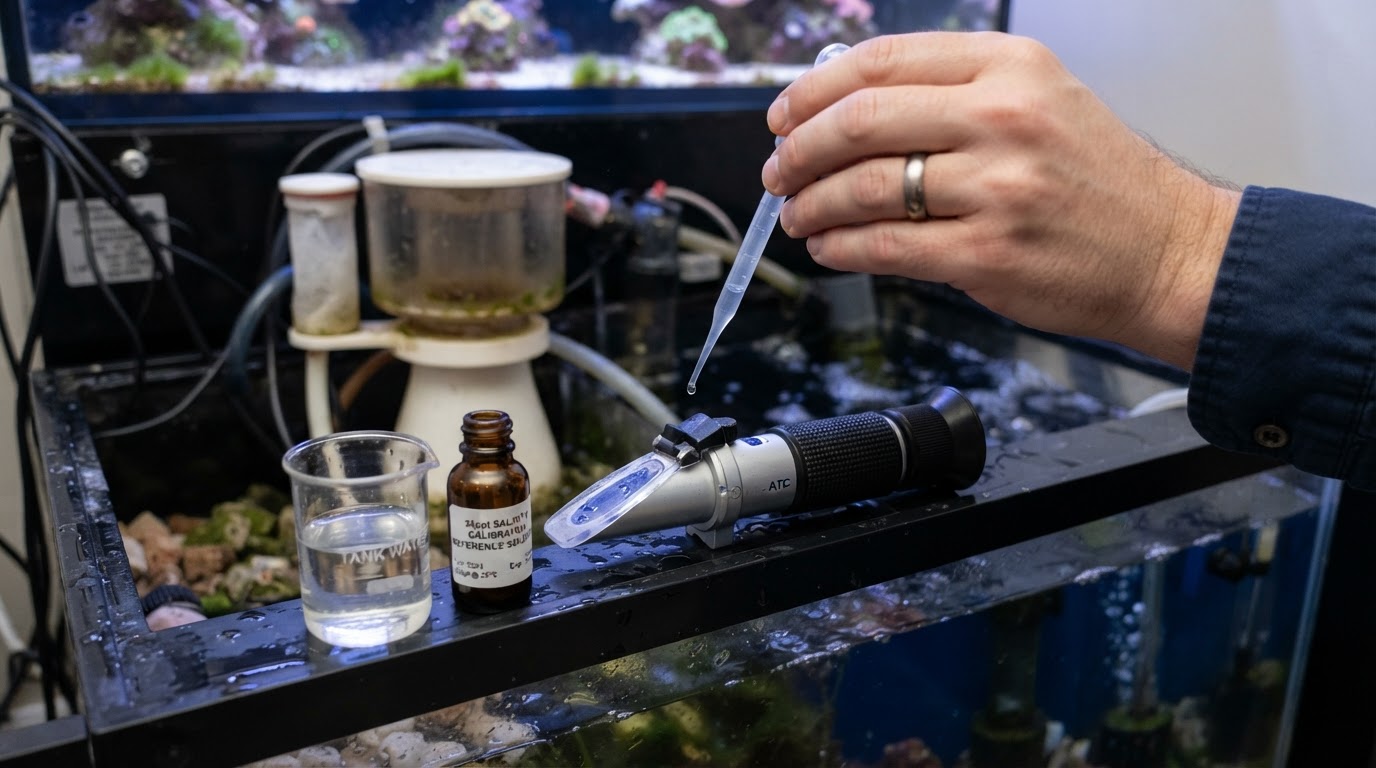
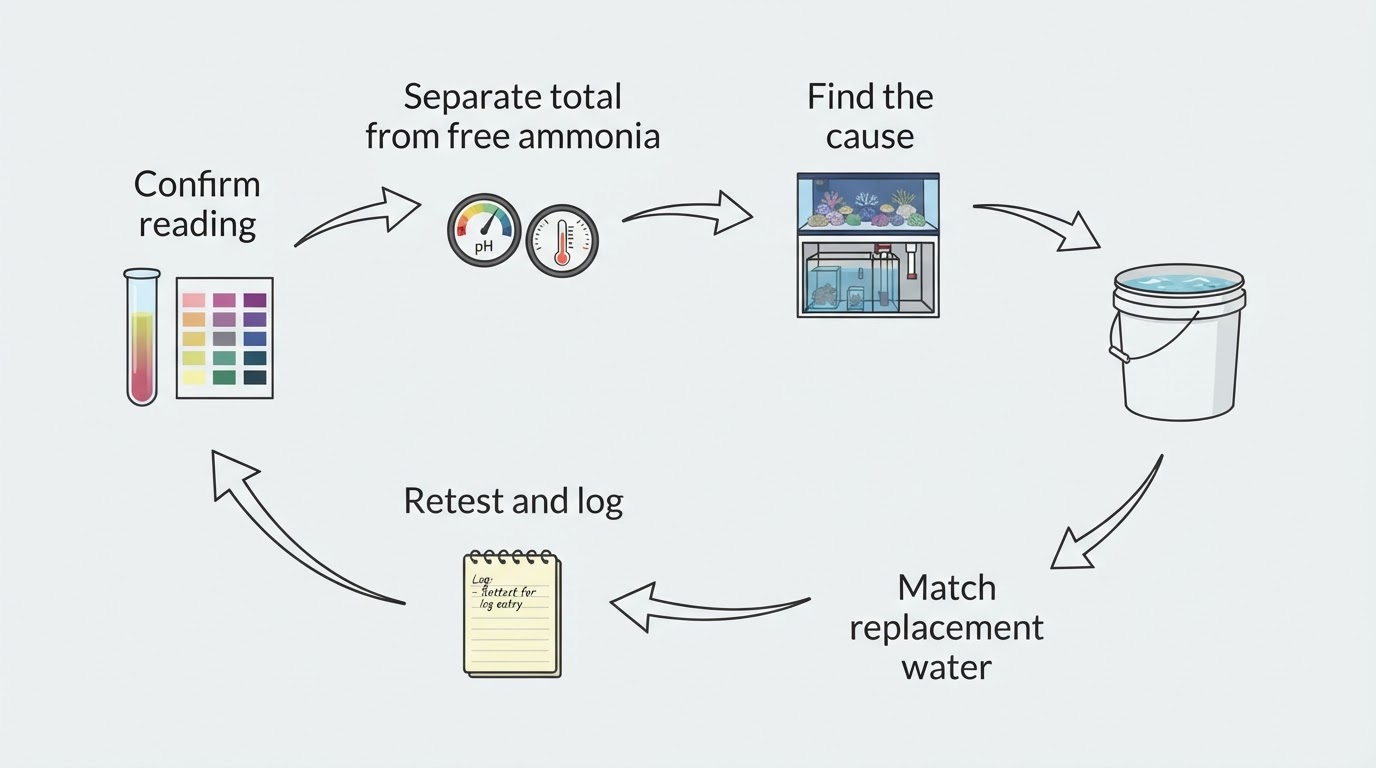
Ammonia kits differ in reagents and charts, and most ship separate fresh water and salt water references. Follow the current saltwater instructions for your exact kit: saltwater chart, required read time, reagent expiry, clean vial. Do not rely on remembered counts of drops, milliliters, or minutes; those details vary by product and batch.
Read at the specified time; reading early or late shifts the color. Old reagents, a dirty tube, or a faded chart change what you see. If the color falls between two patches, treat it as detectable, not zero, and repeat the procedure before deciding what the number means.
Total Ammonia and Free Ammonia Are Not the Same Number
Ammonia test kits mostly report total ammonia — free ammonia (NH3) plus ionized ammonium (NH4+). Seachem's Ammonia Alert sensor measures only free ammonia, the form that crosses gill membranes, and reads continuously rather than as one snapshot.
pH sets the split: as pH rises, more of the same total becomes free ammonia, and temperature shifts it the same way. Seachem's example: 0.02 mg/L of free ammonia is roughly 0.25 mg/L of total in marine water at pH 8.3, versus about 3.6 mg/L in freshwater at pH 7.0 — an illustration, not a safe threshold. A reef tank often runs near the marine end, so a small total deserves more respect there than in an acidic freshwater tank.
Not every positive reading is a confirmed toxic spike, and zero on one sensor is not a complete clearance: the number means something only alongside pH, temperature, and which form the device measures. Check the kit maker's documentation before interpreting it.
Read Binder Products Through Their Own Instructions
Ammonia binders can change what a test detects, and the effect depends on the product. Seachem notes its free-ammonia sensor does not detect ammonia that Prime has already complexed, and that Ammo Lock and similar removers make the color slow to return to yellow because it tracks rising ammonia faster than falling ammonia. Read the documentation for the product you used and the kit maker's notes on interference instead of assuming a binder protects fish. Record the product and time so a change in the reading is not mistaken for proof the spike never happened.
Find the Cause Before Reaching for a Fix
Bulk Reef Supply's answer to an ammonia alarm starts with the source: a spike generally means something has died and is decaying, the tank was overfed, or the biological filter was damaged.
What to check | Why it matters |
|---|---|
Surface movement and flow | Low oxygen and dead spots hide decay |
Overflow, sump, filter socks | Trapped food decays out of sight |
Recent losses | Dead snails, fish, or macroalgae feed the reading |
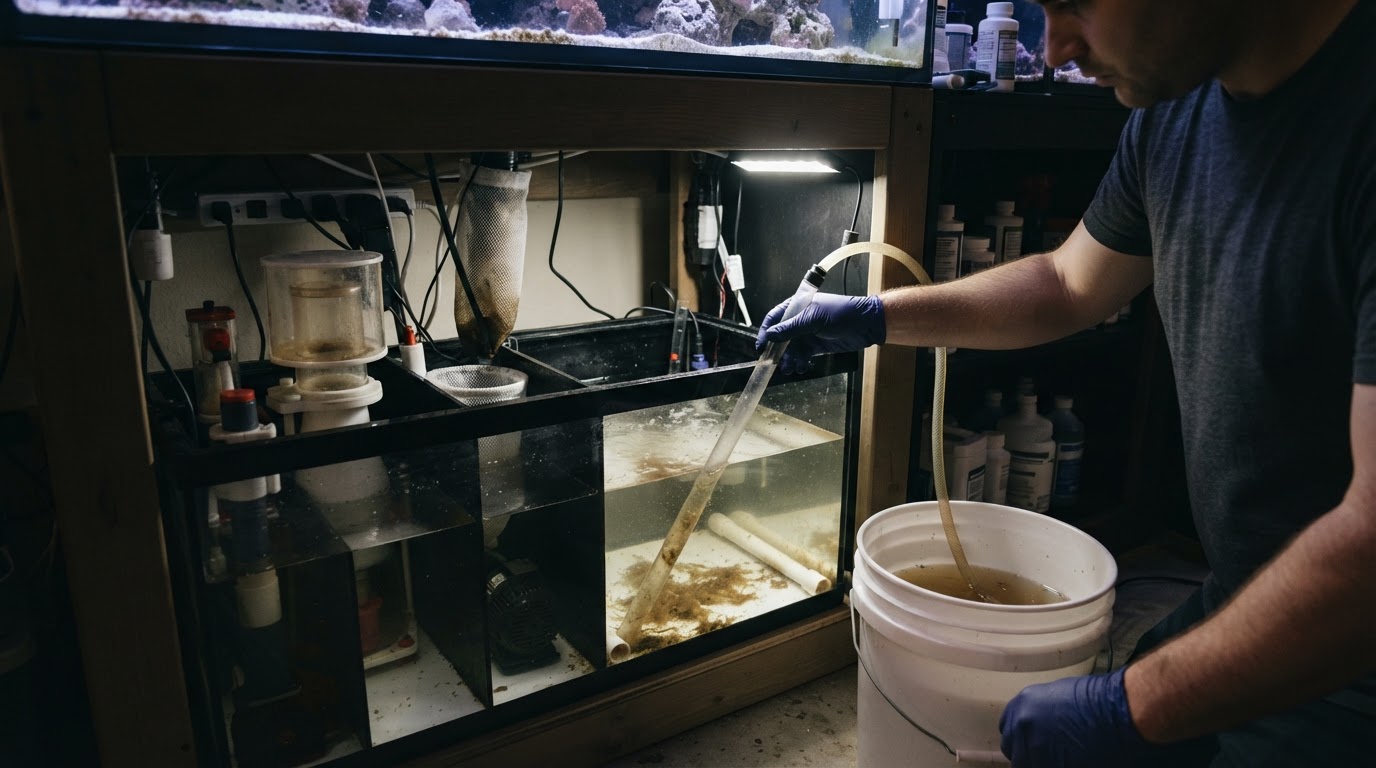
Filter maintenance | Rinsing all media at once removes nitrifying bacteria |
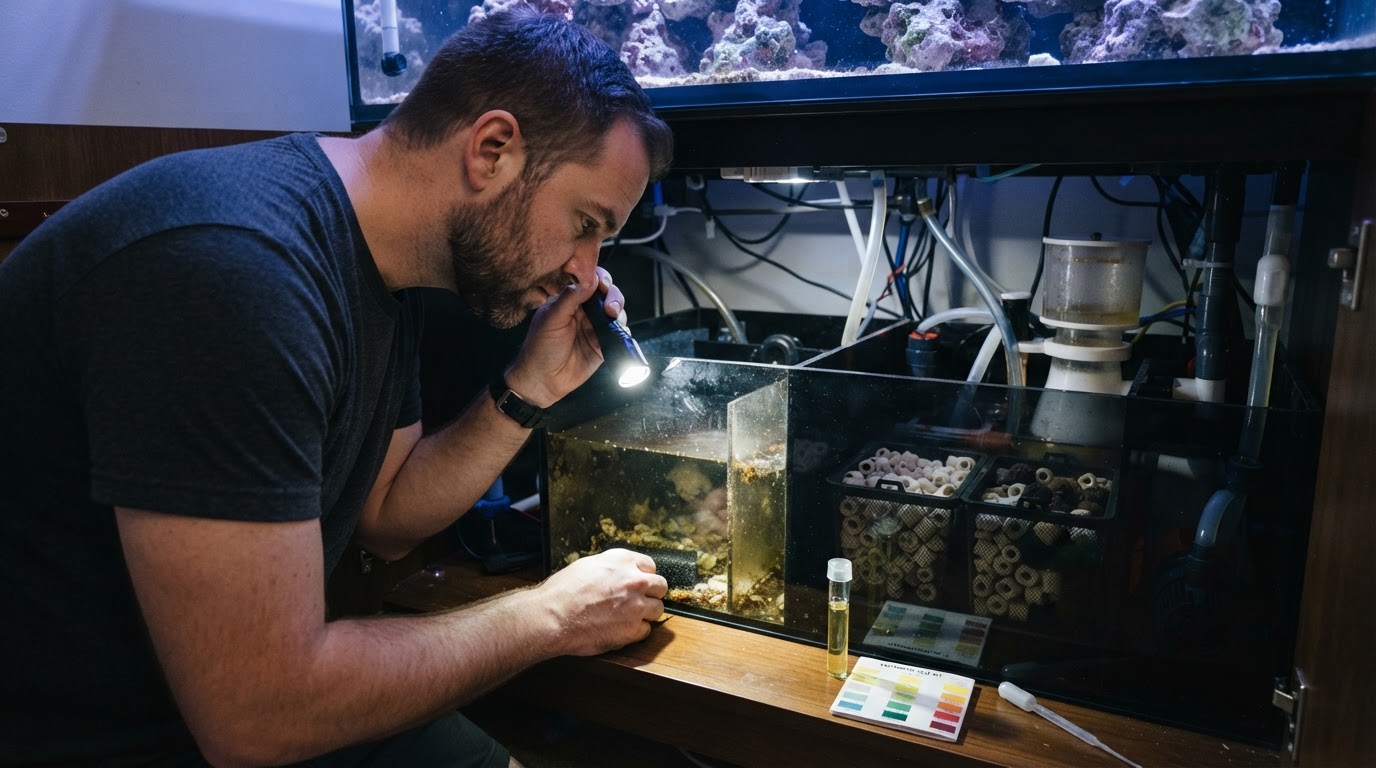
Keep biological media intact while you clean. If a sponge or block was rinsed under tap water, that is a plausible cause and a reason to protect whatever media remains.
Match What You Replace
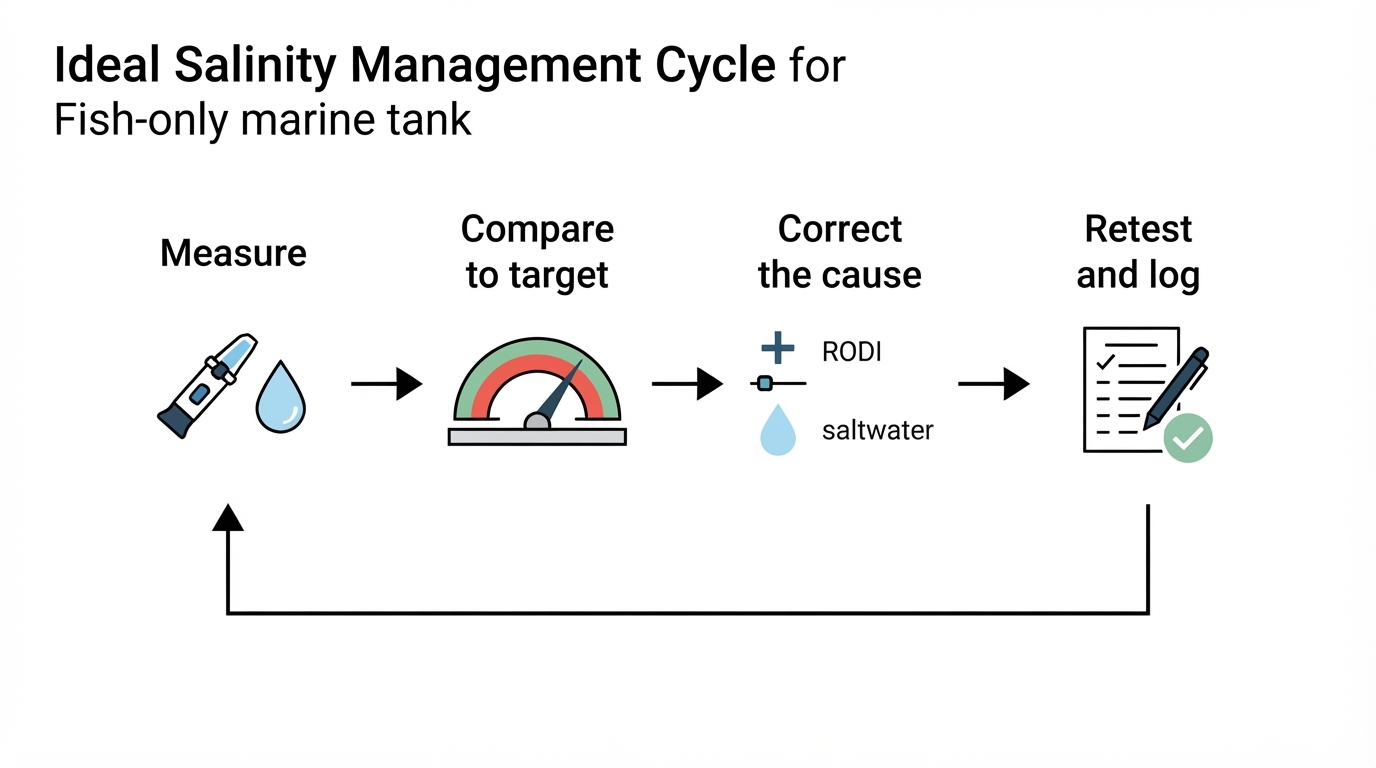
A partial water change with prepared saltwater, mixed to the tank's salinity and temperature, is one response option, and the kit's maker notes water changes reduce ammonia in an emergency. It is not a universal fix: RO or fresh water changes salinity along with the ammonia, and a fixed percentage or dose applied without finding the cause only buys time. Match the mix to the livestock's own salinity rather than guessing — the guide to salinity in a fish-only saltwater tank explains why. If the display clouds after a change, work through why a saltwater tank can turn cloudy after a water change instead of adding another dose. Do not drive pH quickly up or down.
What Recovery Should Look Like
No routine schedule substitutes for confirming an active reading. Test promptly with the same kit and procedure, act on what the result shows, then monitor after each intervention and repeat the test as the exact result, stocking, and feeding situation requires. Waiting two days, or seeing a few zero readings on their own, does not mean every problem is resolved: keep observing the livestock, and get experienced help while fish are still distressed. If the reading returns whenever you feed normally, reassess the filter load and the testing routine; that pattern points to biofilter capacity, not proof the kit cannot be wrong.
Keep biological media intact. Do not cycle a tank with fish, substitute fresh water for salt water, or make rapid pH changes in response. No threshold, dose, or water-change percentage applies to every system; those numbers depend on your livestock, filtration, and kit.