What an endpoint colour does and does not tell you
API's liquid pH Test Kit reads from 6.0 to 7.6, and the High Range kit reads from 7.4 to 8.8 (regular pH kit leaflet; High Range leaflet). The two scales overlap only between 7.4 and 7.6, which makes 7.6 the regular kit's top step and 7.4 the High Range kit's bottom step.
Both leaflets also describe what happens past the ends of a scale. A sample below the regular kit's minimum still shows the 6.0 colour, a sample above its maximum still shows 7.6, and the High Range kit shows 7.4 or 8.8 the same way. An endpoint colour is therefore open-ended: 7.6 means 7.6 or higher as that kit reads it, and 7.4 means 7.4 or lower. Read literally, your two readings pull in opposite directions.
What the pair does support is narrower, and still worth writing down: neither kit came back with a mid-scale number, both came back with a colour from the region where the scales meet, and that is consistent with water near pH 7.4 to 7.6 rather than near 6.6 or 8.4.
Why 7.5 is not the result
Record what you did observe instead: 7.6 from the pH kit, 7.4 from the High Range kit, the date, and anything unusual about the sample or the light. Two clean repeats that land on the same colours show the test is repeatable in your hands. Repeatability is not the same as accuracy, and two cards agreeing does not certify either card.
Run the kits as two separate tests
The steps below follow the English instructions supplied with the US kit.
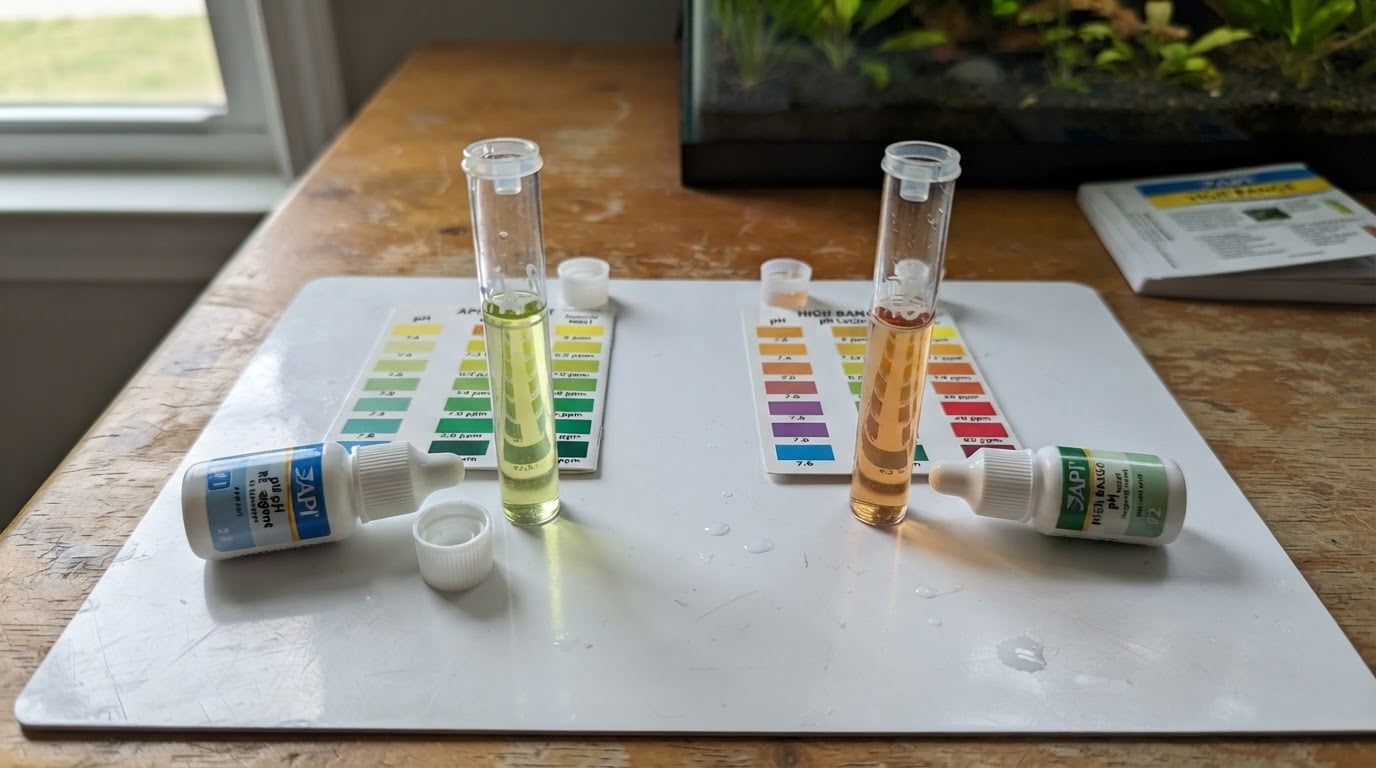
For the pH kit, fill a clean tube to the 5 ml line, add 3 drops of pH Test Solution with the dropper bottle upside down and vertical, cap the tube, invert it several times, then compare it with the pH Color Card on a white background in good light. Rinse the tube afterwards.
For the High Range kit, use 5 ml of water and 5 drops of High Range pH Test Solution, cap and invert, then read against the High Range card that matches the water, freshwater or saltwater. The kit ships with one reagent bottle, one instruction booklet, two colour cards and one capped test tube, and API advises rinsing the tube right after a test so reagent residue does not stain it (High Range product page).
Run the two tests in separate tubes. Each kit has its own reagent, its own drop count and its own card, and neither leaflet describes a combined test.
If your shipped booklet or bottle label disagrees with the linked leaflet — on drop count, for example — ask API to confirm the instructions for your exact kit and follow the label and booklet that came with it rather than privileging one conflicting line.
Two pairs where one kit is clearly limiting, and yours
When one kit lands in the middle of its scale and the other stops at an edge, the mid-scale reading is the informative one.
- pH kit 7.6 with High Range 8.2: the pH kit stopped at its ceiling, so the High Range number is in range and carries the information.
- pH kit 6.8 with High Range 7.4: the High Range kit stopped at its floor, so the pH number is in range and carries the information.
Your pair is the third case. Both numbers are endpoint colours, so neither kit produced a non-endpoint reading to prefer. Repeat both tests from fresh samples with the correct reagent and card for each. If the same two colours come back, you have repeated the observation, not established the pH, and precision is the open question. When the value matters, or when a repeat keeps returning endpoint colours that point in different directions, confirm it with an independent measurement such as a pH probe checked against fresh buffers (how to calibrate an aquarium pH probe).
Checks before you record a number
- Two fresh 5 ml samples taken separately, one for each kit.
- The correct reagent and card for each kit, including the freshwater or saltwater High Range card that matches the tank.
- Dropper bottles held upside down and vertical, so drops form the same way each time.
- Tubes that are clean and rinsed from the previous test.
- Any date or storage direction printed on your own bottle or box, checked as written.
- The same lighting for both tubes, read against the white area of the card rather than the room behind it.
- Both tests repeated in the same session from fresh samples before you draw a conclusion about the tank.
What not to do with an endpoint reading
Don't dose pH UP or pH DOWN from a colour you cannot place on the scale. Neither leaflet turns a colour into an amount, and a 7.6 that may mean 7.6 or higher gives you nothing to correct against; fix the measurement first.
If you also track carbonate hardness, our GH vs KH explainer covers why KH is the buffer that resists pH swings and why it is a separate test rather than a substitute for confirming pH.