What GH and KH each measure
General hardness (GH) is the combined concentration of dissolved calcium and magnesium. Carbonate hardness (KH), as the test is used in aquariums, reports alkalinity — the carbonate and bicarbonate ions that neutralise acid rather than a mineral reserve for fish or plants. The Aquarium Co-Op guide to pH, GH and KH draws the same line, describing GH as calcium and magnesium and KH as the carbonates and bicarbonates behind buffering capacity.
Both are usually reported in degrees or parts per million. One degree of hardness is about 17.9 mg/L when the result is expressed as calcium carbonate equivalent, and that equivalence is a unit convention for comparing readings, not a mass of elemental calcium you could turn into a dose. A tank reading 6 dGH is not holding 107 mg/L of calcium metal; it holds calcium and magnesium salts whose combined effect equals that much calcium carbonate.
Because each test counts different ions, neither value can be calculated from the other. A high GH says nothing about how much buffer is in the water, and a high KH says nothing about whether there is enough calcium or magnesium for snails, shrimp or plants.
Can GH be high while KH is low?
Yes. The readings are independent, and water built from reverse osmosis is one place where they come apart. Seachem Equilibrium is a mineral supplement made for RO or deionised water; its guaranteed analysis lists calcium, magnesium and potassium salts with no carbonate source, so a tank remineralised with it can carry a solid GH reading while KH stays near zero. The same product page names Seachem Alkaline Buffer for maintaining KH.
Alkaline Buffer's own page describes a non-phosphate buffer that raises alkalinity and pH, with a stated working range of pH 7.2 to 8.5. It is not a mineral supplement, so dosing it lifts KH while GH stays where it was.
The two labels are worth reading as examples of the two roles — a mineral source that moves GH, an alkalinity source that moves KH — rather than as products every tank needs. Whether either one belongs in your tank depends on what your readings and your stock say.
Tap water from limestone or chalk usually carries calcium and carbonate together, so both readings climb at once. The Aquarium Co-Op guide makes the same point with crushed coral, which dissolves as calcium carbonate and therefore moves both numbers. That is a tendency rather than a rule: where calcium arrives with sulfate or chloride instead of carbonate, GH can rise while KH does not.
Which reading needs changing?
Start with the question you are trying to answer. KH is the number that predicts pH stability, because carbonate and bicarbonate neutralise the acids a tank produces through respiration, waste breakdown and nitrification. GH describes the mineral supply behind fish osmoregulation, shrimp moulting, snail shell growth and plant growth.
Reading that is low | What it affects | Product role that targets it | Label example |
|---|---|---|---|
KH | pH buffering, the risk of pH swings | Alkalinity (carbonate/bicarbonate) buffer | Seachem Alkaline Buffer |
GH | Calcium and magnesium supply | Mineral GH supplement | Seachem Equilibrium |
The label is the quickest way to tell which reading a bottle will move. A GH supplement should name calcium and magnesium salts; a KH buffer should describe alkalinity or carbonate content, often alongside a pH range. Those are different jobs, and they are easy to confuse when both bottles sit on the same shelf.
Confirm the units and the source reading
Test the source water and the tank separately. A tank can post a high GH because the tap water starts hard, while a tank built on RO water and mineral salts can reach a similar GH with almost no KH. Without the two readings side by side, it is easy to blame the tank for something the source water brought in.
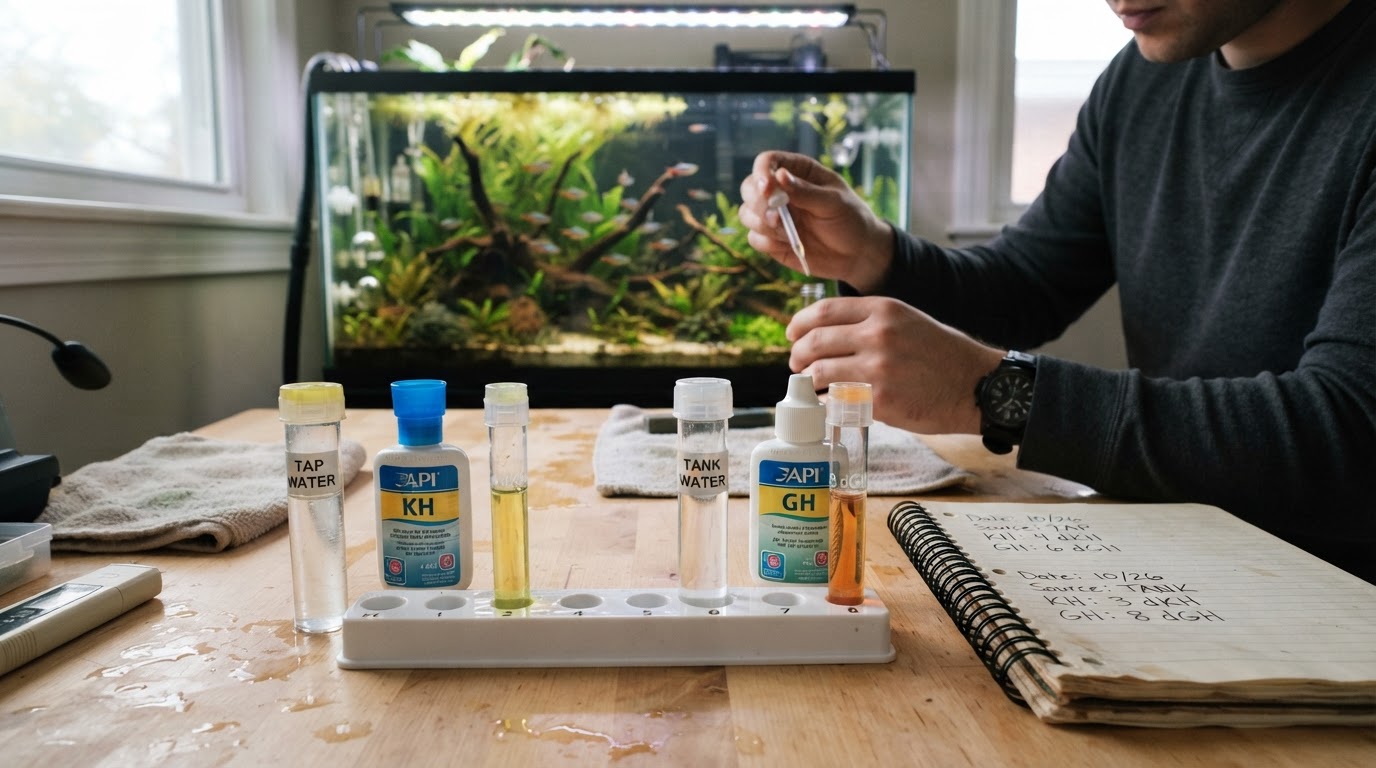
Check the unit on the kit before comparing anything. GH and KH kits report degrees, ppm, or both, and water reports often use mg/L as CaCO3. Convert to a single unit first, because a dKH result does not compare directly with a ppm target. How small a difference your kit can resolve depends on the kit and the sample size it uses, so read a change against the resolution your own test actually has.
Do not substitute TDS or pH for either test. A TDS meter estimates dissolved solids from the water's electrical conductivity using a calibration factor; it does not count every solid or measure individual ions. Its total includes sodium, nitrate and fertiliser salts as well as calcium and magnesium, so it cannot be split into GH and KH. pH is a different measurement again, moving with carbon dioxide and other acids. Neither one returns a hardness value. Hardness also sits apart from the readings that decide whether a tank is cycled at all: ammonia, nitrite and nitrate are separate tests, and our aquarium water quality guide covers those numbers and the maintenance that keeps them in range.
Target values depend on the species and setup
The Aquarium Co-Op guide gives general freshwater ranges of 4–8 dGH and 4–8 dKH, then lists the exceptions that matter more than the middle of a range: livebearers, goldfish and African cichlids are kept in harder water, while discus and crystal shrimp are kept much lower, with 0–3 dKH suggested for the latter. Those are that guide's targets for common setups, not a standard to move every tank toward. Read the target for the species and setup you actually keep, and leave a tank alone when its readings already suit its stock. Fish that evolved in soft, acidic water can be harmed by parameters that suit a community tank, and breeders often run values well outside a beginner chart on purpose.
Prepare the batch, then change gradually
The Aquarium Co-Op guide's gentler methods are worth copying. For harder water it recommends crushed coral in the substrate or filter, noting that it dissolves as calcium carbonate, lifts GH and KH together, and depletes as it dissolves. For softer water it suggests gradually mixing in RO/DI water.
A GH-only product keeps the readings separate. That is the case the Seachem Equilibrium label is written for: RO or DI water with a mineral deficiency, dosed against a target GH, with Alkaline Buffer named separately for KH. Using one where the other belongs is what makes a test result look inexplicable afterwards.
Whatever you add, measure the batch before it goes into the tank. Mix the replacement water, test GH and KH on it, and confirm it lands where you intended before it dilutes the tank; then add it in planned, gradual steps and retest the tank once it has mixed. Equilibrium's instruction not to use it when replacing evaporated water points at the same logic: minerals stay behind when water evaporates, so topping off with remineralised water concentrates them instead of restoring a target.
Decision flow
- Measure the source water and the tank separately.
- Confirm the units on both results before comparing them.
- Decide which reading actually needs to change, based on the stock you keep and the water you start from.
- Choose the product role that matches that reading — mineral salts for GH, an alkalinity buffer for KH.
- Mix the replacement batch and verify its GH and KH before it enters the tank.
- Add it gradually and retest after mixing, avoiding a sudden shift.