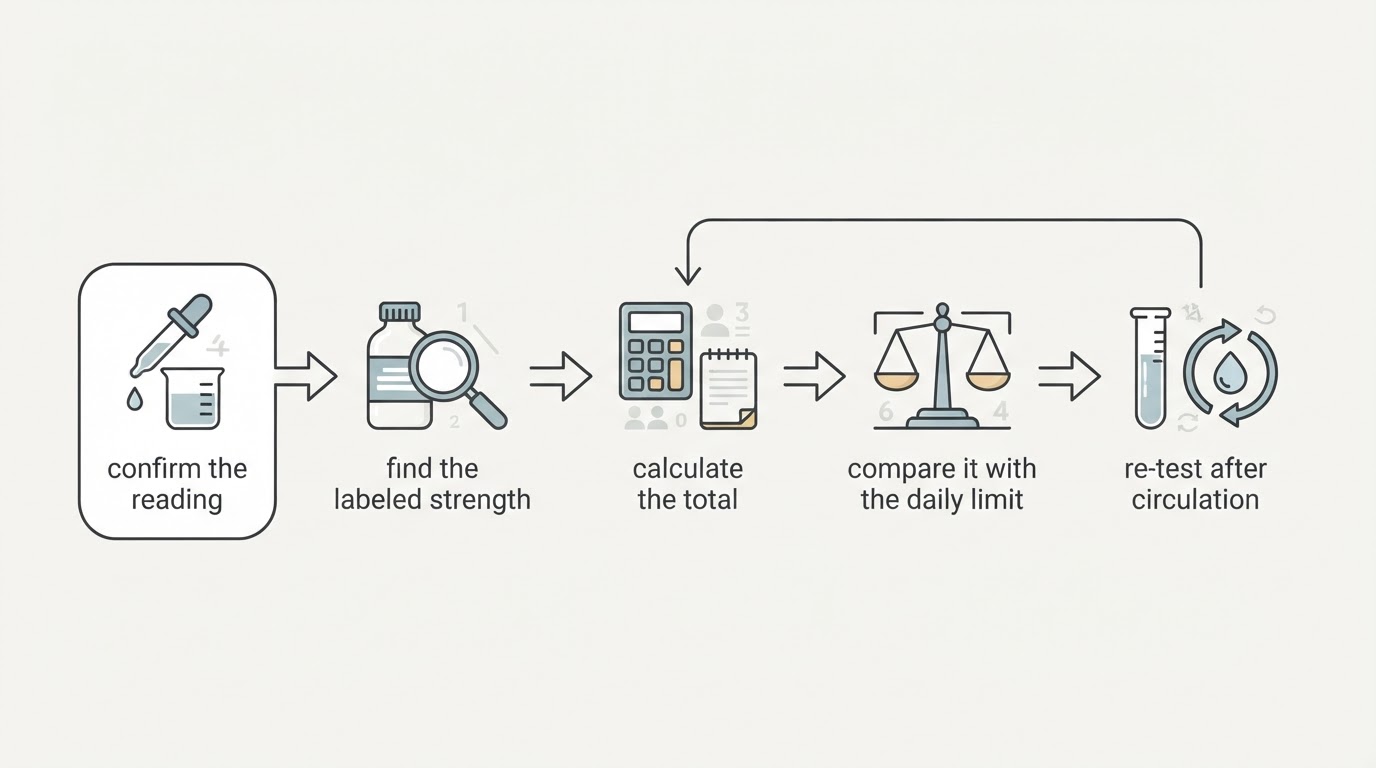
Confirm the reading, the salinity, and the water volume
A correction is only as reliable as the three inputs it rests on: the magnesium result, the salinity that result is interpreted against, and the volume of water being dosed.
Run the magnesium kit as written. Follow its sample size, timing, and endpoint, and check that the reagents are in date and stored as the maker instructs. Record the result in ppm, the unit the label uses. If you are comparing against an older reading, make sure both came from the same kit and the same procedure.
Check salinity against the instrument's own reference. Use a refractometer you have calibrated, and confirm rather than assume two things: what the calibration reference actually is, including the temperature it is stated at, and what salinity you intend to run. A swing-arm hydrometer that has drifted can move the reading enough to change the dose. The saltwater tank setup guide covers the calibration routine and general system setup; use its procedure for your instrument, and top off evaporation with fresh RO/DI water rather than salt mix.
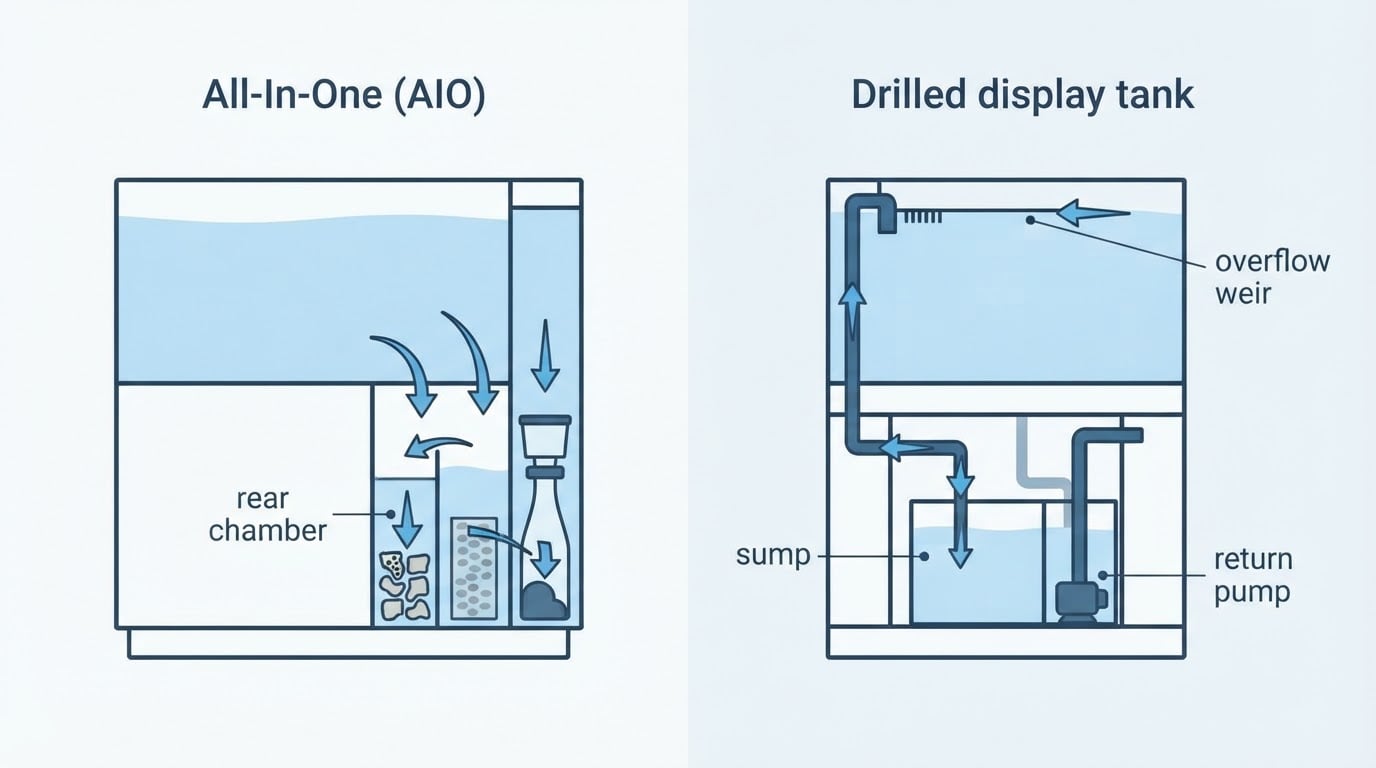
Measure the water the product has to treat. Brightwell's instructions say to estimate the volume of water in the entire aquarium system: the display plus the operating sump, minus the space taken by rock, sand, and equipment. That total is not necessarily smaller than the display's nominal capacity, because a working sump can add more water than the rockwork removes. Write down the figure you will divide into, since it changes the dose directly.
Before you calculate, those are the three checks: kit in date and run to its procedure, salinity verified with a calibrated instrument against a known target, and water volume written down. If one of them is unresolved, fix it first; the arithmetic will faithfully scale whatever error it starts from.
Read the strength on the label of the product in hand
Magnesium helps keep calcium and carbonate in solution — Brightwell's technical background describes it as limiting unwanted precipitation between them — but the amount to add comes from the bottle, not from a general rule about reef water.
For Brightwell Magnesion liquid, the current technical sheet gives four numbers that matter here:
- Test the magnesium concentration with an accurate kit before supplementing.
- Each mL raises magnesium in 1 US gallon (3.785 L) by 26 ppm.
- If the initial concentration is below 1,288 ppm, the stated maximum is 10 mL per 20 US gallons daily.
- The target range given is 1,290 to 1,320 ppm.
Those numbers describe this product. The 1,288 ppm figure is the condition attached to its maximum rate, not a universal definition of low magnesium, and 1,290 to 1,320 ppm is the manufacturer's guidance rather than an optimum that suits every reef. Decide the level you are deliberately correcting toward, then use the strength printed for the product in front of you.
Write the strength so the unit is unambiguous: 26 ppm·USgal/mL means one mL gives 26 ppm in one US gallon. If a label uses a different basis, convert the numbers to one consistent set of units before dividing.
Calculate the dose, then compare it with the daily limit
The formula is the label's rate rearranged:
dose (mL) = desired rise (ppm) × system volume (US gal) ÷ labeled strength (ppm·USgal/mL)
The desired rise is the gap you are closing. The system volume is the water the product has to mix into. The labeled strength says how much one mL moves one gallon, so dividing it into the ppm-gallon requirement converts that requirement into milliliters. Double the volume and you double the dose; use a product with twice the strength and you halve it.
Worked example, using the liquid rate above:
- Desired rise: 10 ppm
- System volume: 50 US gal
- Labeled strength: 26 ppm·USgal/mL
10 × 50 ÷ 26 = 19.23 mL total.
The product's limit belongs next to that figure. For a starting reading below 1,288 ppm, Magnesion's maximum is 10 mL per 20 US gallons daily, which at 50 US gallons is 50 ÷ 20 × 10 = 25 mL per day. The 19.23 mL total sits below one day's ceiling. Dosing at the ceiling instead would move 25 × 26 ÷ 50 = 13 ppm in a day. The limit is a ceiling, not a schedule: a larger total can be split across days as long as each day stays at or below it.
That 19.23 mL is a calculated intermediate correction under the label's concentration assumption, not a measured tank response. It assumes the product mixes through the whole system as the per-gallon figure implies, and that the 50 gallons is water rather than the tank's nominal capacity.
Keep one product's numbers on one page
The 26 ppm·USgal/mL figure is not a universal conversion. Brightwell also sells Magnesion-P, a separate powdered product sold by weight with its own directions, and the liquid rate cannot be carried over to it. The same caution applies to another brand's liquid or concentrate: start from that product's stated strength. This guide covers commercial products whose labels state a concentration and gives no DIY recipe; if you use something else, its label supplies the number.
If you switch products mid-correction, restart the calculation from the new label and re-test instead of converting the old dose.
Dose, circulate, and re-test
Shake the liquid as the label directs, measure the calculated volume, and add it. Follow the label for anything beyond that. Then let the system circulate before you judge the result: the sheet's maintenance method measures magnesium at the same time each day over one to two weeks, and that only works once the product has mixed through the water.
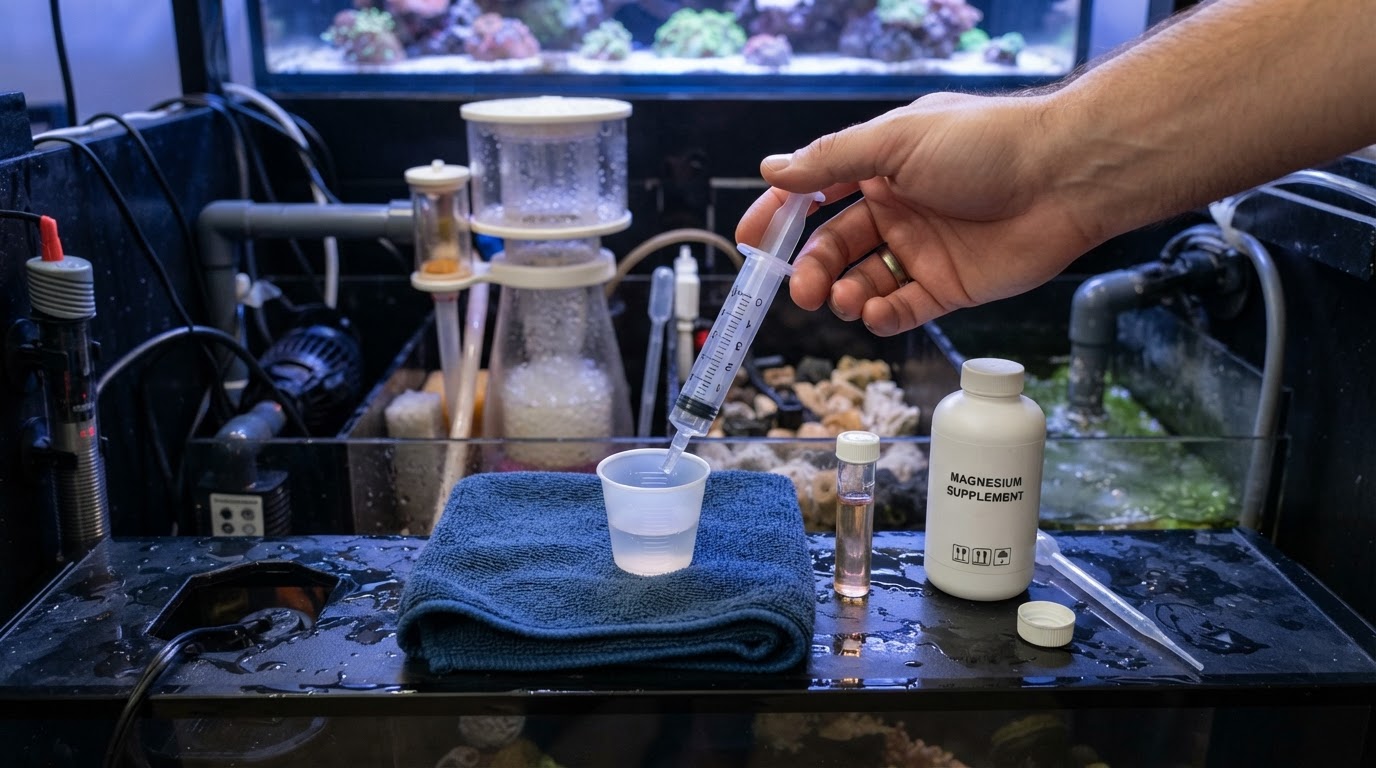
Re-test after circulation and use that result as the new starting point. If the number has not moved, the change may be small relative to the test's resolution and reading uncertainty, and mixing or the volume estimate can also account for part of the gap. Recheck the reading — a fresh test run to the kit's procedure, with salinity and volume confirmed — rather than automatically redosing or deciding something is wrong with the product or the tank.
The sheet asks you to keep the result within about 10 ppm of the target range, so a reading inside your chosen band is a reason to stop correcting. Once you reach that level, measure the daily decline over one to two weeks, divide it by 26, and multiply by the system volume to get a daily maintenance dose in mL. A decline observed under otherwise stable conditions can give you a reasonable first maintenance-dose estimate, but it is not by itself proof of biological uptake: water changes, shifts in salinity or water volume, and test uncertainty can all move the reading. Because consumption varies with stocking, lighting, and growth, the estimate should come from your tank rather than a generic table, and it becomes more dependable as repeat measurements agree.