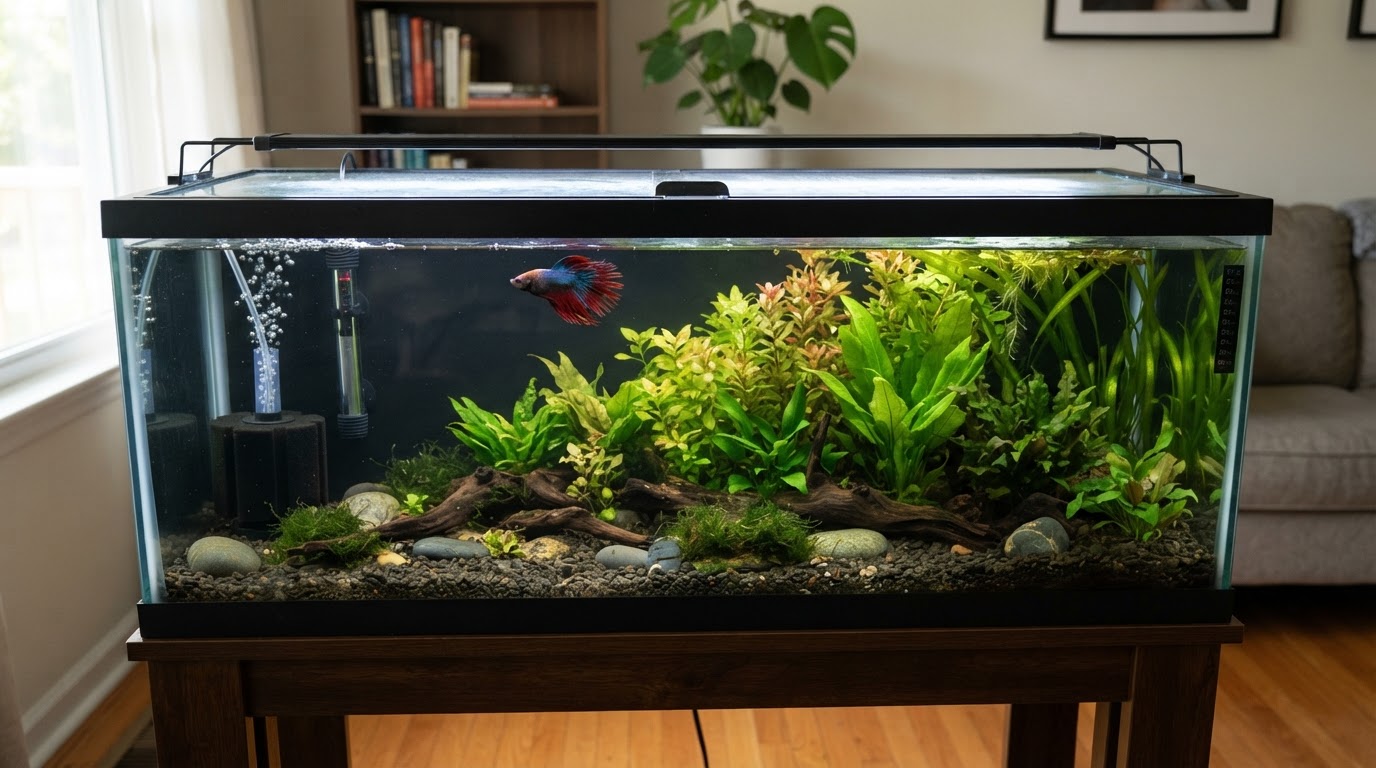
Two named substrates cover the common planted-tank choice between an active soil and a pH-neutral clay bed, and they ask for different routines. Tropica Aquarium Soil is a complete 2–3 mm aquasoil for a new setup that can accept a lower pH and four weeks of frequent water changes. Seachem Flourite is a porous clay gravel whose maker says it will not alter pH and need not be replaced.
The choice is not a ranking. One product changes water chemistry and comes with a startup schedule; the other leaves pH alone and asks you to rinse transport dust and manage plant nutrition through root tabs where needed. Decide which routine fits your water and maintenance, then buy the volume your tank actually needs.
Tropica Aquarium Soil: a complete soil for a new setup
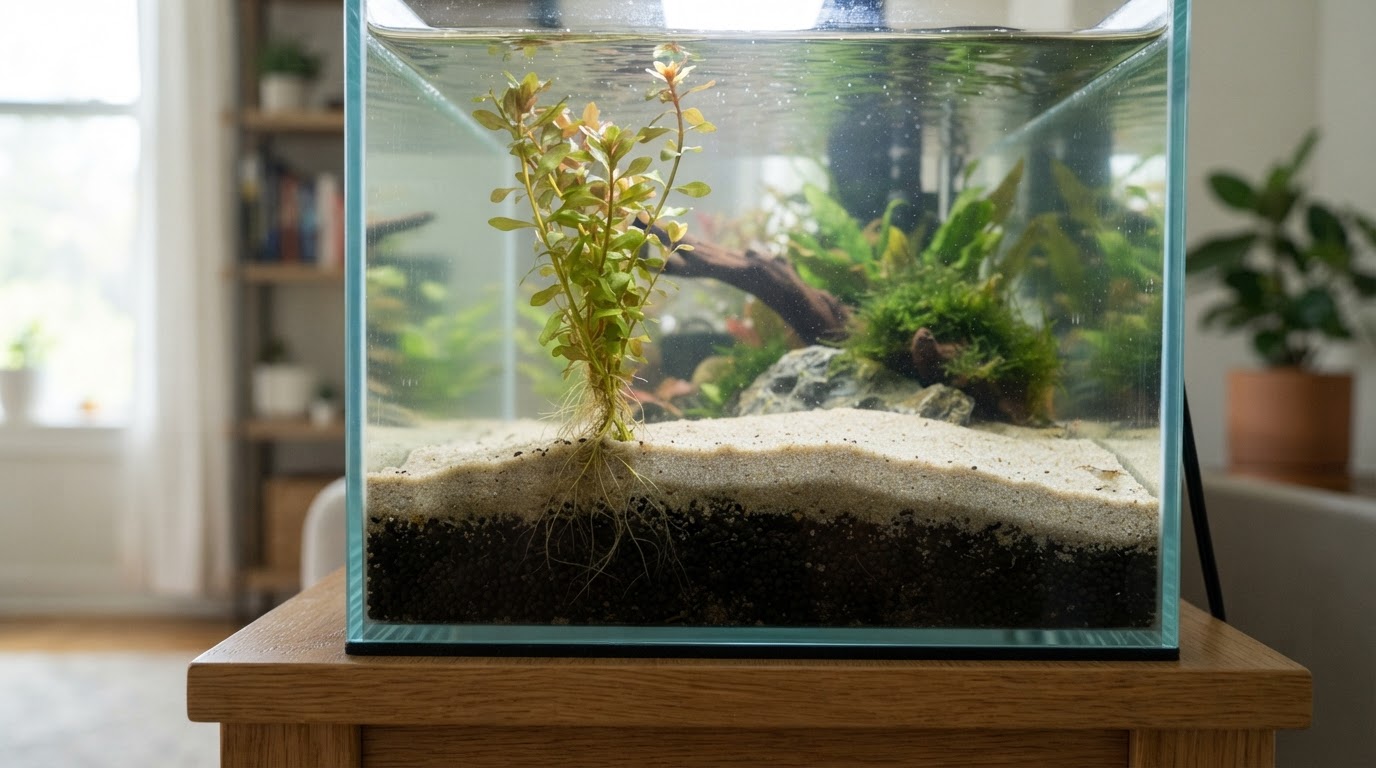
Tropica describes Aquarium Soil as a complete substrate that can be used without any other type of bottom layer. The grains are 2–3 mm, which the maker says makes planting easy. It lowers pH and slightly affects water chemistry, so it fits a new planted setup where a lower pH is acceptable and where you will test pH and carbonate hardness after the tank settles. If your livestock need hard, stable water, treat the pH effect as a reason to choose the clay gravel or as a water-chemistry problem to manage before stocking.
The maker's startup instruction is specific: change 25–50% of the water at least twice a week during the first four weeks. Tropica also suggests a deeper layer toward the back for visual effect. Because the soil is complete, you do not need a separate nutrient base beneath it.
Seachem Flourite: pH-neutral clay gravel for a long-lived bed
Seachem describes Flourite as a stable porous clay gravel for the natural planted aquarium. The maker says it will not alter the pH of the water and that it is good for the life of the aquarium and need not be replaced. It can be used alone or mixed with other gravels.
Flourite is prewashed, but Seachem warns it may become dusty in transit and require rinsing. Rinse small batches until the runoff is less cloudy; initial cloudiness is normal, and the maker says fine particles washed away do not reduce the product's effectiveness. Place a bowl or plate on the bed and fill into it so water overflows gently onto the gravel. Run mechanical filtration such as filter floss to clear the haze. When adding Flourite to an established aquarium, the maker says to add small rinsed amounts 12–24 hours apart and expect filters and floss to clog.
How the two compare
Decision | Tropica Aquarium Soil | Seachem Flourite |
|---|---|---|
What it is | Complete 2–3 mm aquasoil; no separate bottom layer needed | Porous clay gravel; may be used alone or mixed with gravel |
pH effect | Lowers pH and slightly affects water chemistry | Will not alter pH |
Startup work | 25–50% water changes at least twice a week for the first four weeks | Rinse transport dust; fill slowly; expect initial cloudiness |
Planting | Fine grains; grade deeper toward the back if desired | Stable clay bed for anchoring roots; rinse before use |
Best fit | New setup that can accept a pH shift and the four-week water-change routine | Stable, pH-neutral bed kept long-term |
The trade-off is clear from the maker's own directions. Tropica's soil brings a pH shift and a month of frequent water changes; Seachem's gravel asks for dust rinsing and slow filling, then stays pH-neutral.
Which one fits your tank
If the tank is fish-first with a few easy plants, smooth sand or rounded gravel may be the better bed; the two products above are aimed at planted setups. Check substrate recommendations for your actual fish and invertebrates as well as the plants.
Do not choose a substrate to chase a pH number. Test pH and carbonate hardness after the tank settles, and prefer a bed that holds a consistent value over one that swings between water changes. Aquarium GH vs KH: What Each Test Tells You explains what each test measures before you adjust water chemistry.
How much substrate to buy
Use the maker's volume method:
length (cm) × width (cm) × average depth (cm) ÷ 1,000 = liters
For a 60 × 30 cm footprint at a 5 cm average depth: 60 × 30 × 5 = 9,000 cm³, and 9,000 ÷ 1,000 = 9 L.
Nine liters is the volume of substrate to buy. It is not the tank's water volume, and it is not a weight in kilograms. Check the bag's label: some bags state volume in liters, others state weight. If only weight is given, use the maker's coverage or the bag's stated volume; do not assume 1 L equals 1 kg.
Average depth is a planning input, not a universal minimum. A 5 cm average could be 4 cm at the front and 6 cm at the back, which builds a bank without burying the front glass. Choose the average from the plants you intend to grow and the look you want, then calculate. A fine-rooted carpet needs enough room for roots to spread; a fish-focused tank can use a shallower bed. Tropica's page uses the same formula and suggests a deeper back edge, and the arithmetic is the same for Flourite.
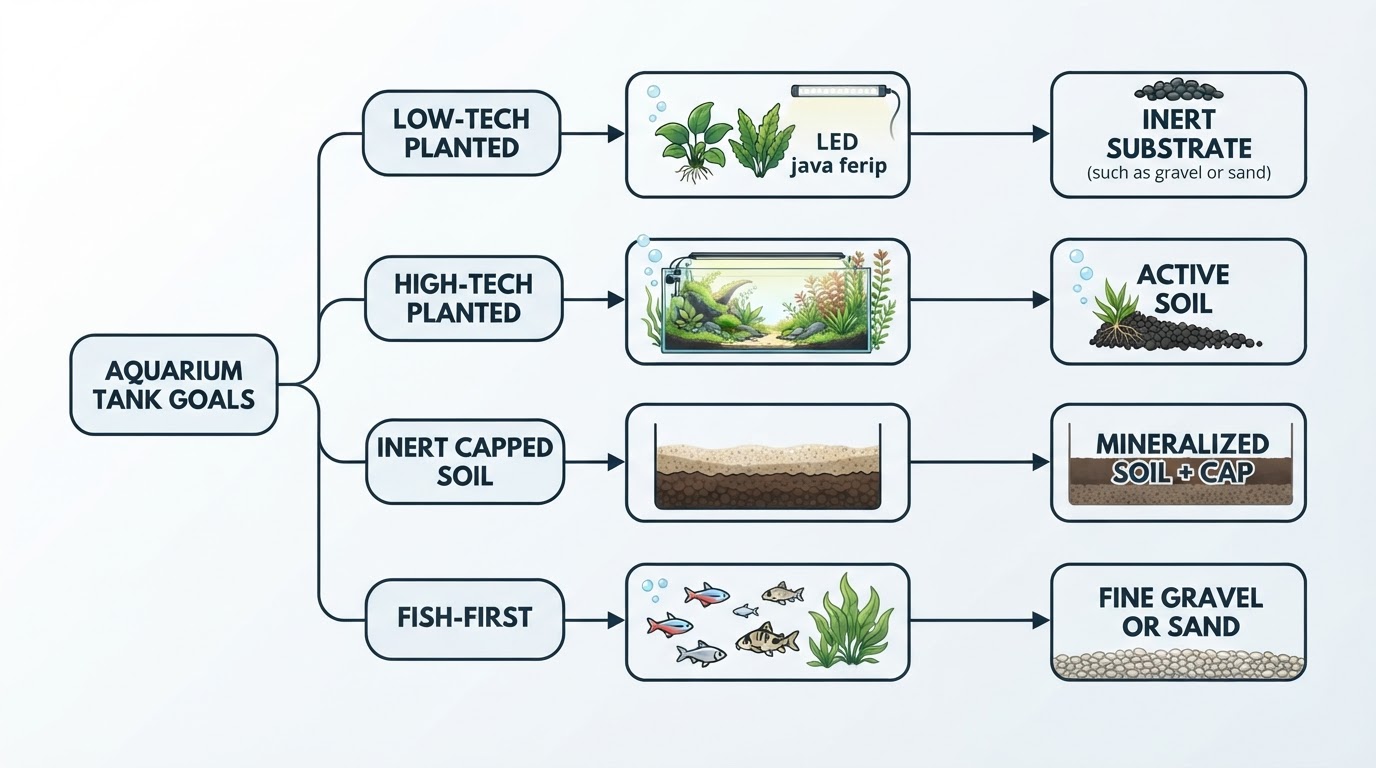
Installation and startup, by product
Use the directions for the exact bag you bought. Do not stock a new tank before it has cycled; the planted aquarium setup guide covers that separate setup sequence.
Why rinse advice is not universal
ADA's Aqua Soil FAQ says to avoid washing Aqua Soil before placing it; washing can crush the grains and cause persistent clouding. If the water is extremely cloudy, ADA says to remove and refill it before starting the filter. That guidance is for ADA Aqua Soil, not for Tropica Aquarium Soil or Seachem Flourite, and it shows why one rinse instruction cannot cover every aquasoil. Seachem's Flourite directions call for rinsing transport dust. Tropica's page gives layer and water-change directions rather than a gravel-rinse step. Read the maker's page for the bag you bought.
Planting: roots, rhizomes and root tabs
Roots can be buried in either substrate; they anchor the plant and take up water and nutrients. Rhizomes are not roots. Anubias and Java fern grow from a horizontal rhizome that should stay above the substrate, with the roots free to attach to wood, rock or the bed. Tropica's planting guide also says not to cover the rhizome of Anubias or Microsorum when planting.
Root tabs are a tool, not a mandatory part of either product. Use them for heavy root feeders when the bed and water-column fertilization are not meeting demand. The need depends on the plant load, growth rate and the rest of your dosing, so add them in response to plant condition rather than on a fixed calendar.
Cleaning, disturbance and replacement
Gravel and clay beds are generally easier to vacuum at the surface than soft soil. Vacuum the surface without driving the tube deep into the bed; deep disturbance releases trapped debris and clouds the water. In an aquasoil, aggressive washing can crush granules and make haze worse, which is one reason ADA warns against washing its soil.
Any substrate can collect debris; a gravel bed is not self-cleaning. The practical difference is how much disturbance the material tolerates before it clouds or loses structure.
There is no single replacement schedule for planted substrates. Seachem says Flourite need not be replaced. Tropica's page does not publish a replacement interval for Aquarium Soil. Soft granular soils can be crushed by rough handling, but the timing depends on the product and how the bed is maintained. Replace or top up when the bed no longer holds plants or has broken down into fine debris, not on a fixed number of years.
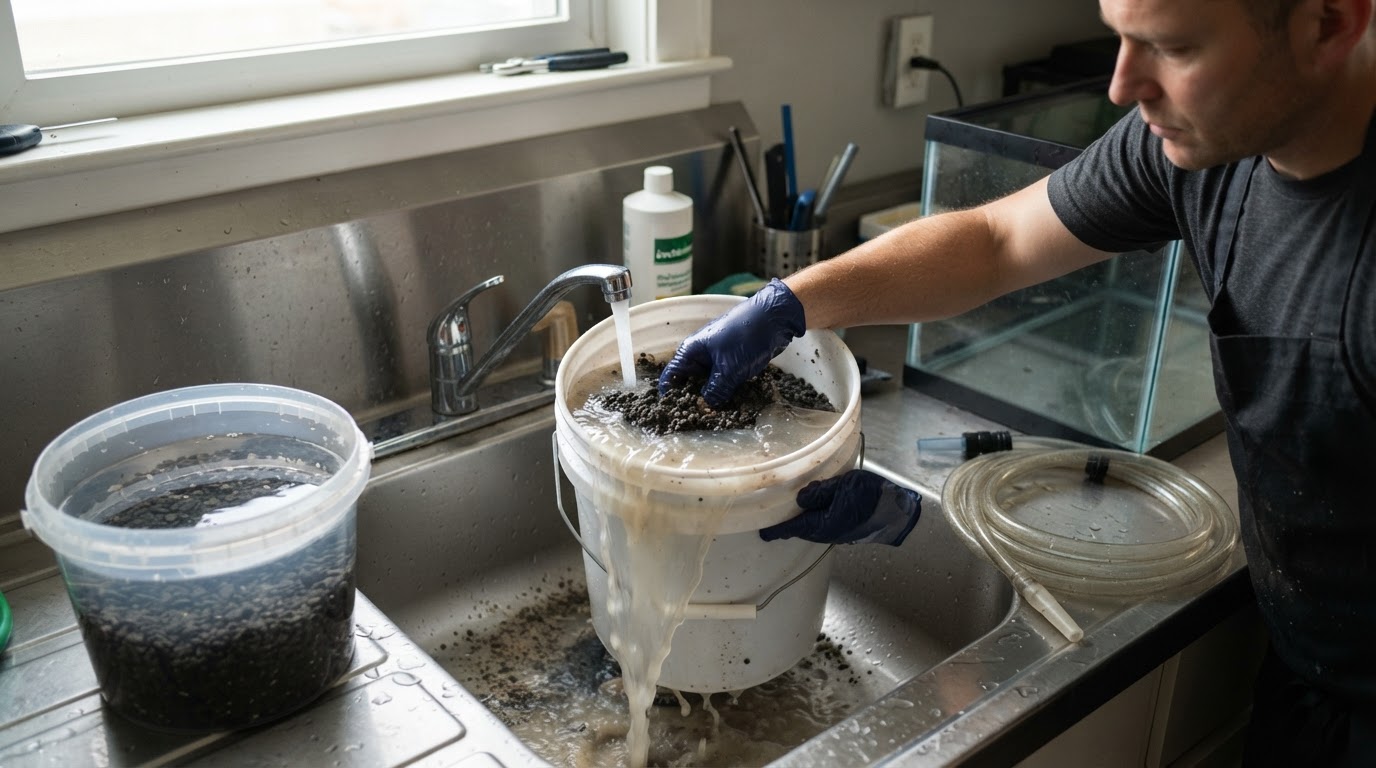
What to confirm on the bag
- The grain size, matched to the finest roots you plan to grow and to the mouthparts of bottom dwellers.
- The maker's pH statement. "Will not alter pH" and "lowers pH" describe different routines.
- Rinse and fill directions. Do not carry a rinse rule from one product to another.
- The volume in liters, or enough coverage information to calculate it.
- Whether the product is an aquarium substrate rather than a landscaping or garden material of unknown composition.
Neither Tropica Aquarium Soil nor Seachem Flourite needs a separate cap, but check the bag if you choose a different product.