The Sequence the Printed Instructions Set Out
The procedure runs in one direction, and the two containers are never shaken at the same moment. A clean test tube is filled to its line with 5 mL of tank water. Ten drops of Solution 1 go in, with the dropper bottle held upside down and completely vertical so the drops come out uniform. The tube is then capped and inverted several times to mix.
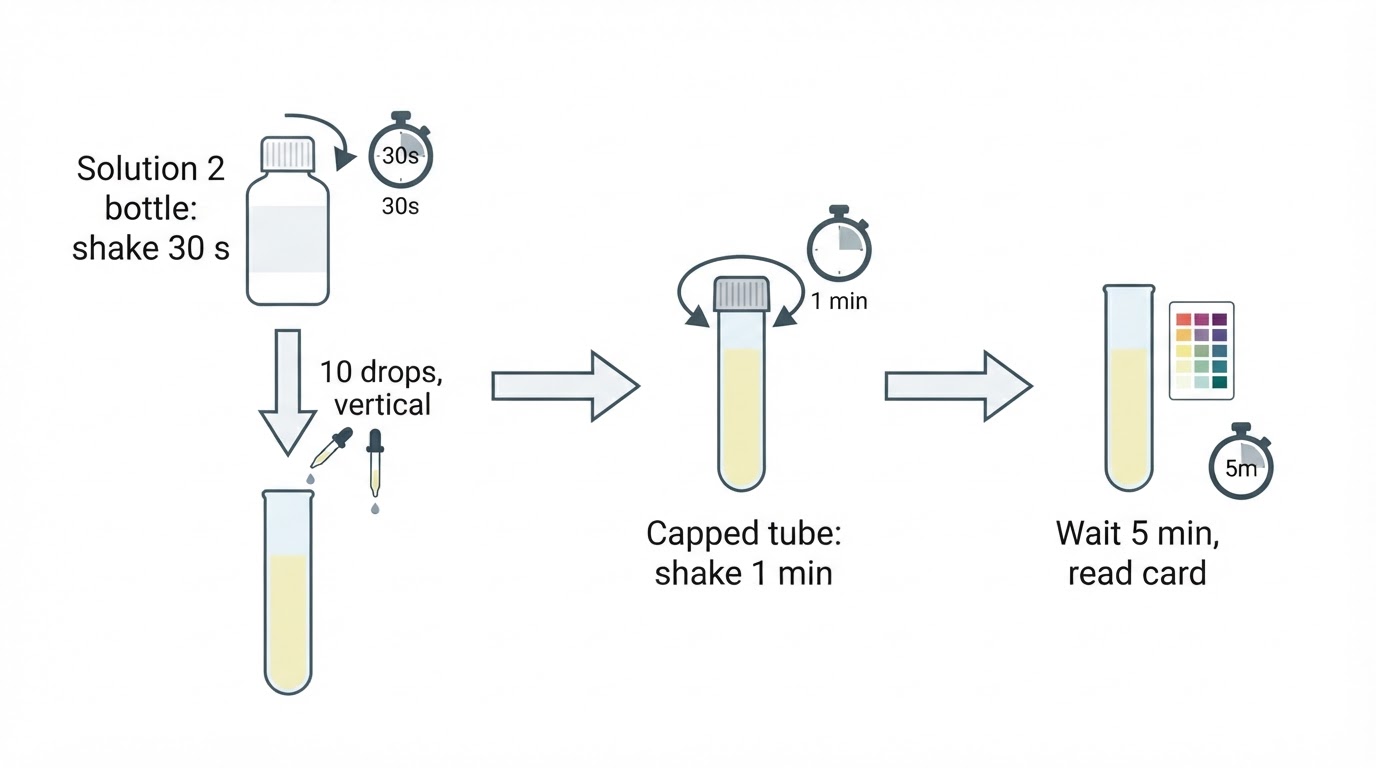
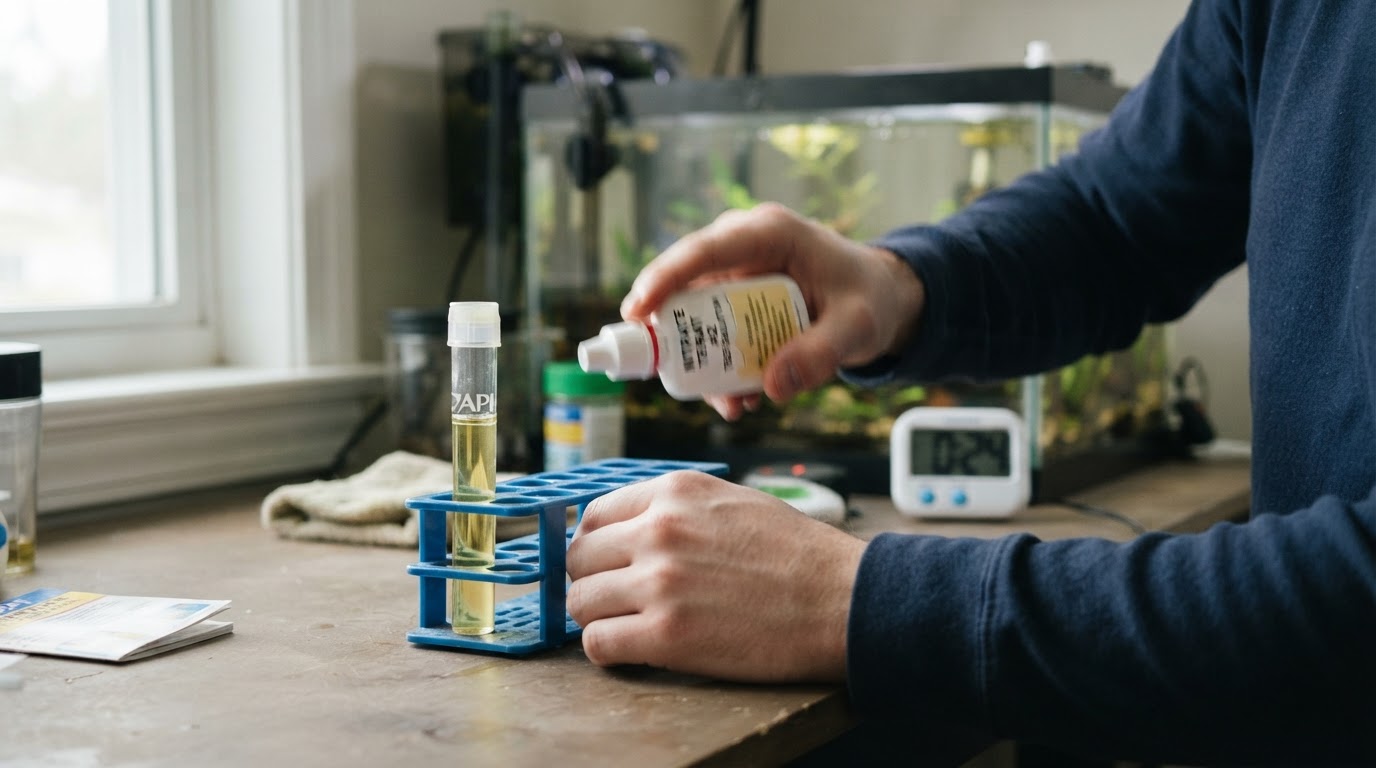
Only after that does the second bottle come into it. Solution 2 is shaken vigorously for at least 30 seconds, still capped and still a bottle of reagent, and then ten drops are added to the tube with the dropper held vertical again. The tube is capped a second time and shaken for one minute. The color then develops over a five-minute wait, after which the tube is compared against the nitrate color chart, held against the white area beside the chart in a well-lit place, using the freshwater or saltwater card that matches the system sampled.
Step | What is shaken | How long | When |
|---|---|---|---|
Solution 1 | Nothing yet; the capped tube is inverted several times | A few inversions | After 10 drops |
Solution 2 bottle | The sealed reagent bottle | At least 30 seconds, vigorously | Before its 10 drops |
Filled tube | The capped tube holding the sample and both reagents | One minute | After the second set of drops |
Those steps and durations come from the instruction insert that the API Nitrate Test Kit product page links to, an API nitrate instruction insert for the two-bottle procedure. The insert attaches a note about accuracy to each of the two timed mixing steps, which is why neither duration can stand in for the other.
Why the Bottle Gets Shaken and the Tube Does Not, Yet
The order follows from where the drops come from. The 30-second shake is printed immediately before the ten Solution 2 drops, so the drops are drawn from a bottle that has just been agitated. Shaking the sample tube at that point would accomplish nothing for the reagent, because the tube holds only tank water and Solution 1.
The insert sets the shaking time and flags the step as important for accuracy; it does not go on to explain the chemistry behind the timing. "At least 30 seconds" is a floor rather than an estimate, so twenty seconds of hard shaking falls short of the printed instruction and a couple of quick flicks is a different action from the one described. Treat the bottle as its own task, keep it capped, and time it.
How the Filled Tube Should Be Mixed
After the second set of drops, the capped tube gets one full minute. The current FAQ on the API Nitrate Test Kit product page describes a gentler option for that step: invert the capped tube back and forth roughly every one to two seconds for the interval the instructions specify, while the reagent bottles still call for vigorous shaking. The minute itself does not shorten, and a quick swirl does not replace it.
Reading the Color at the Five-Minute Mark
The wait exists so the color has developed before it is compared, and reading early or in dim, strongly tinted light changes what the chart is being compared against. The tube is held against the white area beside the chart in a well-lit place, and the card used should be the freshwater or saltwater version that matches the water sampled, since the kit includes both.
If a Shaking Step Was Missed
A skipped or shortened mixing step leaves a result that is unreliable rather than slightly less precise, so a fresh test run through the full sequence is the way to get a reading comparable to an earlier one. Multiplying or dividing the number assumes an error that was never measured, and leaving the tube longer than five minutes changes the comparison basis instead of correcting the mix.
That matters in both directions. A low number after a missed shake does not confirm the tank is fine, and a high one does not confirm a problem; the answer is another test, run as printed.
Which Kit Version This Covers
The product page text mentions a nitrate kit that "comes with one nitrate bottle," which does not match the two-bottle sheet it links to. That inconsistency belongs to the manufacturer's site, so check the insert in your own box before applying anything above. This page describes kits whose supplied instructions use Solution 1 and Solution 2 with ten drops each. If your kit ships a different sheet, a single reagent, or a different drop count, follow the paper in your box; mixing steps from one version do not transfer to another.
What the Reading Represents
The kit reports nitrate as NO3 in parts per million, which the product page treats as milligrams per liter, across a 0 to 160 ppm range. That is an NO3 figure and not nitrate-nitrogen (NO3-N), so a value published on an NO3-N basis needs conversion before the two can be compared. What level to act on is a separate decision from running the test, and it depends on the system being kept.
Cleanup and Handling
Keep the test solutions out of the aquarium, and do not pour the reacted sample back into the tank. Rinse the test tube with clean water after each use, as the insert directs, and follow the storage and handling guidance on the reagent labels rather than improvising a routine. A tube that stays marked, cloudy, or coated adds an error unrelated to mixing, so clean and dry it separately from the testing steps; our guide to cleaning aquarium test vials covers that job and where it stops.