The first drop already ended the test
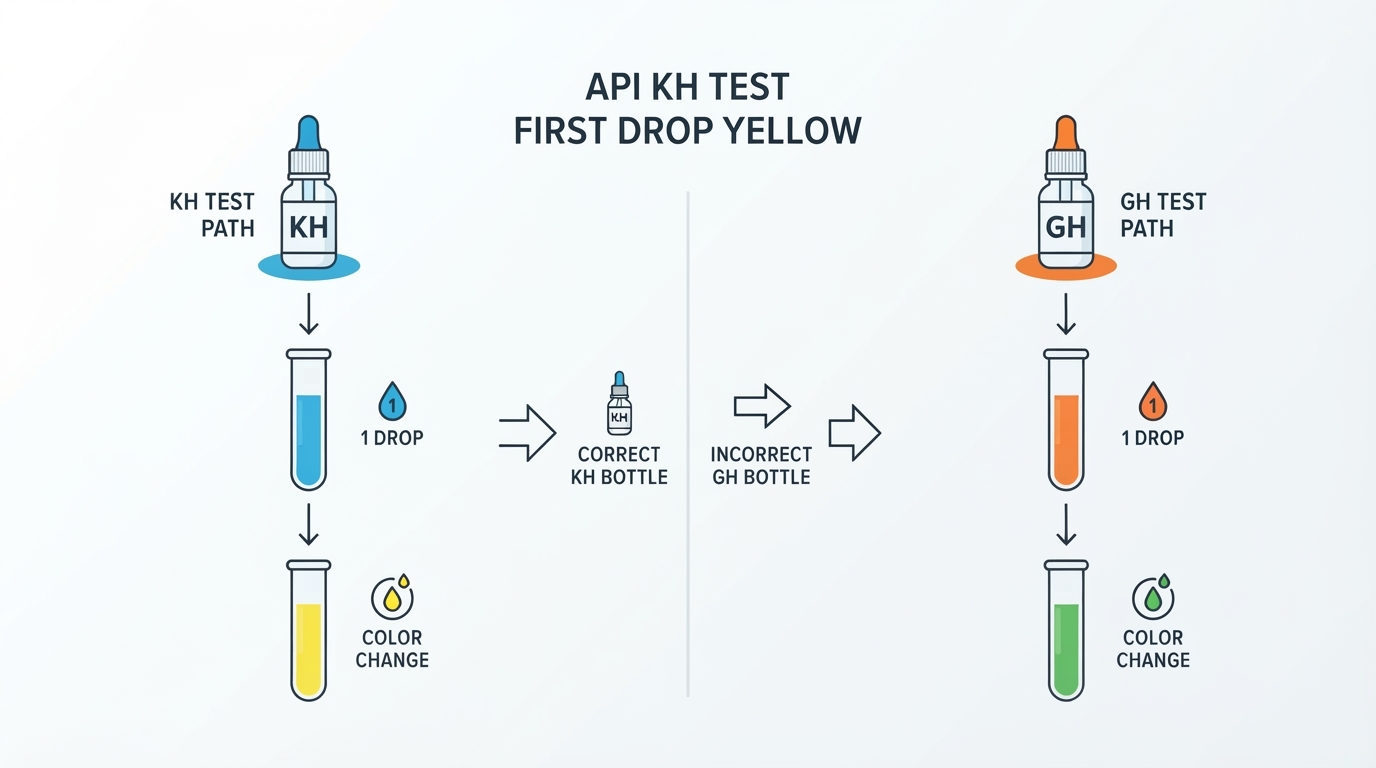
The manufacturer's instruction sheet defines the KH test with one condition: the test is completed when the water in the tube, after shaking, turns from blue to yellow, and the KH value is the number of drops that had to be added to reach bright yellow. Nothing in that rule requires a blue stage to persist, and nothing requires more than a single drop. If the first drop produces the endpoint color, the count is one.
That is why a sample going yellow immediately is not a failed test. It is a sample at the bottom of the scale. The instructions anticipate the awkward case directly: if the color after the first drop is hard to judge, take the cap off, hold the tube over a white background, and look down through it. The check is about confirming the yellow, not about waiting for a later stage to arrive.
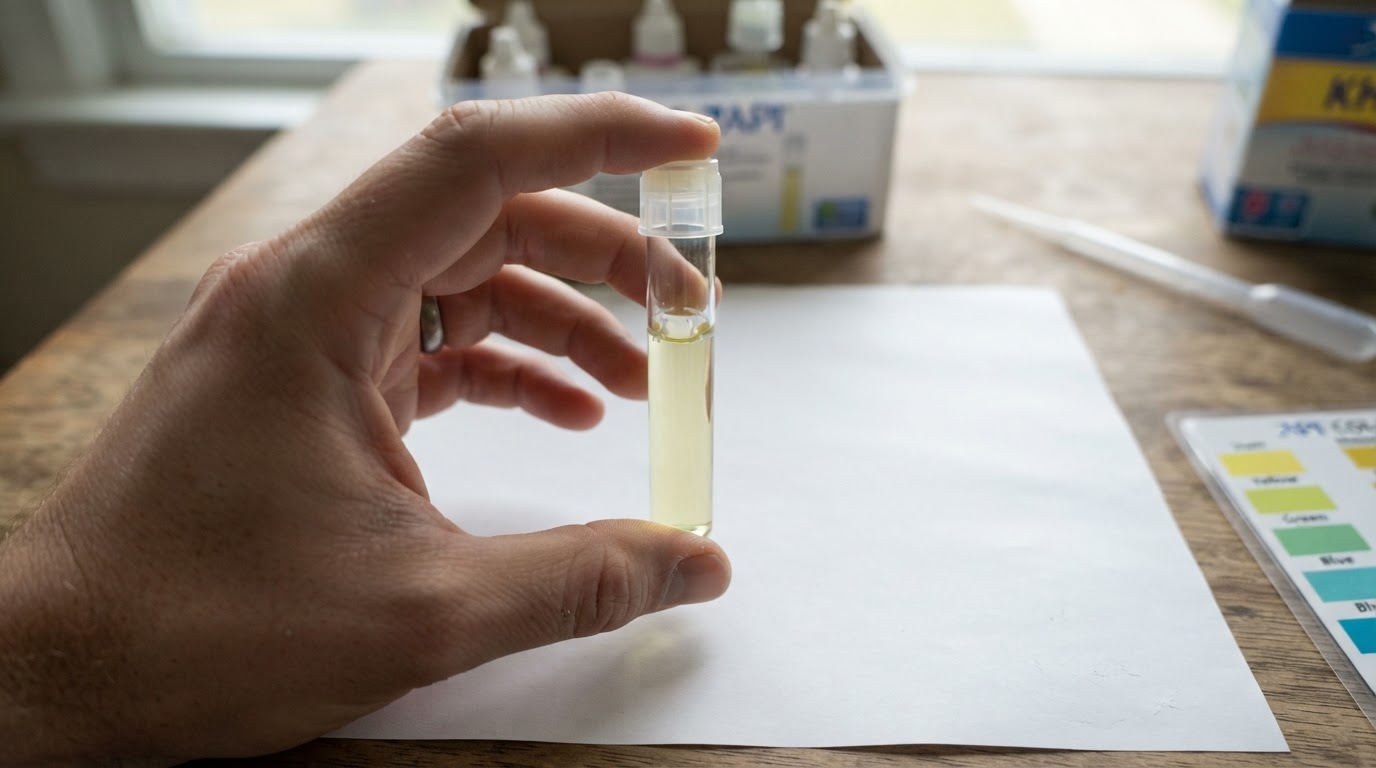
Adding reagent past the endpoint resolves nothing. Every extra drop pushes the count into the next chart row, so a sample that turned yellow at one drop and then received two more is reported as 3 °dKH and 53.7 ppm — a number produced by the dosing rather than by the water. The kit counts drops to a color change, and once the color has changed the count is finished.
What the conversion chart reports
Each drop maps to two numbers: one drop is 1 °dKH and 17.9 ppm, two drops are 2 °dKH and 35.8 ppm, three drops are 3 °dKH and 53.7 ppm, and the table runs to twelve drops at 12 °dKH and 214.8 ppm. The column is headed "ppm GH/KH" because the same 17.9-per-degree factor is used for both tests.
The ppm column is a unit conversion of the degree value, expressed under the calcium carbonate hardness convention common to both kits. It is not an independent measurement of calcium or magnesium in the sample, and it does not add detail that the drop count did not already contain. The smallest row in that chart is one drop, which is also the finest result the kit can produce however the answer gets printed.
One drop is a floor, not a precise one
A titration with a one-drop step can only count whole drops into five milliliters of sample. Near zero, a sample that needs almost no reagent and a sample that needs most of a drop's worth both land on the same row. The sheet publishes no fractional-KH procedure, no error bars, and no larger sample volume to double the resolution, so the accurate description of a first-drop yellow is "at or below the first chart step."
Report it the way the chart reads — one degree, 17.9 ppm — and leave the distance toward zero unknown. Writing 0.000 dKH invents three decimals the chart never prints, and 1.000 dKH makes the same invention in the opposite direction.
Six checks worth running before the number drives a change
At one drop, the handling around the test matters more than it would at ten drops.
- Sample volume. Fill to the line, which the kit defines as 5 ml. A short or overfilled sample changes how much carbonate each drop has to neutralize, and the one-drop-one-degree relationship stops holding.
- The right bottle. The KH solution runs blue to yellow; the GH solution runs orange to green and reports general hardness instead. In the combined GH and KH kit the bottles look alike, so read the label before the first drop. The GH instructions repeat the same pattern — five milliliters, bottle vertical, one drop at a time, cap and invert after each — but stop at green.
- Drop formation. Bottle upside down and vertical, one drop at a time, with a cap-and-invert after each drop so the sample mixes before you judge the color.
- Tube cleanliness. Rinse the tube with the water being tested before filling it, and rinse it again immediately afterward. API's product page notes that reagent left in the tube dries and stains the glass over time, and a stained tube makes the color call harder at the exact point where the call matters.
- Reagent age. Check any expiry and storage guidance supplied with the actual kit. The instruction sheet reviewed here does not establish a shelf life, and matching repeat readings cannot validate an old or questionably stored reagent. Seek manufacturer advice or independent confirmation when that uncertainty matters.
- A fresh repeat. A fresh repeat can check repeatability. Use a fresh 5 ml sample and the same instructions. Agreement means the repeated procedure gave the same coarse reading; it does not establish accuracy, reagent validity or safety for livestock. If repeats disagree, recheck the procedure and seek confirmation before changing the water.
What a first-drop result cannot answer
General hardness is a separate titration with its own solution and an orange-to-green endpoint, and a GH number says nothing about carbonate buffering. The two readings are independent, so a tank can measure hard while carrying almost no buffer, which is the distinction the GH and KH comparison sets out.
pH is a different measurement again and cannot be back-calculated from a bottom-of-scale KH count. A tank reading one degree can hold a steady pH when little acid is being produced, and a tank reading several degrees can still drift when the biological load is heavy. Ammonia, nitrite, and nitrate — the readings that decide whether a tank is cycled at all — come from different kits entirely.
Low KH does carry one specific implication. The instructions' own introduction notes that water with very low KH, below 3 °dKH, can contribute to wide pH swings in the aquarium, because there is little carbonate or bicarbonate to absorb the acids that respiration, waste breakdown, and nitrification keep adding.
When the test is done
The endpoint is reached when the mixed sample is bright yellow, including on the first drop. Record one drop and the chart conversion of 1 °dKH / 17.9 ppm, while stating that the count does not resolve the distance below that first step. An optional repeat checks repeatability only. If a water-chemistry decision depends on the difference, confirm the result with suitable testing and advice for the actual aquarium before adding anything. Extra drops after the endpoint add no information about the original result.