Should You Trust an Expired Reef Test Kit?
No. Treat an expired reagent as unreliable for a tank decision. Hanna Instruments states that using an expired reagent can give inaccurate or false readings, which puts the number itself in question, not just its precision (Hanna Instruments). Expiry is reagent- and product-specific, so there is no universal years-from-purchase rule and no published lot-code decoder that fits every brand. The date and instructions on the bottle, sachet, or kit insert you actually own are the ones that matter.
Inventory the Kit on Your Shelf
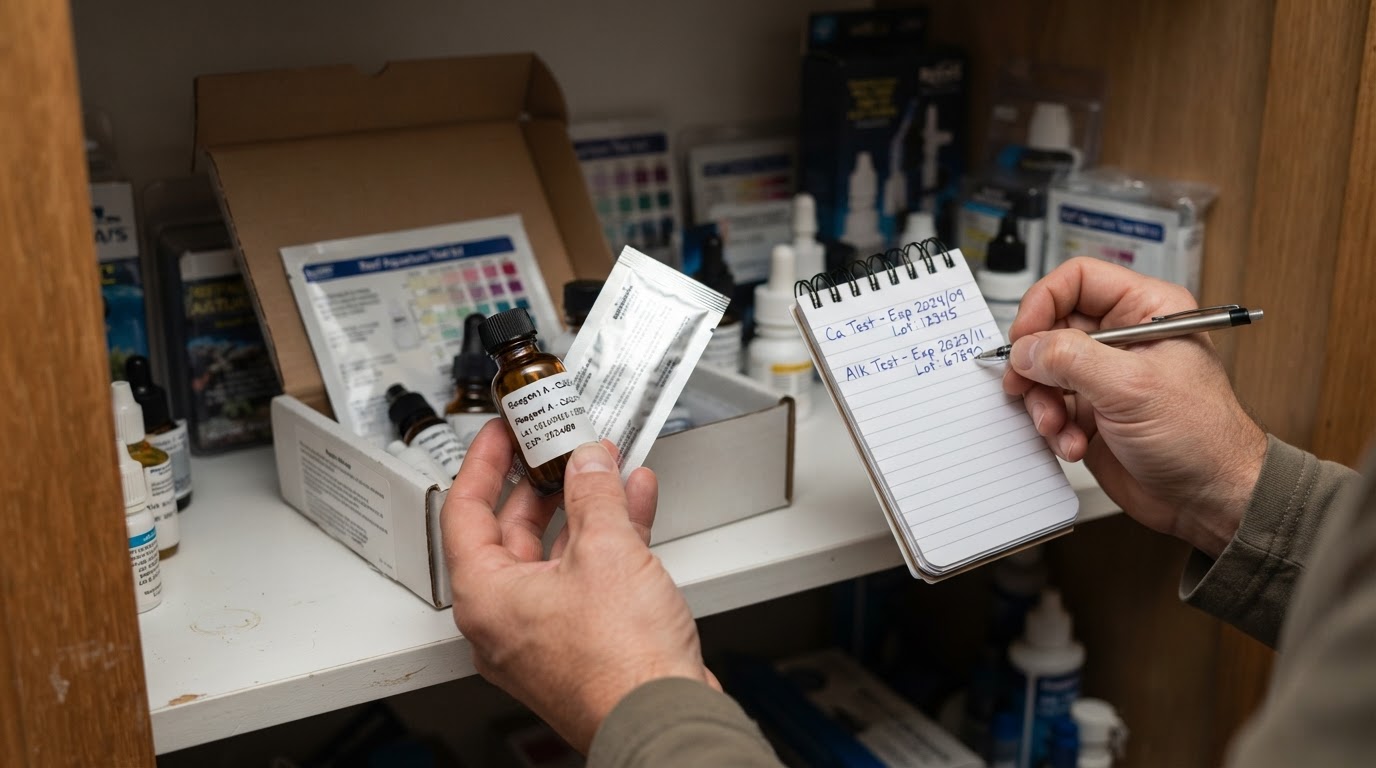
Start with the container in front of you, not with the brand's general reputation. Read every reagent bottle and sachet separately, because components of one kit may not share an expiry date. Record the identifiers the label actually provides: the expiry or best-by date if one is printed, the lot or batch number if present, the reagent name or code, and the opening date if the maker asks you to note it. Printing practice differs between makers and between products, so a missing date panel or lot line is not evidence that you skipped a step; note what is there and ask the manufacturer when the identifiers are unclear. Keep reagents in their original labeled containers so identity and dating stay attached to the right component. If a label is missing, faded, or shows a code you cannot decode, contact the maker with whatever identifiers you do have rather than guessing.
Storage Can Age a Reagent Before Its Date
Storage matters when it departs from what the maker's label or instructions ask for. Hanna's best-practice guidance asks for a cool, dry place and warns that dramatic temperature changes can damage reagents (Hanna Instruments). The useful question is not whether the room was ever humid, but whether the kit was kept outside the conditions the label describes: a shelf above a sump, a cabinet beside hot lighting, a windowsill in direct sun, a freezing garage, or a damp storage box the maker never intended. A kit kept well outside its label guidance deserves suspicion even when the printed date looks fine. Ordinary indoor humidity, on its own, is not proof that a reagent has failed. Close caps fully, keep bottles upright, and do not leave reagents open while you prepare a sample. None of this replaces the printed date, but it explains why two kits bought together can behave differently.
Four Checks Before You Change the Tank
Check | Record | If it fails |
|---|---|---|
Date | Expiry or best-by date, where the label prints one | Do not guess an age; ask the maker how to date an unmarked reagent |
Identity | Reagent name, code and lot or batch number, as printed | Ask the manufacturer what identifies the batch; do not substitute another kit's reagent |
Storage | Where and how the kit was kept, compared with the label's storage guidance | Treat a kit kept outside that guidance as suspect even if it is in date |
Protocol | The exact steps and timing from your kit's instructions | Repeat the protocol exactly before comparing any result |
Replace, Repeat, Then Compare
Buy fresh reagent for the exact kit and test you are running, then repeat that kit's own procedure: same sample volume, reagent amounts, wait time and reading method. Do not transfer a step from another brand or assume two kits with a similar color change use interchangeable chemistry. If you compare an old result with a fresh one, keep the comparison modest. A single difference between old and fresh tests is not calibrated proof that the kit failed, and it does not give you a correction factor to apply to the old number. The reverse also holds: a fresh reagent that produces a repeatable, plausible number does not prove that the number is accurate. Repeating the same procedure can reproduce the same error. When a consequential reading stays doubtful, compare it with an appropriate standard solution or seek independent confirmation; calibration against a known standard is a separate process, and a consistent result is not the same thing as a calibrated one. If fresh reagent reproduces the unexpected result and no standard or independent check is available, move to the wider aquarium water quality troubleshooting sequence instead of replacing more reagents.
When Expiry Is Not the Cause
An unexpected reading is not automatically an expiration problem. Sample handling can produce the same surprise, though the specific steps differ by kit. Hanna's Marine Checker best-practice list, for example, covers fingerprints or bubbles on a cuvette, reagent left sitting in it, rinsing with DI water, and pipette use (Hanna Instruments). That list is specific to Hanna's Marine Checker line; it is not a universal procedure for every test kit. A colorimeter, a drop titration kit and a test strip each have their own sample container, rinse routine and timing, so follow the exact maker protocol for the kit in your hand rather than borrowing steps from another product. The practical test is still a repeat with fresh reagent and that kit's own protocol. If the result is repeatable and plausible, treat it as a usable reading within the limits described above; if it still looks wrong, confirm the measurement against a standard or an independent check before dosing anything. Correcting the number comes before correcting the tank.
A Simple Completion Standard
The check is finished when every reagent has the identifying information its label provides recorded, anything expired or genuinely unidentifiable has been replaced or cleared with the maker, and the exact protocol has been repeated with fresh reagent. You do not need to keep hunting for a lot number that was never printed. From there, act on a result only when it is both repeatable and supported — by an appropriate standard, an independent method, or the maker's own verification guidance — and pause dosing while a consequential doubt remains. The broader water quality guide shows where a confirmed reading fits into a full troubleshooting sequence. Expired reagents are one plausible cause of a doubtful number, not a universal explanation for every unexpected result.