Answer First: Verify Quickly, Act on Risk First
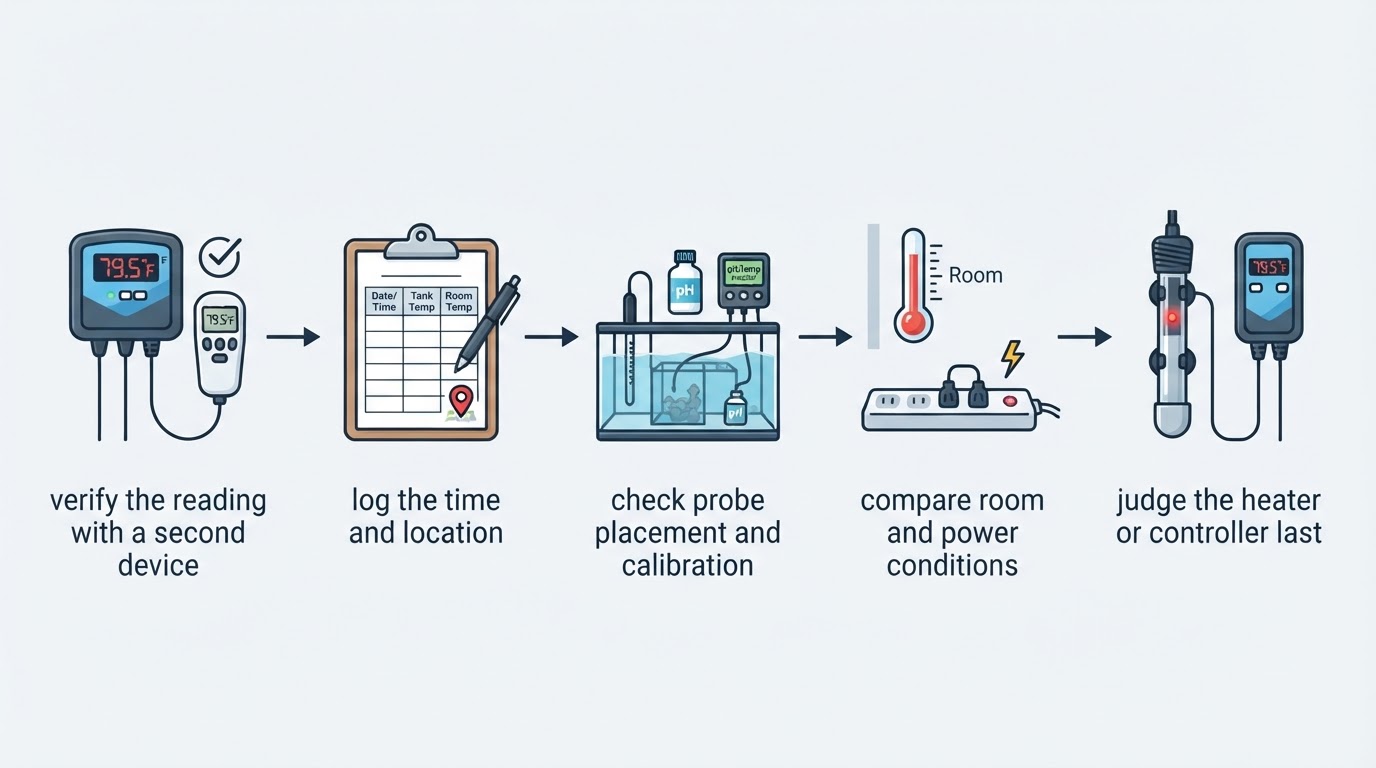
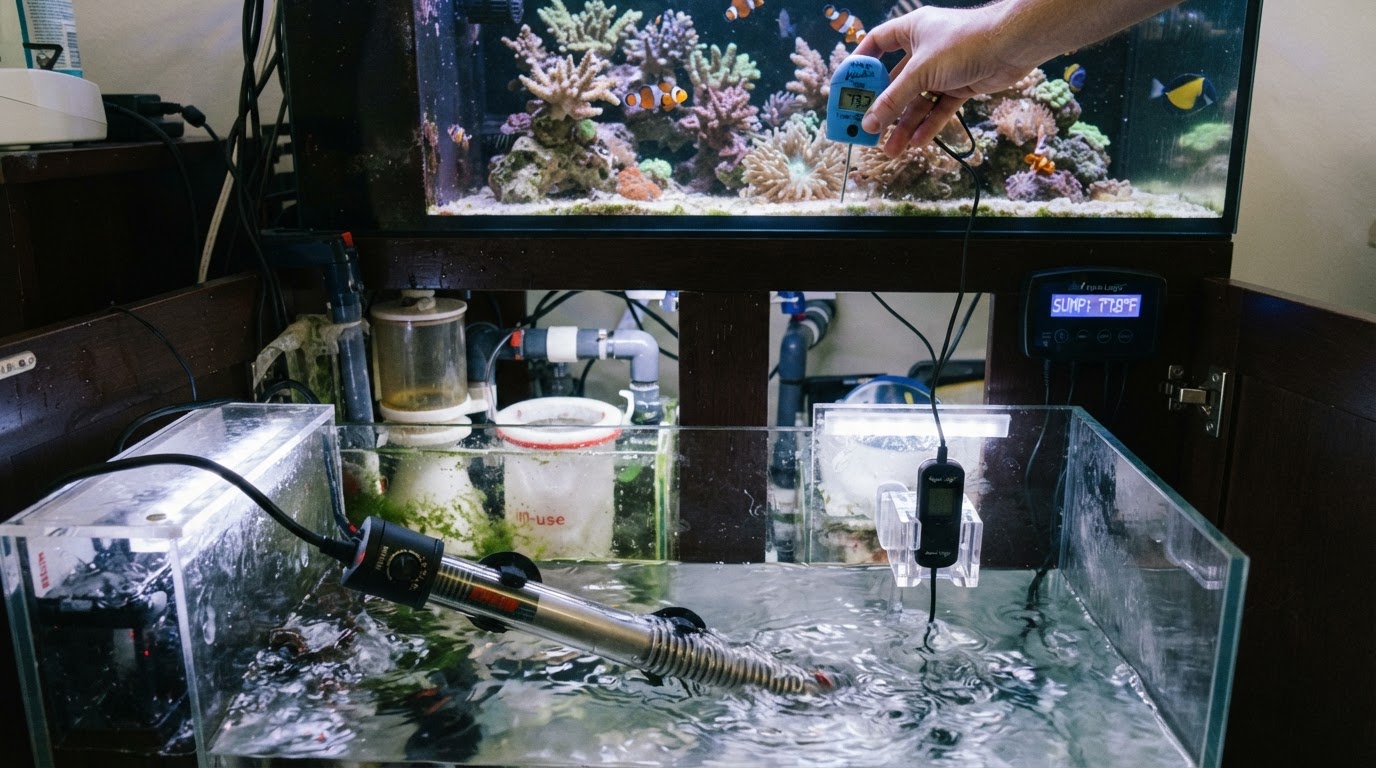
If your reef tank temperature swings, the first job is not a bigger heater. A single display, probe or stick-on strip is one opinion from one location. Put a second, independent thermometer in the tank and read both at the same moment and depth; if they disagree, your measurement is the open question.
Not every reported change is an artifact. Equipment faults, lost circulation, room conditions and load changes can move water for real. Take the second reading now, but if animals are gasping or corals are bleaching, or you see water near a plug or a damaged heater, handle that risk first and sort out the reading afterwards.
Safety First: Power Before Probes
Electrical safety comes before any probe or equipment handling. Follow your heater, controller and thermometer manuals rather than steps written for another model. Never handle probes, cords, plugs or heater bodies with wet hands while anything is energized. If a check needs a disconnect, shut the hardware off and reach the plug through dry access — dry hands, dry floor, a dry switch — before touching water or device. A cracked heater tube, damaged cord, wet plug or burning smell means isolating power and getting qualified help, not another test.
Match the Reading Source to What It Can Show
Reading source | What it can show | What it cannot prove |
|---|---|---|
Setpoint dial | The target the unit is set to reach | That the heater has power, that it is running, or that the water is at that temperature |
Indicator light | What that lamp means for your exact model, as its manual describes | That the water reached the setpoint or that heating is happening |
Stick-on strip thermometer | The temperature of the glass surface where it is stuck | The water temperature at a probe elsewhere in the tank |
Built-in controller probe | The temperature at the probe's own location | The tank average, if near a heater, chiller, light or dead spot |
Second independent thermometer | Whether two devices agree at one time and depth | Which device is right when they disagree |
The Bulk Reef Supply guide to stable water temperature lists poor thermostat placement among the causes of wrong heater and chiller response, and recommends sensors in high-flow areas, away from heaters and chillers, not dead spots.
Log Time, Place and Conditions, Not Just Numbers
Record the time, exact reading point (heater display, sump chamber, rear corner), room temperature and what the equipment was doing: lights on, fan running, pump restarted, water change finished. Identical numbers from different hours or places are not the same evidence, and a high-and-low pair will not say whether the tank cooled overnight or the probe warmed under the lights. Copy this table and fill a row at each check, noting which device produced which reading so a later comparison does not mix a sump probe with a display on the heater.
Time | Location | Reading 1 | Reading 2 | Room temp | Equipment or change | Notes |
|---|---|---|---|---|---|---|
|
|
|
|
|
|
|
|
|
|
|
|
|
|
|
|
|
|
|
|
|
|
|
|
|
|
|
|
|
|
|
|
|
|
|
|
|
|
|
|
|
|
Check the Measuring Chain First
Placement comes before calibration. Move the probe into moving water, away from the heater body and any light, then confirm agreement with a known-good thermometer at the same moment and depth. Calibrate or offset only as your controller maker describes, and recheck on that maker's interval; if the manual states none, leave the gap open rather than borrowing a schedule.
Room, Airflow and Power
The room is a thermostat candidate, not a verdict. Sunlight, an air-conditioning vent, a fan or an open window change how fast heat leaves the system, so a swing that tracks a household schedule is a lead worth testing. Schedule correlation alone does not prove the room caused it; lights, pumps and feeding follow the same clock. A blinking clock shows power was interrupted at some point, not when or for how long, so it cannot establish an outage timeline. The same BRS guide lists lost circulation or lost temperature control during outages as a cause of swings in both directions.
Circulation, Load and Surface Movement
If the warmest and coldest readings come from one system, treat it as a distribution question before a heating one. A heater in still water warms its own pocket and its own thermostat, then switches off while the display stays cool. Pumps, skimmers and lights add heat; evaporation and surface movement remove it, so a swing peaking after lights-on and one bottoming out before dawn need different shortlists.
Heater and Controller Faults
Only now judge the hardware. The same guide separates a heater whose thermostat sticks on, a controller relay that fails, and a heater whose seal or power supply lets water in; each leaves different evidence. A setpoint dial shows the target, not the water, and a lamp means only what your model's manual says. Checks before replacing a unit are in our guide to a leaking or failing heater check.
Change One Variable, Then Re-Measure the Same Way
Pick one change: reposition the probe, correct the heater's placement, put a fan on a schedule, then re-measure at the same times and points. If the swing lands on maintenance days, add the water change to your suspects, because unplugging and restarting a heater, or draining below its marked minimum, changes what happens on restart. Our guide to unplugging an aquarium heater for a water change covers that sequence.
What a Log Can and Cannot Prove
No universal safe swing, alarm temperature, heating wattage or correction rate transfers between reef tanks. Species needs and your manuals' limits are the boundary, and published ranges vary even within one source, so treat any figure as a reference, not a threshold. Do not move livestock between temperatures to test a theory.
A log is an observation record, not proof. Repetition can strengthen a pattern — the same swing at the same points across several checks, or one change that consistently shifts it — but it cannot prove a single cause. One cycle that stops after you move a probe fits a measurement problem without proving the probe was the only cause.