The minimum tank size for one oscar
A single adult oscar needs a 75-gallon (about 284-liter) tank, and that figure is a floor rather than a target.
Oscars (Astronotus ocellatus) are thick-bodied cichlids that reach roughly 12–14 inches (30–35 cm), so the two-inch fish you bring home will occupy most of the water column within a couple of years. A standard 75-gallon tank measures 48 × 18 × 21 inches (122 × 46 × 53 cm): four feet of swimming length, eighteen inches front to back, and enough depth for the fish to turn without scraping its face on the glass.
Treat 75 gallons as the point where maintenance becomes manageable, not the point where the fish is comfortable. If you are buying new and have the space, a 90-gallon tank keeps the same 48-inch length but adds water volume for buffering waste between changes, while a 125-gallon tank (72 × 18 × 21 inches) adds two feet of length, which an adult oscar uses constantly.
Key answers at a glance
One oscar needs 75 gallons and a 4-foot footprint, a pair needs 125 gallons and 6 feet, and every row below repeats one answer in full so you can stop at the line you need.
Question | Short answer |
|---|---|
Minimum tank for one adult oscar | 75 US gallons (284 L) with a 48 × 18 inch footprint |
Comfortable long-term size for one oscar | 90–125 US gallons (341–473 L) |
Minimum tank for two oscars | 125 US gallons (473 L); 180 gallons (681 L) is safer |
Minimum length | 4 feet (122 cm), or 6 feet (183 cm) for adults and pairs |
Minimum width | 18 inches (46 cm); 24 inches (61 cm) is better |
Height | 21 inches (53 cm) is enough — spend extra space on length |
Volume in liters | About 284 L for one adult, about 473 L for two |
Smallest tank for a juvenile | A 40-gallon breeder as a temporary grow-out |
55-gallon tank | Grow-out or hospital use only; too narrow for an adult |
Filtration | Rated for at least double the tank volume, or 8–10× turnover per hour |
Water changes | 25–50% weekly, using 50% for a pair or a growing fish |
Why footprint and width matter more than height
An oscar uses length and width, not depth: a tall, narrow tank looks impressive and wastes most of its volume on water the fish never swims through.
Three things drive that. First, a 14-inch fish has to be able to turn around; an 18-inch-wide tank leaves only two inches of clearance on each side of a full-grown body, and 24 inches gives it a normal turning radius. Second, oscars patrol horizontal territory, and a four-foot run gives them a lane to swim instead of a spot to hover over. Third, footprint controls surface area, and surface area governs how much oxygen enters the water and how quickly waste gases leave it, which matters enormously for a fish this heavy-bodied.
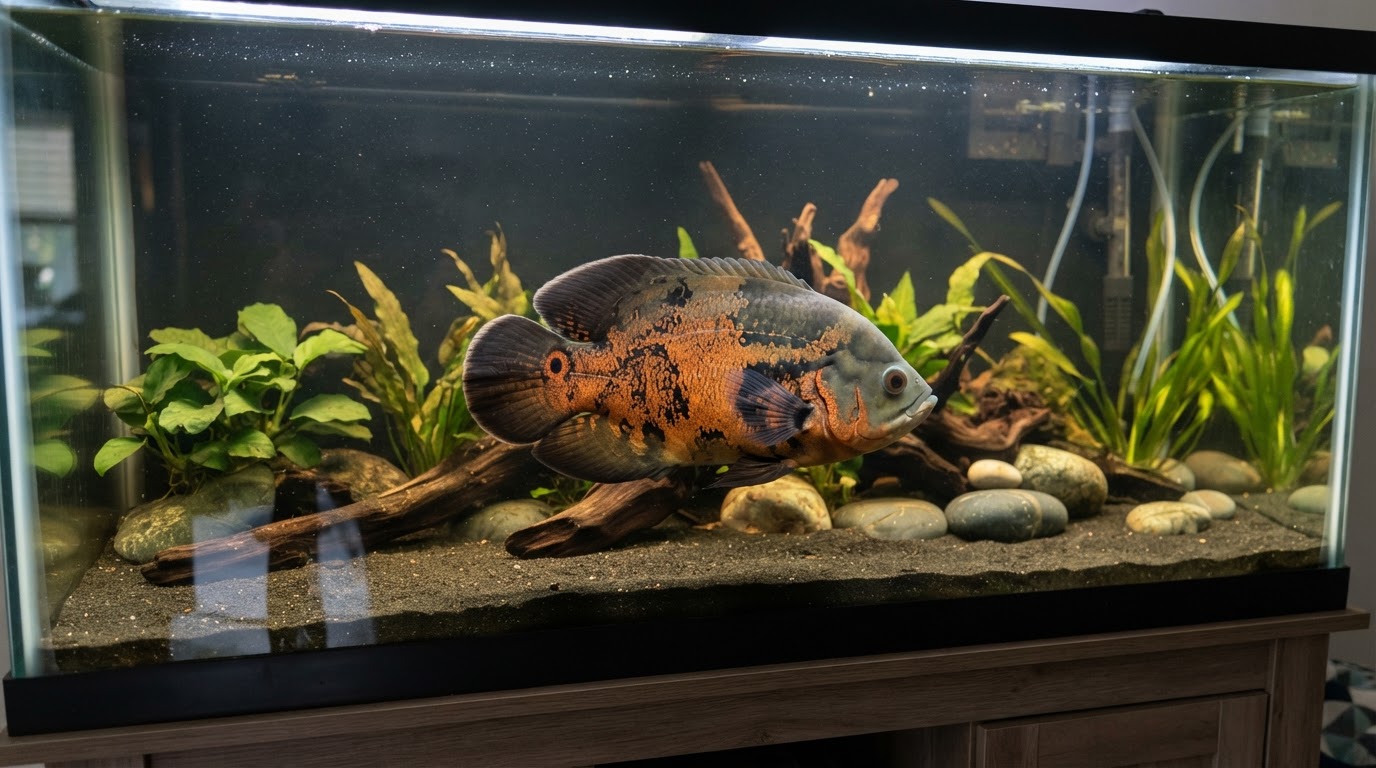
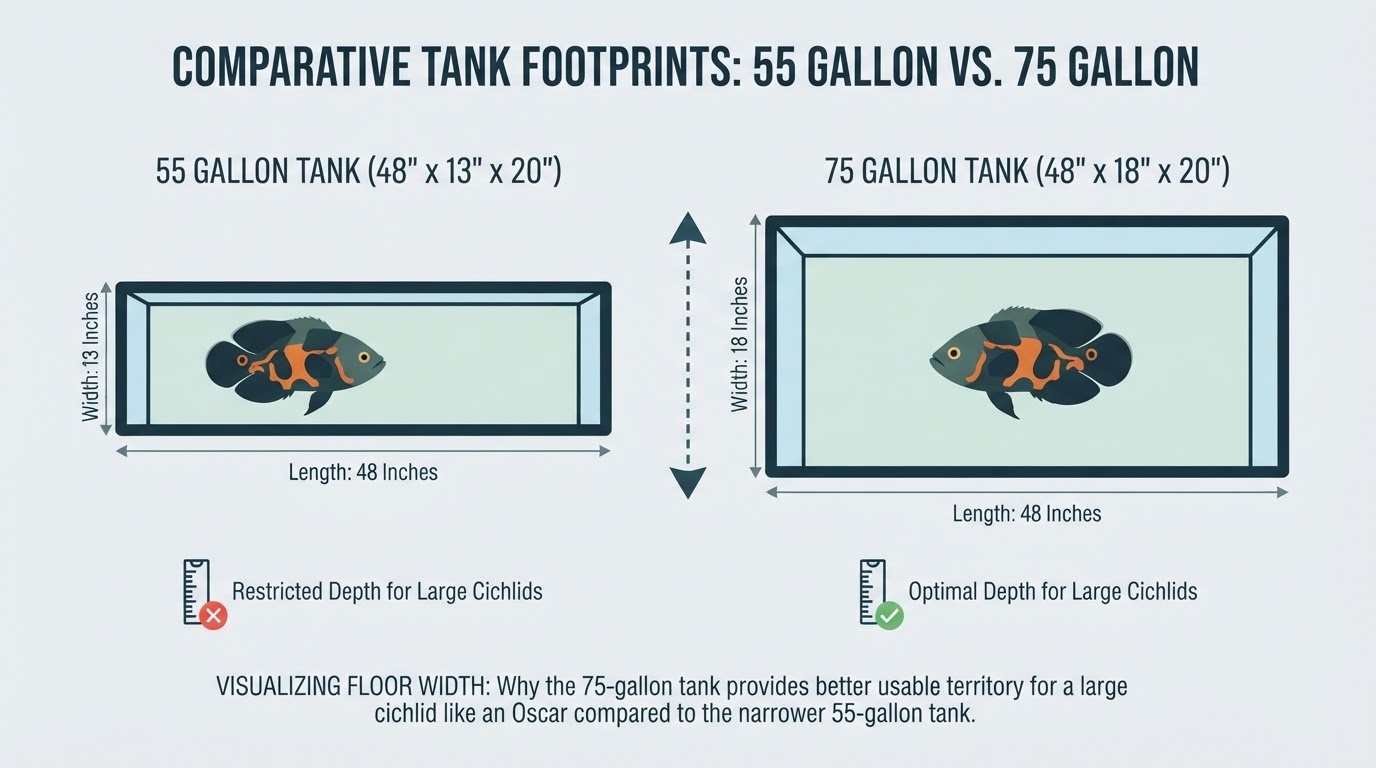
That is why a 55-gallon tank at 48 × 13 × 21 inches is a poor fit despite having the same height as a 75-gallon. The five missing inches of width cost the fish more than any amount of extra depth can repay.
Tank size in feet, liters, and gallons
Converted into the units people search for, one oscar needs 4 feet and roughly 284 liters; two oscars need 6 feet and roughly 473 liters. The same volumes are often written as litres in UK sources, and the gallon figure always means US gallons here.
Tank | Volume | Typical dimensions | Fit for oscars |
|---|---|---|---|
55 gallon | 208 L | 48 × 13 × 21 in | Grow-out only; too narrow for an adult |
75 gallon | 284 L | 48 × 18 × 21 in | Minimum for one adult |
90 gallon | 341 L | 48 × 18 × 24 in | One adult with more water volume |
125 gallon | 473 L | 72 × 18 × 21 in | Best single-oscar size; minimum for a pair |
180 gallon | 681 L | 72 × 24 × 24 in | A pair long-term, or a small group with heavy filtration |
A four-foot tank is 122 cm long and a six-foot tank is 183 cm, which matters if you are measuring a wall or a doorway rather than a spec sheet. Depth in the table is front-to-back width, not height.
Tank size for two oscars or a group
Two adult oscars need 125 gallons (473 liters) at minimum, and a 6-foot footprint matters more than the gallon number.
Two oscars in a four-foot 75-gallon spend their adult lives within a body length of each other, which is where the trouble starts: oscars are cichlids, they become territorial as they mature, and pairs that coexist as juveniles often turn on each other at sexual maturity. A 125-gallon at 72 × 18 inches gives each fish an end of the tank and somewhere to retreat. A 180-gallon at 72 × 24 inches is a much better long-term bet if you want two 12-inch fish to share water for a decade.
A bonded pair is a different situation from two random juveniles, and it usually cannot be predicted at purchase. Keep a plan for separating them, because two males in the same tank is a common outcome.
For three or more oscars, think in terms of 300 gallons (about 1,135 liters) and up, with oversized filtration and a realistic rehoming plan as the fish mature. Most keepers who attempt a group end up reducing it.
Adult size and growth rate
Oscars reach roughly 12–14 inches (30–35 cm) as adults, and most of that growth happens in the first 18 months.
Juveniles sold at one to two inches grow fast while they are young: expect several inches in the first year, closer to 8–10 inches by twelve months in a well-maintained tank, then a slower approach to adult size over the following year. A few fish exceed 14 inches in very large systems, but 12–14 inches is the realistic planning size, and that is the size your tank has to fit.
Tank size does not cap growth the way the old saying about fish growing to the size of their tank implies. What happens in a cramped tank is slower growth, worse water quality, and a shorter, sicker life — not a healthy miniature oscar. Plan for the adult and expect to keep the fish for 10–15 years.
Small oscar tanks: 29, 40, and 55 gallons
A 55-gallon tank is a grow-out tank rather than a permanent oscar home, and a 29- or 40-gallon tank is a juvenile or hospital tank only.
At 48 × 13 × 21 inches, a 55 leaves an adult oscar almost no clearance to turn, and the waste from a 12-inch fish fouls 208 liters of water quickly — you will be changing water twice a week to hold nitrate down. A 40-gallon breeder (36 × 18 inches) is better shaped, with real width, but it is only three feet long. A 29-gallon is a quarantine or hospital tank.
Cramped oscars show it in predictable ways: split fins and body scrapes from turning against the glass, head and lateral line erosion in tanks where water quality and diet have slipped, and sudden aggression toward tank mates. If you already own a 55, use it to grow out a juvenile and plan the upgrade before the fish passes 8 inches.
Tank size with filtration
Filtration does not let you shrink the tank; it only keeps a correctly sized tank stable between water changes.
Oscars are among the messier freshwater fish: they eat a lot of protein, produce a lot of waste, and rearrange the substrate. On a 75-gallon holding one adult, use a canister filter rated for at least twice the tank volume, or aim for total turnover of 8–10 times the tank volume per hour spread across two filters. On a 125, two large canisters or a sump is the normal setup.
One hang-on-back filter rated for 75 gallons is the classic under-filtration mistake with oscars. Mechanical media clogs faster than the rating assumes, so rinse the prefilter weekly and never clean all the biological media at once. Add surface movement from a spray bar or air stone, because a heavy-bodied fish in warm water has a high oxygen demand.
Water-change load by tank size
Plan on replacing 25–50% of the water every week, using the top of that range for a growing oscar, a pair, or a tank at the small end of the size range.
On a 75-gallon with one adult, a 40–50% weekly change is a realistic routine. On a 125-gallon with two adults, either one 50% change or two 30% changes per week keeps nitrate manageable. Read nitrate instead of guessing: if it climbs past roughly 20–40 ppm between changes, the schedule or the stocking is wrong.
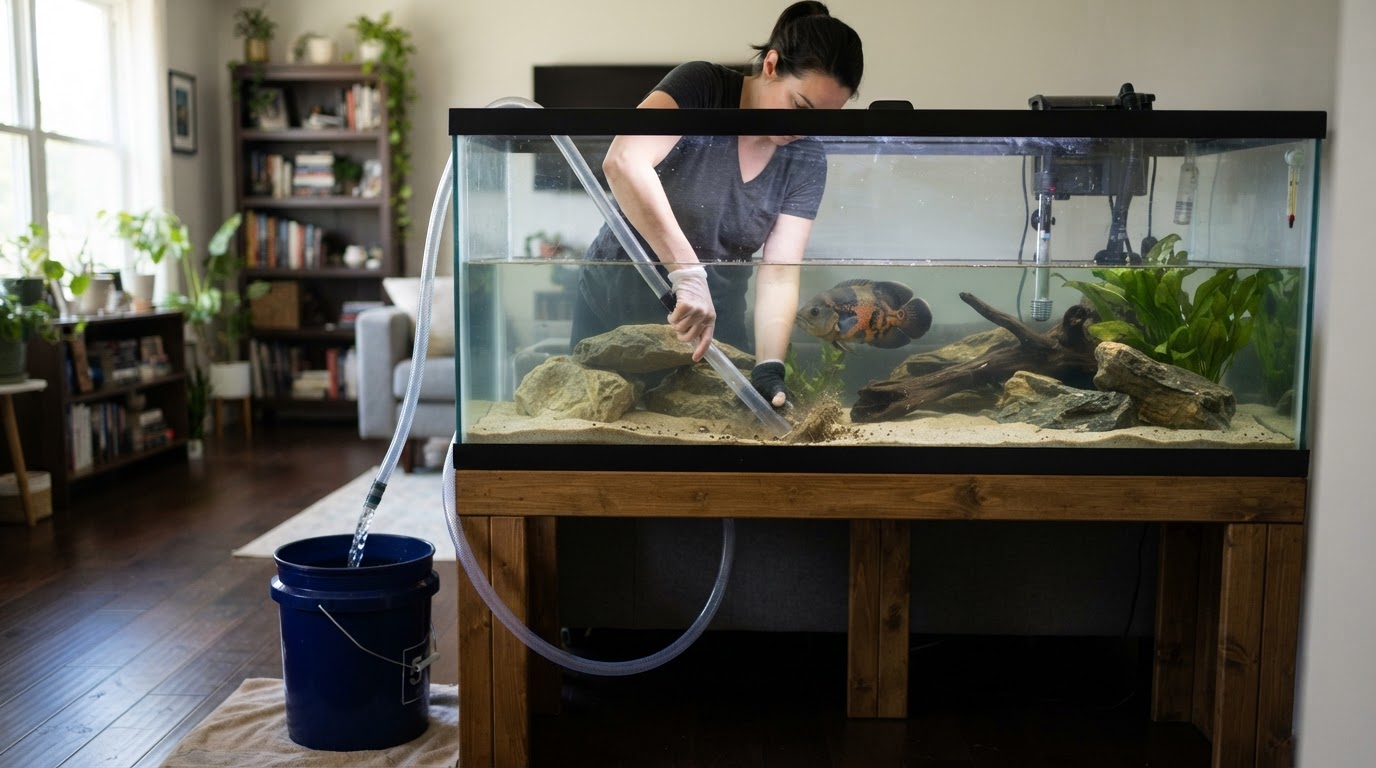
This is the practical reason a bigger tank is easier rather than harder. Doubling water volume roughly doubles the margin between changes, so a 125-gallon forgives a missed week in a way a 55-gallon never will. Match the water temperature during changes, use a dechlorinator, and avoid disturbing the filter media on the same day.
Setting up an oscar tank around its adult size
Buy the largest footprint you can fit and afford, then build the rest of the setup around a 14-inch fish.
- Stand and floor: a filled 75-gallon setup weighs roughly 850 lb (385 kg) once you add water, substrate, and glass; a 125-gallon is roughly 1,400 lb (635 kg) or more. Run it across joists rather than parallel to them, and use a stand rated for the volume.
- Lid: oscars jump, and a 12-inch fish on the floor is a dead fish. Use a heavy, fully covered lid with no open gaps around filter pipes.
- Temperature: hold 72–82°F (22–28°C) with a stable heater; oscars tolerate a wide range but not quick swings.
- Decor and substrate: sand or smooth gravel, no sharp edges, and decor heavy enough that a 14-inch cichlid cannot shove it into the glass. Expect plants to be uprooted; if you want them, choose robust species tied to rock or kept in pots.
- Open water: keep a clear swimming lane along the front glass. The aquascape exists to give the fish cover, not to fill the tank.
- Tank mates: choose fish too large to be eaten and calm enough not to be bullied, and keep the plan flexible because an oscar's tolerance changes as it matures.
- Cycle first: the tank must be fully cycled before the oscar goes in, and a quarantine period for new arrivals protects both the fish and the filter.
Follow-up questions, grouped by what you are deciding
Four feet and 75 gallons covers one adult oscar, six feet and 125 gallons covers two, and the questions below are grouped by which of those decisions you are checking.
Units, feet, liters, and tank classes
One adult fits a 4-foot, 75-gallon tank, anything smaller is a grow-out tank, and anything from 125 gallons upward is where a single oscar stops looking cramped.
Is a 4-foot tank big enough for an oscar? Yes for a single adult if it is at least 18 inches wide, but 6 feet is safer for a pair or for a fish you intend to keep for 15 years.
How many liters is a 75-gallon oscar tank? About 284 liters, the usual minimum quoted for one adult oscar. A 125-gallon works out to about 473 liters.
What is the smallest tank for a small oscar? A 40-gallon breeder at 36 × 18 inches can hold a juvenile temporarily, and a 55-gallon can serve as a grow-out tank, but neither is a permanent home once the fish passes 8–10 inches.
What counts as a large oscar tank? Anything from 125 gallons (473 L) upward. A 180-gallon at 72 × 24 inches is where two adult oscars stop looking cramped.
How many oscars one tank can hold
One oscar per 75 gallons and two per 125 gallons is the practical ceiling, and more fish means a much bigger tank rather than a slightly bigger one.
Can two oscars live in a 75-gallon tank? No, not as adults. Two 12-inch cichlids in a four-foot tank have nowhere to retreat, and aggression usually appears as they mature.
How many oscars can live in a 125-gallon tank? Two adults, and only with a territory at each end plus filtration sized for the load.
Do oscars need to be kept in pairs? No. A single oscar in a correctly sized tank is a complete setup, and it removes the risk of pair aggression entirely.
Filtration and water changes
Filtration keeps a correctly sized tank stable but never substitutes for footprint, and weekly changes of 25–50% are the maintenance baseline.
Does a bigger filter mean I can use a smaller tank? No. Filtration stabilizes water chemistry; it does not add swimming space or turning room, so the tank minimum stays the same.
How often should you change water in an oscar tank? Weekly, at 25–50% of the volume, and a single adult in a 75-gallon needs the upper end of that range.
Why does my oscar tank get dirty so fast? Oscars eat heavily and produce waste to match, so mechanical media clogs and nitrate rises quickly; rinse prefilters weekly and feed only what the fish clears in a couple of minutes.
Setup and safety
A covered lid, a stand rated for the loaded weight, and an 18-inch-wide footprint prevent most of the failures that shorten an oscar's life.
Do oscars jump? Yes, and they are strong enough to knock a light hood loose, so use a weighted, fully covered lid.
Can an oscar live in a tank only 13 inches wide? Not comfortably. A 55-gallon at 13 inches wide forces an adult fish to bend to turn, and that is where scrapes and split fins come from.
How long does an oscar live? Typically 10–15 years, which is why the tank you buy should fit the adult rather than the juvenile.
Bottom line
Buy for the adult fish, not the one in the bag: 75 gallons and a four-foot footprint is the minimum for one oscar, and 125 gallons with six feet of length is the right target for two.
If you can only fit a four-foot tank, choose one that is 18 inches wide instead of a taller, narrower tank, and plan on weekly 40–50% water changes. If you want two oscars, go straight to 125 or 180 gallons, filter it heavily, and expect to run it for 10–15 years.