Which Tank Mates Can Live With Cichlids? The Short Answer
Compatibility is a property of the individual cichlid, not of the word "cichlid." A ram and a jaguar cichlid are both cichlids, yet almost nothing that survives beside one will survive beside the other. The practical route is to identify which of four groups you are stocking — South American, Central American, African rift lake, or dwarf — and then choose tank mates that match that group's adult size, territory, water chemistry, and breeding behaviour.
The short version: dwarf and most South American cichlids can anchor a real community tank; Central American cichlids can share a large tank with a short list of robust, fast, plain-coloured fish; rift lake cichlids are best kept as a species community, with African catfish as the reliable exception.
South American Cichlids: The Most Workable Community
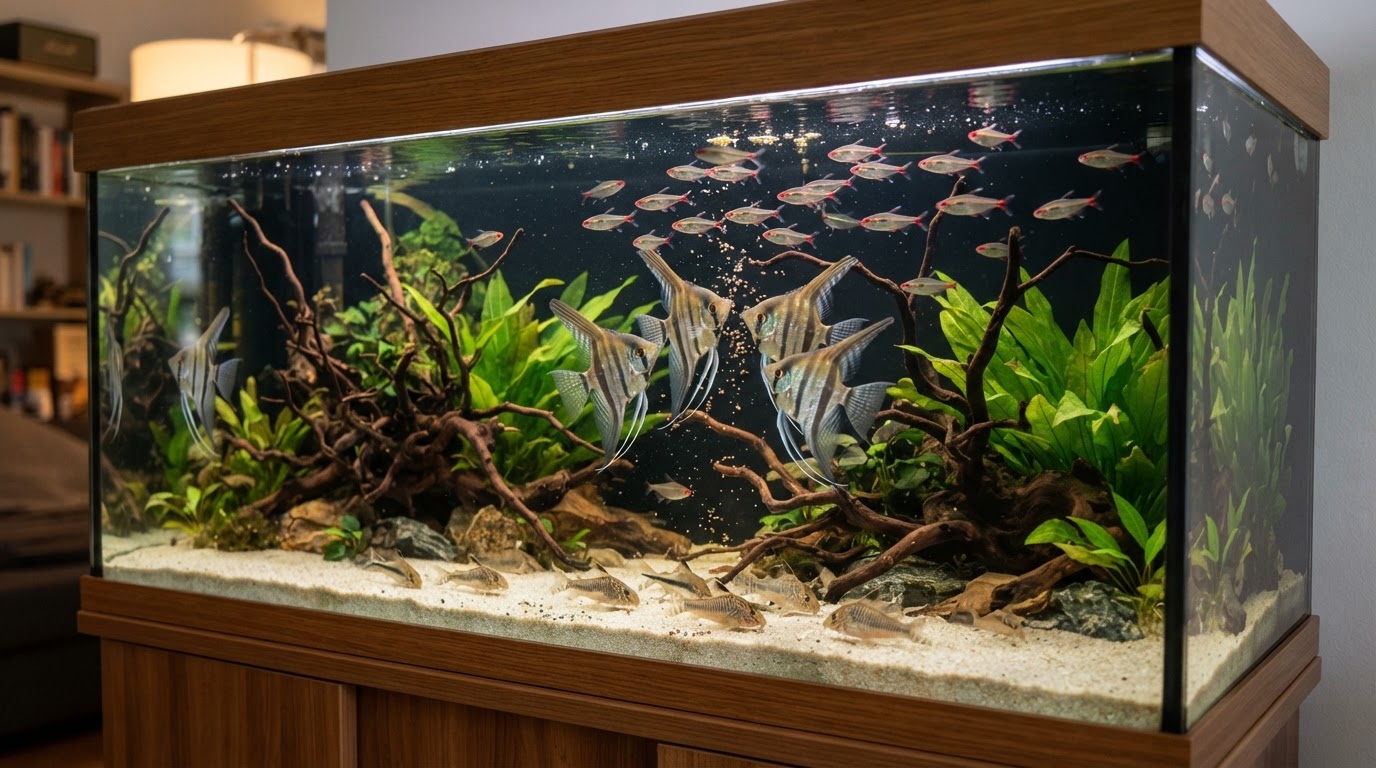
Angelfish, severums, festivums, eartheaters such as Geophagus, and oscars all come from soft, often acidic water and share a relatively relaxed territorial style, especially outside breeding.
- Schooling fish: larger tetras — Congo tetras, Buenos Aires tetras, bleeding hearts — plus silver dollars for big tanks. These fish act as dither fish: their calm midwater movement signals to the cichlids that nothing is wrong, which usually reduces hiding and skittish aggression.
- Bottom dwellers: Corydoras in groups, bristlenose and other medium plecos, and loaches in tanks long enough to give them room.
- Livebearers: work in hard, neutral water with milder species such as severums, but never with oscars or anything large enough to treat them as food.
- Avoid: neon and cardinal tetras with adult angelfish or oscars, long-finned fancy guppies, and anything small enough to fit in a mouth.
Angelfish deserve their own warning: they are peaceful most of the year and then defend a spawning site with real force. A pair in a two-foot cube will terrorise the tank; the same pair in a five-foot tank with sightline breaks usually settles down.
Central American Cichlids: A Much Shorter List
Convicts, firemouths, Jack Dempseys, green terrors, and jaguar cichlids come from harder, faster water and are generally more territorial, more ready to bite, and more willing to eat a tank mate. Convicts and firemouths are the mildest of the group; a Jack Dempsey or jaguar is a large predatory fish.
Tank mates that usually survive:
- Silver dollars and other deep-bodied characins — too tall to swallow and fast enough to be left alone.
- Large plecos with heavy armour, provided the tank is big enough for two territorial fish to hold separate territories.
- Robust livebearers such as large mollies or swordtails in bigger tanks, accepting that fry will be eaten.
- Surface dither fish that are too quick to catch, used to draw timid species such as firemouths out of cover.
Avoid small schooling fish, guppies, bettas, shrimp, snails, and any long-finned species. A Central American community should be built around one or two cichlid species and a handful of fish that can take a bump, not around a mixed bag.
African Rift Lake Cichlids: Species Tank First
Mbuna from Lake Malawi are algae grazers with tight social hierarchies and a small home range; they are among the most aggressive freshwater fish commonly sold. Peacocks and haplochromines are open-water fish with different aggression patterns, and Tanganyikan species follow their own rules. All of them need hard, alkaline water, which on its own rules out most community fish from soft-water South America.
Realistic tank mates:
- Synodontis catfish, including the smaller species, are the classic rift lake companion: armoured, largely nocturnal, and not competing for territory.
- Some larger rainbowfish or robust barbs in very large tanks, still with individual risk.
- Snails are hit and miss. Many mbuna ignore them; many do not.
Do not plan on tetras, rasboras, livebearers, Corydoras, or a heavily planted aquascape. Mbuna eat plants, and soft-water fish do not tolerate the mineral-rich water rift cichlids need. Treat a rift lake tank as a cichlid species community and select its members for compatibility with each other.
Dwarf Cichlids: The Best Candidates for Community Tanks
Apistogramma, Bolivian rams, German blue rams, and kribensis are small enough, and territorial over a small enough area, to make genuine community tanks possible.
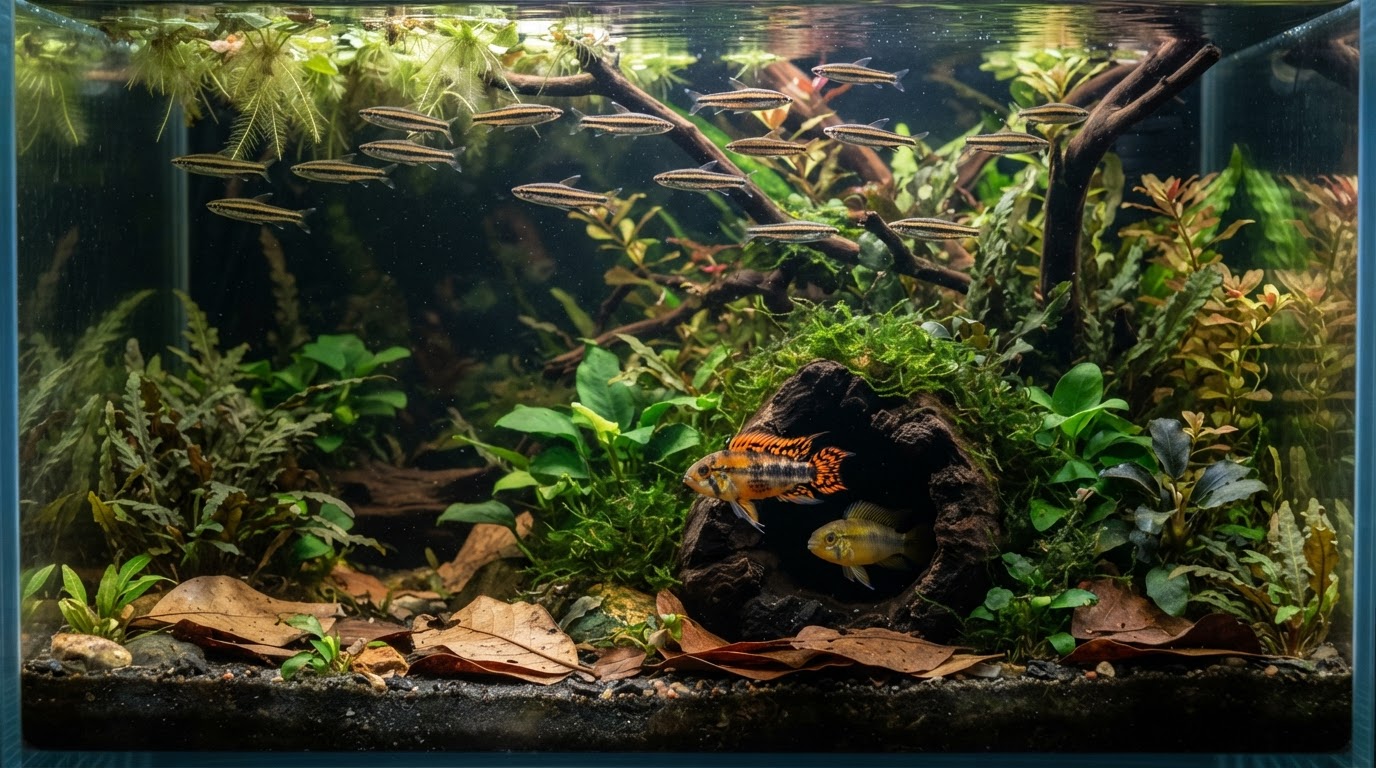
Good companions: rummy-nose and other small tetras, pencilfish, hatchetfish, otocinclus, Corydoras, kuhli loaches, and peaceful surface dwellers. Shrimp are a gamble — adults may be ignored, fry and juveniles rarely are.
The trade-off here is fragility rather than aggression. Rams and Apistogramma want stable, warm, soft, clean water and do not tolerate the swings of a new tank. Put them in a mature setup, not one that finished cycling last week.
Tank Mates That Usually Work, by Type
Across groups, the categories that hold up are consistent:
- Dither and schooling fish: midwater, fast, plain-coloured, and large enough not to be swallowed — silver dollars, Congo tetras, Buenos Aires tetras, giant danios.
- Armoured catfish: Corydoras with mild cichlids; plecos and Synodontis with larger or more aggressive ones.
- Loaches: clown loaches and yoyo loaches in long tanks, kuhli loaches with dwarf cichlids.
- Livebearers: only with mild cichlids, and only where the water chemistry overlaps.
- Invertebrates: the most fragile choice. Large snails and adult Amano shrimp may survive; anything smaller is food.
Which Combinations Should You Avoid?
- Small fish with large cichlids. Body size beats reputation. If a fish fits in the cichlid's mouth, it is food eventually.
- Long-finned fish. Bettas, fancy guppies, and long-finned rasboras are bite magnets.
- Mixing rift lake and soft-water species. The water that keeps mbuna healthy stresses South American fish, and the reverse is also true.
- Two similar species in one territory. A pair of convicts and a pair of firemouths in a four-foot tank will fight over the same cave.
- Adding tank mates to a spawning pair. Breeding cichlids defend a radius, not a cave, and the radius grows with the fry.
- Shrimp and snails with mid-sized or large cichlids. They get eaten, often within days.
What Drives Cichlid Aggression?
Aggression becomes predictable once you know which trigger you are feeding.
Territory. Most cichlids defend a patch of substrate, a cave, or a spawning site. Two territories need twice the floor space, and floor space means length and width, not height.
Tank footprint. A tall tank gives volume without territory. Long tanks work better because a chased fish can break line of sight and a subordinate can retreat.
Sex ratios. Harem spawners such as many mbuna and Apistogramma do better with one male to several females; pair-bonding species do better as a confirmed pair. Two males and one female is the worst ratio in the hobby.
Stocking density. The rule flips between groups. South American community tanks do better understocked, so a chased fish has somewhere to go. Mbuna tanks are often stocked heavily on purpose, so aggression is spread across many targets instead of landing on one fish.
Decor and sightlines. Open sand and a bare glass back give a dominant fish a clear run at a subordinate. Driftwood, rock piles, and planting that break lines of sight let fish disappear and reset.
Breeding and food. A pair with eggs, or fish competing over a feeding station, behaves very differently from the same fish on a quiet day.
Compatibility Reference Table
Cichlid group | Best tank mates | Workable with care | Avoid |
|---|---|---|---|
South American (angelfish, severum, eartheater) | Congo and Buenos Aires tetras, silver dollars, Corydoras, bristlenose plecos, dither fish | Oscars with large armoured fish only; livebearers in neutral water | Neon tetras, guppies, anything mouth-sized |
Central American (convict, firemouth, Jack Dempsey) | Silver dollars, large plecos, fast surface dither fish | Large mollies and swordtails in big tanks; Synodontis | Small tetras, bettas, shrimp, snails |
African rift lake (mbuna, peacock, hap) | Synodontis catfish, other rift cichlids | Large rainbowfish or barbs in very large tanks; some snails | Tetras, Corydoras, livebearers, plants |
Dwarf (Apistogramma, ram, kribensis) | Rummy-nose tetras, pencilfish, otocinclus, Corydoras, kuhli loaches | Adult Amano shrimp; hatchetfish | Large cichlids, boisterous bottom feeders, small shrimp |
Caveats: this table describes typical behaviour, not guarantees. Individual fish vary, tank size changes outcomes, and a combination that works for a year can fail the week a pair spawns. Use it as a first filter, then run the checks at the end of this guide.
Acclimation and Introduction Order
Order matters more than most keepers expect, because the first fish to settle claims the territory.
- Quarantine first. A tank mate that brings disease into a cichlid tank is a worse outcome than a compatibility mistake. Observe new fish separately before introduction.
- Add dither and schooling fish first. Let them establish midwater movement while the cichlids are still newcomers. Timid cichlids such as firemouths settle faster when small fish already swim calmly around them.
- Add the least aggressive cichlids before the most aggressive. This gives the mild species time to claim a cave before the dominant fish starts patrolling.
- Rearrange decor on introduction day. Moving rocks and wood resets territorial memory and forces every fish to renegotiate, which usually flattens the existing hierarchy.
- Acclimate for temperature and water, with the lights off. Float the bag, then drip or add tank water gradually, and release with the room lights low so the new fish can find cover instead of being chased into open water.
- Watch the first 48 hours, then the first two weeks. Chasing is normal; cornering, torn fins, a fish pinned at the surface, or a fish that stops feeding is not.
Keep a fallback ready: a spare tank, a divider, or a store that will take a fish back. The most common failure is not choosing the wrong tank mate but having no plan once the wrong choice becomes obvious.
How to Judge Your Own Combination
Before you buy, run five checks:
- Adult size. Compare the cichlid's adult length, not its current length, with the tank mate's adult length and body depth.
- Water match. Temperature, hardness, and pH ranges must overlap without compromise. Rift lake and soft-water species do not overlap.
- Floor space. Each territory needs its own footprint plus room to flee. Length and width come first.
- Feeding competition. A slow, shy bottom feeder in a tank with a fast, pushy cichlid will starve quietly unless food reaches it.
- Breeding plan. Decide now what happens when a pair spawns: separate tank, divider, or rehoming.
If all five pass and you have a fallback, the combination is worth trying. If any one fails, change the stocking list instead of hoping the fish will adapt.
The Bottom Line
Keep the group in front of the fish name. Dwarf and South American cichlids can live in a community if you respect adult size and territory. Central American cichlids need a short, tough stocking list. Rift lake cichlids are best treated as their own community, with African catfish as company. Get the footprint, sex ratio, and sightlines right, introduce in the right order, and most compatibility problems never start.