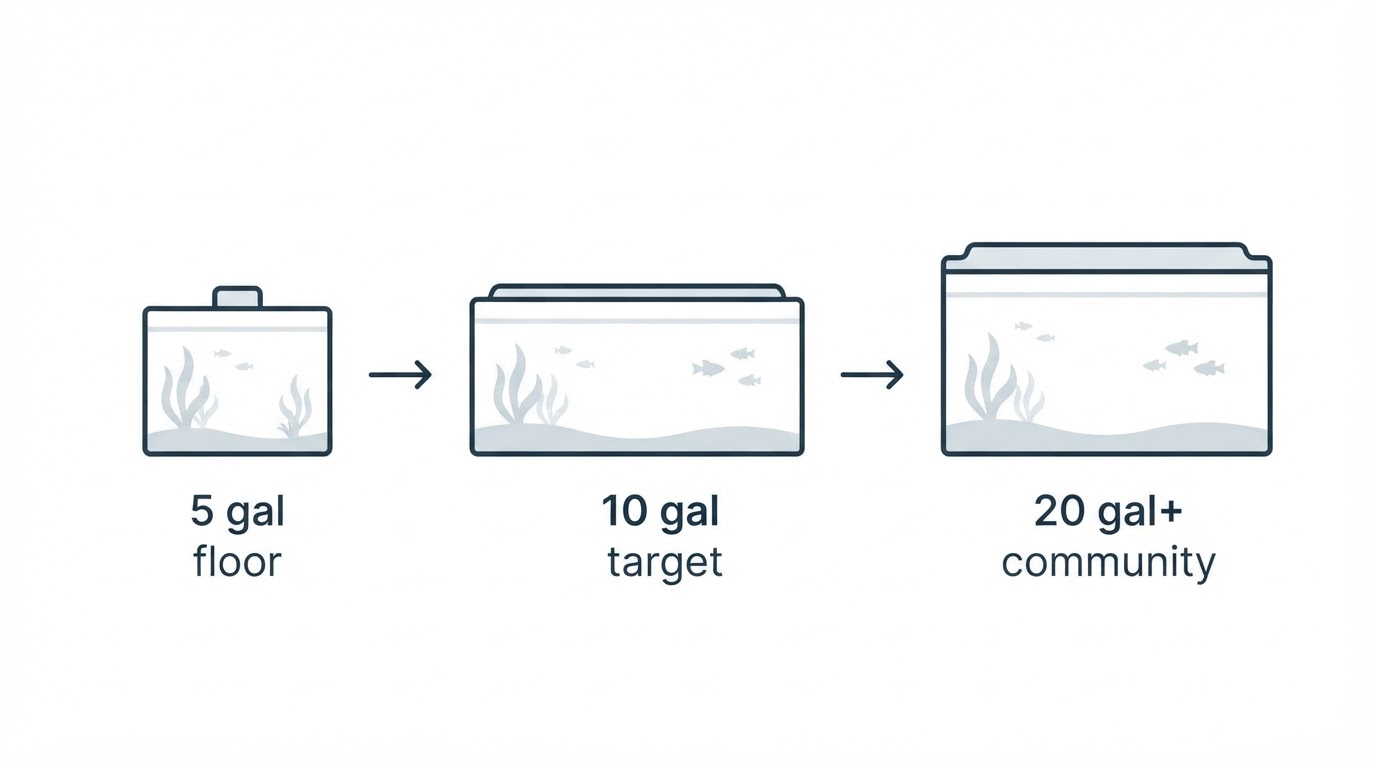
The short answer: 5 gallons is the floor, 10 gallons is the target
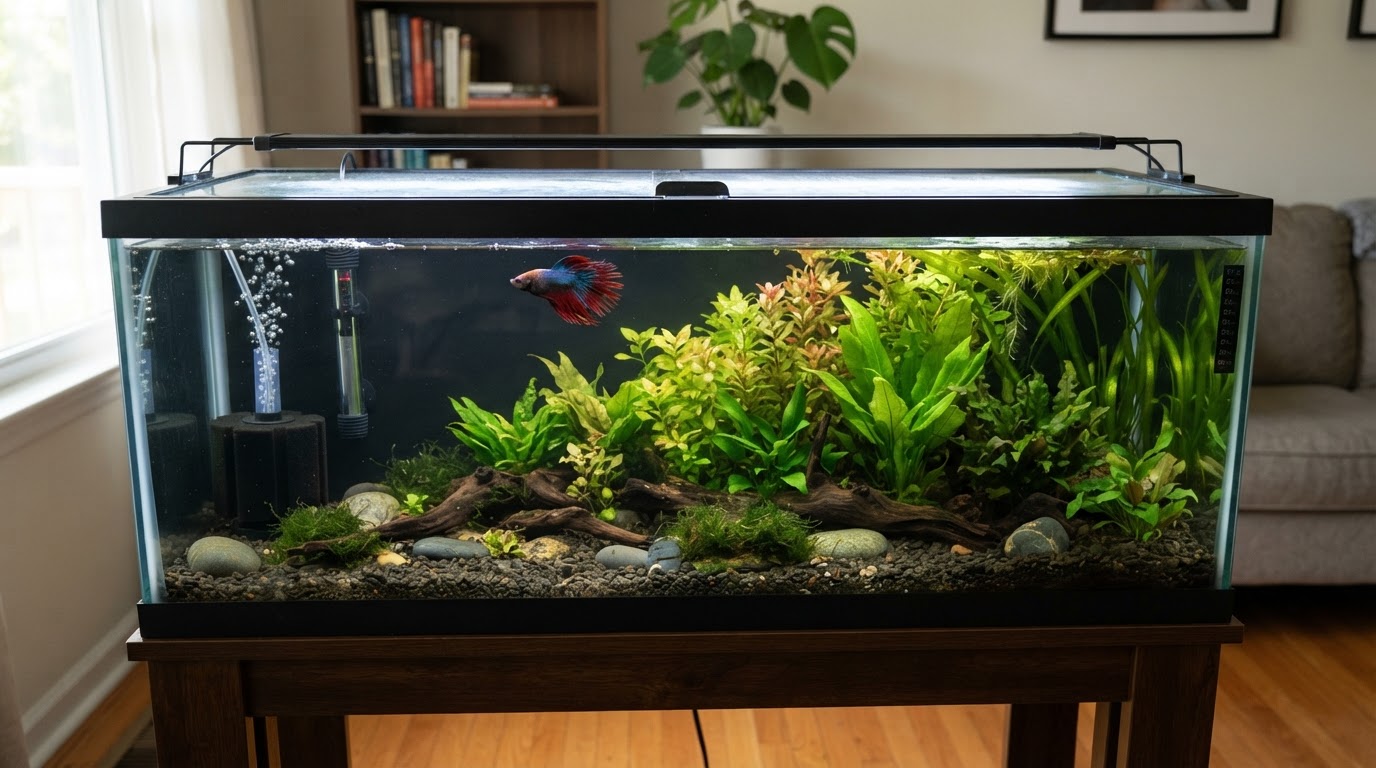
For one adult Betta splendens, 5 gallons (about 19 litres) of actual water is the working minimum. Not because a betta dies overnight below that figure, but because 5 gallons is roughly the smallest volume in which a heater, a filter and a little planting can coexist while still leaving open water for the fish to patrol. Aim for 10 gallons (about 38 litres) if you can. It adds the buffer that makes a missed water change survivable, and it leaves room for a heater guard, a sponge filter and a handful of plants without turning the tank into an equipment locker.
Read the label with suspicion. Volumes are usually quoted as gross capacity measured to the rim, before substrate, hardscape and the air gap a betta needs at the top. A tank sold as 5 gallons often holds closer to 4 gallons once it is set up. If the box number is exactly your target, take the next size up.
Volume is only half the decision. The other half is how that volume is shaped, and a badly proportioned tank wastes gallons you have already paid for.
Minimum survival and a setup that works are different standards
A betta can stay alive in less than 5 gallons. That is true and nearly useless, because survival and thriving are not measured the same way. A thriving betta eats steadily, holds its colour, opens its fins instead of clamping them, patrols the glass, rests in normal places such as a plant leaf or the top of a cave, and comes forward when you approach. A surviving betta eats and hides. The difference is rarely one dramatic failure; it is a fish living permanently at the edge of its tolerance.
The gap between those two states is margin. Every aquarium is a small chemical and thermal system, and the smaller the volume, the less error it absorbs. A pinch of extra food, a dead snail behind the plants, a heater that overshoots by two degrees: in 20 gallons those are inconveniences. In 2 gallons the same events can become an ammonia spike or a temperature crash within hours.
That is why a bowl on the kitchen counter fails even when the fish inside looks fine for a while. A bowl usually holds a gallon or two, leaves no room for a heater or filter, exposes a small water surface for oxygen exchange, and curves the view so you cannot see the fish or the bottom clearly. It is not a smaller aquarium. It is a harder job that happens to be sold next to the aquariums.
Footprint matters more than height
Bettas are labyrinth fish. They have an accessory breathing organ that lets them take oxygen from the air at the water surface, and they use it routinely. That single fact changes what "big enough" means. The fish needs open water at the top, a clear path to reach it, and an air gap above the waterline that is not sealed by a lid pressed onto the surface.
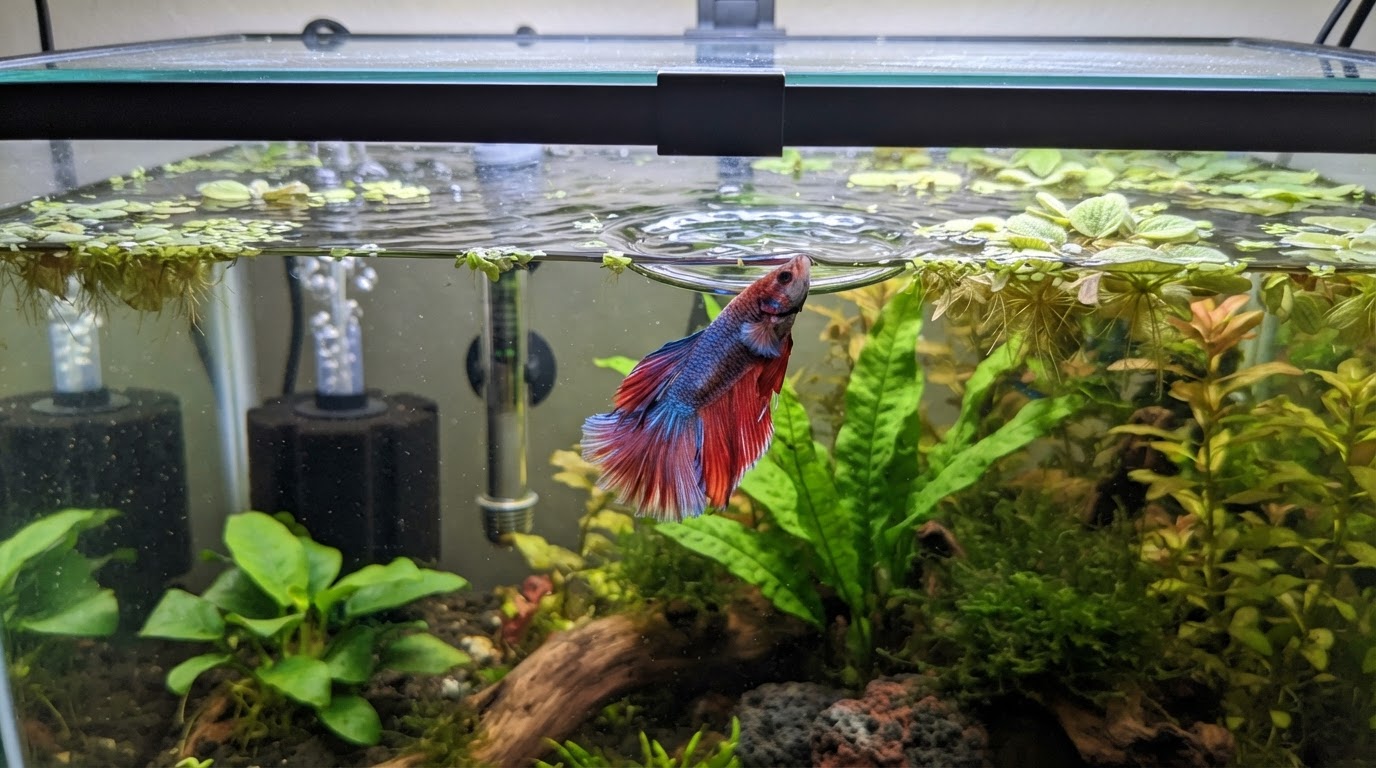
Two tanks can hold the same volume and give the fish completely different amounts of swimming room. A long, low tank offers a horizontal run along the front glass; a tall column of identical capacity offers a short lap and a long climb. For a betta the horizontal run is the one that counts, because they patrol, flare and stake out territory across the length of a tank rather than up and down its walls.
Surface area follows the same geometry. Gas exchange happens at the air-water boundary, and the footprint of that boundary, not the advertised capacity, determines how well the water stays oxygenated. A wide, shallow footprint also spreads light evenly for plants, makes vacuuming the substrate practical, and lets you reach the bottom without a step stool. Among tanks of the same volume, take the one with the longer footprint and the larger open surface, provided you have a stand that fits it.
Heating: small volumes are the hardest to keep stable
Bettas come from shallow, warm, slow-moving water and do best with a steady 78–80°F (roughly 25.5–26.5°C). The word that matters most in that sentence is steady. A tank that sits at 79°F all day and drops to 73°F at night is more stressful than one held slightly cooler but constant.
Heater sizing starts with a rough rule: about 3 to 5 watts per gallon of actual water, adjusted for how cold the room gets. That puts a 5-gallon tank in the region of a 25–50 W heater and a 10-gallon in the region of 50–100 W. Treat those numbers as a starting point, not a specification. A tank in a 68°F room in winter needs more heater than the same tank at 75°F, and an unheated basement changes the answer again.
Verify the result with a separate thermometer at the opposite end of the tank, because heater dials are approximate. Adjust in small steps over a day, then check again at night and the next morning; room temperature swings are what turn one dial setting into an actual daily range.
Small tanks are the hard case. A heater sized for a 20-gallon barely holds temperature there, yet the same unit will overshoot badly in a 3-gallon, and a small volume loses heat faster overnight and gains it faster in a warm room. Choose an adjustable heater rated for the actual volume, place it where filter flow carries warmed water around the tank, and keep it submerged to the water line marked on the body. A heater guard is worth buying when a fish likes to rest against equipment. And top off with dechlorinated water at roughly tank temperature: a cold top-off in a nano tank can drop the temperature several degrees in minutes.
Filtration sized to the fish, not to the gallon count
Filtration does two jobs: it houses the bacteria that convert ammonia into nitrite and then nitrate, and it moves and polishes the water. The amount of biomedia a filter holds matters more than its advertised flow rate, and small filters hold very little of either. That is the margin problem again, expressed in filter media.
By tank size, the practical choices look like this. At 5 gallons and under, a sponge filter driven by an air pump is usually the best fit: gentle, fin-safe, and incapable of turning the tank into a whirlpool. Around 10 gallons, an adjustable-flow hang-on-back with real biomedia or a larger sponge filter works well. At 20 gallons and up, a canister or a bigger hang-on-back is reasonable, still dialed back to suit the fish.
A betta with long fins is a poor swimmer in current, and the test is the fish rather than the filter label. If the fish is pinned in a corner, hiding behind the filter, or visibly fighting to hold position, the flow is too strong regardless of what the box claimed. Baffle the outlet with a piece of sponge, direct it at the glass, or add hardscape and plants that break the stream, so the tank has both gentle movement and a calm resting zone.
Cycle the tank before the fish arrives: ammonia and nitrite should read zero and nitrate should be climbing before a betta goes in, and a small tank is less forgiving because there is less biomedia to absorb a wobble. When you rinse filter media, use water removed during a water change rather than tap water, since chlorine kills the bacteria the filter exists to protect.
What actually goes wrong in small tanks
- Temperature swings. A few litres of water follow room temperature closely, so a cold night, an air-conditioned afternoon or a sunny windowsill shows up in the tank within hours.
- Waste concentration. The same pinch of food produces the same ammonia in 3 gallons and in 30; in 3 gallons the resulting concentration is ten times higher.
- Evaporation and mineral creep. Water leaves, minerals stay, and hardness climbs unless you top off and change water on a schedule.
- Equipment crowding. A heater, a filter, a thermometer and a plant pot in a small footprint leave less open water than the volume figure suggests.
- No room for a mistake. There is no space to separate a fish that is being chased, to quarantine a new arrival, or to recover from a tankmate decision that went wrong.
- Maintenance frequency. Small tanks need more frequent partial water changes, not fewer, because each change is doing more of the work of keeping the water safe.
None of this makes a small tank impossible. It makes it a higher-attention setup, which is the honest trade: you either buy volume or you buy time. If you want a low-effort tank, the answer is a larger one.
Realistic options from nano to community
The tiers below are a starting framework, not a rulebook. They describe what a given volume realistically supports and what tends to go wrong there, so you can match a tank to the fish you plan to keep rather than to a photo you liked.
Actual water volume | What it realistically supports | What to watch |
|---|---|---|
3–4 gallons | One betta, minimal equipment, frequent maintenance | Temperature swings, algae, no backup space; a demanding first tank |
5 gallons | One betta with a sponge filter, a small heater and a few plants | Weekly water changes are not optional; equipment fit is tight |
10 gallons | One betta with real planting, hardscape and a calm open swim lane | Oversized heater without a thermometer; filter flow too strong |
15–20 gallons long | One betta with generous horizontal room; tankmates only if the individual fish tolerates them | Adding fish because the tank "looks empty"; territory conflicts |
20–40 gallons | A community setup with carefully chosen, non-nipping species, with the betta as one fish among them | Planning a backup tank or return option, because betta temperament varies |
Bigger is not automatically easier. A 40-gallon is more chemically stable but harder logistically: heavier water changes, a stand that must carry real weight, and a longer walk with a bucket. The right size is the largest tank you will genuinely maintain on a weekly schedule, not the largest one that fits through the door.
It is also worth saying plainly that a betta kept alone is a complete setup, not an unfinished one. Bettas are territorial, and many are calmer and healthier as the only fish in the tank. Tankmates are an option to evaluate, not a requirement to satisfy.
Shape, lid and flow: the details that decide whether a tank works
Shape. A rectangular tank is the default for good reasons: it maximises footprint for a given volume and accepts standard lids, lights and stands. Column, hexagonal and cylindrical tanks look distinctive, but they trade footprint for height, which is exactly the wrong trade for a labyrinth fish. Bow-front tanks sit in between and are fine if the footprint is long enough.
Lid. Bettas jump, and a lid is what keeps one inside the tank. It also slows evaporation and holds warmth, both of which matter more in small volumes. Fit a lid that covers the tank without sealing the water surface, and leave an air gap of an inch or two (roughly 2.5–5 cm) above the waterline. Filling to the rim removes the gap the fish needs and puts water against the light fixture.
Flow. Aim for movement without a current. Place the filter outlet at one end and let the far end stay calm, then check by watching the fish rather than the equipment. Plants and driftwood are the cheapest flow breakers you can add.
Light and stand. Enough light for the plants you keep, not the maximum the fixture offers: a shallow tank with strong light grows algae quickly, and a deep tank needs more light to reach the bottom. The stand should be level, rated for the filled weight and open enough to reach the filter.
How tank size changes activity and lifespan
Activity is the most visible effect. More horizontal space means more patrolling, more flaring at reflections, more exploring around plants and caves, and more normal territorial behaviour. Short-finned bettas such as plakats swim considerably more than long-finned show types and gain the most from footprint. A long-finned betta in a small tank often looks calm when it is really conserving energy.
The second effect is stress. Cramped quarters combined with unstable temperature or rising nitrogen compounds keep a fish in a low-grade stress state: appetite drops, fins clamp, colours dull, and the fish becomes more vulnerable to infections a settled fish would shrug off.
Lifespan follows from those two. Bettas are commonly kept for around three to five years when conditions are stable, and temperature stability and water quality are the two variables most within a keeper's control. A larger tank does not add years by itself. It makes stable conditions easier to hold, and stability is what shows up as a fish that lives out its normal span. Temperament varies too: some bettas ignore everything, others defend plants, reflections and fingers. Plan for the fish you have rather than the average.
A checklist for judging a tank before you buy
- Actual water volume. At least 5 gallons (about 19 L) for one betta, 10 gallons if you want equipment margin and planting.
- Footprint. Measure the longest horizontal run and the water surface the lid will leave open. If two tanks share a volume, the longer one wins.
- Lid and air gap. A lid is included or available, with cable cut-outs and enough height to leave an inch or two of air above the water.
- Heater fit. There is a mounting spot for a heater rated for the volume and for your coldest room temperature, plus space for a guard.
- Filter fit. The filter has adjustable flow, room for biomedia, and an intake that can be covered or is already fin-safe.
- Unobstructed surface. No hood, brace or built-in filter body blocks the open water the fish uses to breathe.
- Stand and access. The stand is level, rated for the filled weight, and leaves room to reach the filter and siphon the substrate.
- Test kit, thermometer and cycle plan. Both instruments are in the budget before the fish is, and you know how the tank will be cycled and tested.
- Maintenance slot. There is a realistic weekly window for a partial water change and a filter check.
If a tank fails one or two items, it can still work with compensating maintenance. If it fails volume or footprint, choose a different tank rather than planning to upgrade later; the upgrade rarely happens on schedule.
Common mistakes that cost more than they save
- Buying the tank first, then discovering the heater, filter or lid does not fit the opening.
- Filling to the rim, which removes the air gap and puts water against the light.
- Installing an oversized heater in a nano tank and trusting the dial instead of a thermometer.
- Adding tankmates to a small tank because the fish "looks lonely", with no plan for separating them.
- Buying a bowl sold as a betta home, then trying to fix it with more frequent water changes.
- Setting the filter to maximum because more flow sounds healthier, then wondering why the fish hides.
The bottom line
Five gallons of actual water is the floor for a single betta, 10 gallons is the size most keepers should plan for, and footprint beats height every time. Get the thermal and filtration basics right, keep the surface open under a fitted lid, cycle the tank before the fish arrives, and hold a weekly water-change routine. If you already own a smaller tank, the highest-value upgrades are an adjustable heater with a separate thermometer, a baffle on the filter outlet, and a lid that leaves room to breathe.