What the API Ammonia Test Kit Reports
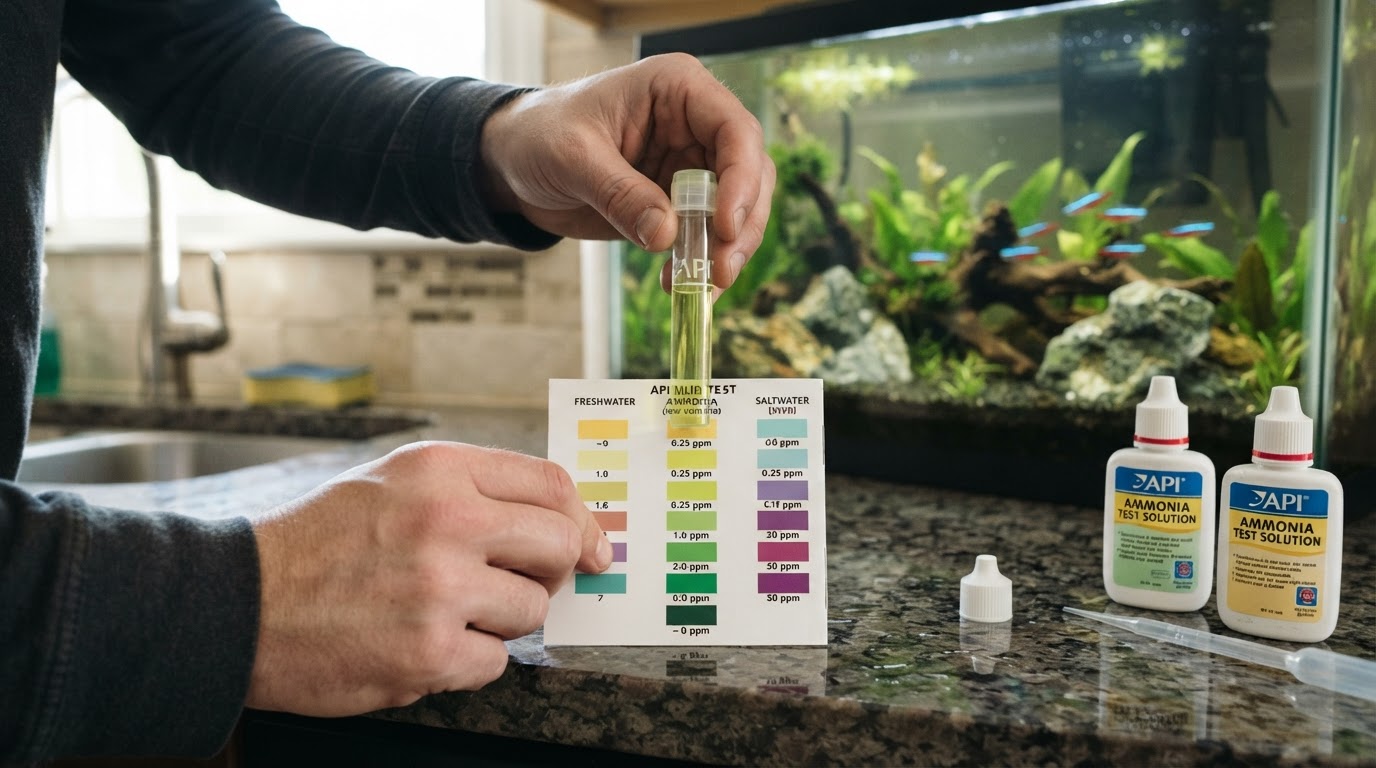
The API ammonia test kit product page gives the procedure for the liquid test: 5 ml of tank water in a clean test tube, 8 drops from ammonia test solution bottle #1, then 8 drops from bottle #2, with each dropper held upside down and vertical so the drops stay even. Cap the tube, shake for 5 seconds, wait 5 minutes for the color to develop, then match it against the freshwater or saltwater color card for the water in the tank. The page also states a 0 to 8 ppm range and lists the test for fresh and saltwater aquariums.
The page does not label the result as total ammonia, and it does not name salicylate. Both come from an older API instruction leaflet for the same test, published as a PDF on a distributor's site: API ammonia test kit instructions (PDF, Midland Waterlife). The leaflet describes a salicylate-based kit that reads total ammonia across 0 to 8 ppm (mg/L), and it lays out the same 5 ml sample, the same 8 drops from each bottle held vertically, the same 5-second shake, the same 5-minute wait and the same choice between freshwater and saltwater cards. Its issue date has not been verified, so treat it as an older manufacturer document rather than a current 2026 specification. Where it and the current page overlap, the procedure is the same; the total label is the part the current page leaves out.
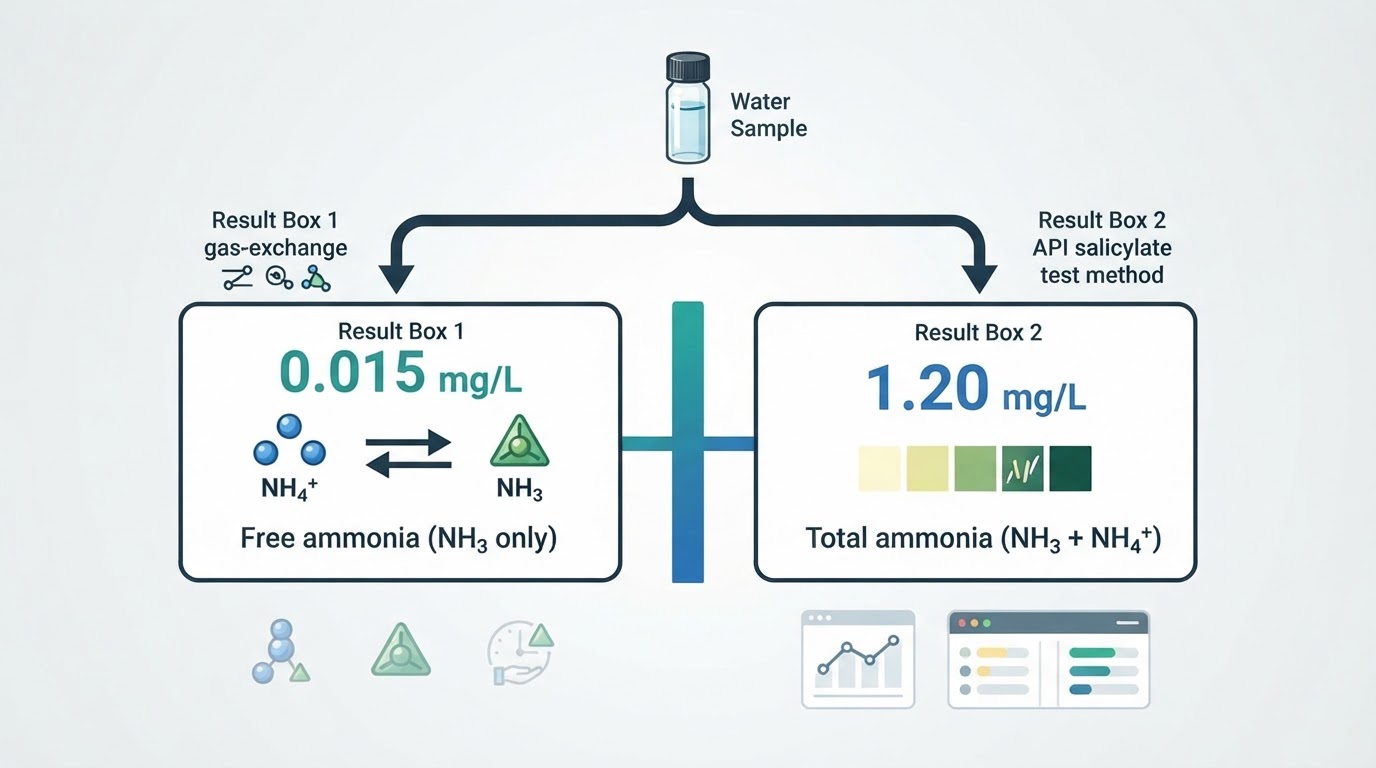
"Total" is the word that decides how a reading should be interpreted. Ammonia in water is present as un-ionized NH3, usually called free ammonia, and as the ammonium ion NH4+. One sample produces one color, and that color stands for both forms combined. The chart then returns a single number for the pool rather than a split between the two, so a 0.5 ppm result does not mean 0.5 ppm of free ammonia is in the tank.
Why the Same Total Can Mean Different Free Levels
The two forms sit on a balance that moves with water chemistry. The EPA's CADDIS ammonia page describes ammonia nitrogen as covering both the ionized ammonium and the un-ionized ammonia, and explains that a rise in pH favors the un-ionized form while a fall favors ammonium; it also notes that temperature affects ammonia's toxicity and that ionic strength can matter (EPA CADDIS: ammonia). The consequence for a test kit is direct: two tanks at 0.5 ppm total can hold different amounts of NH3 when their pH or temperature differs, and cutting the total in half does not halve the free ammonia if the conditions have moved in between.
EPA also describes how the free fraction is handled in ambient monitoring, calculated from total ammonia together with pH, temperature and ionic strength rather than measured on its own. That is water-program practice, not a home kit, but the relationship is the same: the total figure is one input to the calculation. A conversion from total to free ammonia needs the right units together with pH, temperature and salinity, so the useful habit is to record those values next to the ammonia reading.
Seachem's MultiTest Ammonia kit is presented as measuring total ammonia (NH3 and NH4+) and free ammonia (NH3 only) as separate quantities, and its product page describes salicylate and Nessler total-ammonia tests as raising the sample pH to 12 or above. That is a competing manufacturer describing its own kit and a class of methods, not API's documentation, and the two should not be blended into one authority. It does help explain why a salicylate result behaves like a total figure, since the reading is taken from the whole ammonia pool rather than from one form. API's leaflet lists sodium hydroxide in bottle #2, an alkaline reagent, but says nothing about the finished sample's pH and offers no free-ammonia scale.
Which Side of the Total Matters
The EPA page is explicit that un-ionized ammonia is the more dangerous form: it diffuses across gill membranes easily and is highly toxic to aquatic animals, whereas ionized ammonium crosses them much less readily and is considerably less toxic. The context there is ambient water and fish kills rather than aquarium limits, so it supplies no tank threshold. What it does support is why the split deserves attention: the free share is the part tied to harm. Ionized ammonium is not therefore harmless, and a total reading above zero is not automatically safe just because part of it is ionized.
Before Comparing Two Ammonia Numbers
Two readings only form a trend when they describe the same thing measured the same way.
- Same measurand. A total-ammonia result and a free-ammonia result answer different questions. A fall from 0.5 to 0.25 on a total kit need not halve free ammonia if pH, temperature or other relevant conditions changed, and a free-ammonia figure cannot be checked against the API color card.
- Same chart and water type. API supplies separate freshwater and saltwater cards, and the leaflet sends pond samples to the freshwater card. The card converts a color into a concentration, so the wrong card changes the number even when the color looks identical.
- Same units and basis. API equates ppm with mg/L on its chart, which keeps those two expressions interchangeable. A result reported on an ammonia-nitrogen basis is a different scale and is not the same concentration without the conversion that basis needs.
- Same tube and handling. The leaflet's rinse instruction keeps residue from one sample out of the next, which would change the next color, while the warning not to return the tube contents to the aquarium keeps the test chemicals out of the tank.
- Same water chemistry and reagents. pH and temperature belong next to the total reading, because without them the number cannot be placed on the NH3/NH4+ balance. If a bottle carries a date marking, check it before trusting a color that looks wrong.
Reading a Positive Result
Confirm the test before interpreting it. A second run with a clean tube, 8 drops from each bottle, the full 5 seconds of shaking, the full 5 minutes and the correct card shows whether the first color was reproducible. A repeat is a check on handling and consistency; it does not by itself separate every possible testing error from a real reading, and a color that returns twice is still worth investigating.
A conditioner in the tank does not make the reading meaningless. API's leaflet says the test will still register ammonia after AMMO LOCK is added, because the product binds ammonia into a form the leaflet calls non-toxic. That is the manufacturer's statement about its own product, and the leaflet carries it only so far: it gives no dose for that use, does not say every ammonia molecule becomes ammonium, and sets no safe total-ammonia figure. A positive reading after dosing is still a reading to interpret, with pH and temperature measured at the same time.
Other checks narrow down the source. Testing a sample of the source water with the same kit shows whether the reading follows the water being added. Feeding, stocking and recent filter cleaning are worth reviewing, since the leaflet attributes ammonia in an established tank to over-feeding, too many fish or inadequate biological filtration. The site's aquarium water quality troubleshooting plan sets out the other tests that go alongside ammonia when a tank needs a fuller picture.
The leaflet's own standard for an established aquarium is 0 ppm, with any reading above that described as able to harm fish. Acting on a confirmed result means using the pH and temperature figures to judge how much of the total sits as free ammonia, checking what changed in the tank, and choosing the response for the species and life stage actually stocked.