The short answer: how big a tank does an angelfish need?
For one adult angelfish, the working minimum is 29 gallons (110 L) with at least 18 inches (45 cm) of water height, on a footprint of roughly 30 × 12 inches (76 × 30 cm). Treat that as a floor rather than a target. Twelve inches front to back is a corridor, and a full-grown angelfish is a tall, deep-bodied fish that needs room to turn without dragging its fins along the glass.
For a small group, plan on 55 gallons (208 L) as the entry point and 75 gallons (284 L) as the size that actually holds up long term. The 55 gives you 48 inches of length and 21 inches of height, but only 13 inches of depth. The 75 adds five inches of depth, and it is the first standard tank where height, length, and depth are all adequate at the same time.
A bonded pair is the exception. Two adults that have already spawned together manage in 29 to 40 gallons, because the territory they defend collapses to a few square feet around the spawning site.
What does not work: a 10-gallon, a 20-high, or any starter kit whose hood leaves you 14 inches of water. Angelfish reach about 6 inches (15 cm) in body length and 8 to 10 inches (20 to 25 cm) from the top of the dorsal fin to the tips of the pelvic fins. In a short tank, a fish built to glide can only hover.
Why height and footprint beat gallon count
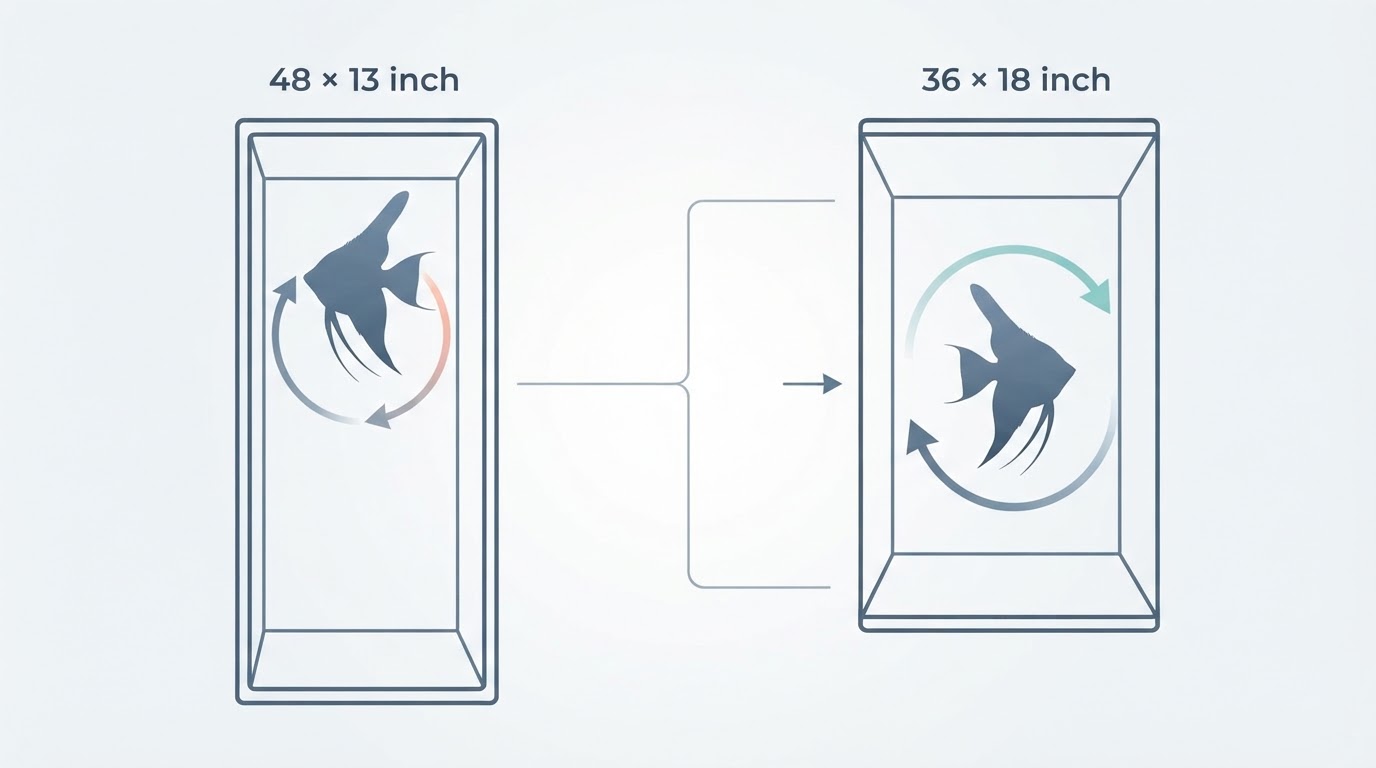
Gallons measure volume. They tell you how much water you have for diluting waste, not how much room the fish has to move. A standard 55-gallon and a 40-gallon breeder hold nearly the same footprint of glass — 48 × 13 inches versus 36 × 18 inches — while one holds 15 more gallons. In the dimension that decides whether an angelfish can behave normally, the smaller tank wins.
Three measurements do the real work:
- Water height is the distance from the substrate line to the surface. Angelfish are vertically oriented; below 18 inches, an adult's dorsal fin nearly touches the surface and its pelvic fins trail near the substrate. That changes how it swims, where it shelters, and how exposed it feels.
- Front-to-back depth is how far the fish can travel away from the glass. It is the dimension that lets a subordinate fish retreat from a dominant one. Twelve inches is a corridor. Eighteen inches is a room.
- Length is what supports a group. Angelfish space their loose territories along the horizontal axis, and 48 inches lets four or five fish stay out of each other's faces.
Volume still earns its keep, for a different job: a larger body of water swings more slowly in temperature, ammonia, and pH. That is why the 75 is the more forgiving group tank — not because the fish needs 20 extra gallons to swim in, but because it needs the water chemistry not to lurch while you are at work.
The trade-off is the thing most angelfish tank size advice skips. Standard tanks are built to be cheap to ship, not to suit tall fish: the 55 is long and high but shallow, the 40 breeder is deep and long but short, and only at 75 gallons do the three dimensions stop fighting each other. If you can buy exactly one tank for angelfish, buy the 75 and skip the intermediate step.
From juvenile to adult: what two inches becomes
Angelfish are usually sold at 1.5 to 2 inches (4 to 5 cm) of body length. At that size the fish fits, visually, in almost anything, and that is how it ends up in a tank it will outgrow. Within roughly 8 to 12 months it will be 4 to 6 inches (10 to 15 cm) long and 8 to 10 inches (20 to 25 cm) tall once the fins are counted.
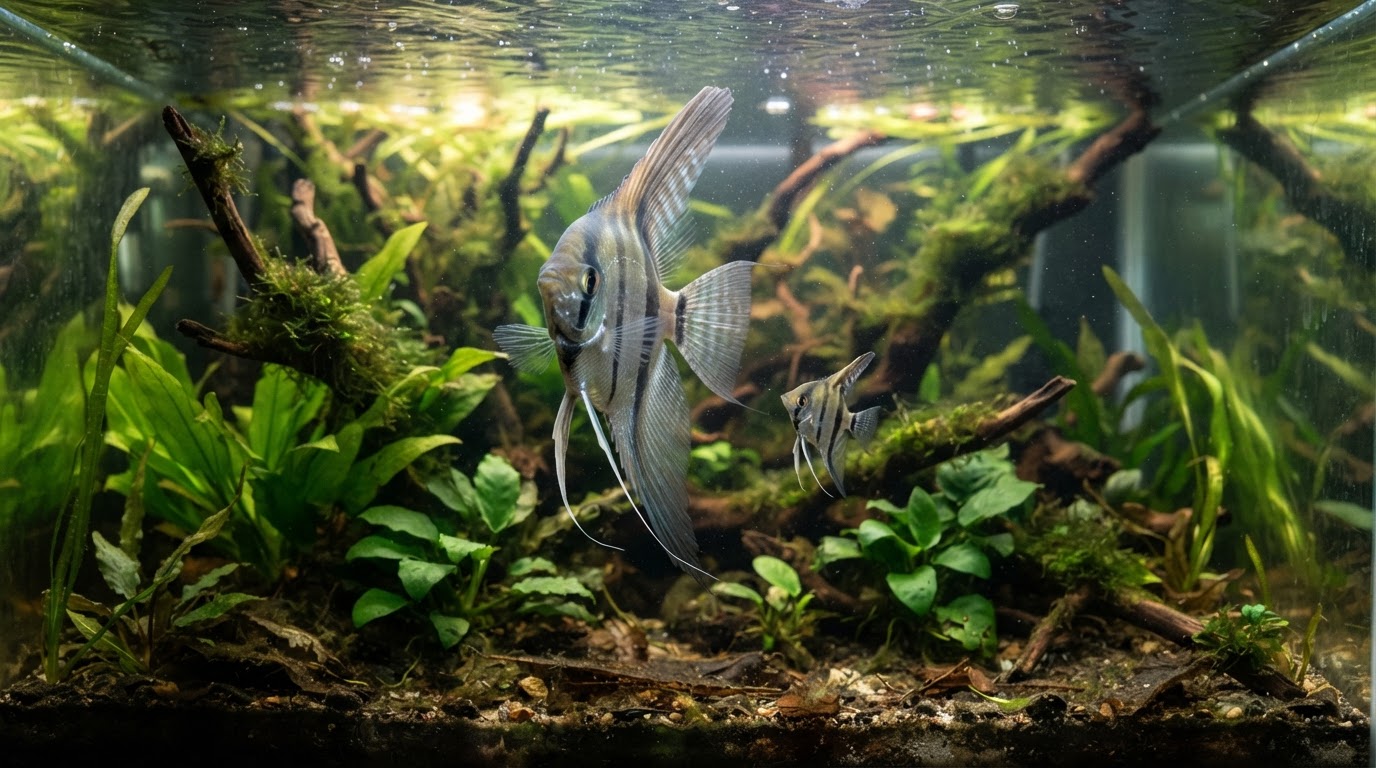
Two things change at that point. The fish needs a turning radius it did not need before, and its bioload is no longer the bioload of a juvenile. A 6-inch cichlid produces far more waste than a 2-inch one, in a tank that was sized when it was small. That is the usual path from "angelfish are easy" to cloudy water, fin rot, and a fish that spends its day behind the filter.
Buy for the adult. If the tank you are looking at only works for the fish in the bag, it does not work.
Tank sizes by class: a decision table
Tank | Typical dimensions (L × W × H) | Volume | Best use | Main compromise |
|---|---|---|---|---|
20 high | 24 × 12 × 16 in | 20 gal (76 L) | quarantining or growing out juveniles | too short and too shallow for an adult |
29 | 30 × 12 × 18 in | 29 gal (110 L) | one adult, absolute minimum | 12 in of depth leaves nowhere to retreat |
36 bow front | 30 × 15 × 21 in | 36 gal (136 L) | one adult, or a bonded pair | curved glass, limited length |
40 breeder | 36 × 18 × 16 in | 40 gal (151 L) | bonded pair, heavily planted setup | 16 in of height is short for a full adult |
55 | 48 × 13 × 21 in | 55 gal (208 L) | small group, entry point | shallow depth, narrow aquascape |
75 | 48 × 18 × 21 in | 75 gal (284 L) | group of five or six, long-term home | weight, floor support, water-change volume |
90 and 125 | 48 × 18 × 24 in and 72 × 18 × 22 in | 90-125 gal | group with dither fish | footprint, not fish, becomes the cost |
If you are still comparing species before you commit to a footprint, Sea Life Planet's species guides keep the numbers in one place: every guide opens with a Quick Facts panel that lists scientific name, care level, minimum tank size, temperament, diet, water temperature, maximum size, and lifespan, so angelfish can be checked against another cichlid without opening three separate articles.
How many angelfish belong in one tank?
One, or five or six. Two or three is the configuration that goes wrong.
Angelfish are cichlids, and cichlid social structure is not a numbers game you can split down the middle. With a group of five or six juveniles, aggression spreads across the group and no single fish absorbs all of it. As the fish mature, a pair forms, and the pair takes one end of the tank. The extra length of a 48-inch tank is what lets the remaining fish keep a polite distance; in a 36-inch tank the same pair can police the whole footprint.
Two angelfish is the worst version of this. If they pair, you have a breeding pair that will want a tank of their own. If they do not, one fish spends the rest of its life being chased. Three is barely better: the third fish is the one that takes the damage.
When a pair does spawn, move them to a 29 or a 40 breeder for the event, then decide whether you want to raise the fry. A pair left in the group tank will defend a corner and stress everything else in the water.
Mid-water tank mates change the arithmetic. Every fish that shares the angelfish's band of the tank subtracts from the usable footprint, while bottom dwellers occupy a different layer and add much less social pressure.
Filtration, heating, and what a taller tank changes
A taller tank is not just a bigger box. Water stratifies, and the top of a 21-inch column is not the same water as the bottom.
- Turnover. Aim for roughly four to six times the tank volume per hour through the filter, spread along the length rather than dumped into one corner. Angelfish do not enjoy a current, so a filter that turns the tank into a whirlpool is the wrong kind of turnover.
- Heating. Angelfish belong in the 76-82°F (24-28°C) range. Size the heater for the gap between your room temperature and that target, and expect a tall tank to need more than the gallon rating printed on the box suggests. Two smaller heaters also fail more gracefully than one large one.
- Oxygen. Warm water holds less oxygen, and a deep tank mixes less readily. Surface movement matters more than bubble volume, especially at the top of the temperature range.
- Lid and evaporation. Angelfish can jump. A lid holds heat and cuts evaporation, but check the clearance it costs you: trim, substrate, and a brace can turn an 18-inch tank into 15 inches of water.
- Water changes. A larger tank buys slack, not immunity. A weekly change of roughly a quarter of the volume is a working default, and a small tank on the same schedule will still climb in nitrate faster.
How tank size affects lifespan and stability
Angelfish commonly live 8 to 12 years in good conditions. The tank is one of the main reasons they do not.
The mechanism is not the glass. A fish does not stop growing because the tank is small — stunting is a symptom of chronic poor conditions, not a design feature of aquariums. What a small tank does is shorten the distance between a stable system and an unstable one. Nitrate climbs faster, temperature swings further when the room changes, and a missed water change goes from a nuisance to a problem within days. Chronic low-level stress of that kind is what opens the door to the fin rot, fungal infections, and cloudy-eye issues angelfish are prone to.
Space changes behavior too. An angelfish with somewhere to retreat patrols and feeds normally; one with nowhere to go hangs in a corner, eats less, and gets picked on. In a tank that is tall enough but too shallow, that behavior shows up before any water test does.
Protecting lifespan, then, is mostly about giving the filter and the water volume enough runway to absorb the mistakes you will inevitably make in a busy week.
A short stocking caveat
Stock by footprint, not by gallons. The old inch-per-gallon rule was never good, and it fails badly for deep-bodied fish, because a 6-inch angelfish is not six inches of slender fish — it is a plate.
Angelfish also eat anything that fits in their mouth, and "fits" is measured against the adult, not the fish in the bag today. Choose tank mates by adult size and by water layer. Neon tetras are a classic pairing that works right up until it does not; a mid-sized barb is a safer bet than a fish you will spend the next year watching shrink out of the water column.
One more thing worth doing before you buy anything: measure the tank in person. Advertised gallons describe external dimensions including trim, and a hood can eat two or three inches of the height you were counting on.
Before you buy: a five-minute check
- Measure the water height you will actually get: internal floor to the water line, with substrate in. Eighteen inches (45 cm) is the minimum for one adult; 20 to 24 is better.
- Measure front to back. Fifteen inches for a single adult, eighteen for a group.
- Measure the length along the front glass. Thirty-six inches for a bonded pair, forty-eight for a group.
- Subtract for the lid, any brace, and built-in filter housings.
- Decide group size first — one, or five to six — and let that pick the tank. Buying the tank first and filling it with fish is how the two-angelfish mistake happens.
Get those five numbers right and the rest of angelfish care gets easier: filtration, heating, planting, and water changes all end up with a stable platform to sit on.